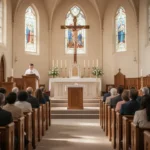
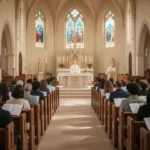
The adjective liturgical describes something related to liturgy. In Christian use, liturgy is the ordered pattern a congregation follows when it gathers for worship. It can include Scripture readings, prayers, songs, preaching, confession, baptism, Communion, gestures, and dismissal.
The word comes through Latin and Greek terms associated with public service or work performed for the community. That background helps explain why liturgy is more than a schedule or script. It describes worship offered by a gathered people rather than a performance presented only by clergy or musicians.
A liturgical church usually has a recognizable form of worship that is shaped by Scripture, tradition, theological teaching, and the church calendar. The exact form differs considerably among Roman Catholic, Eastern Orthodox, Anglican, Lutheran, Episcopal, and other Christian communities.
Plain definition: If something is called liturgical, it is connected to the shared, public, and ordered worship of a church.
How liturgical worship differs from other worship styles
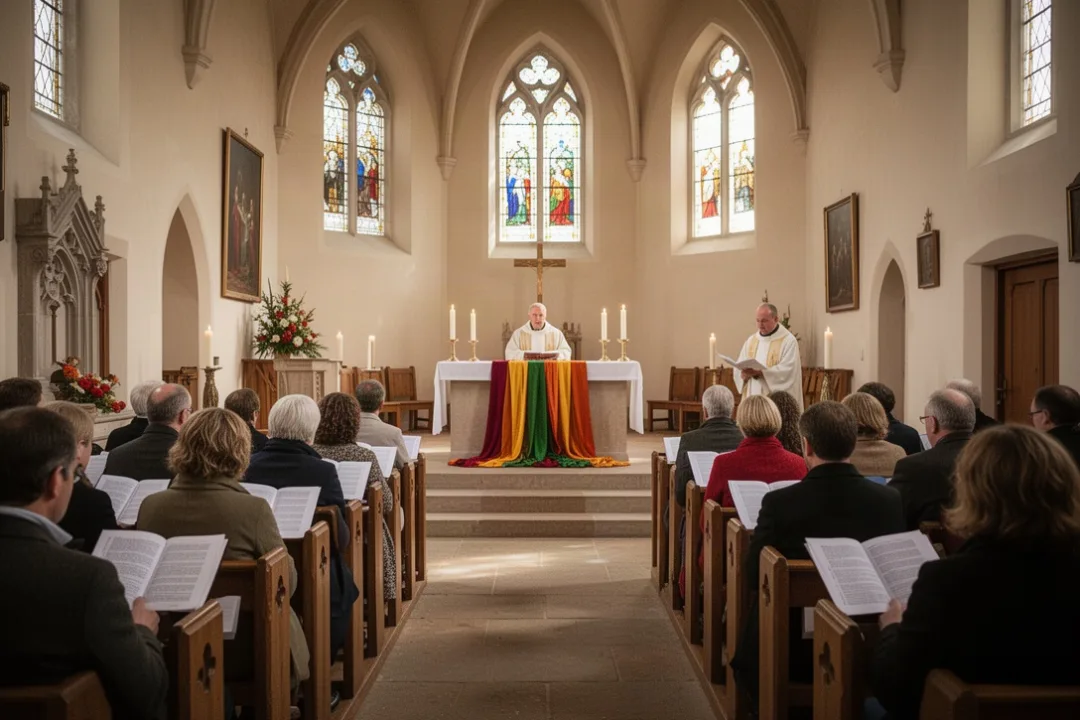
Liturgical worship generally follows a known pattern. People may have a printed service, prayer book, hymnal, worship booklet, or projected responses. The congregation often participates by standing, sitting, kneeling, singing, saying prayers together, and responding to a leader.
Non-liturgical worship may also have an order, but that order is often less formally prescribed. A service might center on contemporary songs, an extended sermon, spontaneous prayer, or a flexible sequence chosen by the local congregation. The difference is not that one type has structure and the other has none; all worship has some structure, even when that structure is informal.
It is also inaccurate to treat “liturgical” as a simple synonym for “traditional.” A church can use ancient prayers while incorporating current language and modern music. Another church can have a highly organized service without following a historic liturgical tradition.
Liturgical worship: commonly uses a shared order, repeated responses, appointed readings, and established rites.
Non-liturgical worship: often gives local leaders greater freedom to arrange prayers, music, preaching, and other elements.
Blended worship: combines a historic service pattern with contemporary songs, instruments, language, or presentation.
Where the term liturgical is commonly used
People most often use liturgical to discuss Christian worship, but the word can describe several related areas. Someone might refer to a liturgical church, a liturgical service, a liturgical calendar, liturgical music, liturgical colors, or liturgical vestments.
The term is especially common in traditions that preserve formal rites. Roman Catholic and Eastern Orthodox worship are strongly liturgical, though their services and theology are not identical. Anglican and Episcopal churches use established prayer books and orders of worship. Lutheran churches often retain a historic pattern centered on Scripture and the sacraments.
Some Methodist, Presbyterian, Reformed, and other Protestant congregations also follow liturgical forms, even if they use less ceremony. A local church may describe itself as liturgical because it observes the church year, reads appointed passages, celebrates Communion regularly, and uses a consistent order of service.
Labels can be helpful, but they do not tell you everything about a congregation. Two churches may both call themselves liturgical while differing in music, preaching style, Eucharistic practice, vestments, architecture, and the amount of participation expected from worshipers.
What happens in a typical liturgical service
There is no single worldwide liturgy, but many Christian services have a recognizable movement from gathering to sending. The order expresses a theological understanding of worship: people assemble, hear God’s word, respond in faith, receive a sacrament or blessing when appropriate, and return to daily life.
Gathering: The congregation assembles through an opening hymn, procession, greeting, prayer, or act of praise.
Confession and praise: Worshipers may acknowledge sin, receive words of assurance, and praise God through a hymn, psalm, or formal response.
Proclamation: Readings from the Old Testament, Psalms, Epistles, and Gospels may be followed by a sermon or homily.
Response: The people respond through a creed, prayers, offerings, hymns, or intercessions for the church and world.
Sacrament: In traditions that celebrate Communion or the Eucharist, the service may include the Great Thanksgiving, consecrated bread and wine, and distribution to the congregation.
Sending: A blessing, charge, hymn, or dismissal sends worshipers into their ordinary responsibilities.
Not every service includes every element. A baptism, wedding, funeral, daily prayer office, or Communion service has its own order. Still, the service is usually connected to a broader tradition rather than designed from the beginning for one particular gathering.
Why liturgical churches repeat prayers and actions
Repetition is one of the most visible features of liturgical worship. Congregations may say the Lord’s Prayer, recite a creed, sing familiar responses, or hear the same blessing at regular intervals. This repetition is intended to form memory and shared identity, not merely to save preparation time.
Repeated words can help worshipers participate even when they are distracted, grieving, tired, or unfamiliar with the service. The congregation does not need to invent a prayer from nothing. It receives language shaped by Scripture and generations of Christian practice, then speaks that language together in the present.
Liturgical repetition can also place personal experience within a larger story. A worshiper may feel hopeful, doubtful, joyful, or sorrowful, while the service continues to proclaim God’s promises and the central events of Christian faith. The stable pattern can provide continuity during changing circumstances.
That does not mean every repeated form is automatically meaningful. Congregations can recite words without attention, and leaders can use a fixed order without explaining it. Good liturgical practice makes room for understanding, participation, silence, and genuine response.
How the liturgical year organizes Christian worship
The liturgical year arranges worship around the life of Jesus Christ and major events in Christian faith. Instead of treating every Sunday as interchangeable, it gives different seasons a particular emphasis, mood, color, and set of readings.
Advent: A season of expectation that looks toward Christ’s coming and prepares for Christmas.
Christmas: A celebration of Jesus’ birth and the Christian teaching that God entered human life.
Epiphany: A season that emphasizes Christ’s manifestation or revelation, including the widening recognition of his mission.
Lent: A period of repentance, self-examination, prayer, and preparation for Easter.
Holy Week: The days that remember Jesus’ entry into Jerusalem, the Last Supper, crucifixion, and burial.
Easter: The central celebration of Christ’s resurrection and the hope of new life.
Pentecost: A festival associated with the coming of the Holy Spirit and the mission of the church.
Ordinary time or the season after Pentecost: A period focused on Christian growth, discipleship, and the continuing work of the church.
Names, dates, and lengths of seasons vary among traditions. Some churches emphasize additional feasts, saints’ days, fasts, or periods of preparation. The purpose is not simply to mark dates on a calendar; the cycle gives worshipers a repeated way to encounter the central themes of Christian belief.
What liturgical colors and symbols communicate
Many liturgical churches use colors to reinforce the season or occasion. The colors may appear on clergy vestments, altar cloths, banners, or other worship furnishings. Practices differ, so color alone cannot identify a church’s denomination with certainty.
Purple or violet is often associated with Advent and Lent, though some communities use blue for Advent. White and gold commonly appear at Christmas and Easter or at celebrations emphasizing joy and resurrection. Red may be used for Pentecost, ordinations, martyr commemorations, or other occasions connected with the Holy Spirit and witness. Green is often associated with periods of ordinary time and ongoing growth.
Other visible symbols can include the cross, candles, water, bread and wine, ashes, incense, processional objects, and sacred art. These symbols give physical form to ideas that could otherwise remain abstract. Water can point to baptism, bread and wine to Communion, ashes to mortality and repentance, and light to Christ’s presence or resurrection.
Symbols are not decorations added only to make a room attractive. In liturgical worship, the physical environment can teach, prompt memory, and involve the senses. At the same time, churches interpret symbols differently, and some Protestant communities use few visual elements by deliberate choice.
What liturgical music does in worship
Liturgical music serves the movement and meaning of the service. It may include psalms, hymns, chants, sung prayers, instrumental music, choral settings, or congregational responses. Music is selected not only for artistic quality but also for its relationship to the readings, season, sacrament, and role of the congregation.
Some liturgical traditions use chant or musical settings of fixed parts of the service. Other churches sing hymns and contemporary songs within a historic order. A congregation might sing a psalm after the first reading, a hymn before the Gospel, a song during Communion, and a closing hymn connected with sending and mission.
The central question is often who is doing the singing. Liturgical music can support the whole congregation rather than turning worship into a presentation by a choir, band, or soloist. Choirs and musicians may lead, but the service remains the prayer of the gathered community.
Music also establishes the character of a season. Advent music may sound restrained and expectant, while Easter music often has a more celebratory character. During Lent, some churches omit particular songs or instruments as a sign of penitence, then restore them for Easter worship.
What liturgical vestments are for
Liturgical vestments are garments worn by clergy, assistants, or other ministers during worship. Their names and uses differ by denomination, but they often communicate a role, a season, or the sacred character of the service.
A robe or alb may provide a common garment that draws attention away from ordinary clothing. A stole can indicate ordained ministry, while a chasuble may be worn by a priest or presider during the Eucharist in traditions that use it. Deacons, readers, acolytes, and other ministers may have distinctive garments or colors.
Vestments are not intended to suggest that the person wearing them has greater personal worth than other worshipers. Their purpose is generally symbolic and functional: they identify a ministry, connect the present service with the church’s tradition, and make the roles in the liturgy visible.
Some churches use elaborate vestments, incense, and processions. Others use simple robes or ordinary clothing. Both approaches can be liturgical if the congregation follows an established form of public worship.
How Scripture functions in a liturgical service
Scripture usually has a central place in liturgical worship. Many churches use an lectionary, which is a planned cycle of biblical readings assigned to particular Sundays, feast days, or daily services. A lectionary helps congregations hear a broad range of Scripture over time rather than relying only on passages selected for one sermon series.
A service may include readings from several parts of the Bible, a psalm or song, and a Gospel reading given special prominence. The sermon or homily typically interprets one or more readings and applies them to the life of the congregation.
Using assigned readings does not eliminate local judgment. Ministers may preach on a particular passage, adapt the selection for pastoral reasons, or use a different lectionary. The lectionary provides a framework, while preaching and teaching help worshipers understand the text in context.
Liturgical worship also uses biblical material in less obvious ways. Creeds, prayers, hymns, blessings, and responses often draw on biblical themes or language. The service can therefore surround the congregation with Scripture through reading, singing, praying, and proclamation.
How the Eucharist and other sacraments fit into liturgy
In many liturgical churches, the sacraments are not occasional additions but central acts of worship. Baptism marks entry into the Christian community, while the Eucharist, also called Holy Communion or the Lord’s Supper, is celebrated as a recurring act of thanksgiving and fellowship.
Christians disagree about the meaning and manner of Christ’s presence in Communion, who should receive it, and how often it should be celebrated. Those differences are significant, but the service usually has an ordered pattern that includes prayer, thanksgiving, the words of institution, sharing of bread and wine, and a prayer of thanksgiving or sending.
Other rites may also be described as liturgical: confirmation, marriage, ordination, reconciliation, anointing of the sick, funerals, and daily prayer. Their forms vary by tradition, but each gives a community a shared way to mark important moments before God and with other believers.
Practical tip for visitors: You do not need to know every response before attending a liturgical service. Follow the printed guide, stand or sit when the congregation does, and ask a greeter about any practice you do not understand.
How to follow an unfamiliar liturgical service
A first visit can feel confusing because the congregation may move through several postures and responses without explanation. The service booklet is usually designed to guide you, but pages may refer to a hymnal, prayer book, or seasonal insert as well.
Arrive a few minutes early: Ask for the worship guide and find out whether the service begins with announcements, music, or a procession.
Watch for congregational cues: The leader may announce when people should stand, sit, kneel, sing, or speak.
Use the printed responses: You may listen during your first visit instead of saying every response aloud.
Notice the movement of the service: Look for gathering, readings, sermon, prayers, Communion if offered, and dismissal.
Ask about Communion: Churches differ on who may receive it and how it is distributed, so follow the local guidance.
Stay attentive to meaning: Focus on why an action is taking place rather than trying to perform every movement perfectly.
Participation does not require pretending to understand everything. A respectful visitor can observe, join in familiar prayers or songs, and remain seated during a practice that is unfamiliar. Most congregations expect newcomers to need guidance.
Benefits and challenges of liturgical worship
Liturgical worship offers several practical and spiritual strengths. Its shared language can unite people across generations and cultures. Its calendar connects personal worship with the wider church, and its repeated pattern can make worship accessible when emotions or circumstances change.
Continuity: A congregation receives prayers, readings, and practices that extend beyond one leader or generation.
Participation: Responses, songs, gestures, and readings give the congregation an active role.
Balance: The service can hold together praise, confession, Scripture, preaching, thanksgiving, and silence.
Formation: Repeated themes teach Christian beliefs through the body, memory, imagination, and words.
Pastoral support: Familiar prayers can give people language during grief, illness, guilt, celebration, or uncertainty.
The same features can create challenges. Visitors may find the service difficult to follow, and regular worshipers may repeat words without reflection. A congregation can also become overly focused on external correctness, historical custom, or clerical performance.
These problems are not inevitable results of liturgy. They arise when form is separated from meaning and participation. A well-prepared liturgical service explains its practices, uses language people can understand, and keeps the congregation’s attention directed toward worship rather than procedure.
How liturgical and contemporary worship can work together
The choice is not always between a formal historic service and a completely spontaneous gathering. Many churches use a blended approach that keeps a liturgical framework while changing music, language, technology, or the length of particular sections.
For example, a congregation might use a historic confession and creed, contemporary songs, a sermon, intercessory prayer, and Communion within the same service. Another might follow a prayer book closely but use modern translations and instruments. The defining feature is the ordered communal worship, not the age of the melody or the style of the building.
Blended worship requires thoughtful decisions. Music should support congregational singing, modern language should preserve theological meaning, and visual or technical elements should serve the service rather than compete with it. A familiar structure can give freedom for appropriate variety without making every week feel identical.
What liturgical means outside a church service
The word can describe anything connected with the rites and worship life of a church. Liturgical theology studies how worship expresses Christian belief. Liturgical studies examines the history, texts, development, and practice of rites. Liturgical art and architecture consider how buildings, images, objects, and space support worship.
People also use liturgical to describe a book or resource, such as a liturgical calendar, service book, or collection of prayers. A liturgical ministry may include altar preparation, music, reading, serving Communion, arranging processions, or helping the congregation understand the service.
The adjective does not automatically mean “better,” “more reverent,” “older,” or “more biblical.” It identifies a relationship to a public form of worship. Questions about quality, faithfulness, accessibility, and spiritual value require a closer look at the particular church and practice.
Questions to ask when comparing liturgical churches
If you are visiting churches or studying Christian traditions, the label is only a starting point. Ask how the congregation understands worship and how that understanding appears in practice.
What order does the service follow, and where is that order found?
How often is Communion celebrated, and who is invited to receive it?
Which seasons and feast days does the congregation observe?
How are Scripture readings selected and explained?
What participation is expected from the congregation?
Which roles do clergy, musicians, readers, servers, and other ministers have?
How are local language, music, silence, art, and ceremonial actions used?
These questions reveal more than a broad label. One congregation may use a simple order with little ceremonial movement, while another may include incense, processions, sung prayers, and a detailed calendar. Both can be liturgical, but they may create very different experiences for worshipers.
At its best, liturgical worship gives a congregation a common language for approaching God. It joins word, action, time, music, symbol, and community so that worship is not limited to a sermon or a private feeling. The form matters because it helps carry the meaning, but the form serves the living act of worship rather than replacing it.
Frequently asked questions
Is liturgical worship only found in Catholic churches?
No. Catholic worship is liturgical, but so are many Orthodox, Anglican, Episcopal, Lutheran, and other Christian services. Some Methodist, Presbyterian, and Protestant congregations also follow a formal order, use a lectionary, observe the church year, and celebrate Communion regularly. The word describes a worship pattern, not one denomination alone.
Does liturgical mean that worship is boring or repetitive?
Not necessarily. Liturgical worship uses repetition intentionally, but it can include strong preaching, congregational singing, silence, visual symbols, instrumental music, and active participation. Its quality depends on how meaningfully the congregation engages the service. Repeated words can become routine, yet they can also help people pray when they have difficulty finding their own words.
Do you have to be Christian to attend a liturgical service?
Visitors of any background can attend respectfully, although practices such as Communion may have specific guidelines. You can observe the congregation, follow the printed order, and remain seated during actions you do not understand. Greeters or clergy can explain expectations, including who may receive Communion and how the congregation approaches the service.
What is a liturgical calendar used for?
A liturgical calendar organizes worship around major events and themes in Christian faith, including Advent, Christmas, Lent, Holy Week, Easter, and Pentecost. It helps churches choose readings, prayers, music, colors, and preaching themes that correspond with each season. Calendars vary among traditions, especially in the observance of saints’ days and other feasts.












Leave a Reply