Humeral veil: meaning, uses, and Catholic liturgical practice
Humeral veil: meaning, uses, and Catholic liturgical practice
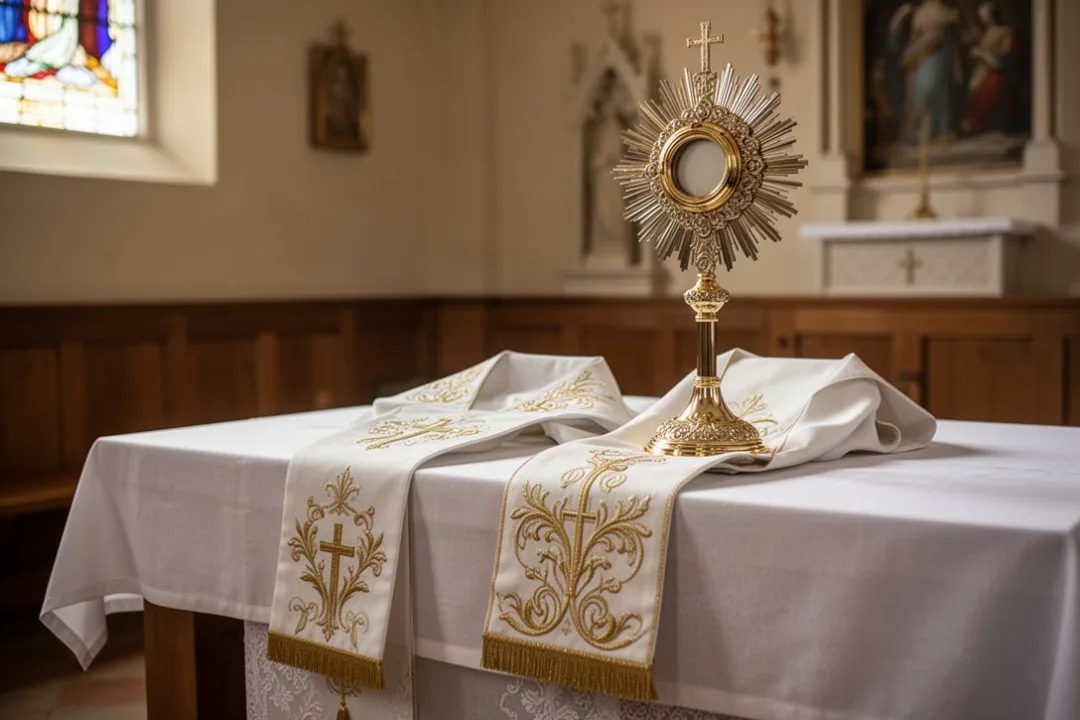
A humeral veil is a long, broad Catholic liturgical cloth worn over the shoulders and arms, most often by a priest or deacon during Benediction of the Blessed Sacrament and Eucharistic processions. Its most recognizable use is covering the minister’s hands while carrying a monstrance containing the consecrated host.
The veil is not an ordinary scarf or decorative stole. It is a specialized vestment connected with the Church’s reverence for the Eucharist. Its name comes from the Latin word humerus, meaning shoulder, because the fabric rests across the shoulders and extends down over the arms.
A humeral veil is usually a rectangular piece of fabric long enough to pass around the shoulders and wide enough to cover the forearms and hands. It may be made from silk, damask, brocade, polyester, or another fabric suitable for sacred use. Many examples include embroidery, metallic trim, fringe, or a central symbol such as a cross, IHS monogram, or Eucharistic image.
The veil is generally worn over the shoulders like a shawl. When the minister holds a monstrance, the ends fall forward and wrap around the hands or handles. From the congregation’s perspective, the fabric creates a visible sign that the minister is acting in a liturgical capacity rather than handling the sacred vessel casually.
Designs vary considerably by parish, religious community, period, and region. A simple white or gold veil may be used for Eucharistic celebrations, while older or more elaborate examples can feature ornate embroidery and rich woven patterns. The construction may include a lining, reinforced edges, concealed hand openings, or small fastening devices that help the veil remain in place.
Essential distinction: A humeral veil is worn over the shoulders and arms for Eucharistic rites. It is different from a chalice veil, which covers the chalice and paten before and after their use at Mass.
Why clergy use a humeral veil
The humeral veil expresses reverence and solemnity when the Blessed Sacrament is exposed or carried in procession. Covering the hands does not mean that the fabric itself is believed to have special power. Rather, it provides a ceremonial gesture of respect and helps direct attention toward Christ present in the Eucharist.
The minister’s covered hands also communicate a practical liturgical principle: the monstrance is being handled with particular care because it contains the consecrated host. The veil separates the ordinary act of carrying an object from the ritual action of exposing, blessing with, or accompanying the Eucharist.
Several meanings are commonly associated with the veil:
Honor: It marks the presence of the Blessed Sacrament as worthy of exceptional reverence.
Humility: The minister’s hands are visually subordinated to the Eucharist rather than displayed as the focus of the rite.
Protection: It helps keep the minister’s hands from direct contact with the monstrance during solemn handling.
Visibility: Its shape and movement make the Eucharistic procession recognizable to the congregation.
Continuity: It connects contemporary celebrations with established Catholic liturgical custom.
These symbolic explanations should not be treated as a single official definition that applies to every veil. The Church’s liturgical books establish how the vestment is used, while its deeper symbolism is understood through the rite, the Eucharist, and longstanding devotional practice.
When a humeral veil is used
The most familiar setting is Benediction of the Blessed Sacrament. In this rite, the Blessed Sacrament is exposed, the congregation prays and worships, and the priest or deacon may use the monstrance to bless the people. The minister puts on the humeral veil before taking the monstrance and removes it after returning the Blessed Sacrament to the tabernacle or completing the prescribed rite.
A humeral veil may also be used during a Eucharistic procession. The procession can take place inside a church, around parish grounds, or along a designated public route, depending on local permissions, pastoral practice, and the form of celebration. The veil helps identify the minister carrying the monstrance and reinforces the solemn character of the procession.
Other Eucharistic services may call for the veil when the Blessed Sacrament is carried or used for a blessing. The exact practice depends on the approved liturgical rite, the instructions of the diocese, and the role of the minister. A parish should not assume that every ceremony involving the Eucharist uses a humeral veil in exactly the same way.
The vestment is not normally worn throughout Mass. It is not a replacement for the alb, stole, chasuble, or dalmatic. Its purpose is tied to specific actions involving the exposed or carried Blessed Sacrament, not to general decoration during the entire celebration.
Who may wear the veil during a liturgy?
A priest or deacon commonly wears the humeral veil when carrying the monstrance or giving Benediction. In some circumstances, another authorized minister may assist with exposition or reposition of the Blessed Sacrament according to the applicable liturgical norms. The person who performs a particular action should follow the rite and the direction of the celebrant or competent church authority.
There is no good reason to treat the veil as a costume available to anyone who wants to participate visually. Its use belongs within a real liturgical function. A sacristan, altar server, or lay volunteer may prepare the vestment, help arrange it, or assist with practical needs, but those tasks do not automatically authorize the person to wear it or use the monstrance.
Follow local direction: Practices can differ according to the Roman Rite, another Catholic liturgical tradition, diocesan guidance, or an approved ritual book. When preparing a service, ask the pastor, celebrant, or master of ceremonies which vestments and gestures are required.
How the humeral veil is worn and handled
The minister normally receives the veil after vesting in the garments proper to the service. It is placed across the shoulders so that both ends hang forward. Depending on its construction, the veil may be secured with a discreet clasp, ribbon, or other fastening method, although some ministers simply arrange it over the shoulders and arms.
Before carrying the monstrance, the minister gathers the forward portions of the veil around the hands and the monstrance’s stem or handles. The fabric should provide a stable grip without being pulled so tightly that it slips or obstructs the vessel. The minister should be able to walk, turn, kneel, and raise the monstrance safely.
The practical sequence usually involves these considerations:
Confirm that the vestment is clean, intact, and suitable for the celebration.
Place it evenly across the shoulders, with the ends hanging at a similar length.
Arrange the fabric so it covers the hands without blocking the minister’s view or footing.
Take the monstrance according to the rite and the celebrant’s established practice.
Move slowly and deliberately, especially on steps, turns, and uneven surfaces.
Return the monstrance and remove or release the veil only at the appropriate point in the rite.
The veil should never be allowed to trail on the floor, catch on furniture, or interfere with another minister. A sacristan can quietly check the arrangement before the service begins. If the fabric is unusually heavy, stiff, slippery, or oversized, a rehearsal is sensible before a procession.
How the humeral veil differs from related vestments
Several liturgical textiles can look similar in photographs, especially when they are richly embroidered. Understanding their different purposes prevents a parish from using one vestment as a substitute for another.
Humeral veil: Worn over the shoulders and arms, especially when carrying the monstrance or giving Benediction.
Chalice veil: A smaller square cloth placed over the chalice and paten before and after their use at Mass.
Stole: A narrow vestment worn by ordained ministers as a sign of their liturgical office. It is not designed to cover the hands while carrying the monstrance.
Cope: A large semicircular vestment worn for processions, Benediction, and other solemn services. A priest or deacon may wear a cope in addition to a humeral veil.
Burse: A stiff, flat case used in some traditions to carry a folded corporal. It is not a shoulder veil.
Velum or shoulder veil: A broader category that can include fabrics used to cover the shoulders or hands in sacred rites; terminology varies by tradition and language.
The cope and humeral veil can appear together. The cope covers the body as an outer liturgical garment, while the humeral veil covers the arms and hands for the particular Eucharistic action. They are therefore complementary rather than interchangeable.
Colors, symbols, and materials used for humeral veils
Many humeral veils are white, ivory, or gold because those colors are strongly associated with the Eucharist and solemn celebrations. Still, color practice may depend on the liturgical tradition and the specific rite. The safest choice for a parish is one that agrees with the relevant liturgical norms and complements the other vestments used for the occasion.
Common decorative elements include a cross, wheat and grapes, a chalice, rays surrounding a host, or a Christogram. These images can identify the veil’s Eucharistic purpose without making the fabric visually overwhelming. Embroidery is often placed near the center or along the borders so that the design remains visible when the veil is held forward.
Traditional veils may use silk damask, velvet, brocade, or metallic thread. Contemporary versions often use durable synthetic blends that are easier to clean and less expensive. A high-quality veil should have secure seams, balanced weight, and a stable lining. The most ornate material is not automatically the most suitable; a veil that is difficult to handle can create a safety and reverence problem.
When selecting material, consider the church’s climate, storage conditions, frequency of use, and cleaning resources. A parish that uses the veil only a few times a year may favor a traditional fabric with careful storage. A community that holds frequent processions may need a more durable textile designed for repeated handling.
Practical tips and common mistakes
Most problems with a humeral veil are avoidable. They usually result from choosing a size without testing it, storing the fabric poorly, or treating a liturgical vestment as ordinary event décor.
Do not confuse the veil with a stole. A stole identifies ordained ministry; the humeral veil serves a specific Eucharistic function.
Do not wrap it tightly around the neck. It should rest across the shoulders and remain comfortable and safe.
Do not let the ends drag. Check the length before the service, especially when the minister will climb steps.
Do not cover the monstrance carelessly. The fabric should support the hands and vessel without hiding the sacred action unnecessarily.
Do not use pins where they could damage the textile. Use an appropriate fastening system or ask a vestment professional for advice.
Do not wash embroidered or metallic fabric without checking its care instructions. Water, heat, and detergents can cause permanent damage.
Do not improvise the rite. Follow the approved liturgical books and the direction of the celebrant.
Do not choose a veil solely by appearance. Weight, dimensions, lining, and ease of movement matter just as much.
A short rehearsal is especially helpful when the veil is new. The minister can practice receiving the monstrance, walking through the church, turning near pews, and returning the vessel to its place. This also allows the sacristan to identify loose trim, awkward fasteners, or fabric that slips from the shoulders.
How to choose a humeral veil for a parish
Begin with the intended use. A veil for occasional Benediction may have different requirements from one used regularly in outdoor processions. Consider whether it will be worn with a cope, whether the minister will carry a large monstrance, and whether more than one person may need to use it.
Next, examine the dimensions. The veil should be long enough to cover the hands and provide a dignified fall at the front, but not so long that it reaches the floor. Its width should allow comfortable shoulder coverage without becoming cumbersome. Because manufacturers measure differently, compare the actual dimensions rather than relying only on labels such as “standard” or “large.”
Evaluate the following features before purchasing:
Fabric weight: Heavy fabric may look formal but can become tiring during a long procession.
Hand coverage: The ends should be long enough to gather around the monstrance securely.
Lining: A smooth lining can help the veil sit comfortably and protect embroidery.
Edge finishing: Strong hems and trim reduce fraying from repeated handling.
Fastening: A discreet, reliable closure can prevent the veil from slipping.
Cleaning: The manufacturer should provide clear instructions for the particular textile.
Storage: The veil should fit the parish’s available cabinet, drawer, or garment box without crushing it.
If the church already owns a cope or set of Eucharistic vestments, match the colors and level of ornament where possible. Matching does not require identical fabric, but a coherent set looks more intentional and supports the solemnity of the celebration.
How to clean, fold, and store a humeral veil
Liturgical textiles benefit from careful handling even when they are used infrequently. Dust and oils from hands can accumulate over time, while poor storage can leave permanent creases. Before cleaning, identify the fiber, lining, embroidery, metallic thread, and any attached fasteners.
For valuable, antique, heavily embroidered, or metallic-thread veils, consult a professional textile conservator or a cleaner experienced with ecclesiastical vestments. Do not assume that a veil labeled “fabric” can safely go into a household washing machine. Water may shrink the lining, bleed the dye, loosen metallic decoration, or distort the shape.
After use, allow the veil to air briefly in a clean, dry place if it has been exposed to perspiration or damp weather. Do not place it in a sealed plastic bag while it is still damp. Once it is dry, inspect the hem and trim, then store it away from direct sunlight, insects, moisture, and sharp objects.
For storage, fold the veil along broad, gentle lines rather than pressing many narrow creases into the same area. Acid-free tissue or a clean protective cloth can cushion embroidery and reduce friction. A dedicated drawer or archival box is preferable to a crowded closet where other vestments may compress it.
A well-cared-for vestment serves the liturgy best when its beauty supports reverence rather than distracting from the Eucharist.
Where the humeral veil fits in Catholic worship
The humeral veil makes most sense when viewed as part of a complete liturgical setting. Its use is connected with the real presence of Christ in the Eucharist, the actions prescribed for exposition and Benediction, and the visible language of Catholic worship. It is not an isolated ornament added to make a service look more ceremonial.
During Eucharistic adoration, the veil can mark the transition from preparing or exposing the Blessed Sacrament to a more solemn action involving the monstrance. During Benediction, it accompanies the minister’s careful handling of the vessel and helps the congregation recognize the moment as distinct from ordinary movement in the sanctuary.
The best use is therefore restrained and purposeful. A clean, properly fitted veil, worn by the appropriate minister and handled according to the rite, communicates more than an elaborate garment used without understanding. Its value lies in the way material, gesture, and prayer work together.
For a parish preparing a first Eucharistic procession or replacing worn vestments, the pastor and sacristan should review the approved rite, local diocesan guidance, and the practical conditions of the church. That preparation protects both the dignity of the celebration and the people who carry out its ministries.
Frequently asked questions
Can a layperson wear a humeral veil?
A layperson may assist with preparation and other authorized tasks, but wearing or using the veil depends on the specific liturgical role and applicable norms. The celebrant or diocesan authority should make that determination. The veil should not be worn simply as a decorative accessory or as a substitute for an ordained minister’s vestment.
Is a humeral veil required for Benediction?
Its use is a traditional and established part of solemn Eucharistic Benediction, particularly when the priest or deacon carries the monstrance. The exact requirements can depend on the approved ritual and local direction. A parish should follow its diocesan guidance and the instructions of the celebrant rather than treating one custom as universal in every circumstance.
What size should a humeral veil be?
It should be long and wide enough to rest comfortably across the shoulders, cover the hands, and allow secure handling of the monstrance without touching the floor. There is no single universal measurement that fits every minister or vessel. Test the veil with the actual cope, minister, and monstrance before purchasing whenever possible.
Can a humeral veil be used during Mass?
It is not normally worn throughout Mass and does not replace the alb, stole, chasuble, or dalmatic. Its use is associated primarily with specific Eucharistic actions, such as carrying the monstrance or giving Benediction. If a particular Mass includes a procession or another approved Eucharistic rite, follow the directions of the liturgical books and the celebrant.















Leave a Reply