Catholic Corpus Christi: Meaning, Mass, and Processions
Catholic Corpus Christi: Meaning, Mass, and Processions
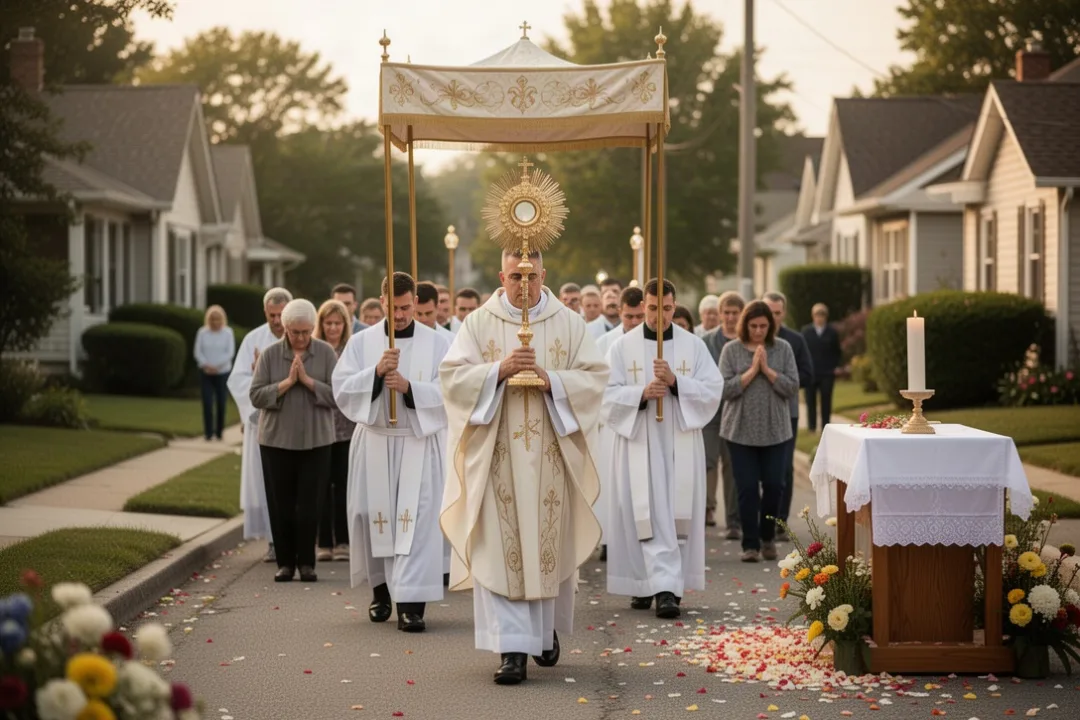
Have you seen a Catholic parish carrying a consecrated host through the streets beneath a canopy and wondered what the procession means? Corpus Christi is the Catholic solemnity honoring the real presence of Jesus Christ in the Eucharist. The name comes from Latin and means “Body of Christ.”
The celebration centers on the Mass, where Catholics receive the Eucharist as the sacramental Body and Blood of Christ. Many parishes also hold a public procession, prayer service, Eucharistic adoration, or a period of reflection after Mass. These practices express the belief that Christ is truly present in the consecrated host and invites worship both inside and outside the church.
Corpus Christi focuses on the Eucharist as the central sacrament of Catholic worship. At Mass, bread and wine are changed into the Body and Blood of Christ through the Eucharistic Prayer and consecration. Catholics continue to see the outward appearances of bread and wine, but they believe the substance has become Christ himself.
This teaching is often called the Real Presence. It does not mean that Catholics regard the Eucharist as an ordinary object or as a reminder with only symbolic meaning. It means that Jesus is truly and sacramentally present, in a manner that depends on faith rather than ordinary physical observation.
The feast also draws attention to the connection between the Eucharist and the Church. Catholics receive Communion as nourishment for Christian life, but the sacrament also calls them to become a more united and generous community. Eucharistic devotion cannot be separated from love of neighbor, forgiveness, service, and concern for people who are suffering.
Central idea: Corpus Christi is not a replacement for the Mass. The Mass is the source of the celebration, while processions and adoration extend prayerful attention to the Eucharist.
When Corpus Christi is celebrated
Corpus Christi is observed on the Thursday after Trinity Sunday, which follows Pentecost. Its traditional place on Thursday connects it with Holy Thursday, the day during Holy Week when the Church remembers the institution of the Eucharist at the Last Supper.
Holy Thursday, however, also includes the beginning of the Easter Triduum and points toward Christ’s Passion. Corpus Christi gives the Church a separate occasion to celebrate the Eucharist with a joyful and public emphasis. In many places, the solemnity is transferred to the following Sunday so more people can participate.
Because the date depends on Easter, Corpus Christi changes every year. The exact date may also differ between countries or dioceses when a bishop’s conference or local bishop transfers the celebration. Your parish calendar is the most reliable place to check the local schedule for Masses and processions.
Why Thursday has a special connection
The weekday placement reflects the Eucharist’s connection with the Last Supper. On Holy Thursday, Catholics remember Jesus giving himself to his disciples under the signs of bread and wine. Corpus Christi revisits that mystery after the Easter season, when the Church can focus more directly on Eucharistic worship.
The Thursday celebration also helps explain why processions are sometimes held on a weekday evening or why a parish may observe the solemnity on Sunday instead. The date and public schedule can vary, but the central subject remains the same: Christ present in the Eucharist and the Church gathered around him.
How the feast developed in the Catholic Church
The Eucharist has been at the heart of Catholic worship since the earliest Christian communities. The specific feast of Corpus Christi developed later as Christians sought a dedicated celebration of the Eucharistic presence of Christ beyond the annual observance of Holy Thursday.
The feast is associated with St. Juliana of Liège, a 13th-century religious woman in what is now Belgium. She strongly supported a liturgical celebration devoted to the Eucharist. Church authorities in Liège established such a feast locally before it spread more widely.
Pope Urban IV established Corpus Christi as a feast for the universal Church in the 13th century. The celebration later became more broadly established in Catholic life, including the tradition of a procession with the Blessed Sacrament. The exact customs developed differently from place to place.
Over time, Corpus Christi processions became especially visible in Catholic communities throughout Europe, Latin America, the Philippines, and other parts of the world. Some use flower carpets, temporary altars, music, incense, banners, or children who have recently received First Communion. These customs can be beautiful, but they are expressions of the Eucharistic celebration rather than requirements for every parish.
What happens during a Corpus Christi celebration
A parish celebration may look different depending on its size, local tradition, and liturgical schedule. The most common pattern begins with a special Mass and continues with prayer before the Blessed Sacrament or a procession.
A solemn Mass: The parish gives particular attention to the Eucharistic Prayer, Communion, music, preaching, and the dignity of the liturgy.
Exposition of the Blessed Sacrament: A consecrated host is placed in a vessel called a monstrance so people can pray in its presence.
A Eucharistic procession: A priest carries the monstrance through the church, parish grounds, or public streets while the faithful accompany it.
Stations or temporary altars: The procession may stop at several locations for Scripture readings, prayers, hymns, and a blessing.
Benediction: The priest or deacon blesses the people with the Eucharist in the monstrance.
Community hospitality: Some parishes share a meal, refreshments, or educational activities after the liturgy.
Not every parish includes every element. One church may celebrate a large outdoor procession, while another may offer a quiet hour of adoration after Sunday Mass. Both can observe Corpus Christi faithfully when the Eucharist is honored according to the Church’s liturgical norms.
How to participate in a Corpus Christi procession
A procession is a public act of faith. The people do not merely watch a priest carry the Eucharist; they accompany Christ in prayer. Walking together also shows that the Church is a pilgrim people whose worship belongs in daily life, not only inside a church building.
If you plan to attend, these steps can help:
Check the parish schedule. Find out whether the procession follows the Saturday evening or Sunday Mass, takes place on Corpus Christi Thursday, or is scheduled at another time.
Ask where to gather. Some processions begin inside the church, while others start near a school, chapel, or parish hall.
Dress for the conditions. Outdoor processions may involve heat, sun, uneven pavement, or a longer walk. Wear respectful, comfortable clothing and practical shoes.
Follow the procession leaders. Ministers, ushers, or parish staff usually indicate when to walk, stop, kneel, sing, or return to the church.
Pray in a simple way. You can use a hymnal, rosary, Scripture meditation, or silent prayer. You do not need specialized knowledge to participate reverently.
Respect the Blessed Sacrament. When the Eucharist passes, people generally remain prayerful and avoid unnecessary conversation or photography.
People who cannot walk the entire route may often remain at the church or join at one of the stops. Families with young children, older adults, and people with disabilities should ask the parish about accessible seating and the expected distance.
Practical tip: The route may cross public streets, so allow extra time and follow directions from parish volunteers. If you are unsure when to stand, kneel, sing, or respond, quietly follow the people around you.
Why Catholics process with the Eucharist
The procession makes visible what Catholics believe about the Eucharist. The consecrated host is not carried as a mere religious symbol or ceremonial object. The monstrance displays the Eucharist for adoration, and the people accompany it as an act of faith in Christ’s real presence.
The movement through public space has several related meanings. It can be a form of adoration, because the faithful honor Jesus. It can be a prayer for the community, because the route passes through places where people live and work. It can also be a reminder that Christian discipleship continues after Mass and reaches ordinary responsibilities.
Many processions pause at altars or stations. These stops allow the parish to pray for particular needs, such as families, the sick, public officials, schools, workers, or people experiencing poverty. The prayers may also connect the Eucharist with the mission of serving the world.
The procession should not be understood as an attempt to put on a public spectacle. Its purpose is worship. Music, flowers, banners, and other customs can support that purpose when they direct attention toward Christ rather than toward the event itself.
What Catholics believe about the Real Presence
The Catholic Church teaches that Christ is present in the Eucharist in a unique and substantial way. This presence begins with the consecration during Mass and remains as long as the Eucharistic species continue to exist. For this reason, consecrated hosts are reserved in a tabernacle and treated with profound reverence.
Catholic theology uses the term transubstantiation to describe the change that occurs at consecration. The word refers to a change in substance, not to a visible alteration in appearance. The Eucharist continues to look, taste, and feel like bread and wine, while Catholics believe its deepest reality has become Christ’s Body and Blood.
The Church’s teaching also holds that Christ is present whole and entire under each species. Receiving only the consecrated host or only from the chalice is still receiving Christ fully, though receiving both kinds may be offered according to local practice and liturgical guidance.
This belief shapes the way Catholics handle the Eucharist. It explains why the Church uses careful procedures for distribution and reservation, why the tabernacle is treated with reverence, and why people genuflect or bow before the Blessed Sacrament according to local custom.
Real Presence and symbolic meaning
Calling the Eucharist a sacrament does not mean that its signs are unimportant. Bread and wine communicate nourishment, celebration, sacrifice, gift, and communion. The Eucharist has rich symbolic meaning precisely because Catholics believe God acts through these signs in a real sacramental way.
It is also possible to speak of the Eucharist as a memorial without reducing it to a mental reminder. In Catholic worship, a memorial makes God’s saving work present sacramentally to the gathered Church. The Mass recalls Christ’s death and resurrection while making their saving power present in the Church’s worship.
Corpus Christi is rooted in the biblical witness about the Eucharist and God’s covenant with his people. At the Last Supper, the Gospel accounts of Matthew, Mark, and Luke, along with First Corinthians 11, describe Jesus giving bread and wine in connection with his body and blood. The Church reads these passages during its broader reflection on the Eucharist.
John 6 presents Jesus as the bread of life and connects faith in him with receiving life from God. Catholics read this chapter together with the Last Supper accounts and the Church’s sacramental tradition. The passage is not treated as an isolated slogan; it contributes to the Church’s understanding of Christ as spiritual nourishment.
First Corinthians 10 discusses the cup and bread of the Eucharist as participation in Christ. First Corinthians 11 describes the Christian gathering for the Lord’s Supper and warns against receiving without proper concern for the unity and dignity of the community. These texts connect Eucharistic worship with ethical responsibility.
The Old Testament also provides images that Christians associate with Eucharistic faith. The Passover meal, manna in the wilderness, covenant sacrifice, and priestly worship all contribute to the Church’s understanding of how God feeds, saves, and remains with his people. These connections are explored especially during the Easter season and Eucharistic liturgies.
Corpus Christi and the meaning of Communion
Receiving Communion is a personal encounter with Christ, but it is not an individual practice detached from the Church. The word Communion points to union with Christ and with the members of his Body. The Eucharist therefore calls Catholics to live in a way that reflects reconciliation and mutual care.
St. Paul’s teaching in First Corinthians 11 makes this connection especially clear. The Christian community’s treatment of poorer members was inconsistent with the meaning of the Lord’s Supper. A Corpus Christi celebration should therefore lead believers to examine how they treat neighbors, strangers, families in need, and people who feel excluded.
The feast can become a useful occasion for parish action. A community might connect Eucharistic prayer with a food pantry, visitation of homebound parishioners, support for a shelter, or another work of mercy. Such activities do not replace worship, but they can express what Eucharistic worship demands from a Christian community.
The same principle applies at home. A person who spends time in Eucharistic adoration may also be encouraged to forgive someone, serve without recognition, care for a sick relative, or make a practical contribution to someone’s wellbeing. The Eucharist sends the faithful back into ordinary life with a renewed responsibility to love.
How Eucharistic adoration relates to Corpus Christi
Eucharistic adoration is prayer before the Blessed Sacrament outside the celebration of Mass. During exposition, the consecrated host is displayed in a monstrance. People may sit or kneel in silence, read Scripture, pray the rosary, sing hymns, or simply remain attentive to God.
Adoration and the Mass are closely related but not interchangeable. The Mass is the Church’s sacrificial liturgy and the primary celebration of the Eucharist. Adoration extends reverence toward the Eucharist that has been consecrated at Mass and can prepare a person to participate more deeply in the liturgy.
A Corpus Christi parish may offer a scheduled holy hour, all-day adoration, or benediction. If you attend, you can pray in a simple and unhurried way. There is no required formula, and it is acceptable to remain silent if you do not know the traditional prayers.
Common Corpus Christi customs around the world
Local culture strongly influences how the solemnity is observed. In some countries, Corpus Christi is connected with a public holiday or a major civic celebration. In others, it is a modest parish observance with a Mass and brief procession.
Common customs include:
Flower carpets and designs: Communities create temporary patterns along the procession route using flowers, colored sawdust, herbs, or other natural materials.
Temporary outdoor altars: Families, neighborhoods, or parish groups prepare places where the procession can stop for prayer and blessing.
Children in First Communion clothing: Children may accompany the procession, scatter flower petals where local custom permits, or carry small religious symbols.
Church bells and incense: These traditional signs help mark the solemnity and draw attention to the sacred procession.
Music and hymns: Choirs, cantors, instrumentalists, or congregational singing accompany the route and support communal prayer.
Parish meals and service projects: Communities may gather afterward or connect the feast with charitable work.
These customs should be evaluated by their purpose and setting. They can help people pray, teach children, and strengthen community identity, but they should remain ordered toward worship of the Eucharist. Local pastors and dioceses guide the liturgical details.
What visitors and non-Catholics should know
Visitors are welcome at a Corpus Christi Mass and may observe a procession respectfully. Practices concerning Communion differ among Christian traditions, so a visitor who is not Catholic should follow the parish’s guidance and may remain seated or come forward for a blessing if that is customary and clearly offered.
Non-Catholics do not need to pretend to hold beliefs they do not share. Quiet observation, prayer according to your own faith, or respectful interest in the tradition are appropriate. A priest, deacon, or parish staff member can answer questions about the procession, the Eucharist, and participation.
Catholics who have not received First Communion or who are not prepared to receive Communion should also follow their parish’s practice. Attending Mass and joining the procession do not require receiving the Eucharist. The most important response is respectful participation at the level appropriate to your circumstances.
How families can observe Corpus Christi at home
When a parish procession is unavailable, families can still mark the solemnity in a simple way. The goal is not to recreate a church service at home, but to connect the feast with prayer, gratitude, and acts of love.
A household might:
Attend the parish Mass offered for Corpus Christi.
Read one of the Gospel accounts of the Last Supper and discuss what Jesus gives to his disciples.
Pray for the parish, priests, people who are sick, and those who lack food or companionship.
Prepare a respectful meal and talk about the Eucharist as nourishment and communion.
Visit an elderly or homebound person, write a note, or make a charitable donation.
Spend several quiet minutes thanking God for the gift of Christ’s presence.
Children often understand the feast more readily when adults explain concrete details. You can describe the monstrance as a vessel used to display the consecrated host, explain why people walk reverently, and emphasize that the procession is a prayer rather than a parade.
Questions to ask when choosing a parish celebration
Schedules and customs vary, especially when Corpus Christi is transferred from Thursday to Sunday. A quick call to the parish office or a visit to its website can prevent confusion.
Useful questions include:
Is the solemnity celebrated on Thursday or Sunday?
Will the procession take place indoors, outdoors, or both?
How long is the route, and is accessible seating available?
Will there be exposition, adoration, or benediction?
Are children, visitors, and people who cannot walk the full route able to participate in another way?
Are there weather-related changes or special parking instructions?
Once you know the schedule, arrive early enough to settle in and listen for instructions. Corpus Christi is a solemn celebration, but it is not reserved for specialists. A person can participate meaningfully through attentive presence, prayer, and respect for the Eucharist.
How the feast shapes Catholic life beyond one day
Corpus Christi brings a particular focus to the Eucharist, but Eucharistic faith belongs to every Sunday Mass and to the daily life of the Church. The solemnity gives Catholics an opportunity to renew their awareness of what they celebrate whenever they gather for worship.
Its lasting question is practical: does receiving Christ change how you treat other people? Eucharistic devotion should deepen gratitude, humility, patience, and willingness to serve. A procession may last an hour, but its meaning continues when believers bring the values of communion, sacrifice, and charity into their homes, workplaces, and neighborhoods.
For Catholics, Corpus Christi is therefore both an act of worship and a public witness. It proclaims faith in Christ’s real presence while reminding the Church that the Eucharist is meant to form a people who live in communion and share God’s love with others.
Frequently asked questions
Is Corpus Christi a holy day of obligation in the United States?
Corpus Christi is a solemnity, but it is not generally one of the six U.S. holy days of obligation listed by the bishops’ conference. Catholics are still required to attend Sunday Mass, and many dioceses celebrate Corpus Christi on Sunday. Local diocesan calendars can clarify the schedule and any particular observance in your area.
Can I attend a Corpus Christi procession if I am not Catholic?
Yes. Visitors may respectfully attend and observe the prayers, music, and procession. Communion is reserved for Catholics who meet the Church’s requirements for receiving, but you can remain in your place or follow the parish’s customary option for receiving a blessing. Parish staff can explain local practices without pressure.
What is the difference between Corpus Christi and Holy Thursday?
Both celebrations focus on the Eucharist, but they have different settings. Holy Thursday occurs during the Easter Triduum and remembers the Last Supper in connection with Christ’s Passion. Corpus Christi occurs after Pentecost and gives the Church a separate, joyful solemnity devoted especially to Eucharistic worship and public procession.
Why is a consecrated host placed in a monstrance?
A monstrance is a liturgical vessel designed to display the consecrated host during adoration and benediction. Catholics use it so the faithful can see the Eucharist and pray in Christ’s presence. The vessel does not make the host holy; the host has already been consecrated during Mass.












Leave a Reply