Liturgical calendar 2026: Catholic feast days and seasons
Liturgical calendar 2026: Catholic feast days and seasons
Are you trying to plan Lent, check the date of Easter, or find out when Advent begins in 2026? The 2026 Catholic liturgical calendar places Ash Wednesday on February 18, Easter Sunday on April 5, and the First Sunday of Advent on November 29.
The dates below follow the Roman Catholic calendar commonly used in the United States. Some observances can be transferred to a Sunday, and local dioceses, religious communities, and other Christian traditions may use different calendars.
Quick answer: The 2026 liturgical year begins with Advent on November 30, 2025, continues through Christmas and the seasons of 2026, and ends with the Solemnity of Christ the King on November 22, 2026. Advent 2026 begins the next liturgical year on November 29.
The liturgical calendar is the Church’s annual pattern of worship. It does more than list saints’ feast days: it arranges the major events of Christ’s life, death, resurrection, and sending of the Holy Spirit across a repeating cycle of seasons.
Unlike the civil calendar, which starts on January 1, the Catholic liturgical year begins with the First Sunday of Advent. That means the first weeks of calendar year 2026 belong to the liturgical year that began in late 2025. The next liturgical year starts on November 29, 2026.
The principal seasons and periods in 2026 are:
Christmas Time: January 1 through the Baptism of the Lord on January 11, with local variations in the closing date.
Ordinary Time: January 12 through February 17, then May 25 through November 28.
Lent: February 18 through April 2, ending before the evening Mass of the Lord’s Supper on Holy Thursday.
The Paschal Triduum: The evening of April 2 through April 5.
Easter Time: April 5 through Pentecost Sunday on May 24.
Advent: November 29 through December 24.
Christmas Time: Beginning with the celebration of the Nativity on December 25.
The exact boundaries of a season can be described slightly differently in parish calendars, especially around Christmas and the Triduum. The principal celebrations and their dates remain the same.
Major Catholic dates in the 2026 liturgical calendar
These are the dates most people need for planning parish worship, prayer, fasting, religious education, and family observances.
January 1: Solemnity of Mary, the Holy Mother of God
January 4: Epiphany of the Lord, observed on Sunday in many U.S. dioceses
January 11: Feast of the Baptism of the Lord
February 18: Ash Wednesday
March 19: Solemnity of Saint Joseph
March 25: Solemnity of the Annunciation of the Lord
March 29: Palm Sunday of the Lord’s Passion
April 2: Holy Thursday
April 3: Good Friday
April 4: Holy Saturday and the Easter Vigil
April 5: Easter Sunday
May 14: Ascension of the Lord on its traditional Thursday date; many U.S. dioceses transfer it to May 17
May 24: Pentecost Sunday
May 31: Solemnity of the Most Holy Trinity
June 4: Solemnity of the Most Holy Body and Blood of Christ, traditionally Corpus Christi; many U.S. dioceses observe it on June 7
June 12: Solemnity of the Most Sacred Heart of Jesus
August 15: Solemnity of the Assumption of the Blessed Virgin Mary
November 1: Solemnity of All Saints
November 22: Solemnity of Our Lord Jesus Christ, King of the Universe
November 29: First Sunday of Advent
December 8: Solemnity of the Immaculate Conception of the Blessed Virgin Mary
December 25: Nativity of the Lord, or Christmas Day
Dates marked as transferred require special attention. The United States Conference of Catholic Bishops permits or observes certain major celebrations on Sundays rather than their traditional weekday dates. Your parish bulletin or diocesan calendar is the best source for the date used locally.
January 2026 begins in Christmas Time
January 2026 does not begin in Ordinary Time. The first part of the month remains within Christmas Time, which continues the celebration of Christ’s birth and manifestation to the world.
New Year’s Day, January 1, is the Solemnity of Mary, the Holy Mother of God. It is also the Octave Day of Christmas and, in the Catholic calendar, a solemnity. In the United States, it is a holy day of obligation unless the obligation is abrogated when the date falls on a Saturday or Monday, according to the norms applied by the U.S. bishops.
The Epiphany of the Lord commemorates Christ’s manifestation to the nations, traditionally associated with the visit of the Magi. January 6 is the traditional date, but in many U.S. dioceses the celebration is transferred to Sunday, January 4, in 2026.
The Christmas season reaches a major turning point with the Baptism of the Lord on January 11. Ordinary Time begins on the following day, January 12, unless a local calendar follows a slightly different arrangement for the closing days of Christmas Time.
Ash Wednesday falls on February 18, 2026. It begins the forty-day season of Lent, a period of prayer, fasting, almsgiving, repentance, and preparation for the celebration of Easter. Sundays are not counted as the same kind of fast days, which is why Lent begins more than forty calendar days before Easter.
On Ash Wednesday, Catholics commonly receive ashes as a visible sign of repentance and mortality. The day is also observed as a day of fasting and abstinence under Catholic discipline. The specific requirements apply differently by age and circumstance, so anyone with health concerns should seek pastoral or medical guidance rather than attempting a harmful fast.
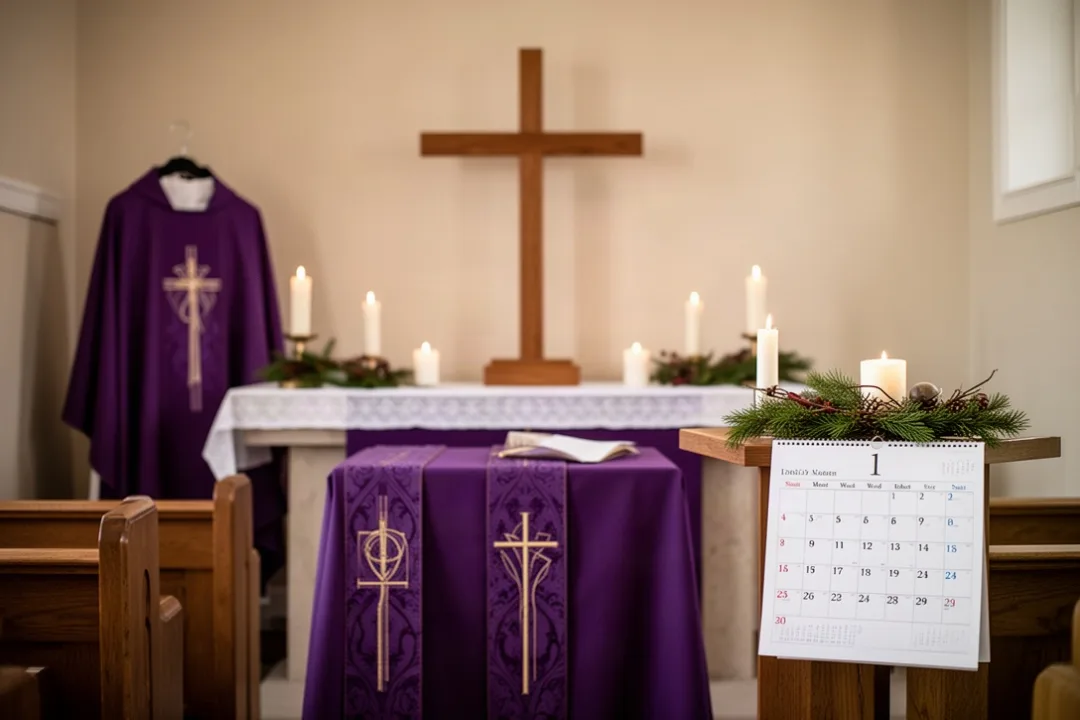
During Lent, the Sunday readings focus attention on conversion, covenant, baptismal preparation, and the approach of Christ’s Passion. The liturgical color is generally violet or purple. Churches usually omit the Gloria at Sunday Mass, and the Alleluia is not used from the beginning of Lent until the Easter Vigil.
The Sundays of Lent in 2026 are:
First Sunday of Lent: February 22
Second Sunday of Lent: March 1
Third Sunday of Lent: March 8
Fourth Sunday of Lent: March 15, Laetare Sunday
Fifth Sunday of Lent: March 22
Palm Sunday: March 29
Laetare Sunday, the Fourth Sunday of Lent, offers a lighter note within the season. Rose-colored vestments may be used, as on Gaudete Sunday during Advent. The final week of Lent is Holy Week, which begins with Palm Sunday and leads directly into the Triduum.
Planning tip: If you want to attend a reconciliation service before Easter, check parish schedules during the last two weeks of Lent. Confession times often change during Holy Week because priests are preparing for the Triduum.
What happens during Holy Week and the Paschal Triduum
Palm Sunday of the Lord’s Passion is March 29. The liturgy recalls Christ’s entry into Jerusalem and also proclaims the account of his Passion. Many parishes distribute blessed palm branches, though the form of the celebration can vary.
Holy Thursday is April 2. The evening Mass of the Lord’s Supper begins the Paschal Triduum, the central three-day celebration of the Christian year. It recalls the institution of the Eucharist, Christ’s commandment of love, and the beginning of the Passion.
Good Friday is April 3. The Church does not celebrate Mass on this day. The Liturgy of the Lord’s Passion includes readings, the solemn intercessions, the veneration of the cross, and Holy Communion consecrated at an earlier celebration.
Holy Saturday is April 4. The Church remains in prayerful expectation until nightfall, when the Easter Vigil begins. The Vigil includes the blessing of the Easter fire, the Paschal candle, Scripture readings, baptismal celebration or renewal, and the first Eucharist of Easter.
Easter Sunday is April 5. It celebrates the resurrection of Jesus Christ and begins the fifty-day Easter season. Easter is the central solemnity of the Catholic liturgical year, and its date determines many other movable celebrations.
Follow the Easter season through Pentecost
Easter Time continues for seven weeks, not just through Easter Sunday. The season keeps the Church focused on the risen Christ, baptismal life, the appearances of Jesus to his disciples, and the mission given to the Church.
The Second Sunday of Easter, April 12, is also known as Divine Mercy Sunday. The Easter Sundays that follow continue the paschal celebration, with readings that prepare for the Ascension and Pentecost.
Ascension of the Lord has its traditional date on Thursday, May 14, forty days after Easter. In many dioceses in the United States, the solemnity is transferred to Sunday, May 17. Because the transfer varies by ecclesiastical province, a parish may list either May 14 or May 17 as the principal local celebration.
Pentecost Sunday is May 24. It celebrates the descent of the Holy Spirit upon the apostles and marks the end of Easter Time. The liturgical color is red, symbolizing the Holy Spirit and the fire associated with Pentecost.
Several important celebrations follow Pentecost:
Trinity Sunday: May 31, honoring the mystery of the Father, Son, and Holy Spirit.
Corpus Christi: June 4 on the traditional Thursday date, or June 7 in many U.S. dioceses, celebrating the Eucharist.
Sacred Heart of Jesus: June 12, emphasizing Christ’s love and mercy.
Immaculate Heart of Mary: June 13, observed on the day after the Sacred Heart celebration.
Understand Ordinary Time in 2026
Ordinary Time is not a season of lesser importance. The word “ordinary” comes from a term related to counting or ordering the weeks. It describes the period in which the Church reflects on Christ’s public ministry and the meaning of discipleship outside the concentrated seasons of Christmas, Lent, and Easter.
The first portion of Ordinary Time runs from January 12 through February 17. It pauses for Lent and Easter, then resumes on May 25, the day after Pentecost. The second portion continues through November 28, the day before Advent begins.
Green is the usual liturgical color for Ordinary Time. The Sunday Gospel readings in 2026 follow Sunday Cycle A, which gives particular prominence to the Gospel according to Matthew. Weekday readings follow Year II, because 2026 is an even-numbered year.
Individual feast days can replace the Ordinary Time readings. A parish may celebrate a saint’s memorial, a solemnity, or another proper observance instead of the readings assigned to the numbered Sunday or weekday. This is one reason printed missals and parish calendars can show more than one possible celebration for a date.
Important saints’ days and solemnities from June through November
The middle and later months of 2026 contain many celebrations that shape Catholic prayer and parish life. Not every feast is a holy day of obligation, and the rank of a celebration—solemnity, feast, memorial, or optional memorial—affects how it is observed in the liturgy.
June 24: Nativity of Saint John the Baptist
June 29: Solemnity of Saints Peter and Paul
July 3: Feast of Saint Thomas, Apostle
July 22: Feast of Saint Mary Magdalene
July 25: Feast of Saint James, Apostle
July 26: Memorial of Saints Joachim and Anne
August 15: Assumption of the Blessed Virgin Mary
August 22: Memorial of the Queenship of the Blessed Virgin Mary
September 8: Feast of the Nativity of the Blessed Virgin Mary
September 14: Feast of the Exaltation of the Holy Cross
September 29: Feast of Saints Michael, Gabriel, and Raphael
October 1: Memorial of Saint Thérèse of Lisieux
October 4: Memorial of Saint Francis of Assisi
October 7: Memorial of Our Lady of the Rosary
October 28: Feast of Saints Simon and Jude
November 1: Solemnity of All Saints
November 2: Commemoration of All the Faithful Departed, or All Souls’ Day
Some celebrations have special importance in particular countries or religious communities. For example, a parish may honor a patron saint with a solemn Mass even when the universal calendar gives that date a different rank. The proper calendar of the United States also includes celebrations that are not found in every country.
Advent and Christmas dates at the end of 2026
The First Sunday of Advent is November 29, 2026. Advent begins the next liturgical year and includes four Sundays in 2026: November 29, December 6, December 13, and December 20.
Advent has a twofold character. It prepares the Church to celebrate the first coming of Christ at Christmas and directs attention toward Christ’s future coming. The liturgical color is usually violet or purple, while rose may be used on the Third Sunday, Gaudete Sunday, which falls on December 13.
Advent weekdays from December 17 through December 24 have a particularly direct focus on the coming birth of Christ. The “O Antiphons,” traditionally prayed during the final days before Christmas, give these days a distinctive character in the Church’s evening prayer.
Christmas Day is December 25, 2026. It falls on a Friday. The Christmas celebration includes several Mass formularies in the Roman Rite, including Mass during the night, at dawn, and during the day. Parish schedules may offer one or more of these celebrations.
The Feast of the Holy Family falls on Sunday, December 27, in 2026. The Christmas season then continues into January 2027, leading toward the Solemnity of Mary, the Epiphany, and the Baptism of the Lord.
How to use the calendar for parish and personal planning
A liturgical calendar is most useful when you connect its dates with your actual schedule. Instead of checking only major holidays, use the seasons to plan worship, prayer, fasting, service, and family observances.
Mark the movable dates first. Add Ash Wednesday, Holy Week, Easter, Ascension, Pentecost, and Advent before entering fixed feast days.
Check local transfers. Confirm whether your diocese celebrates Ascension and Corpus Christi on Thursday or Sunday.
Note holy days of obligation separately. A solemnity is not automatically a holy day of obligation in the United States.
Match your prayer to the season. Consider a Lenten practice, an Easter devotion, or a short Advent prayer routine.
Allow for parish schedule changes. Triduum liturgies, Christmas Masses, and reconciliation services often use special schedules.
Use the correct reading cycle. Sundays in most of 2026 follow Cycle A, while weekday readings follow Year II.
The calendar can also help families make the year visible at home. A simple seasonal display, a weekly Scripture reading, or a shared meal on a major feast can connect everyday life with the Church’s worship. The practice does not need to be elaborate; consistency matters more than decoration.
Which 2026 dates may differ by denomination or country
“Liturgical calendar 2026” can refer to more than one tradition. Roman Catholics, Eastern Catholics, Eastern Orthodox Christians, Anglicans, Episcopalians, Lutherans, and other churches may share major Christian celebrations while assigning different dates, readings, colors, or levels of observance.
Even within the Roman Catholic Church, calendars differ by country. The United States calendar includes national memorials and follows local rules for transferring certain solemnities. A religious order may also use its own proper calendar for saints connected to its history.
Eastern Christian communities may calculate Easter using a different method, so their Pascha can fall on another date. For that reason, anyone arranging ecumenical events, school schedules, or travel should confirm the calendar used by the specific church or parish.
For a personal schedule, the safest method is to combine a reliable national calendar with your parish’s published bulletin. That approach accounts for local feast days, transferred celebrations, holy day obligations, and special Mass times without treating every calendar entry as universal.
Frequently asked questions
When does the Catholic liturgical year begin in 2026?
The next Catholic liturgical year begins on the First Sunday of Advent, November 29, 2026. The calendar year begins while the Church is still celebrating Christmas Time from the liturgical year that started on November 30, 2025. Advent 2026 includes four Sundays and leads to Christmas Day on Friday, December 25.
What are the dates for Lent and Easter in 2026?
Lent begins on Ash Wednesday, February 18, 2026. Palm Sunday is March 29, Holy Thursday is April 2, Good Friday is April 3, and the Easter Vigil is celebrated on the night of April 4. Easter Sunday falls on April 5, followed by Pentecost on May 24.
Is Ascension Thursday a holy day of obligation in the United States in 2026?
Ascension is traditionally celebrated on Thursday, May 14, 2026. Many U.S. dioceses transfer the solemnity to Sunday, May 17, while others retain Thursday observance. The obligation and local date depend on the ecclesiastical province, so check your diocese or parish rather than relying on a general calendar.
What Sunday reading cycle is used during 2026?
Most Sundays in calendar year 2026 use Sunday Cycle A, which features the Gospel of Matthew. Advent 2026 begins the next liturgical year and changes the Sunday cycle to Year B. Weekday Mass readings in 2026 generally follow Year II, the cycle assigned to even-numbered years.












Leave a Reply