Holy Week 2026: Dates, meaning, and ways to observe
Holy Week 2026: Dates, meaning, and ways to observe
Holy Week 2026 begins on Palm Sunday, March 29, and ends on Easter Sunday, April 5. The central days are Holy Thursday on April 2, Good Friday on April 3, and Holy Saturday on April 4. These dates follow the Western Christian calendar, including the Roman Catholic, Anglican, Lutheran, and many Protestant traditions.
The week moves from Jesus’ entry into Jerusalem to the Last Supper, crucifixion, burial, and resurrection. Churches mark these events through worship services, Scripture readings, processions, silence, prayer, and shared meals, although the customs and service times vary by denomination and congregation.
Each day has a particular place in the Christian story and in the rhythm of church worship. Some congregations hold services on every day of the week, while others focus on Palm Sunday, Good Friday, and Easter.
Palm Sunday: March 29, 2026
Holy Monday: March 30, 2026
Holy Tuesday: March 31, 2026
Holy Wednesday: April 1, 2026
Holy Thursday, also called Maundy Thursday: April 2, 2026
Good Friday: April 3, 2026
Holy Saturday: April 4, 2026
Easter Sunday: April 5, 2026
Ash Wednesday falls on February 18, 2026. It begins Lent, the 40-day season of preparation that leads toward Holy Week, although Sundays are not counted in the same way as the weekdays of Lent. The week after Easter is often called Easter Week, and the broader Easter season continues well beyond April 5.
Planning note: Service times, processions, fasting expectations, and terminology differ among churches. Check the website or office of the congregation you plan to attend, especially for Holy Thursday and the Easter Vigil.
What Holy Week remembers and why it matters
Holy Week is the annual Christian observance of the final period of Jesus’ earthly life. It begins with his arrival in Jerusalem, traditionally remembered as a public welcome, and leads through the events Christians understand as his suffering, death, and resurrection.
The week is not simply a set of historical anniversaries. For many Christians, worship makes the biblical story present in a spiritual and communal way. The congregation may hear the Passion narrative, receive Communion, keep periods of darkness or silence, and then celebrate Easter with light, music, and renewed baptismal promises.
The movement of the week also explains its emotional range. Palm Sunday includes celebration but also anticipates suffering. Holy Thursday emphasizes service and fellowship. Good Friday creates space for grief and contemplation, while Holy Saturday rests in the uncertainty of the tomb. Easter announces resurrection and hope.
Churches use different readings and liturgical forms, but the central themes are widely shared:
Faithfulness under pressure: Jesus’ final days are remembered as a time of conflict, abandonment, prayer, and steadfastness.
Servant leadership: The Last Supper and the foot-washing tradition emphasize humility and care for others.
Reconciliation: The cross is understood within Christian traditions as central to God’s work of forgiveness and redemption.
Hope beyond death: Easter proclaims that death does not have the final word.
Palm Sunday on March 29, 2026
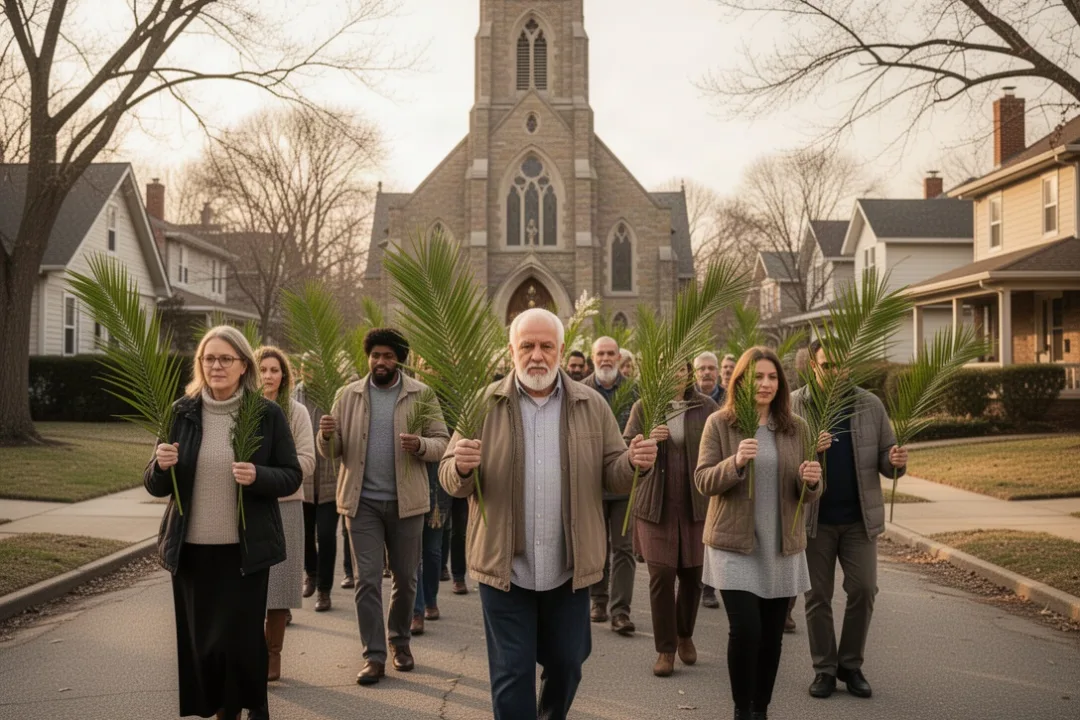
Palm Sunday commemorates Jesus’ entry into Jerusalem shortly before his death. The Gospel accounts describe crowds welcoming him with branches, an image that gives the day its name. In churches, worshipers may receive palm branches, palm crosses, or other local symbols and join a procession before the service.
The day has a deliberate change in tone. It may begin with music and joyful movement, then turn toward the account of Jesus’ arrest, trial, suffering, and death. Many congregations read the Passion narrative on Palm Sunday, particularly when they will not gather for a separate Good Friday service.
In some places, palms are saved and later burned to make the ashes used on Ash Wednesday. If you receive a palm, follow your church’s guidance about returning, recycling, or displaying it. Palms should not be treated as lucky objects; they function as reminders of the faith and story being observed.
How to participate in Palm Sunday worship
You do not need to know every response or tradition to attend. Arrive a little early if the service includes a procession, and ask an usher where to stand or sit. If your church distributes palms, you can take one home or leave it for proper collection.
At home, reading one of the Gospel accounts of Jesus’ entry into Jerusalem can help connect the service with the rest of Holy Week. The relevant passages include Matthew 21, Mark 11, Luke 19, and John 12. Rather than treating them as identical reports, notice the different details each writer highlights.
The middle weekdays of Holy Week are observed differently from one church to another. They may include daily Mass, evening prayer, Bible studies, devotional services, or no special public gathering. Their quieter pace gives worshipers time to remain with the story rather than rushing from Palm Sunday to Easter.
Holy Monday is often connected with Jesus’ teaching and actions in Jerusalem after the entry. Holy Tuesday may focus on his debates with religious and political authorities, his warnings to the disciples, or parables about readiness and faithfulness. Holy Wednesday is sometimes associated with the decision of Judas to betray Jesus, although the emphasis and readings vary.
These days can be valuable for personal reflection because they make room for questions that are easy to overlook during major services. Consider how the Gospel narratives portray power, fear, loyalty, public opinion, and the cost of discipleship. A short period of quiet reading can be more meaningful than trying to complete a large devotional program.
Holy Thursday on April 2, 2026
Holy Thursday, also known as Maundy Thursday, remembers the Last Supper and Jesus’ final night with his disciples. The word “Maundy” is related to the commandment to love one another. The day therefore joins Communion, service, love, and remembrance in one observance.
Many churches hold an evening service that includes the Eucharist or Lord’s Supper. A foot-washing ceremony may follow or accompany it, reflecting the Gospel account in John 13. This practice is not universal, and congregations that do not wash feet may still emphasize the same call to humble service.
The service often ends without a conventional dismissal. In some traditions, the altar is stripped, candles are removed, and the church becomes quiet. The congregation may keep watch in prayer, remembering Jesus’ prayer in Gethsemane and the disciples’ struggle to remain awake.
If you attend Holy Thursday worship, expect a service that feels more intimate and restrained than a typical Sunday gathering. Communion practices differ, so visitors should follow the directions of the congregation. Some churches welcome all baptized Christians, some invite those who share their confession of faith, and others offer a blessing to people who do not receive Communion.
“Do this in remembrance of me” is associated with the Last Supper in the Gospel accounts and is understood by Christians as a call to remember through worship and faithful living.
Good Friday on April 3, 2026
Good Friday commemorates Jesus’ crucifixion. Despite the name, it is generally a solemn day of mourning, repentance, and prayer. Churches may use subdued music, bare worship spaces, extended silence, readings from the Passion narratives, or a service focused on the cross.
Common observances include the Stations of the Cross, the Solemn Reproaches, the Three Hours’ Devotion, and the Good Friday liturgy. Not every church uses these forms. Some congregations gather at noon, while others meet in the evening or follow a service that lasts less than an hour.
Many Christians fast or abstain from particular foods on Good Friday. The rules depend on denomination, age, health, and personal conviction. A fast should not put your health at risk, and children, pregnant people, older adults, and people with medical conditions may need different guidance. When a church has formal requirements, ask its pastor or priest for clarification.
The biblical Passion readings may come from Matthew 27, Mark 15, Luke 23, or John 18–19. These references can guide personal reading without requiring you to combine every detail into one account. Read slowly, allow silence between sections, and consider the people who appear around the cross: the disciples, soldiers, women, religious leaders, and the bystanders.
Good Friday reminder: A solemn service is not meant to be a test of how much emotion you can display. Quiet attention, honest prayer, and respectful presence are appropriate ways to observe the day.
Holy Saturday and the Easter Vigil on April 4, 2026
Holy Saturday remembers the period between Jesus’ death and resurrection. It is a day of waiting. The church may remain quiet, and some traditions do not celebrate Communion during the daytime. The mood differs from Good Friday because the focus shifts from the event of death toward expectation.
The Easter Vigil begins after sunset on Holy Saturday in many Western traditions. Its structure commonly moves from darkness to light, then through readings, baptismal remembrance, and the first celebration of Easter. A new fire or Paschal candle may symbolize Christ as light, and the congregation may hear a series of readings that trace God’s work in salvation history.
The Vigil is also a traditional time for baptisms and confirmations. People preparing to join the church may make public professions of faith, while the wider congregation renews its own baptismal commitments. The service can last longer than a regular Sunday service, so check the schedule before attending.
Not every congregation offers an Easter Vigil. Some celebrate Easter for the first time at a sunrise service or on Easter morning. If you want to attend a Vigil, look for terms such as Easter Vigil, Great Vigil of Easter, or Holy Saturday service when searching a church calendar.
Easter Sunday on April 5, 2026
Easter Sunday celebrates the resurrection of Jesus. It is the principal feast of the Christian year, and many churches hold their largest worship gatherings on this day. Services may include joyful music, flowers, bells, a sermon on the resurrection accounts, Holy Communion, and baptismal renewal.
Some congregations offer a sunrise service, while others meet midmorning or at several times throughout the day. The familiar Easter customs of decorated eggs, new clothing, family meals, and children’s activities are cultural practices rather than requirements of Christian worship. They can accompany the religious observance, but churches differ in how prominently they include them.
The Gospel accounts of the empty tomb appear in Matthew 28, Mark 16, Luke 24, and John 20. They have different details and emphases, yet each directs attention to the claim that Jesus has risen. Reading one account before worship can help you listen for its particular message instead of treating Easter as only a seasonal tradition.
Easter also begins a longer period of Christian celebration. The 50-day Easter season continues through Pentecost in many churches. That extended season matters because Easter is not only a single morning of celebration; it shapes how Christians understand worship, community, service, and hope throughout the year.
How Holy Week differs among Christian traditions
Holy Week is shared across much of Christianity, but the services do not look the same everywhere. Roman Catholic, Eastern Orthodox, Anglican, Lutheran, Methodist, Presbyterian, Baptist, and non-denominational churches may use different calendars, readings, music, and expectations.
The dates above apply to the Western Easter calendar. Eastern Orthodox churches generally calculate Pascha using a different calendar method, so their Holy Week and Easter dates can fall later. A church’s local practice may also use a different name for the same service or may combine several observances into one gathering.
Here are some differences you may encounter:
Communion: Churches vary in who may receive it and how it is distributed.
Fasting: Some traditions set formal rules, while others encourage voluntary fasting or another spiritual discipline.
Palms and processions: These may be central to Palm Sunday or absent from the service.
Foot washing: It is practiced in some congregations and explained symbolically in others.
Passion readings: A church may read the Passion on Palm Sunday, Good Friday, or both.
Easter Vigil: Some churches consider it the high point of the week, while others do not hold one.
These differences do not necessarily indicate disagreement about the importance of Holy Week. They often reflect distinct worship traditions, pastoral choices, and interpretations of how the biblical events should be remembered in public prayer.
Practical ways to observe Holy Week 2026
You can observe Holy Week through church attendance, personal prayer, service to others, or a combination of these. A meaningful plan does not need to be elaborate. Choose practices that help you pay attention to the sequence of the week and connect faith with daily conduct.
Mark the dates on your calendar. Set aside time for Palm Sunday, Holy Thursday, Good Friday, Holy Saturday, and Easter. If you cannot attend every service, select one or two that fit your schedule.
Read the Gospel accounts gradually. Read a short section each day rather than waiting until Easter morning. Use a printed Bible or a translation familiar to you.
Attend at least one weekday service. Holy Thursday, Good Friday, and the Easter Vigil each offer a different experience from ordinary Sunday worship.
Practice a specific form of service. Prepare a meal for someone, visit a neighbor, volunteer through a local organization, or reconcile with someone when doing so is safe and appropriate.
Keep space for silence. Turn off unnecessary notifications, take a quiet walk, or sit for several minutes without filling the time with entertainment.
Share a respectful meal. A simple family or community meal can create an opportunity to talk about forgiveness, sacrifice, hospitality, and hope.
Prepare for Easter responsibly. Confirm service times, accessibility arrangements, parking, childcare, and Communion practices before arriving.
Families with children can adapt the observance without making it overly complicated. Read a short Gospel passage, create a simple palm craft, use a candle during prayer, or explain why the mood changes from celebration to sorrow and then to joy. Children do not need every theological answer at once; clear language and honest acknowledgment of difficult emotions are often most helpful.
Common mistakes to avoid during Holy Week
Many people want to observe the week respectfully but are unsure about the details. A few practical precautions can prevent confusion and help you participate without placing pressure on yourself or others.
Assuming every church follows the same schedule: Service times and names vary, so verify them directly.
Treating Palm Sunday as only a cheerful procession: The Passion reading may make the service more solemn than expected.
Starting a medically risky fast: Choose a safe practice and seek professional advice when health conditions are involved.
Receiving Communion without knowing the local practice: Follow the congregation’s instructions or ask an usher for guidance.
Expecting Good Friday to feel like Easter: Silence, grief, and simplicity are intentional parts of many services.
Leaving Holy Saturday out entirely: The day’s waiting and quiet can be an important part of the movement toward Easter.
Reducing the week to a checklist: Attendance matters, but reflection, prayer, compassion, and changed behavior are also central to the observance.
Visitors are usually welcome at public Holy Week services, but the level of participation is your choice. You can stand or sit with the congregation, remain silent during prayers you do not know, and accept a blessing if that is offered instead of Communion. Modest, comfortable clothing and a respectful attitude are generally sufficient.
Questions to reflect on during Holy Week
Holy Week can become more personal when you allow the readings to raise specific questions. You might ask what forms of fear influence your decisions, where you need to offer forgiveness, or how you respond when doing what is right carries a cost.
On Holy Thursday, consider how service is expressed in your relationships. On Good Friday, make room for grief without trying to explain it away. On Holy Saturday, reflect on experiences of waiting and uncertainty. On Easter, consider what new life, restored trust, or renewed purpose might look like in practical terms.
These questions are not meant to replace worship or force a particular emotional response. They give you a way to connect the public story of Holy Week with real responsibilities, relationships, losses, and hopes.
How to find Holy Week services near you
Begin with the official website of a local church, cathedral, parish, synagogue? No, Holy Week services are held by Christian congregations, so search for Catholic, Episcopal, Lutheran, Methodist, Presbyterian, Baptist, Orthodox, or non-denominational churches according to the tradition you seek. Local dioceses, denominational directories, and community calendars may also list services.
Search specifically for “Holy Week 2026 services,” “Good Friday service,” “Holy Thursday Mass,” or “Easter Vigil 2026” along with your city or ZIP code. Confirm the information close to the date because schedules can change. Ask about accessibility, children’s programming, language options, parking, and whether reservations are required for especially popular services.
If you cannot attend in person, some congregations stream services or provide recorded worship. Online participation can be helpful, but it may not include every element of an in-person service, such as processions, Communion, or congregational singing. Use the option that allows you to observe the week with attention and sincerity.
What to remember about Holy Week 2026
Holy Week 2026 runs from March 29 through April 5. Palm Sunday opens the week, Holy Thursday remembers the Last Supper, Good Friday recalls the crucifixion, Holy Saturday waits at the tomb, and Easter Sunday celebrates the resurrection.
The most useful preparation is practical: check local schedules, understand the customs of the church you visit, plan any fasting safely, and allow the week to move at its own pace. Its purpose is not to create a perfect religious experience but to give Christians a structured way to remember the central events of their faith through worship, reflection, service, grief, and hope.
Frequently asked questions
Is Holy Week the same week as Easter?
Yes. Holy Week is the seven-day period that begins with Palm Sunday and ends on Easter Sunday. In 2026, it runs from March 29 through April 5. Easter Sunday is part of Holy Week and marks its culmination, while the broader Easter season continues for several weeks afterward in many Christian traditions.
Is Good Friday a federal holiday in the United States?
Good Friday is not a federal holiday, so federal offices and many businesses remain open. Some states, schools, banks, and private employers may observe it differently. Check your local calendar or workplace policy if you need time away for worship. Church services are commonly held at midday, in the afternoon, or during the evening.
What should I wear to a Holy Week service?
Wear clean, comfortable clothing that fits the congregation’s setting. Good Friday services are often subdued, while Easter services may be more formal, but there is no single required outfit. If you are unsure, modest business-casual clothing is usually appropriate. Comfortable shoes can help if Palm Sunday includes an outdoor procession or extended standing.
Can someone attend Holy Week services if they are not Christian?
Many churches welcome visitors, including people who are exploring Christianity or accompanying friends and family. You may participate in singing or prayer as you choose, or simply observe. Communion rules vary, so ask an usher or follow the printed guidance. You can usually receive a blessing instead if the congregation offers that practice.










Leave a Reply