Holy Thursday meaning: What Christians commemorate
Holy Thursday meaning: What Christians commemorate
Holy Thursday commemorates the evening before Jesus’ crucifixion, especially the Last Supper with his disciples. Christians remember Jesus giving himself in the Eucharist, washing the disciples’ feet, praying in Gethsemane, and instructing his followers to serve one another.
Holy Thursday is also called Maundy Thursday or Holy and Great Thursday in some Christian traditions. It begins the Easter Triduum, the three-day celebration of Christ’s Passion, death, and resurrection, which continues through Good Friday and Holy Saturday until Easter Sunday.
What Holy Thursday means in the Christian calendar
Holy Thursday falls during Holy Week, the final week of Lent. Its date changes each year because Easter moves according to the church calendar. It is observed on the Thursday before Easter Sunday, usually in March or April.
The day has a distinctive place in Christian worship because it combines celebration and sorrow. The Church celebrates Jesus’ love and the gift of the Eucharist, yet the evening leads directly toward his arrest, trial, and crucifixion. That movement from fellowship to abandonment gives the day its solemn character.
Holy Thursday is the first day of the Easter Triduum. In many traditions, the Triduum is understood as one continuous liturgical celebration that begins with the evening Mass or Communion service on Holy Thursday and ends with Easter worship. The services may be separated by days on the calendar, but they tell one connected story.
The central meaning: Holy Thursday remembers Jesus’ self-giving love—expressed through the Eucharist, humble service, and faithful prayer before suffering.
The day is not simply a memorial of an ancient meal. It asks Christians to consider how worship should shape their relationships, priorities, and treatment of other people. The themes of remembrance, service, communion, and sacrifice remain closely connected throughout the observance.
Why Holy Thursday is also called Maundy Thursday
The name Maundy Thursday comes from the Latin word mandatum, meaning “command” or “mandate.” The term refers to Jesus’ command that his disciples love one another in the same self-giving spirit he showed them. The word does not refer to a month, a person, or a type of religious service.
The command is associated especially with Jesus’ actions at the Last Supper and his washing of the disciples’ feet. The Gospel of John presents this act as a powerful lesson: leadership among Jesus’ followers is not meant to be based on status or privilege but on humble care.
Different Christian communities emphasize the command in different ways. Some include foot washing in the service. Others focus on the reading of the Gospel, prayers for unity, or acts of charity. In every case, Maundy Thursday points beyond words to a life shaped by practical love.
“Maundy” points to Jesus’ commandment of love, not to a separate holiday or unrelated custom.
The name Holy Thursday highlights the sacred events remembered that day, while Maundy Thursday highlights the command to love. Both names describe the same observance and draw attention to different parts of its meaning.
How the Last Supper shapes Holy Thursday
The Last Supper is the meal Jesus shared with his disciples before his arrest. Christians remember it as the setting in which Jesus interpreted his approaching death and gave his followers a lasting way to remember him. The accounts in Matthew 26, Mark 14, Luke 22, and 1 Corinthians 11 describe the bread and cup as signs connected with his body and blood.
Christians understand the Eucharist in different theological ways, but they agree that it is central to Holy Thursday. In Communion, believers remember Christ’s sacrifice, receive spiritual nourishment, and express their unity as a worshiping community. The Eucharist is therefore both a memorial of Jesus’ death and a celebration of his continuing presence with his people, according to Christian faith.
Jesus’ words and actions at the meal also establish a pattern of gratitude and generosity. The English word “Eucharist” comes from a Greek term associated with thanksgiving. For many Christians, receiving Communion means giving thanks for God’s grace while accepting a call to become more generous toward others.
The meal also contains a warning against treating religious ritual as a substitute for love. Paul’s discussion of Communion in 1 Corinthians 11 connects participation in the Lord’s Supper with the responsibility to recognize and care for fellow believers. Holy Thursday therefore invites honest reflection on whether a congregation’s shared worship is matched by shared concern for the vulnerable.
What Jesus washing the disciples’ feet represents
One of the most memorable Holy Thursday readings comes from John 13, where Jesus washes the disciples’ feet. In the ancient world, feet became dusty from walking on unpaved roads, and washing them was associated with a low-status household task. Jesus’ decision to perform it reverses the expected roles of teacher and student, master and servant.
The scene represents humility in action. Jesus does not merely tell the disciples to be humble; he takes a towel, kneels, and serves them. His example challenges the desire for recognition and asks Christian leaders and believers alike to measure greatness by their willingness to care for others.
Foot washing can also represent trust and vulnerability. The disciples must allow Jesus to serve them, even when they feel confused or uncomfortable. Christian service is not only about doing things for people. It may also require receiving help, admitting need, and allowing relationships to become more honest.
Some churches reenact foot washing during Holy Thursday worship. The practice may be offered to members of the congregation, church leaders, people experiencing poverty, or representatives of a particular community. Where it is practiced, the gesture is meant to be reverent rather than theatrical.
Humility: no role in the Christian community makes a person too important to serve.
Care: love should address real needs rather than remain an abstract idea.
Equality: service can challenge social and religious hierarchies.
Imitation: Jesus’ followers are called to continue his pattern of self-giving love.
Why the Holy Thursday service becomes more solemn
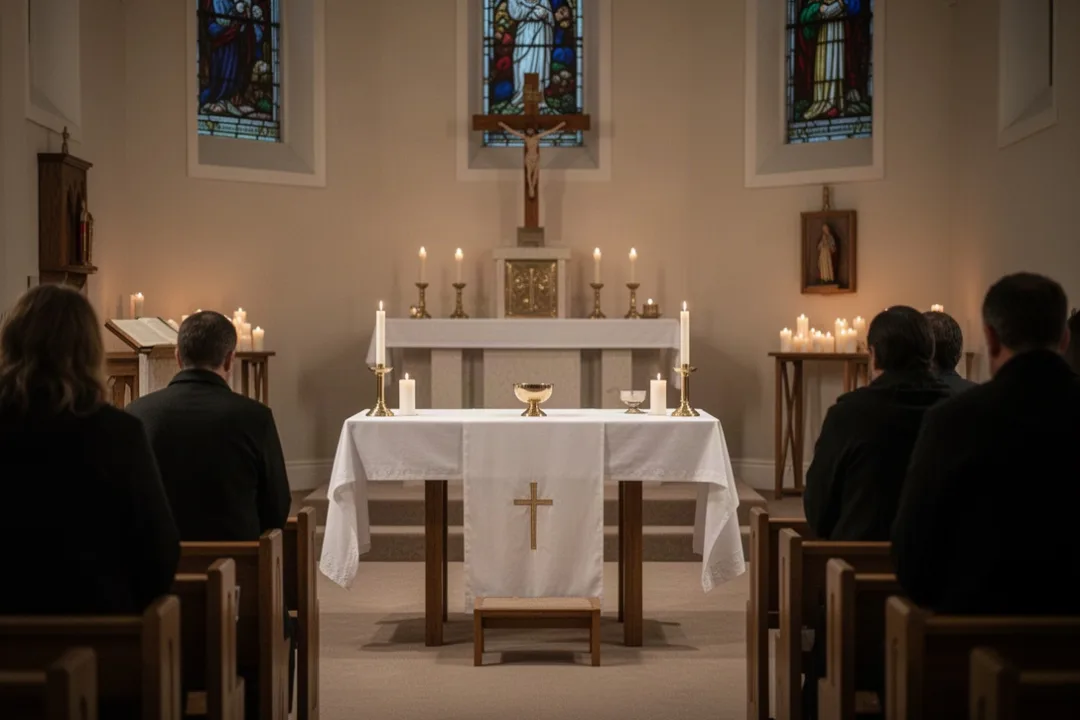
Many Holy Thursday services begin with a sense of celebration because they remember the Last Supper and the gift of the Eucharist. Churches may use music, candles, flowers, and white or other festive colors, depending on the tradition. The atmosphere then changes as the service recalls Jesus’ departure to pray and his approaching arrest.
In many Western churches, the Gloria is sung during the service, sometimes with bells. Afterward, the bells may remain silent until the Easter Vigil or Easter morning. The altar may be stripped of cloths and decorations, and the church may become quieter and more austere.
These customs are not universal, and local practice varies. Their purpose is to help worshipers experience the transition from the intimacy of the meal to the loneliness of Jesus’ Passion. The outward changes make visible the movement from celebration toward mourning.
Some congregations continue the service with a procession to an area set aside for prayer. Others conclude in silence. The service may end without a traditional dismissal because Holy Thursday is understood as the opening part of the single Triduum observance.
Why the mood changes: Holy Thursday does not end with the Last Supper. Its worship leads from Communion and service into Jesus’ prayer, betrayal, and arrest.
After the meal, Jesus goes with his disciples to the Garden of Gethsemane. There he prays in anguish before his arrest. The Gospel accounts show him facing suffering honestly while remaining committed to God’s will. This part of the story prevents Holy Thursday from becoming only a celebration of fellowship or religious tradition.
Gethsemane reveals the cost of faithful love. Jesus does not approach the coming suffering as though it were painless or insignificant. His prayer expresses distress, loneliness, and obedience. For Christians, this gives the day a particular meaning for people who are afraid, grieving, or facing circumstances they cannot control.
The disciples’ failure to remain awake also becomes part of the remembrance. Their weakness reflects the limits of human attention and courage. Holy Thursday can therefore be a time to examine how easily people overlook another person’s suffering, even when they intend to be supportive.
Many churches hold a prayer vigil after the evening service, recalling the disciples’ watch in Gethsemane. Worshipers may remain for a few minutes or several hours, praying quietly, reading Scripture, or sitting in silence. The practice encourages watchfulness and compassion rather than a hurried transition to the next activity.
How Holy Thursday connects with Christian ministry and priesthood
In Roman Catholic, Anglican, Lutheran, and some other traditions, Holy Thursday also has a connection with ordained ministry. Earlier on Holy Week, many dioceses celebrate a chrism or oils service in which the bishop and clergy gather, bless or consecrate oils for ministry, and renew their commitments. The timing and structure differ by denomination.
This connection comes from the Last Supper and Jesus’ commission to his disciples. The Eucharist is understood as central to the church’s life, and ordained ministers have a recognized role in presiding at it in traditions that maintain a sacramental priesthood. Holy Thursday can therefore emphasize both the ministry of the whole church and the responsibilities of clergy.
The day should not be reduced to a celebration of ministers, however. The foot washing story makes the standard for ministry clear: authority is meant to serve. Clergy, church officers, volunteers, parents, and every Christian are called to reflect Christ’s humility in the work entrusted to them.
Some churches celebrate the institution of the Eucharist and ordained ministry at the same service. Others give greater attention to the commandment of love or to the beginning of the Passion. These emphases reflect different traditions rather than entirely different meanings.
How different Christian traditions observe Holy Thursday
Holy Thursday is observed widely across Christianity, although the name, calendar, and worship practices may differ. Roman Catholic and many Protestant churches commonly hold an evening service that includes Communion and the reading of the Passion narrative. Foot washing may be included, and the altar or worship space may be changed afterward.
Eastern Orthodox and Eastern Catholic Christians usually call the day Holy and Great Thursday. Their services include distinctive hymns and prayers connected with the Last Supper, the washing of the disciples’ feet, and the betrayal of Christ. The date may differ from Western Easter because some Eastern churches calculate Easter using a different calendar method.
Some evangelical churches observe Communion on Holy Thursday, while others hold a special meal, teaching service, or prayer gathering. A congregation may use the evening to explain the Jewish setting of the Last Supper, although Christians should take care not to collapse distinct Jewish and Christian traditions into one observance.
Some denominations do not observe Holy Thursday as a formal holy day. Their members may still read the Last Supper accounts, attend a Good Friday service, or practice Communion at another time. The absence of a formal observance does not necessarily mean the events lack theological importance.
Practical ways to observe Holy Thursday thoughtfully
You do not need a formal church role to observe Holy Thursday. The most meaningful practices connect the day’s themes with real choices: sharing a meal, receiving Communion, serving someone quietly, or making time for prayer. The point is not to recreate every ceremony but to respond to the meaning behind it.
Attend an evening service. Look for a Holy Thursday, Maundy Thursday, or Holy and Great Thursday service at a local congregation.
Read the Last Supper accounts. Consider Matthew 26, Mark 14, Luke 22, John 13, and 1 Corinthians 11, paying attention to the different details each passage emphasizes.
Share a simple meal. Eat with family, friends, or members of your church while giving thanks and discussing how love becomes visible through service.
Perform an unrecognized act of service. Help with a task, visit someone who is isolated, prepare food, or support a practical need without seeking credit.
Make room for silence. Spend time in prayer for people who are afraid, grieving, imprisoned, displaced, sick, or facing violence.
Examine your relationships. Ask whether pride, resentment, or indifference is preventing you from treating someone with dignity.
Families with children can explain foot washing through a simple act of care, such as serving one another at dinner or completing a household task for someone else. The explanation should make clear that Jesus’ action was about humble love, not about forcing physical contact or making anyone uncomfortable.
Common mistakes people make about Holy Thursday
Because Holy Thursday includes several important themes, it is easy to misunderstand its purpose. A few distinctions help keep the observance focused and respectful.
Do not treat it as Easter Sunday. Holy Thursday begins the Triduum, but it does not celebrate the resurrection. Easter’s central celebration comes later.
Do not assume “Maundy” means mourning. The name comes from mandatum, meaning commandment or mandate.
Do not reduce it to the Last Supper alone. The foot washing, Gethsemane prayer, betrayal, and movement toward the cross are also essential.
Do not present one denomination’s customs as universal. Communion practices, foot washing, colors, bells, and prayer vigils vary among churches.
Do not turn foot washing into a performance. The gesture should communicate service and dignity, not embarrassment or pressure.
Do not confuse Christian Communion with Passover. The Last Supper took place in a Jewish context, but Christian Eucharist and Jewish Passover are distinct religious observances.
Do not overlook people who are suffering. The day’s message of love should lead to attention to practical needs, not only private reflection.
These distinctions help preserve both the historical setting and the spiritual purpose of the day. Holy Thursday is not about copying a ritual mechanically. It is about allowing the remembered actions of Jesus to shape how Christians worship and serve.
Questions Holy Thursday invites Christians to consider
The day raises questions that reach beyond a single service. What does it mean to receive Communion while refusing reconciliation? How can a church exercise authority without becoming controlling? Who is being overlooked, and what kind of service would meet that person’s actual need?
Holy Thursday also asks believers to hold together two truths: love can be joyful, and love can be costly. The Last Supper is a meal of fellowship, yet it occurs before betrayal and death. Christian discipleship includes gratitude and celebration, but it also includes patience, sacrifice, and presence during suffering.
For people who are not Christian, the day can still be understood as a significant part of Christian history and worship. Its central images—shared food, washing another person’s feet, staying awake with someone in distress, and choosing service over status—offer a clear picture of the values Christians associate with Jesus.
By the time Holy Thursday ends, the church has moved from table fellowship toward the cross. That movement explains why the day feels both celebratory and solemn. Its meaning rests in the conviction that self-giving love is at the heart of Christian faith and should be visible in the lives of those who follow Jesus.
Frequently asked questions
Is Holy Thursday a holy day of obligation?
That depends on the Christian denomination and, in some cases, the country. Roman Catholic holy days of obligation are established by church law and local bishops, and Holy Thursday is generally not included as a universal obligation to attend Mass. Many Catholics still attend because the evening liturgy begins the Easter Triduum and has exceptional spiritual importance.
What color is used on Holy Thursday?
Many Western churches use white or gold because the service celebrates the Eucharist and Christ’s love. The color may change later as the altar is stripped and the worship space becomes more solemn. Eastern Christian traditions follow their own liturgical customs, so colors are not identical in every church.
Can you receive Communion on Holy Thursday?
In churches that celebrate the Eucharist, Holy Thursday services commonly include Communion. Eligibility and preparation rules depend on the denomination. Some churches welcome baptized Christians who share their understanding of Communion, while others limit participation to members or require particular preparation. Visitors should follow the local congregation’s guidance respectfully.
Why are the church bells sometimes silent after Holy Thursday?
In some Western traditions, bells ring during the celebratory part of the Holy Thursday service and then remain silent until the Easter Vigil or Easter morning. The silence symbolizes the sorrow and gravity of Christ’s Passion. This is a local liturgical custom, not a practice followed by every Christian denomination.













Leave a Reply