Saint Michael: Who He Is and Why Christians Pray to Him
Saint Michael: Who He Is and Why Christians Pray to Him
When you feel spiritually unsettled, see Saint Michael named in a church, or hear someone pray for his protection, you may wonder who he is and what Christians actually believe about him. Saint Michael the Archangel is a heavenly messenger and protector honored in several Christian traditions. His name means “Who is like God?”, a question that points away from the angel himself and toward God’s unique authority.
Michael is not a human being who became an angel after death. He is presented in Scripture as a powerful angelic figure who serves God and stands against evil. Christians ask for his intercession and imitate his loyalty to God, while worship remains directed to God alone.
The name Michael comes from a Hebrew expression meaning “Who is like God?” It is commonly understood as a rhetorical question: no created being compares with God. The name therefore expresses humility, reverence, and resistance to pride.
Christian teaching describes angels as spiritual beings created by God. They do not have physical bodies like human beings, although the Bible and Christian art often use human imagery to communicate their role. Angels serve God, deliver messages, protect his people, and participate in the struggle between good and evil.
Michael is specifically identified as an archangel in the New Testament. The title suggests a leading or chief angel, although Scripture does not provide a complete ranking system for angels. It does show Michael acting with authority in the heavenly conflict and defending what belongs to God.
The word “saint” can sometimes cause confusion. In this context, Saint Michael is not called a saint because he lived a human life on earth or underwent human martyrdom. Christians honor him as a holy servant of God, just as they recognize the holiness of other faithful angels.
A helpful distinction: Christians do not worship Saint Michael. They honor him as God’s servant and may ask him to pray for them, while adoration belongs to God alone.
Michael’s role is closely associated with faithfulness, courage, justice, and protection. These qualities do not mean that Christians should seek conflict or imagine every difficulty as a supernatural attack. Rather, they point to a disciplined commitment to truth, goodness, and dependence on God.
What the Bible says about Saint Michael
Michael appears by name in several important biblical passages. Each reference contributes something different to the Christian understanding of his identity and mission. Scripture does not present a long biography of him; instead, it shows him in specific moments connected with spiritual authority and God’s purposes.
Michael in the book of Daniel
In the book of Daniel, Michael is described as a great prince who stands with and protects God’s people. Daniel’s visions use symbolic language about earthly kingdoms, heavenly conflict, and the future deliverance of God’s people. Michael appears within that setting as a defender rather than as an independent source of power.
Daniel 10 presents Michael as coming to assist another heavenly messenger during a conflict connected with spiritual forces. The passage is difficult and highly symbolic, so Christians should be cautious about turning every detail into a fixed explanation of invisible events. Its central emphasis is that God’s purposes are not defeated by opposition, even when the struggle is hidden from human sight.
Daniel 12 again connects Michael with a time of distress and with the protection of God’s people. The passage also speaks about resurrection and judgment. Michael’s presence reinforces the image of a heavenly guardian acting under God’s authority during a decisive moment.
Michael in the Letter of Jude
Jude 9 refers to Michael the archangel disputing with the devil over the body of Moses. The passage says that Michael did not pronounce a proud or personal condemnation; instead, he appealed to the Lord’s judgment. This detail is significant because it presents Michael’s strength together with restraint.
The verse does not encourage Christians to use sensational language or claim personal control over spiritual forces. It points toward humility before God’s judgment. Even a powerful angel does not act as though he were equal to God or entitled to make divine decisions independently.
Michael in the book of Revelation
Revelation 12 describes a battle in heaven involving Michael and his angels against the dragon, identified with the devil and Satan. The passage is filled with symbolic images, including a woman, a child, a dragon, and heavenly warfare. Christian interpretations differ on some details, but Michael clearly represents the victory of God’s side over evil.
The scene is not a license to treat ordinary people as enemies or to use religious language aggressively. Its focus is the defeat of accusation, rebellion, and opposition to God. For many Christians, Michael’s role in Revelation makes him a fitting figure for prayers asking for courage, protection, and perseverance in faith.
Taken together, these passages portray Michael as a defender of God’s people, a leader among the angels, and a servant who does not compete with God. They do not say that Michael replaces Christ, controls human destiny, or guarantees that believers will avoid suffering. His mission remains subordinate to God’s will.
Why Christians honor Saint Michael
Christians honor Saint Michael because he represents a faithful response to God in the face of evil. His biblical image combines strength with obedience. He is not admired for personal glory but for standing on the side of God’s truth.
For many people, Michael’s example is especially meaningful when they are facing fear, temptation, injustice, or spiritual confusion. Asking for his intercession can express a desire to remain steady rather than surrendering to panic. It can also remind you that courage is not the same as aggression.
Michael’s name carries a practical spiritual lesson. The question “Who is like God?” challenges the human tendency to treat power, money, status, ideology, or personal control as ultimate. A prayer associated with Michael can therefore become an examination of priorities: What has taken God’s place in my thinking, and where do I need humility?
Devotion to Saint Michael has also been connected with the protection of communities, churches, military personnel, police officers, first responders, and others who face danger or responsibility. These associations vary across cultures and traditions. They should be understood as expressions of prayer and symbolism, not as a promise that a particular group will never suffer harm.
Protection: asking for help to remain faithful and safe from spiritual harm.
Courage: seeking strength to resist fear, dishonesty, cruelty, and temptation.
Justice: remembering that evil should be opposed without hatred or revenge.
Humility: recognizing that all genuine authority comes from God.
Perseverance: continuing to choose what is good during prolonged difficulty.
Different Christian communities express this honor in different ways. Catholics may pray the Saint Michael Prayer, attend a Mass or liturgy connected with his feast, or use devotional practices such as a chaplet. Eastern Christians may honor Michael through liturgical celebrations, icons, hymns, and prayers. Other Christians may appreciate his biblical role without using formal prayers to angels.
Keep the focus balanced: A healthy devotion to Saint Michael leads you toward prayer, truth, humility, and responsible action. It should not encourage fear, obsession, superstition, or the belief that a formula works automatically.
Saint Michael’s feast day and major traditions
In the Roman Catholic calendar, Saint Michael is celebrated on September 29, together with Saints Gabriel and Raphael. The day is known as the Feast of the Archangels. Because all three are named in Scripture, the feast honors their different missions while directing attention to God, who sends and sustains them.
Michael, Gabriel, and Raphael are associated with distinct biblical roles. Michael is linked with spiritual defense and heavenly conflict. Gabriel is known as a messenger in the announcements surrounding John the Baptist and Jesus. Raphael appears in the book of Tobit as a guide, healer, and companion.
The way this feast is observed depends on local custom. A parish may celebrate a special liturgy, offer a homily about angelic service, organize a prayer service, or display an image of the archangel. Some people use the day to pray for protection over their families, workplaces, communities, or those serving in dangerous occupations.
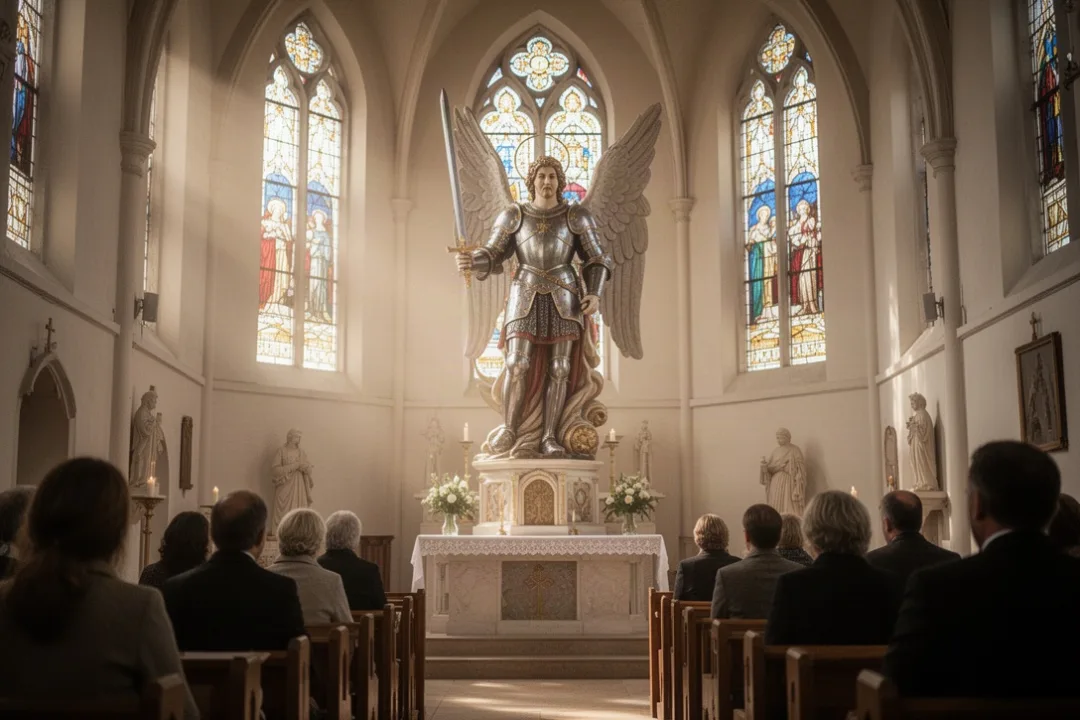
Churches and chapels dedicated to Saint Michael can be found in many parts of the world. His image often shows him with wings, armor, a sword, and a dragon. These symbols are artistic representations of his role in the biblical vision of spiritual conflict. They are not meant to provide a physical description of angels.
The sword commonly represents the power of truth and the defeat of evil. Armor suggests readiness and protection. The dragon represents Satan or the forces opposed to God, especially in connection with Revelation 12. Some images show Michael standing over the defeated dragon, emphasizing that evil does not have the final victory.
Christian art may also depict Michael holding scales. This symbol is associated with judgment and the weighing of human deeds, although the Bible passages that name Michael do not specifically identify him as the judge of individual souls. The image should not be confused with the Christian belief that final judgment belongs to God.
How to pray with Saint Michael’s example
Prayer to Saint Michael can be very simple. You may address God directly and ask for protection, then ask Saint Michael to intercede for you. The purpose is not to perform a magical act but to place your concerns before God with confidence and honesty.
A short prayer might ask God to strengthen you against evil and to help you follow truth, while requesting Saint Michael’s prayers for courage and protection. You can include a specific concern, such as a difficult decision, a threatening situation, a harmful habit, or anxiety about someone you love.
The well-known Saint Michael Prayer in Catholic devotion asks Michael to defend believers in spiritual battle and to resist the devil. Wording can vary by translation and prayer book. If you use it, focus on its central meaning rather than treating each phrase as a guaranteed shield.
A thoughtful prayer routine can include these steps:
Begin with God: acknowledge God as the source of life, truth, mercy, and protection.
Name the concern: describe what is frightening, tempting, confusing, or unjust without exaggerating it.
Ask for Michael’s intercession: request help to remain faithful, courageous, alert, and humble.
Choose a responsible response: consider what honest, safe, and compassionate action is needed.
End with trust: place the outcome in God’s hands and remain open to help from trustworthy people.
Prayer should not replace practical care. If you are in immediate danger, contact emergency services or move to a safe place. If fear, intrusive thoughts, or spiritual concerns are affecting your daily life, speak with a qualified mental health professional and a trusted religious leader rather than relying only on private rituals.
It is also wise to avoid people who claim special power to command angels, identify every problem as demonic, or demand money in exchange for spiritual protection. Christian prayer is not a transaction, and Saint Michael is not a tool that one person can control.
What Saint Michael can teach about spiritual warfare
The phrase spiritual warfare is used by Christians to describe the struggle against sin, deception, despair, injustice, and forces that pull people away from God. It does not require seeing every disagreement, illness, or inconvenience as a direct attack from the devil. A careful understanding keeps the language spiritual and moral without becoming fearful or accusatory.
Michael’s example emphasizes that evil should be resisted through loyalty to God, truth, humility, and perseverance. It does not support hatred toward people. Christian teaching generally distinguishes between opposing destructive actions and treating the person involved as beyond mercy or redemption.
Praying with Michael’s example may encourage you to identify the ordinary forms that spiritual harm can take. These may include persistent dishonesty, exploitation, resentment, addiction, contempt for vulnerable people, or the gradual loss of compassion. Such problems often require confession, boundaries, counseling, restitution, medical care, or community support alongside prayer.
Michael also offers a corrective to two opposite mistakes. One is to dismiss evil entirely and assume that every choice is harmless. The other is to become preoccupied with demons, hidden messages, or imagined supernatural threats. A balanced Christian response takes evil seriously while keeping God’s goodness, wisdom, and authority at the center.
Ask whether a belief or action produces truth, humility, and love.
Reject advice that encourages violence, hatred, isolation, or reckless behavior.
Seek counsel from mature and trustworthy people when a situation is unclear.
Use prayer alongside medical, psychological, legal, or safety support when needed.
Remember that spiritual strength can include asking for help and admitting limits.
Saint Michael’s biblical role is therefore more substantial than a decorative image or a protective slogan. He represents the conviction that evil is real but not ultimate, that God’s authority is greater than every rival power, and that faithful service requires both courage and humility.
Common symbols and ways to recognize Saint Michael
Images of Saint Michael often make his identity immediately recognizable. He may wear armor, carry a sword or spear, hold a shield, or stand above a dragon. Artists use these details to communicate his role as a heavenly defender and to connect him with the conflict described in Revelation.
His wings identify him as an angelic being, while the armor suggests readiness rather than earthly military status. The dragon is usually a visual representation of the devil or of evil defeated by divine authority. Some images show Michael with one foot placed on the dragon, expressing victory rather than a literal event that Christians are required to picture in exactly the same way.
In some traditions, Michael holds a banner or shield bearing a Christian symbol. Others show him lifting a sword toward heaven, which can suggest that his authority is received rather than self-created. Artistic details differ widely by region, period, and denomination.
When you see a church, medal, statue, or painting dedicated to Saint Michael, the most useful question is not whether the object has independent power. Ask instead what it is meant to recall: God’s protection, the defeat of evil, and the call to faithful courage.
Michael’s name directs the heart toward God: no power, created or human, is like God.
That message explains why Saint Michael continues to matter to Christians who are seeking protection without superstition and courage without aggression. He is honored as a servant of God, remembered through Scripture and worship, and invoked by many believers as an intercessor in times of fear or struggle.
Frequently asked questions
Is Saint Michael an angel or a human saint?
Saint Michael is an angel, specifically called an archangel in the New Testament. He is honored as a holy servant of God, which is why Christians use the title “Saint.” He was not a human being who became an angel after death. His role is to serve God and defend God’s people, not to receive the worship owed to God.
What is Saint Michael the patron saint of?
Patronage varies by country and tradition, but Saint Michael is widely associated with protection, courage, soldiers, police officers, first responders, and people facing spiritual or physical danger. These associations express prayerful support rather than a guarantee of safety. His broader example concerns resisting evil, remaining faithful, and acting with humility.
Can anyone pray to Saint Michael?
Practices differ among Christian denominations. Catholics and many Orthodox Christians honor Saint Michael and may ask for his intercession. Other Christians prefer to pray directly to God while appreciating Michael’s biblical role. In traditions that use such prayers, the request is directed to God through Michael’s intercession, not treated as magic or as worship of the angel.
Why is Saint Michael shown standing on a dragon?
The dragon symbolizes Satan or the forces opposed to God, especially in the imagery of Revelation 12. Michael standing over it represents the defeat of evil under God’s authority. The scene is symbolic religious art, not a reason to treat other people as monsters or enemies. Its message is spiritual courage, not permission for violence.















Leave a Reply