When you hear someone mention the four archangels, you may wonder which four they mean and where those names come from. In most conversations, the list is Michael, Gabriel, Raphael, and Uriel. The first three are named in the Bible, while Uriel comes from later Jewish and Christian writings and is recognized differently across religious traditions.
These figures are understood as powerful messengers and servants of God, not as independent gods or replacements for worship. Their names are associated with particular ways God’s help is described: protection, communication, healing, and wisdom. The exact roles assigned to them vary by denomination, scripture, and devotional tradition.
The commonly used list includes Michael the protector, Gabriel the messenger, Raphael the healer, and Uriel associated with wisdom and light. Their names come from different sources, so they do not all have the same level of biblical authority.
Michael appears in the Bible as a chief angelic figure who defends God’s people and opposes evil.
Gabriel appears as a messenger who explains divine revelations and announces significant events.
Raphael appears in the Book of Tobit, where he guides travelers and brings healing.
Uriel is named in certain Jewish and Christian apocryphal or pseudepigraphal writings, but not in the standard Protestant Bible.
The word archangel generally means a leading or chief angel. The Bible uses the term explicitly in a limited way, and Christian traditions do not always agree on how many archangels there are. Some traditions name only Michael as an archangel, while others use the title for several prominent angels.
Important distinction: Michael, Gabriel, and Raphael have different scriptural foundations from Uriel. Treating all four as equally named in every Bible can create confusion.
How to understand the four archangels step by step
If you are trying to understand the four archangels without mixing together scripture, tradition, and popular symbolism, use this sequence. It keeps the central ideas clear while leaving room for differences among churches.
Identify the source. Ask whether a name appears in the Bible, in an accepted deuterocanonical book, or in later religious literature.
Read the character’s actual story. A name’s traditional symbolism should be compared with what the source says the angel does.
Separate biblical teaching from devotional custom. Prayer cards, feast days, artwork, and folk traditions may add details not found in scripture.
Consider the denomination. Catholic, Orthodox, Anglican, Protestant, and Jewish traditions do not use identical lists.
Focus on the theological purpose. The angels point beyond themselves to God’s protection, message, healing, judgment, or wisdom.
This approach is especially useful when a book, church service, painting, or spiritual practice presents the four archangels as a fixed group. The group is widely recognized, but the list is not universally standardized.
Michael represents protection and faithful courage
The name Michael is commonly understood to mean “Who is like God?” It is framed as a question that emphasizes God’s uniqueness rather than Michael’s own greatness. In scripture, Michael is portrayed as a powerful heavenly defender who acts in service to God.
In the Book of Daniel, Michael is described as a chief prince who stands in support of God’s people. The passage presents him in the setting of spiritual conflict and national struggle. Michael is not depicted as an independent military deity; his authority remains subordinate to God.
In the New Testament letter of Jude, Michael disputes with the devil over the body of Moses. Even in that confrontation, Michael does not pronounce judgment by his own authority. Instead, he appeals to the Lord’s judgment, which reinforces the idea that angelic power is delegated rather than self-generated.
The Book of Revelation describes a heavenly battle in which Michael and his angels fight the dragon, identified with the devil and Satan. This scene has shaped centuries of Christian art, where Michael is often shown with armor, a sword, a shield, or a defeated dragon.
Michael’s traditional role therefore includes:
Defending God’s people against spiritual evil.
Standing for justice when evil appears powerful or overwhelming.
Leading heavenly forces in symbolic depictions of cosmic conflict.
Encouraging courage and fidelity during fear, temptation, or persecution.
Many Christians pray for Michael’s intercession when they feel threatened or when they are confronting serious moral and spiritual danger. This does not mean that Michael is believed to replace God’s protection. Rather, devotion to Michael presents him as a servant who helps direct the faithful toward trust, courage, and resistance to evil.
Gabriel represents divine messages and clear understanding
The name Gabriel is often interpreted as “God is my strength” or “strength of God.” Gabriel’s biblical appearances center on revelation: he helps people understand what God is communicating and announces events connected with salvation history.
In the Book of Daniel, Gabriel appears to Daniel and explains visions that Daniel does not understand. His role is not simply to deliver information. He also provides interpretation, helping a human being make sense of a difficult and symbolic revelation.
In the Gospel of Luke, Gabriel appears to Zechariah and announces the future birth of John the Baptist. Later, Gabriel appears to Mary and announces that she will give birth to Jesus. The account identifies Gabriel as a messenger sent by God, making him especially important in Christian reflection on the Annunciation.
Explaining visions or revelations that require interpretation.
Announcing births and callings connected with God’s purposes.
Supporting truthful communication and a receptive response to divine guidance.
Gabriel is frequently associated with communication, writing, broadcasting, teaching, and vocations that involve sharing information. Some of these associations are devotional extensions rather than direct biblical descriptions. The strongest scriptural theme remains revelation that demands attention and response.
Gabriel’s messages also show that divine communication can be unsettling. Zechariah is afraid, and Mary is troubled by Gabriel’s greeting. The biblical accounts do not present revelation as entertainment or mere prediction. They show people being asked to listen carefully, trust God, and accept a demanding responsibility.
Raphael represents healing, guidance, and safe travel
The name Raphael is commonly translated as “God heals” or “God has healed.” Raphael’s story is found in the Book of Tobit, which is included in Catholic and Orthodox Bibles but not in the standard Protestant canon. It is also known as a deuterocanonical book in Catholic tradition.
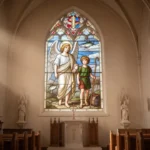
Raphael travels with Tobias, the son of Tobit, while concealing his identity as an angel. He helps Tobias complete the journey, gives him practical instructions, protects him from danger, and helps resolve the family’s suffering. Raphael’s guidance is active and personal rather than distant.
In the story, Raphael helps bring healing to both Tobit and Sarah. Tobit has suffered blindness, while Sarah has experienced repeated tragedy in her marriages. The narrative connects physical, emotional, relational, and spiritual restoration, making Raphael a natural symbol of healing in more than one sense.
Raphael’s traditional role includes:
Bringing healing to the sick and suffering.
Guiding travelers and protecting people on difficult journeys.
Supporting family restoration and reconciliation.
Helping people use practical remedies within a larger framework of faith.
The Book of Tobit does not portray Raphael as a substitute for physicians, responsible care, or human action. He gives instructions, Tobias follows them, and the healing unfolds through a combination of divine help and concrete obedience. That pattern has influenced Christian prayers for the sick, medical workers, travelers, and families facing distress.
Raphael’s place in the list also illustrates why religious context matters. A reader using only the Protestant Bible will not find Raphael by name, while a Catholic or Orthodox reader may know him from a canonical biblical book. The difference is about the boundaries of the biblical canon, not simply about whether one group has heard of the angel.
Uriel represents wisdom, light, and discernment
The name Uriel is often interpreted as “God is my light” or “light of God.” Uriel is not named in the standard Protestant Bible, and he is not included among the named archangels in the same way across all Christian traditions. His identity comes primarily from later Jewish writings and Christian apocryphal traditions.
Uriel appears in works such as 1 Enoch and 2 Esdras, although the role and status of these writings differ among religious communities. In these sources, Uriel is associated with explanation, heavenly knowledge, judgment, and illumination. He is often portrayed as a guide who helps people understand mysteries or recognize the consequences of their choices.
Because the name means “light of God,” later devotion commonly connects Uriel with wisdom, discernment, truth, and spiritual insight. Artwork may show him holding a book, a scroll, a flame, or a lamp. These symbols express his traditional meaning rather than a single universally accepted biblical description.
Uriel’s traditional associations include:
Illuminating difficult questions and confusing situations.
Encouraging wise judgment before a major decision.
Revealing truth and exposing self-deception.
Representing divine light in times of darkness or uncertainty.
Some Anglican and Eastern Christian sources recognize Uriel among a group of archangels, while many Protestant traditions do not include him in their regular worship. The Roman Catholic Church recognizes Michael, Gabriel, and Raphael as the three archangels named in its liturgical tradition and generally cautions against assigning names to angels beyond those found in approved scripture and tradition.
When you encounter Uriel: describe him as a traditional or apocryphal archangel, not as one of four names that every Christian Bible presents in the same way.
What the Bible says about archangels
The Bible contains many references to angels, but it provides fewer details about a formal ranking system than popular charts often suggest. Angels are presented as servants, messengers, worshipers, protectors, and participants in God’s purposes. Their descriptions are spread across different books and literary settings.
The term archangel appears explicitly in the First Letter to the Thessalonians, which refers to an archangel’s voice at the return of Christ. Jude calls Michael an archangel. Revelation gives Michael a leading role in heavenly conflict, although it does not provide a full list of archangels.
Gabriel is named in Daniel and Luke, but the passages do not use the title archangel in the same direct way. Raphael is named in Tobit, and Uriel is named in later writings outside the Protestant canon. These distinctions explain why a simple list can conceal substantial differences in authority and interpretation.
It is also helpful to remember that angelic names are not invitations to angel worship. Biblical passages consistently place angels in a servant role and direct worship toward God. Revelation, for example, includes a warning against worshiping an angelic messenger, emphasizing that the messenger is a fellow servant rather than the object of worship.
How Catholic, Orthodox, Protestant, and Jewish traditions differ
Christian traditions do not organize the four archangels in exactly the same way. The differences arise from the biblical canon, church teaching, liturgical practice, and the use of apocryphal writings.
Catholic tradition and the three named archangels
Catholic tradition gives a prominent place to Michael, Gabriel, and Raphael. These are the three archangels named in the Bible as recognized within the Catholic canon. Catholic churches may celebrate their shared feast on September 29, the Feast of the Archangels, while individual devotions also honor each one.
Uriel is not generally included in official Catholic devotion as a fourth named archangel. Catholic teaching has traditionally been cautious about adopting angelic names that do not appear in approved scripture. Private religious artwork or popular material may still mention Uriel, but that does not make him part of the same official list.
Eastern Orthodox tradition and a larger group
Eastern Orthodox tradition commonly honors a group of seven archangels, although lists and naming practices can vary. Michael, Gabriel, Raphael, and Uriel may appear alongside other names drawn from scripture and early religious writings. Orthodox calendars and iconography give these figures a broader collective presence than many Western Protestant settings.
The Orthodox approach often emphasizes the heavenly order and the angels’ service before God. An icon or prayer may include several archangels together, showing that the number four is not the only traditional arrangement.
Protestant traditions and biblical caution
Most Protestant traditions give primary attention to Michael and Gabriel, since they are named in the Protestant Old and New Testaments. Raphael is usually discussed as a character in the Apocrypha rather than as a figure from the Protestant canon. Uriel is generally treated as an apocryphal or extra-biblical figure.
Many Protestant teachers also avoid assigning detailed offices to angels unless the Bible clearly supports them. For that reason, a Protestant explanation may discuss Michael’s defense and Gabriel’s messages while treating the four-archangel list as a later tradition rather than a biblical doctrine.
Jewish sources and the role of Uriel
Jewish writings include several important angelic names and traditions, especially in texts connected with apocalyptic visions. Uriel appears in some of these writings as an angel of wisdom, interpretation, or heavenly knowledge. Jewish beliefs about angels are diverse, and the four-archangel list should not be presented as a universal Jewish teaching.
The Hebrew Bible names relatively few angels. Michael and Gabriel are named in Daniel, while other names arise in later Jewish literature. This historical development helps explain why Christian and Jewish angel traditions overlap in some places but differ in others.
Why angel names and roles matter to believers
People often seek information about the four archangels because they are praying for protection, looking for meaning in religious artwork, choosing a patron for a ministry, or trying to understand a family tradition. The names can offer a structure for reflection, but their value depends on how they are used.
Michael can prompt reflection on courage and resistance to evil. Gabriel can encourage careful listening and honest communication. Raphael can support prayer for healing, travel, and restored relationships. Uriel can symbolize wisdom when you need light for a difficult choice.
These associations are best understood as devotional symbols, not guarantees. Praying with an archangel’s traditional role does not promise a particular outcome, replace medical care, or provide secret knowledge. It can help focus attention on qualities that religious communities have long connected with God’s work.
For many Christians, the appropriate practice is to ask God for help while requesting the intercession of an angel. That distinction preserves the central belief that God is the source of protection, healing, wisdom, and salvation.
Common symbols associated with the four archangels
Religious art uses visual symbols to communicate an angel’s role quickly. The symbols are not uniform, and a specific object may vary by region or artist. Still, several associations are widely recognized.
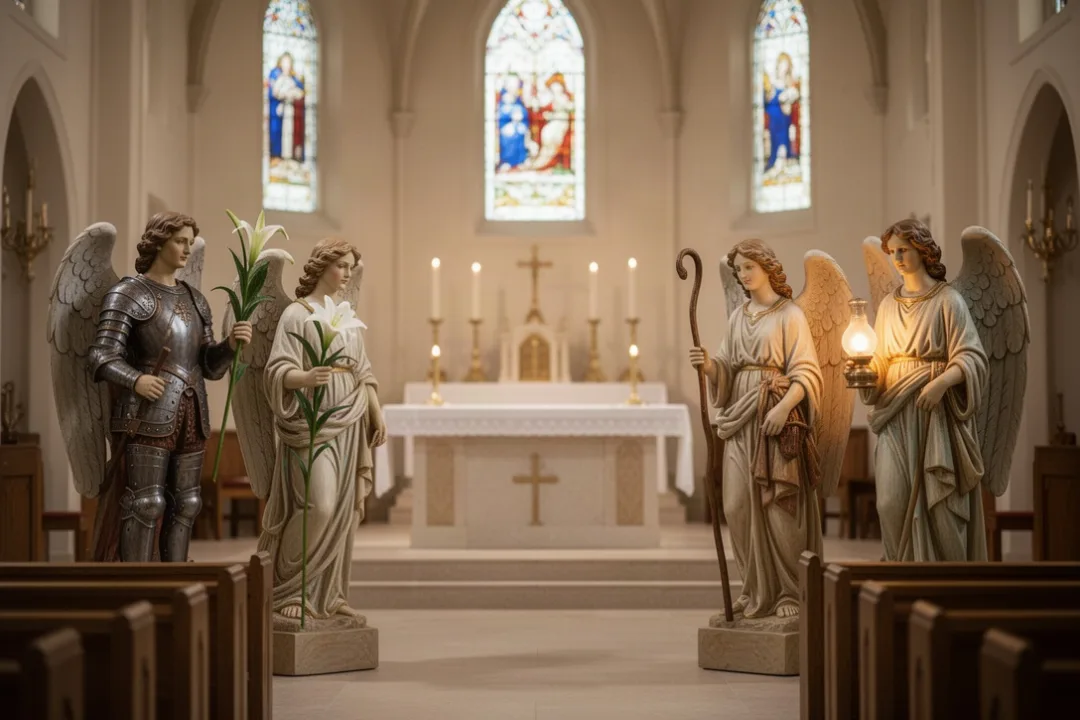
Michael: armor, sword, shield, scales, or a dragon beneath his feet. These symbolize spiritual defense, justice, and victory over evil.
Gabriel: a lily, trumpet, scroll, or staff. These suggest purity, proclamation, revelation, and the delivery of a divine message.
Raphael: a traveler’s staff, a fish, a small container, or Tobias beside him. These refer to the journey and healing story in Tobit.
Uriel: a book, scroll, flame, lamp, or radiant light. These symbolize wisdom, understanding, and illumination.
Artistic symbols should be read alongside the source behind them. A sword does not mean that Michael is a god of war, and a lamp does not prove that Uriel has a universally established biblical office. The image communicates a tradition that has developed through scripture, commentary, liturgy, and devotion.
How to research the four archangels responsibly
Online lists often combine Bible passages, medieval writings, occult systems, modern spirituality, and fictional material without identifying the differences. If accuracy matters, check each claim against the source that supposedly supports it.
Start with the biblical passage. Read the surrounding chapter rather than relying on a name’s popular description.
Check the canon. Find out whether the source is part of your church’s Bible, a deuterocanonical book, or a later writing.
Look for the exact role. Distinguish what the text says from an association added by later devotion.
Compare translations and traditions. Names, titles, and interpretations can differ between communities.
Be cautious with spiritual claims. A list that assigns angels control over days, planets, colors, or secret rituals may reflect a later esoteric system rather than mainstream biblical teaching.
This method does not require dismissing every noncanonical tradition. It simply helps you describe a belief honestly. You can appreciate Raphael’s place in Tobit or Uriel’s role in apocalyptic literature without claiming that every church accepts those sources in the same way.
How to pray with the traditional roles of the four archangels
Prayer practices differ, but a simple structure can help you use the traditional roles thoughtfully. Begin by addressing God, then name the concern that is on your mind. If your tradition permits prayers for angelic intercession, ask the relevant archangel to pray with or for you rather than treating the angel as a divine power.
For protection: ask God for courage and safety, with Michael’s traditional example of faithful defense in mind.
For communication: ask for honesty, attentiveness, and wisdom, reflecting Gabriel’s role as a messenger.
For healing: pray for the sick, caregivers, and wise treatment, drawing on Raphael’s association with restoration.
For discernment: ask for clarity, humility, and sound judgment, using Uriel’s traditional symbolism of divine light.
Prayer should remain connected to responsible action. Seek medical attention for illness, consult trusted advisers for serious decisions, and address danger through appropriate practical help. Religious symbolism can focus your intentions, but it should not encourage you to ignore professional care or ordinary responsibilities.
Are the four archangels the same as guardian angels?
The four archangels are not the same as guardian angels. In Christian teaching, archangels are usually understood as prominent heavenly servants with broad roles in God’s purposes. A guardian angel, by contrast, is traditionally associated with protection and guidance for an individual person.
These categories are not explained with complete uniformity across all churches. Some traditions describe ranks or orders of angels, while others avoid detailed hierarchies. Even where the distinction is accepted, the Bible does not provide a full organizational chart showing exactly how every angelic being relates to every other one.
Michael, Gabriel, Raphael, and Uriel may be honored as leading angels, but that does not mean each person has one of them as a personal guardian. Those are separate ideas that popular writing sometimes combines.
What the four archangels ultimately point toward
The four archangels are best understood as a meeting point between scripture, religious tradition, and symbolic devotion. Michael points to faithful resistance against evil; Gabriel to God’s message; Raphael to healing and guidance; and Uriel to wisdom and light. Their individual stories are not interchangeable, and their recognition differs across communities.
The most accurate short answer is this: Michael, Gabriel, Raphael, and Uriel are the four names most often meant by the phrase, but only Michael, Gabriel, and Raphael have strong recognition in major Christian scriptural or liturgical traditions, while Uriel belongs mainly to later Jewish and Christian writings. Understanding that difference lets you explore the tradition with both respect and precision.
Frequently asked questions
Are all four archangels named in the Bible?
No. Michael and Gabriel are named in the Protestant Bible. Raphael is named in Tobit, a book accepted as scripture by Catholic and Orthodox Christians but not by most Protestants. Uriel is named in later Jewish and Christian writings rather than in the standard biblical canon used by most churches.
Which archangel is associated with healing?
Raphael is traditionally associated with healing because of his role in the Book of Tobit. In that story, he helps bring healing to Tobit and Sarah and guides Tobias during a difficult journey. Christians may ask for Raphael’s intercession for the sick, while still relying on medical care and practical support.
Why is Uriel sometimes left out of lists of archangels?
Uriel does not appear in the standard Protestant Bible and is not one of the three archangels officially emphasized in Catholic devotion. His name comes from later Jewish and Christian writings. Some Orthodox and Anglican traditions recognize him, so whether he appears depends on the religious community and its sources.
Can Christians pray directly to the archangels?
Practices vary by denomination. Catholic and Orthodox Christians may ask archangels to intercede, meaning they request the angel’s prayers while directing worship to God. Many Protestant Christians prefer to pray only to God and may treat archangels as biblical figures rather than devotional intercessors. The distinction between honoring an angel and worshiping one is central.











Leave a Reply