The word saint comes from a term meaning “holy” or “set apart.” In the broadest Christian sense, a saint is a person who belongs to God and seeks to live according to God’s purposes. The New Testament sometimes uses the word for the whole community of believers, not only for especially famous or formally recognized individuals.
In everyday Christian speech, however, “saint” usually means a person remembered for extraordinary holiness, courage, service, prayer, or faithfulness. These men and women may have been missionaries, teachers, monks, parents, reformers, artists, caregivers, rulers, or people who endured persecution. Some lived publicly, while others served quietly and left few historical records.
Different Christian traditions use the word in different ways. The Catholic Church and Eastern Orthodox churches formally recognize many saints and ask for their prayers. Many Anglican churches also honor saints. Most Protestant communities emphasize the “saints” as all faithful Christians while giving less attention to formal canonization or asking saints for intercession.
Central idea: Christians do not worship saints as gods. Saints are honored because their lives point beyond themselves to God.
Why Christians honor saints
Honoring a saint is meant to be an act of respect and remembrance, not divine worship. Christians may study a saint’s life, celebrate a feast day, display an image, visit a shrine, or ask the saint to pray for them. The purpose is to recognize God’s work in that person and to encourage faithful living.
Many Christians find saints helpful because they show how faith can be lived under real conditions. A saint may have faced poverty, illness, political pressure, family responsibilities, violence, doubt, or moral failure. Their stories make holiness concrete rather than presenting it as an abstract ideal.
Saints also represent the worldwide and historical nature of Christianity. They come from different centuries, cultures, languages, and social backgrounds. A person may look to a particular saint because of shared work, nationality, life experience, concern for the poor, or commitment to a specific spiritual practice.
Honoring saints does not mean believing that every detail in a traditional story has been proven. Some accounts contain reliable historical information alongside later legends or symbolic details. Responsible devotion can appreciate a saint’s spiritual meaning while recognizing that historical evidence varies.
How saints appear in the Bible and early Christianity
In the Bible, the word “saints” often refers to people who are devoted to God. For example, letters attributed to Paul address Christian communities as saints, meaning members of the holy people, even though those communities also had serious conflicts and weaknesses. This usage shows that Christian holiness is not limited to people with biographies, statues, or feast days.
The Bible also presents specific figures as examples of faith. Abraham, Moses, the prophets, Mary, the apostles, and many others are remembered for trusting God and serving a particular calling. Hebrews 11 describes a long line of faithful witnesses; the passage emphasizes perseverance rather than presenting its subjects as flawless heroes.
The earliest Christians remembered martyrs in a special way. A martyr is someone who dies because of loyalty to the Christian faith. Communities preserved accounts of these deaths, gathered for prayer, and marked anniversaries of the martyrs’ deaths. Their witness was understood as a sign of faithfulness and hope in eternal life.
As Christianity spread, Christians also began honoring people who demonstrated holiness through prayer, teaching, care for the vulnerable, missionary work, or disciplined communal life. Over time, local communities developed traditions around these figures, and churches created more formal methods for recognizing them.
What makes someone a saint in different traditions
There is no single process shared by every Christian denomination. The meaning of recognition depends on the church and its theology. A helpful breakdown is:
Broad biblical usage: All faithful Christians may be called saints because they belong to God.
Local recognition: A Christian community may honor a person whose life had a lasting spiritual influence.
Liturgical recognition: A church may include a person’s name in its calendar and celebrate a feast day.
Formal canonization: A church may investigate a person’s life and officially declare that person a saint.
Martyrdom: In some traditions, dying for the faith carries particular significance in the recognition process.
These categories can overlap, but they are not identical. Someone may be widely respected as a holy person without being formally canonized. A person can also be officially recognized in one Christian tradition while receiving little attention in another.
How the Catholic Church recognizes saints
In the Catholic Church, canonization is a formal process that examines a person’s life, writings, reputation for holiness, and, in many cases, reported miracles. The process usually begins at the local level after the person’s death. A local bishop gathers evidence and may ask the Vatican to allow a formal investigation to proceed.
A person under investigation is often called a Servant of God. The investigation considers testimony, documents, personal writings, and the person’s conduct. Church officials look for evidence of a consistent life of Christian virtue, rather than a single admirable act.
If the evidence supports recognition of heroic virtue, the person may be declared Venerable. This title indicates that the church recognizes an exceptional pattern of Christian virtue, but it does not yet mean that the person is available for universal public veneration as a saint.
A person may then be declared Blessed, a stage commonly called beatification. For many non-martyrs, this requires evidence of a miracle attributed to the person’s intercession after death. Martyrs may follow a different path because their death for the faith is treated as a distinctive witness.
Canonization is the formal declaration that the person is a saint. In Catholic teaching, this means the person is worthy of universal veneration and is with God. Canonization does not mean the person never made a mistake or had an easy life. It means the church judges that the person’s life offers a trustworthy example of holiness.
Claims of miracles receive separate investigation. Medical experts, theologians, and church authorities examine the evidence according to the procedures used by the church. The process can take many years, and not every proposed cause reaches canonization.
Important distinction: Canonization is not the same as declaring that a saint was morally perfect. It is a formal recognition of a life marked by faithful Christian virtue.
How Orthodox and other churches recognize saints
Eastern Orthodox churches honor saints through worship, feast days, icons, hymns, biographies, and prayers. Recognition often develops through the church’s experience of a person’s holiness and the lasting devotion of the faithful. Synods or other church authorities may later confirm that recognition for wider liturgical use.
Orthodox Christianity places strong emphasis on the communion of saints, meaning the unity of Christians living on earth with those who have died in faith and are with God. Icons are not treated as ordinary portraits or as gods. They are used as windows toward prayerful remembrance and as visual declarations that God has worked through human lives.
Anglican churches may observe feast days for biblical figures and historic saints, and some also recognize more recent holy people. Practices differ among Anglican provinces and congregations. Lutheran, Methodist, Presbyterian, Baptist, and other Protestant communities may honor historical Christians as examples without using a formal canonization process.
Some Protestant Christians avoid asking saints to pray for them because they believe prayer should be directed only to God or because they do not find a clear biblical basis for invoking departed believers. Others appreciate the idea of the communion of saints while expressing it through remembrance rather than direct intercession.
What saints do for Christians
Saints serve several roles in Christian life. These roles are connected, but they should not be confused with the belief that saints possess divine power independently of God.
Examples: Their choices show what courage, compassion, repentance, discipline, and trust can look like in practice.
Teachers: Their writings, sermons, art, and spiritual practices help Christians understand prayer, Scripture, justice, and discipleship.
Intercessors: In Catholic and Orthodox practice, Christians may ask saints to pray to God for particular needs.
Witnesses: Martyrs and other saints demonstrate faithfulness under pressure and remind believers that Christianity has a long history.
Companions: Their stories can help people feel connected to a wider community of believers across time and place.
Patrons: Some saints are associated with occupations, places, causes, illnesses, or situations, giving people a particular figure to remember in prayer.
When Christians ask a saint to pray, they are not necessarily replacing prayer to God. The practice is similar to asking another Christian to pray, except that the person being asked is believed to be living with God. Christians who reject this practice usually still agree that the faithful departed should be remembered with gratitude.
Saints, worship, and the difference between honor and adoration
A major point of Christian teaching is the difference between worship owed to God and honor given to holy people. In Catholic theology, worship or adoration belongs to God alone. Saints may be honored, and Mary receives a distinctive form of honor because of her role as the mother of Jesus, but neither saints nor Mary are understood to be divine.
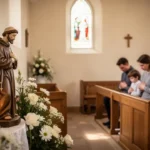
Outward actions can sometimes look similar. A person may kneel before an icon, light a candle, kiss a relic, or bow before a statue. The meaning of the action depends on the church’s teaching and the intention of the person. A candle may express prayer and remembrance rather than belief that the object itself has supernatural power.
Christians have also criticized abuses connected with the veneration of saints. Concerns may involve superstition, treating objects as magical, exaggerating legends, or allowing devotion to distract from care for neighbors. Healthy Christian devotion keeps God, love of neighbor, and moral transformation at the center.
Why Mary is honored differently from other saints
Mary, the mother of Jesus, holds a unique place in Christian tradition. Catholic, Orthodox, and many Anglican Christians honor her because she gave birth to Jesus and is portrayed in the Gospels as responding faithfully to God’s call. She is often called the greatest of the saints, but she is not considered God.
Different churches teach different things about Mary’s holiness, lifelong virginity, assumption into heaven, and role in Christian prayer. Some Protestant communities honor her as Jesus’ mother and an example of faith but do not accept all later Marian doctrines or devotional practices.
Marian devotion may include prayers, feast days, hymns, icons, and pilgrimages. Catholics and Orthodox Christians may ask Mary to pray for them, while maintaining that God alone is the source of salvation and divine grace. The differences among churches are significant, so explanations should avoid treating all Christians as having the same beliefs about her.
What feast days and patron saints mean
A feast day is a day set aside to remember a saint or an important event connected with Christian faith. The date may mark a death, martyrdom, dedication of a church, discovery of relics, or another event associated with the person. In many traditions, a saint’s death is viewed as a birth into eternal life, so the anniversary can become the principal day of remembrance.
Feast days may be observed during worship or through private prayer. A congregation might read a saint’s biography, sing hymns, hear a sermon, or celebrate the Eucharist. In some cultures, families and communities hold processions, prepare traditional foods, visit churches, or carry out charitable work connected with the saint’s example.
A patron saint is a saint associated with a person, place, occupation, group, or special need. The association may come from the saint’s work, life story, location, a reported event, or a long-standing tradition. Choosing a patron can give a person a focused example and a reminder to pray for a particular concern.
Patronage should not be understood as a guarantee that a saint will produce a desired result. It is better understood as a relationship of remembrance and prayer. For example, a person who honors a saint associated with care for the sick might also be encouraged to visit patients, support caregivers, or contribute to practical help.
Relics, icons, and sacred images
A relic is an object connected with a saint, such as a physical remains, clothing, writing, or item associated with the person. Catholic and Orthodox Christians may honor relics as tangible reminders of a saint’s life and the Christian belief in the resurrection of the body. The relic itself is not considered a god.
Icons and other sacred images serve a similar function in traditions that use them. They help worshipers remember Christ, Mary, angels, and saints. An icon is not simply a decorative portrait; it has a place within a visual language of prayer and worship.
Churches have established rules and practices to prevent deception and misuse. Questions about authenticity can arise because historical records are incomplete and multiple places may claim to possess objects connected with the same saint. A thoughtful approach distinguishes devotional value from certainty about an object’s historical identity.
How to learn from a saint’s life responsibly
Reading about a saint can be spiritually useful, but it helps to approach biographies with care. Older stories may include miracles, visions, dramatic conversions, or symbolic episodes that were recorded long after the events. These accounts can express what a community believed about a person without providing modern historical proof for every detail.
Start with the person’s historical setting. Learn where and when the saint lived, what social pressures existed, and what kind of Christian community shaped the person.
Read more than one reliable account. Compare a traditional biography with historical research or the person’s own writings when available.
Look for the central virtue. Ask whether the person is remembered for mercy, courage, prayer, justice, learning, service, or repentance.
Separate example from imitation. You can follow a saint’s faithfulness without copying every custom, hardship, or historical practice.
Connect admiration with action. Turn the lesson into a practical response, such as forgiving someone, helping a neighbor, or setting aside time for prayer.
Saints should not be used to excuse harmful behavior. A person may have been honored for spiritual qualities while also reflecting the limitations of a particular era. Good historical judgment allows you to appreciate genuine courage and still examine difficult issues honestly.
No. Christian traditions generally do not require saints to have lived without any mistake, weakness, or uncertainty. Saints are understood as people who responded to God’s grace, grew in holiness, and remained faithful through their particular circumstances.
Some saints are remembered for dramatic conversion after serious wrongdoing. Others struggled with fear, anger, illness, doubt, conflict, or poor judgment. Their stories often include long periods of ordinary work rather than constant religious intensity. This matters because it shows that holiness is associated with faithfulness and transformation, not an unrealistically flawless personality.
The title “saint” also does not mean that every opinion held by that person is accepted by the church. A saint may have written about issues outside their expertise or reflected the assumptions of their time. Recognition focuses on the person’s relationship with God and witness to Christian virtue, not automatic approval of every statement.
Can ordinary people become saints?
In the broad Christian meaning, ordinary believers are already included among the saints. In traditions with formal recognition, an ordinary person may also become a candidate for sainthood. The person does not need to be famous, wealthy, educated, or publicly influential.
Many recognized saints lived through ordinary responsibilities: raising children, working, caring for relatives, teaching, farming, serving in a local church, or enduring illness. Their holiness was expressed through repeated acts of patience, honesty, forgiveness, prayer, and love.
Formal recognition is not the goal of Christian discipleship. Most holy people are never canonized and may never be known beyond their family or community. Their faithfulness can still matter deeply, because Christian traditions teach that God sees and values acts of love that receive little public attention.
How saints connect to Christian hope
Saints are connected to Christian teaching about resurrection and eternal life. They are remembered not merely as people from the past but as members of a living communion with God. This belief gives remembrance a forward-looking character: the lives of the saints point toward the hope that death does not have the final word.
The communion of saints also links generations. Christians worship with words, songs, Scriptures, and practices shaped by people who lived long before them. Remembering saints can create gratitude for that inheritance while challenging believers to hand on faith through their own choices.
The most useful question is not only, “Who was this saint?” It is also, “What did this person’s life reveal about Christian love, and how might that lesson shape the way I live?” That question keeps saintly remembrance connected to its central purpose: directing attention toward God and toward faithful love of other people.
Frequently asked questions
Do all Christians believe in saints?
Christians generally agree that faithful people can be called saints in the biblical sense, but denominations differ over formal recognition and prayer. Catholic and Orthodox Christians have established traditions of honoring named saints and asking for their intercession. Many Protestants use “saints” for all believers and honor historic Christians mainly as examples rather than addressing prayers to them.
Is a saint the same as an angel?
No. A saint is a human being who lived and died as a faithful Christian. An angel is a spiritual being created by God, not a human who became an angel after death. Christian traditions may honor both saints and angels, but they understand them as different kinds of beings with different roles.
Why do some saints have special symbols?
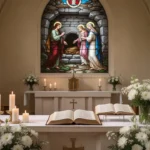
Symbols help identify saints in paintings, sculptures, and stained glass. They may refer to the person’s occupation, a major event in the person’s life, a martyrdom story, or a distinctive teaching. These symbols are visual reminders of the person’s witness, not objects that give the saint supernatural power.
Can a person pray directly to God and still honor saints?
Yes. Catholic and Orthodox Christians commonly pray directly to God while also asking saints to pray for them. They understand the saint’s intercession as dependent on God, not as a competing source of power. Christians who do not ask saints for intercession can still respect their examples and remember their contributions to the church.













Leave a Reply