Catholic saints: who they are and why Catholics honor them
Catholic saints: who they are and why Catholics honor them
You may have seen a saint’s name on a church, school, medal, or calendar and wondered: Who are Catholic saints, and why do Catholics pray with them? In Catholic teaching, saints are people who lived in close friendship with God and now share eternal life with him. Catholics honor their example and ask them to pray for the Church, while worship belongs to God alone.
Saints are not presented as flawless superheroes. Many faced fear, grief, illness, temptation, injustice, or serious mistakes before turning more fully toward God. Their lives show how ordinary human beings can respond to grace in very different circumstances, from family life and professional work to missionary service, religious vows, care for the poor, and courageous suffering.
The word saint comes from a term meaning “holy.” In the broadest Catholic sense, all people who belong to Christ and seek holiness are called to become saints. The Church also uses Saint as a title for a person whose holiness has been formally recognized and whose name may be proposed for public veneration.
That formal title does not mean that only canonized people are with God. Catholic belief includes the communion of saints: the spiritual bond uniting the faithful on earth, the souls being purified after death, and those already enjoying the presence of God in heaven. The canonized saints are known examples within this much larger community.
Saints come from many periods, cultures, countries, and walks of life. Some were bishops, priests, monks, or nuns. Others were parents, rulers, teachers, physicians, artists, workers, children, or laypeople who served God in the middle of ordinary responsibilities.
Martyrs gave their lives rather than deny their faith.
Confessors are saints who bore witness to Christ without dying as martyrs.
Virgins and religious saints dedicated their lives to prayer, service, and consecration.
Lay saints pursued holiness through marriage, work, family life, public service, or charitable action.
Doctors of the Church are saints whose teaching has made an especially important contribution to Catholic theology and spiritual life.
These categories describe patterns in a saint’s life; they do not rank one form of holiness above another. A person becomes holy by loving God and neighbor, not by receiving a particular title or performing an impressive public role.
Why Catholics honor saints but worship God alone
A central Catholic distinction is between worship and veneration. Worship, called latria in Catholic theology, is given only to the Holy Trinity: God the Father, Son, and Holy Spirit. Saints receive honor, called dulia, because God’s grace was active in their lives. Mary receives a unique form of honor because of her role as the mother of Jesus, but she is still a creature and is not worshiped.
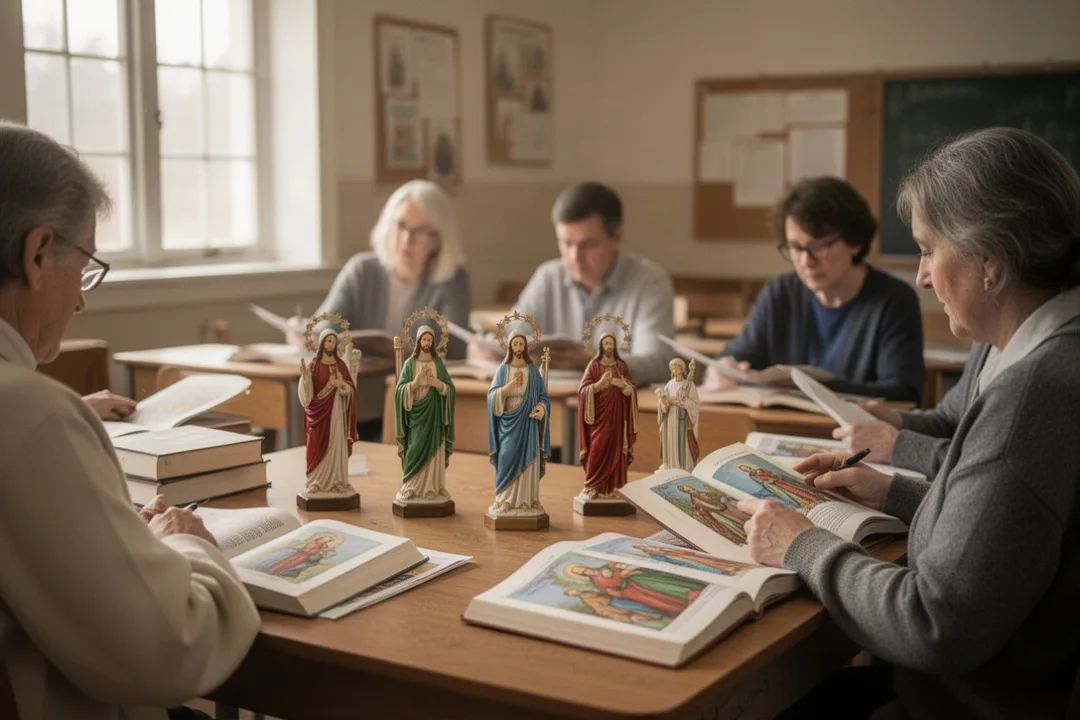
Honoring a saint is similar to respecting a faithful Christian mentor, except that Catholics believe the saints are alive with God and can pray for the Church. A statue, icon, medal, or feast day is not treated as a god. It points beyond the material object to the person represented and, ultimately, to God who made that person holy.
The basic distinction: Catholics worship God, honor the saints, and ask the saints to pray for them. A saint’s holiness is understood as a reflection of God’s grace, not as an independent source of divine power.
This distinction also explains why Catholic prayer to a saint may sound different from prayer directed to God. When Catholics say, “Saint Peter, pray for us,” they are asking for intercession. They are not asking Saint Peter to replace God, create a miracle by his own authority, or give the worship that belongs to God.
How saints point Catholics toward Jesus Christ
For Catholics, the purpose of devotion to the saints is to deepen relationship with Christ, not to create a separate spiritual system. The saints are understood as members of Christ’s body, and their lives show different ways of responding to the Gospel. Their courage, charity, humility, and repentance are meant to lead believers back to Jesus.
Saint Francis of Assisi is associated with poverty, peace, and care for creation. Saint Monica is remembered for persistent prayer for her family. Saint Joseph is honored for quiet responsibility and faithful protection. Saint Thérèse of Lisieux emphasized small acts of love. These examples differ, but each reflects a life oriented toward Christ rather than toward personal fame.
The saints also show that holiness is not limited to one personality type. A person who is naturally contemplative may learn from a prayerful saint, while someone drawn to public service may find encouragement in a saint who worked for justice or cared for the sick. Their lives can broaden a person’s understanding of what Christian discipleship looks like.
“Blessed are the merciful” (Matthew 5:7) expresses the kind of holiness Catholics see in saints: lives shaped by mercy rather than self-interest.
Bible passages such as Hebrews 12:1, which describes a great cloud of witnesses, and Revelation 7:9, which portrays people from every nation before God, are commonly associated with the Catholic understanding of the saints. Catholics read these passages alongside the Church’s wider teaching about the communion of believers in Christ.
How the Catholic Church recognizes a saint
Canonization is the Church’s formal process for declaring that a deceased Catholic is in heaven and may be proposed for public veneration throughout the Church or in a particular setting. It is not a process that makes a person holy. Rather, it investigates whether the person’s holiness and reputation are well founded.
The process often begins at the local level after the person’s death, usually when there is a sustained reputation for holiness. A diocesan inquiry gathers documents, testimony, writings, and other evidence about the person’s life, virtues, death, and reputation. The person may then receive the title Servant of God.
If the inquiry is accepted for further consideration, the person may be called Venerable. This indicates that the Church has recognized a life of heroic virtue or, in the case of a martyr, a death freely endured for the faith. Venerable does not yet mean that the person has been beatified or canonized.
The next stage is beatification. A person declared Blessed may generally be honored in a limited area, religious community, or group connected with that person. For a non-martyr, the process normally requires evidence of a miracle attributed to the person’s intercession after death. Martyrs may follow a different path because their witness is centered on giving their lives for the faith.
Canonization usually requires another recognized miracle for a non-martyr after beatification. The investigation of a possible miracle typically examines medical facts, timing, scientific explanations, and the connection between the prayer and the claimed healing. The Church’s judgment concerns whether the event is unexplained by natural causes and linked to the candidate’s intercession.
Local inquiry: A diocese or appropriate Church authority gathers evidence about the person.
Roman review: The case is examined by the Vatican’s office responsible for causes of saints.
Recognition of heroic virtue or martyrdom: The person may be declared Venerable.
Beatification: The person is declared Blessed under the conditions established for the case.
Canonization: The pope formally declares the person a saint for the universal Church.
Canonization does not mean that every detail of a saint’s biography is approved as perfect. Some saints lived in cultures with customs, political assumptions, or personal limitations that Catholics today may question. The Church’s formal claim concerns the person’s holiness and place with God, not the claim that every decision or opinion in the person’s life should be copied.
What Catholics mean when they ask a saint to pray
When Catholics ask a saint for intercession, they are asking that saint to bring a prayer or need before God. Christians already ask friends and family on earth to pray for them; asking a saint is understood as an extension of that practice, based on the belief that death does not destroy the unity of the Church in Christ.
A prayer might say, “Saint Jude, pray for me,” or “Saint Monica, pray for my family.” The wording acknowledges the saint as an intercessor rather than the source of grace. Catholics may also ask Mary, angels, or other saints to pray, while directing their ultimate trust and worship to God.
Intercession should not be treated as a spiritual transaction. A medal, novena, or particular saint does not force God to grant a request. Catholic prayer includes the willingness to accept God’s wisdom, seek appropriate help, and act responsibly rather than waiting for a supernatural solution to every problem.
For example, someone praying to Saint Peregrine for a person with cancer may also support that person emotionally, follow medical advice, ask others to pray, and seek pastoral care. Prayer and practical action are not competing choices. Catholic spirituality generally treats compassionate action as part of faithful prayer.
How saints are represented in Catholic art and worship
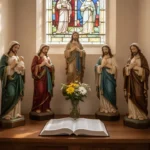
Churches often use statues, paintings, icons, stained glass, and symbols to help worshipers remember the saints. A key, for example, may identify Saint Peter; lilies may be associated with purity; a wheel may point to Saint Catherine of Alexandria; a book may suggest teaching or Scripture. These symbols help tell a story without making the artwork an object of worship.
Relics are physical remains or objects associated with a saint. They may include a portion of bodily remains, clothing, or another item connected with the person. Catholic practice classifies relics in different ways, and authentic relics are handled according to Church rules. A relic is respected because of its relationship to a saint, not because matter has magical power.
The Church’s sacraments and liturgy remain more important than private devotion to any individual saint. A saint’s feast day may be celebrated with Mass, readings, prayers, or local customs, but the Eucharist is worship of God. Devotional practices should support participation in the Church’s sacramental life rather than replace it.
Avoid magical thinking: A statue, relic, medal, or prayer card is not a charm. Catholic devotion depends on faith in God and a life of charity, not on treating sacred objects as automatic protection.
How feast days and patron saints work
A saint’s feast day is a day on the Church calendar connected with that saint’s memory. It may mark the person’s death, which Christians often understand as a birth into eternal life, or another significant event. The importance of a feast varies: some celebrations are observed throughout the universal Church, while others are local or connected with a religious community.
A patron saint is a heavenly intercessor associated with a person, place, profession, illness, cause, or activity. Catholics may choose a patron because the saint’s life speaks to their circumstances. A patron is not a guarantee of success and does not replace personal responsibility. The relationship is meant to inspire prayer and imitate good qualities.
People may be connected with a patron saint through a baptismal name, confirmation name, family tradition, parish, country, occupation, or a particular need. Someone starting a demanding vocation might study a saint known for perseverance. A student may choose a saint associated with learning. A family may honor a saint whose life reflects its hopes or struggles.
Patronage can develop through history and popular devotion, and not every association has the same official status. Some are formally recognized by the Church; others are longstanding local customs. If the distinction matters, consult a reliable Catholic parish, diocese, or reference work rather than assuming that an internet list is authoritative.
Different kinds of Catholic saints and what they can teach
Martyrs who remained faithful under persecution
Martyrs are remembered for accepting death rather than renouncing Christ. Their witness is not an invitation to seek danger or provoke conflict. It is a testimony to the depth of faith and to the conviction that loyalty to God can remain firm under extreme pressure.
Founders and reformers who renewed Christian life
Some saints founded religious communities, renewed existing institutions, or called the Church to deeper prayer and service. Saint Benedict, Saint Teresa of Ávila, and Saint Ignatius of Loyola are examples of figures whose spiritual traditions continue to shape Catholic life. Their work often combined prayer, disciplined formation, education, and practical leadership.
Saints who served the poor and sick
Many saints expressed love of God through direct care for vulnerable people. They established hospitals, educated children, welcomed strangers, defended the marginalized, or served people with contagious illness. Their witness challenges Catholics to see charity as more than occasional generosity; it is a demand to recognize the dignity of every person.
Parents, workers, and people in ordinary circumstances
Some canonized saints lived lives that look familiar: marriage, raising children, employment, civic duties, and household responsibilities. Saint Gianna Beretta Molla, for example, is remembered as a physician, wife, and mother. Such saints remind Catholics that holiness can grow through patience, honesty, sacrifice, and love expressed in daily routines.
Saints whose lives included conversion
Several saints experienced a significant change after sin, confusion, selfishness, or distance from the faith. Their stories do not excuse wrongdoing, but they show that repentance can redirect a life. Saint Augustine’s writings, for instance, describe a long movement toward Christian faith and disciplined love after years of spiritual searching.
Practical ways to learn from Catholic saints
Choosing a saint does not require finding someone whose life exactly matches your own. Start with a real concern, virtue, or responsibility, then look for a saint whose story can give you perspective. Read a trustworthy biography, examine the historical setting, and pay attention to the person’s habits of prayer and service rather than only to extraordinary events.
Read a short biography: Begin with a source that identifies historical evidence and separates documented facts from later traditions.
Study the saint’s writings: If the saint left letters, sermons, or spiritual works, read selected passages with guidance when the material is difficult.
Pray for intercession: Ask the saint to pray for a specific need, then place the request before God.
Practice one virtue: Choose a concrete response, such as patient listening, honest work, forgiveness, or generosity.
Observe the feast day: Attend Mass, read the day’s Scripture, learn about the saint, or perform an act of charity.
Check your sources: Compare popular stories with information from a parish, diocese, religious order, or reputable Catholic publisher.
Some common mistakes can make devotion less helpful. People sometimes focus on sensational legends and miss the saint’s real spiritual teaching. Others choose a patron only for a perceived ability to solve a problem, as though saints were specialists in a supernatural service directory.
Do not treat a saint as a substitute for God. Keep worship, trust, and thanksgiving centered on God.
Do not assume every story is historically certain. Legends may contain devotional meaning without providing precise biography.
Do not copy a saint’s circumstances mechanically. A practice suited to a hermit may not suit a parent, student, or employee.
Do not ignore professional help. Prayer for illness, addiction, abuse, or mental health concerns should accompany appropriate medical, legal, or pastoral support.
Do not reduce holiness to extraordinary experiences. Faithfulness in ordinary duties can be a serious path to sanctity.
How to choose a Catholic saint for prayer or confirmation
You may choose a saint based on a meaningful connection rather than a dramatic story. Consider a saint who shares your profession, language, family background, struggle, or interest. You might also choose someone whose virtue challenges you, such as patience, courage, humility, truthfulness, or compassion.
Learn the saint’s full story before settling on a name. Look at how the person treated other people, handled suffering, used authority, responded to failure, and understood prayer. A saint’s most useful lesson may not be the event that made the person famous.
For a confirmation name, some Catholics choose a saint whose intercession they want to seek throughout life. Others keep their baptismal name or select a saint connected with a particular vocation. The choice is personal, but it should involve more than selecting a name because it sounds attractive or because the saint is popular.
A simple prayer routine can keep the devotion grounded:
Spend a few minutes reading about the saint’s life.
Identify one virtue or challenge that relates to your own circumstances.
Ask the saint to pray for you and those affected by your situation.
Speak directly to God about the same need.
Choose one practical action that reflects the virtue you studied.
Over time, the saint becomes less a decorative figure and more a companion in Christian practice. The goal is not to collect names, medals, or novenas. It is to grow in faith, hope, love, and concrete service while remembering that every saint’s holiness comes from God.
Where to find reliable information about Catholic saints
Start with your parish, diocese, or a religious order connected with the saint. Many orders maintain historical resources about their founders and members. Catholic encyclopedias, official Church documents, and well-researched biographies can also help you distinguish established facts from pious tradition.
When reading online, check who published the material, whether it provides sources, and whether it acknowledges uncertainty. Be cautious with pages that promise guaranteed miracles, sell objects as supernatural protection, or present every colorful legend as confirmed history.
The most reliable study combines historical curiosity with spiritual discernment. Ask what is known, what is traditional, and what the saint’s life can teach about following Christ today. That approach respects both the truth of the person’s story and the purpose of Catholic devotion.
Frequently asked questions
Are Catholic saints considered divine?
No. Catholic saints are human beings who lived holy lives and are believed to be with God in heaven. Catholics honor them because of God’s work in their lives, but saints do not possess divinity. Worship is reserved for God alone, while requests directed to saints ask for their intercession.
Can Catholics pray directly to God if they also pray to saints?
Yes. Catholics are encouraged to pray directly to God, especially through the Lord’s Prayer, the Mass, Scripture, and personal prayer. Asking a saint to intercede is an additional practice, similar to asking another Christian to pray. It does not prevent someone from bringing the same need directly to God.
Do Catholics have to choose a patron saint?
No. Choosing a patron saint can be meaningful for baptism, confirmation, a profession, or personal devotion, but it is not required for every Catholic. A person may keep a baptismal name, follow a family patron, or simply learn from several saints without formally selecting one.
Why are some famous holy people not officially canonized?
Canonization requires a formal investigation of a person’s life, writings, reputation, and claims associated with intercession. The process can take many years or may never be opened. Lack of canonization does not automatically mean that a person was not holy; it means the Church has not formally declared that person a saint.












Leave a Reply