When someone hears Catholics speak about Jesus as the Son of God, they may wonder whether Catholics mean that Jesus is divine in a symbolic or honorary way. The answer is clear: Catholics believe that Jesus is God. They also believe that he is genuinely human, not merely appearing to have a human body or human experiences.
Catholic teaching holds that Jesus Christ is the second Person of the Holy Trinity. He is the eternal Son of the Father, sharing the one divine nature with the Father and the Holy Spirit. At the same time, through his birth as a human being, Jesus possesses a complete human nature. This belief is central to Catholic worship, prayer, the sacraments, and the Christian understanding of salvation.
Catholics do not believe that Jesus became God at his baptism, after his resurrection, or when his followers began honoring him. They believe he was divine from eternity. The Son existed with the Father before taking on a human life in first-century Judea.
Catholics also do not believe that Jesus is a separate god alongside the Father. Christianity teaches that there is one God, not three gods. The Father, the Son, and the Holy Spirit are distinct Persons, but they possess the same divine nature.
In one sentence: Catholic belief is that Jesus is fully God and fully human—the eternal Son who became human without ceasing to be divine.
That statement can sound difficult because ordinary experience does not provide an obvious comparison for it. Catholic theology treats the Trinity and the Incarnation as mysteries: realities revealed by God that can be expressed carefully but never completely reduced to a simple human example.
What Catholics mean by “Jesus is God”
The phrase has several connected meanings in Catholic teaching. It does not mean that Jesus is the same Person as God the Father. It means that the Person who lived as Jesus of Nazareth is the divine Son, and that his divine nature is fully and truly God’s nature.
The main points are these:
Jesus is eternal. He did not begin to exist when Mary conceived him, although his human life began at that moment.
Jesus is the Son. “Son” describes his eternal relationship with the Father, not a later creation or a lesser status.
Jesus is fully divine. He possesses the complete divine nature, not a partial share of divinity.
Jesus is fully human. He has a real human body, mind, will, emotions, and mortal life.
Jesus is one Person. His divinity and humanity are united in the one Person of the Son.
Jesus is not the Father. The Father and the Son are distinct Persons within the one Trinity.
This is why Catholic prayers can address Jesus directly while also praying to the Father through the Son and in the Holy Spirit. Catholics worship Jesus with the same worship owed to God, while recognizing the personal distinction between Jesus and the Father.
How the Trinity explains Jesus’ relationship to the Father
The Trinity is the Catholic doctrine that one God exists in three divine Persons: the Father, the Son, and the Holy Spirit. These Persons are not three parts of God, three temporary appearances, or three independent beings. Each is fully God, and the three are united in one divine nature.
The Father is not the Son, and the Son is not the Holy Spirit. Yet the Father, Son, and Holy Spirit are not separate gods. Catholic language preserves both truths: personal distinction and divine unity.
Jesus’ prayers to the Father do not disprove his divinity. They show the relationship between the divine Persons and also show that Jesus truly lived a human life. In the Gospels, Jesus prays, obeys, suffers, and speaks to the Father as the incarnate Son. His human experience does not cancel his divine identity.
Likewise, when Jesus says that the Father is greater than he is, Catholic interpretation considers the context of his incarnation and mission. As a human being, Jesus accepts a humble role and carries out the Father’s saving work. This does not mean the Son is less divine by nature.
Why Catholics believe Jesus is both God and human
Catholic Christianity teaches that the Son of God became human in the womb of Mary. This event is called the Incarnation. Jesus did not abandon his divinity in order to become human, and he did not merely add a costume or temporary appearance. He took on a complete human nature while remaining fully divine.
Being human includes more than having a physical body. A real human being also has a human mind, a human will, emotions, relationships, the ability to suffer, and a life that unfolds through time. Catholic teaching therefore affirms that Jesus experienced genuine hunger, tiredness, sorrow, pain, and death.
His humanity is not a lesser version of his divinity. Nor does his humanity make him a separate human person alongside the divine Son. Catholic doctrine describes Jesus as one Person with two natures: divine and human.
This distinction helps explain how Jesus can perform divine works and have ordinary human experiences. The same Jesus who forgives sins and gives divine teaching can also sleep, weep, become tired, and suffer. His actions reveal both natures united in one Person.
What the Bible passages about Jesus’ divinity mean
Catholics find the belief in Jesus’ divinity throughout the New Testament, although the biblical writers express it in different ways. Some passages identify Jesus with God’s eternal Word; others describe him receiving divine honor, exercising divine authority, or sharing the glory of God.
For example, John 1 presents Jesus as the eternal Word who was with God and who is divine, then explains that this Word became flesh. Catholic readers see this as a direct connection between Jesus’ human life and his eternal identity.
In John 8, Jesus speaks about an existence that reaches back before Abraham. Catholics understand this as more than a claim to have existed for a very long time. It points to a divine identity outside ordinary human history.
John 10 describes Jesus speaking of unity with the Father. John 20 portrays Thomas addressing the risen Jesus with language of worship and recognition. These passages, along with many others, helped the early Church articulate the conviction that Jesus is not simply a prophet or specially favored servant.
The letters of Paul also present Jesus in divine terms. Philippians 2 describes Christ’s preexisting status, his taking the condition of a servant, and his humiliation before exaltation. Colossians 1 presents Christ as existing before creation and having a unique role in creation and reconciliation.
Catholics do not treat one isolated phrase as the entire basis for the doctrine. They read these passages together with the whole biblical witness, the Church’s worship, and the teaching handed down from the apostles.
How Jesus’ names and titles point to his identity
The New Testament uses several titles for Jesus. Each title contributes something different to the Catholic understanding of who he is.
Son of God: In Catholic teaching, this means far more than a person who behaves well or has a special relationship with God. It refers to Jesus’ unique, eternal relationship with the Father.
Son of Man: Jesus uses this title for himself in ways that connect human identity with the heavenly figure described in Daniel 7. It includes both humility and authority.
Lord: This title can mean “master” in ordinary speech, but its use for the risen Jesus also carries the biblical sense of divine authority and worship.
Messiah or Christ: This identifies Jesus as the promised anointed king and Savior. It describes his mission and does not imply that he is only a political ruler.
Savior: Catholics believe Jesus saves humanity from sin and restores communion with God, a work that has a uniquely divine source.
Word: John’s Gospel uses this title to speak of the eternal Son through whom creation exists and who becomes human.
The title “Son of God” can cause confusion if it is understood biologically. Catholics do not believe God physically fathered Jesus in the way a human father begets a child. The title refers to the eternal divine relationship of the Son to the Father, while Jesus’ human birth comes through Mary by the power of the Holy Spirit.
What the early Church taught about Jesus
The Catholic belief that Jesus is God was not invented centuries after the New Testament. The earliest Christians worshiped Jesus, baptized in the name of the Father, Son, and Holy Spirit, and confessed him as Lord. They also prayed through him and gathered for the Eucharist in his memory and presence.
As Christianity spread, some teachers offered explanations that the Church judged incompatible with the apostolic faith. Some claimed Jesus was only a human being adopted or favored by God. Others said he was divine but not genuinely human. Still others treated him as a lesser heavenly being rather than fully God.
These disputes led Church leaders to state the faith with greater precision. The Council of Nicaea in the fourth century taught that the Son is truly divine and shares the same divine being as the Father. The Council of Constantinople later reaffirmed this faith and helped clarify the Church’s teaching about the Holy Spirit.
The Council of Ephesus and the Council of Chalcedon addressed related questions about Christ’s humanity and divinity. Chalcedon taught that Jesus Christ is one Person in two natures, without confusion or separation. This language remains important in Catholic theology because it protects both parts of the Christian claim.
“For us and for our salvation” is the central purpose Catholic worship associates with the Son’s becoming human.
These councils did not create Jesus’ divinity. They gave the Church technical language for defending what Christians believed from the beginning. The formulas helped prevent one truth from being emphasized in a way that erased another.
If Jesus were only a moral teacher, his death could still be moving or inspiring, but Catholic Christianity would understand it differently. Catholics believe Jesus’ saving work has power because the one who acts in human history is the divine Son, and because he acts through a real human life.
Human beings need more than advice. Catholic teaching describes sin as a rupture in the relationship with God, and salvation as reconciliation, healing, liberation, and participation in divine life. Jesus enters human existence to restore that relationship from within human history.
Because Jesus is truly human, he can represent humanity. He can suffer, obey, die, and rise as a human being. Because he is truly divine, his saving work is not merely the achievement of one individual. It is the action of God reaching humanity with perfect faithfulness and love.
The cross is therefore not understood as a tragic accident with no deeper meaning. Catholics believe Jesus freely offers himself to the Father for the salvation of the world. His resurrection confirms his victory over sin and death and reveals his divine identity.
This does not mean the Father punishes an unwilling third party. The Father, Son, and Holy Spirit share one divine will and one saving purpose. The Son gives himself freely in love, and the Father raises him from the dead through the power of the Holy Spirit.
How Catholics worship Jesus in ordinary practice
Catholic worship makes sense only if Jesus is truly God. Catholics may ask Jesus for mercy, healing, guidance, and help because they believe he is alive and has divine authority. They also honor him through the Mass, the sacraments, personal prayer, Eucharistic adoration, and many forms of devotion.
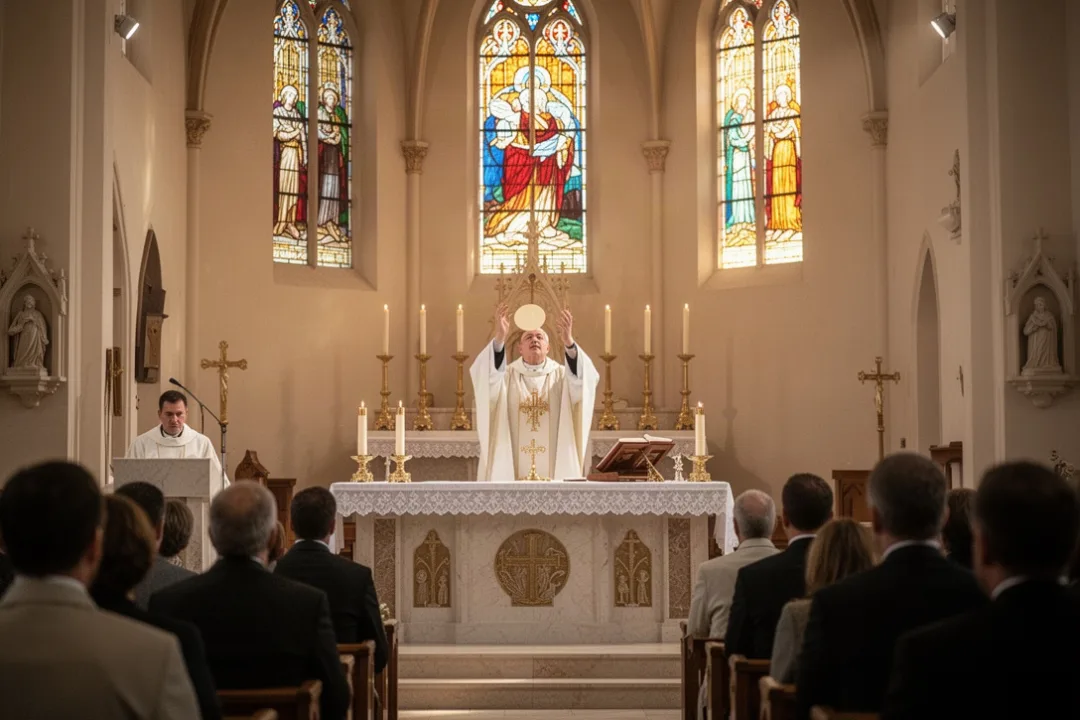
At Mass, Catholics hear Scripture, profess faith in Christ, and celebrate the Eucharist. The Church teaches that the Eucharist is not merely a reminder of a dead teacher. Through the sacrament, Christ is truly present in a unique way under the appearances of bread and wine.
Catholics also use prayers directed to the Father, through the Son, in the Holy Spirit. The basic pattern reflects the Trinity. Prayer can be addressed directly to Jesus as Lord, or it can ask the Father for gifts through Jesus Christ.
The sign of the cross summarizes this belief by naming the Father, Son, and Holy Spirit. It is not a reference to three gods. It is a short confession of the one God revealed in three divine Persons and of salvation accomplished through Christ’s cross.
How Catholics distinguish Jesus from Mary, the saints, and prophets
Catholics honor Mary, the apostles, and the saints, but they do not place them on the same level as Jesus. Mary is honored as the mother of Jesus and as a model of faithful discipleship. The saints are respected as people transformed by God’s grace. Prophets and apostles are human messengers.
Jesus is different because he is not merely a messenger who points away from himself toward God. He is the divine Son through whom God speaks and acts. Catholics may ask saints to pray for them, but they worship God alone—and they worship Jesus because he is God.
This distinction is reflected in Catholic vocabulary. Latria refers to adoration owed to God. Dulia refers to honor given to the saints, while a special form of honor is given to Mary. These honors are not alternatives to worshiping Jesus; they depend on God’s action in their lives and ultimately direct attention back to him.
Common misunderstandings about Catholic belief in Jesus
“If Jesus is God, why does he pray?”
Jesus prays because he is truly human and because the Son has an eternal relationship with the Father. His prayer expresses both his human life and his personal relationship within the Trinity. It does not mean that Jesus is a separate, lesser deity who needs to contact a higher god.
“If Jesus is God, how can he die?”
Jesus truly dies according to his human nature. Catholic teaching does not say that the divine nature stops existing. The divine Son experiences human death through the humanity he assumed, while remaining divine. His resurrection then reveals that death does not have the final word.
“Does Jesus being the Son mean he was created?”
No. Catholic teaching distinguishes between being the eternal Son and being a created being. The Son is eternally begotten of the Father, which describes a divine relationship rather than an event in time. Jesus’ human body and human life begin through the Incarnation, but the Son himself has no beginning.
“Does believing Jesus is God mean Catholics deny his humanity?”
No. Denying Jesus’ humanity would contradict Catholic teaching just as much as denying his divinity. Catholics believe Jesus had a real human body, human emotions, a human intellect, and a human will. He is not half human and half divine; he is fully both.
What Catholics mean when they call Jesus the only Savior
Catholics believe salvation comes through Jesus Christ. This does not mean that every person must already understand Catholic doctrine in the same way before God can show mercy. It means that whatever salvation God gives is ultimately made possible through Christ’s life, death, and resurrection.
The Church therefore proclaims Jesus as the universal Savior rather than one spiritual teacher among many equal options. Catholic respect for people of other religions does not remove this central claim. Catholics can recognize goodness and truth outside the visible boundaries of the Church while still believing that the fullness of salvation is found in Christ.
This belief also explains why the Church evangelizes. Sharing the Gospel is not simply passing along a set of moral rules. It is announcing that God has entered human history in Jesus and offers reconciliation and new life through him.
How to read Catholic statements about Jesus accurately
When you encounter a Catholic statement about Jesus, look for three questions: Is it speaking about his divine nature, his human nature, or his one Person? Careful Catholic theology uses these distinctions to avoid confusing Jesus’ divinity with his humanity.
A practical way to test an explanation is to ask whether it preserves all of these claims:
Jesus is truly God.
Jesus is truly human.
Jesus is one Person, not two persons joined together.
The Father, Son, and Holy Spirit are distinct Persons.
There is only one God.
Jesus’ human life, suffering, death, and resurrection are real.
If an explanation says Jesus is only a good man, it denies his divinity. If it says Jesus only looked human, it denies his humanity. If it describes the Trinity as three gods, it denies Catholic monotheism. The traditional doctrine is demanding because it refuses to discard any of these convictions.
A useful distinction: Catholics do not claim that Jesus is the Father. They claim that Jesus is the eternal Son, who is fully God with the Father and the Holy Spirit.
Why this belief remains central to Catholic life
For Catholics, Jesus’ divinity is not an abstract label. It shapes how they understand prayer, forgiveness, the sacraments, the Church, and human destiny. If Jesus is God who became human, then his words carry divine authority, his compassion reveals God’s character, and his resurrection opens the possibility of eternal life.
It also gives Catholic devotion its focus. Catholics do not simply admire Jesus as an example of courage or kindness. They seek to know him, follow him, receive his grace, and worship him as Lord. His humanity makes him close to human experience; his divinity makes him the source of salvation.
So the Catholic answer to the question is unambiguous: Jesus is God the Son incarnate. He is eternally divine, genuinely human, distinct from the Father, united with the Father and the Holy Spirit in the one God, and the Savior whom Catholic Christians worship.
Frequently asked questions
Do Catholics believe Jesus is the same person as God the Father?
No. Catholics believe Jesus is the Son, the second Person of the Trinity, while the Father is the first Person. They are distinct Persons, not one Person using two names. However, they share the one divine nature, along with the Holy Spirit. So Catholics say Jesus is truly God without saying that Jesus is the Father.
Do Catholics believe Mary is the mother of God?
Yes, Catholics use this title because Mary is the mother of Jesus, who is one divine Person. The title does not mean Mary existed before God or created Jesus’ divinity. It protects the belief that the child born from her is truly God incarnate, not merely a human person later connected to God.
Do Catholics believe Jesus existed before he was born in Bethlehem?
Yes. Catholic teaching says the Son is eternal and did not begin at Jesus’ human birth. His human nature began through the Incarnation, but the divine Person of the Son has always existed with the Father and the Holy Spirit. Bethlehem marks the beginning of his human life, not the beginning of his existence as God.
Why do Catholics say Jesus is both God and man instead of choosing one?
Catholic belief requires both because each explains a different part of Christian faith. Jesus’ humanity makes his suffering, death, and representation of humanity real. His divinity gives his saving work its divine source and authority. The Church therefore teaches that one Person, Jesus Christ, has a complete divine nature and a complete human nature.











Leave a Reply