The Catholic Apostles’ Creed is a short statement of Christian belief centered on the Trinity: God the Father, Jesus Christ the Son, and the Holy Spirit. Catholics commonly pray it during the Rosary, at certain liturgies, and as a profession of faith in baptism.
Its traditional Catholic wording begins, “I believe in God, the Father almighty,” and ends with belief in the resurrection of the body and life everlasting. Each line summarizes a central teaching of the Catholic faith, from creation and the Incarnation to the Church, forgiveness, and eternal life.
The Apostles’ Creed is a profession of faith rather than a prayer of petition. When you recite it, you are not asking God for a particular favor; you are personally affirming what the Church believes. The repeated phrase “I believe” expresses trust, commitment, and acceptance of God’s revealed truth.
The Catholic form commonly used in English is:
I believe in God, the Father almighty, Creator of heaven and earth, and in Jesus Christ, his only Son, our Lord, who was conceived by the Holy Spirit, born of the Virgin Mary, suffered under Pontius Pilate, was crucified, died and was buried; he descended into hell; on the third day he rose again from the dead; he ascended into heaven, and is seated at the right hand of God the Father almighty; from there he will come to judge the living and the dead. I believe in the Holy Spirit, the holy catholic Church, the communion of saints, the forgiveness of sins, the resurrection of the body, and life everlasting. Amen.
Here, “catholic” is not a reference only to Roman Catholics as a modern denomination. The lowercase word means universal. It describes the Church as worldwide, intended for every people, and united in one faith under Christ.
A wording detail: “I believe in” does not mean the same thing as merely saying that an idea seems possible. In the Creed, it expresses faith in God and confident trust in the truths he has revealed.
You may see small differences in capitalization, punctuation, or older English translations. These variations do not change the Creed’s meaning. The essential structure remains the same: belief in the Father, the Son, the Holy Spirit, the Church, salvation, resurrection, and eternal life.
How the Apostles’ Creed developed in the Catholic Church
The Apostles’ Creed was not written by the Twelve Apostles as a single document, despite its traditional name. Instead, it developed from early baptismal professions of faith, especially the ancient creed associated with the Church of Rome. Christians used these statements to teach converts what they were committing themselves to believe.
Early Christians needed a clear way to distinguish the faith handed on by the apostles from false teachings. A baptismal creed served that purpose. Before or during baptism, a person professed faith in the Father, Son, and Holy Spirit and accepted the central events of Christian salvation.
The Creed’s three-part structure reflects the Trinity:
The Father: Creator of heaven and earth, the source of all creation.
The Son: Jesus Christ, who became human, died, rose, ascended, and will judge the living and the dead.
The Holy Spirit: The divine person who gives life to the Church and applies Christ’s saving work to believers.
The text reached its familiar form gradually as the Church clarified and preserved its teaching. It is shorter than the Nicene Creed, which Catholics normally recite at Sunday Mass, but both creeds express the same basic Christian faith.
The Apostles’ Creed has a particularly strong connection with Christian initiation. It is used in the Rite of Baptism for Children and in the baptismal liturgy for adults, where the person being baptized, or the parents and godparents, professes faith in response to questions based on the Creed.
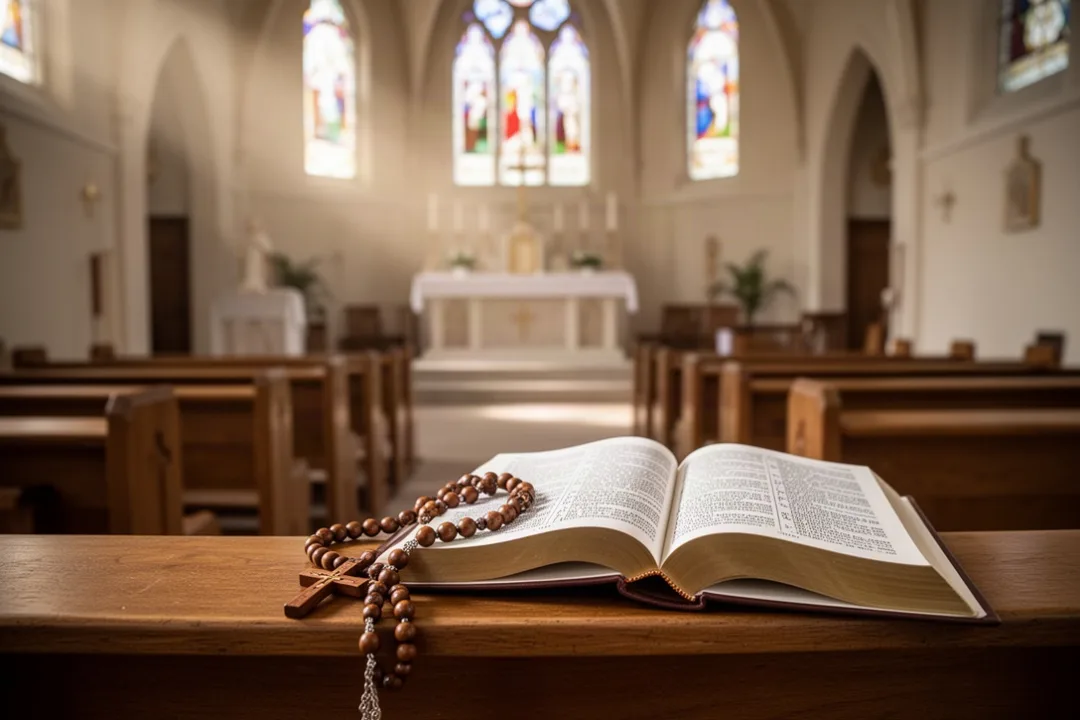
It also has an important place in personal devotion. Catholics often recite it at the beginning of the Rosary, after making the Sign of the Cross and before praying the Our Father. In that setting, the Creed establishes the foundation for meditating on the life of Christ and the saving work of God.
The Creed begins by naming God as Father almighty and Creator of heaven and earth. Catholic faith teaches that God is not one powerful being among many. He is the source of everything that exists, visible and invisible, and creation depends on him at every moment.
Calling God “Father” also points to a relationship within God himself. The Father is eternally related to the Son, and Christian revelation shows that God is not isolated or impersonal. God is love, and creation comes from his free goodness rather than from necessity or a struggle between rival gods.
Belief in creation does not require you to reject careful study of the natural world. The Creed answers the question of who is responsible for existence and its ultimate purpose, while scientific investigation examines physical processes. Catholic teaching holds that faith and sound reason need not be enemies.
Belief in Jesus Christ, the only Son
The second major section focuses on Jesus Christ. The name Jesus identifies the historical person who lived in first-century Palestine. The title Christ means “Anointed One” or Messiah, identifying him as the Savior promised in the history of Israel.
Calling Jesus God’s “only Son” means that he has a unique and eternal relationship with the Father. Catholic belief is not that Jesus was merely a good teacher who later received an honorary title. The Son is truly divine, and the Creed presents his human life as the decisive action of God for the salvation of the world.
When the Creed calls Jesus “our Lord,” it expresses more than respect. It acknowledges his authority over the whole person. To confess Jesus as Lord is to recognize him as the one to whom Christians owe faith, worship, obedience, and hope.
The Incarnation and the Virgin Mary
The line about Jesus being conceived by the Holy Spirit and born of the Virgin Mary summarizes the Catholic teaching of the Incarnation. The eternal Son truly became human while remaining truly divine. He did not merely appear to have a human body or temporarily act like a human being.
Mary’s role is central because she is the mother of Jesus according to his human nature and the Mother of God according to the identity of the person she bore. The Creed keeps the focus on Christ, while also affirming that his human life entered history through Mary by the power of the Holy Spirit.
This teaching also shows that salvation is not an escape from the physical world. God took a real human body and entered ordinary human history. Human life, the body, family relationships, suffering, and material creation can therefore be approached as realities that God has chosen to redeem.
Christ’s suffering, death, and descent to the dead
The references to Pontius Pilate and the Crucifixion place Jesus’ suffering in a definite historical setting. Catholic faith does not present the Passion as a myth outside time. Jesus truly suffered, was condemned under a Roman governor, was crucified, died, and was buried.
The phrase “he descended into hell” can be confusing in modern English. In the Creed, “hell” refers to the realm or state of the dead, not to the place of eternal punishment. It teaches that Jesus truly died and that his saving presence reached those who had died before him.
This line does not mean that Jesus needed to be purified from sin. Rather, it expresses the fullness of his death and the beginning of his victory over death. The Son entered the condition of the dead so that death itself would no longer have the final word.
The Resurrection, Ascension, and judgment
The Creed says that Jesus rose again from the dead on the third day. The Resurrection is not merely a symbol for the survival of Jesus’ ideals or the continuation of his influence. It is the central Christian claim that God raised him bodily and transformed his human life into glory.
After the Resurrection, Jesus ascended into heaven. Heaven is not simply a physical location somewhere above the earth. The Ascension teaches that Christ entered the glory of the Father while remaining united to his disciples and continuing to intercede for his people.
The phrase about sitting at the Father’s right hand uses biblical imagery for shared authority and honor. Jesus is not absent in the sense of being uninvolved. Catholics believe that the risen Christ remains Lord of the Church and will return to judge the living and the dead.
Judgment means that every human life has lasting moral significance. God sees the truth of what people have done, the love they have shown, the harm they have caused, and the repentance they have offered. The Creed therefore joins hope in Christ’s mercy with a serious call to responsibility.
The Holy Spirit and the Church
The Creed then turns to the Holy Spirit, the third person of the Trinity. The Holy Spirit is not simply a force, mood, or poetic name for God’s influence. The Spirit is fully divine and works in creation, the prophets, the life of Jesus, the Church, and the hearts of believers.
Belief in the holy catholic Church means that Christ did not leave behind only a collection of private spiritual opinions. He established a visible community that receives the apostles’ teaching, celebrates the sacraments, proclaims the Gospel, and serves as an instrument of unity and salvation.
The Church is called holy because God is holy and because the Holy Spirit acts within it, even though its members remain capable of sin. It is called catholic because its mission is universal in scope and because it preserves the fullness of Christian faith. It is apostolic because it remains rooted in the apostles’ witness and ministry.
The communion of saints and forgiveness
The communion of saints describes the spiritual union of all who belong to Christ. This includes faithful Christians on earth, those being purified after death, and the saints who share God’s glory. The Church is therefore larger than the group of believers currently living in the world.
This communion explains why Catholics ask the saints to pray for them. Such a request does not replace prayer to God or treat saints as rival gods. It reflects the belief that those united with Christ can intercede for the Church, just as Christians on earth can pray for one another.
The Creed’s reference to the forgiveness of sins points to the heart of the Gospel. Sin damages a person’s relationship with God and others, but Christ offers reconciliation. Catholics encounter this forgiveness especially through Baptism and the Sacrament of Reconciliation, while the Church also calls believers to ongoing repentance and works of mercy.
The resurrection of the body and everlasting life
Christian hope is not limited to the immortality of an invisible soul. The Creed says, “the resurrection of the body,” affirming that God will raise the dead and bring human beings into a transformed fullness of life. The exact manner of this transformation is a mystery, but it includes the redemption of the whole person.
This belief gives the human body real dignity. The body is not disposable, irrelevant, or merely a temporary container for the self. Catholic moral teaching about human life, sexuality, care for the sick, burial, and treatment of the dead is connected to the hope that God intends to redeem the whole person.
Life everlasting means lasting communion with God through Christ. It is not simply endless time or an improved version of earthly comfort. Eternal life is participation in God’s own life, where love, truth, and joy reach their complete fulfillment.
When Catholics use the Apostles’ Creed
The Apostles’ Creed is familiar in several Catholic settings, but its use is not limited to one particular devotion. It can function as a public profession of faith, a baptismal response, or a personal prayer that gathers the mind around the central truths of Christianity.
The Rosary: Catholics traditionally begin the Rosary with the Apostles’ Creed before the Our Father, Hail Marys, and Glory Be.
Baptism: The Creed’s questions and responses form part of the profession of faith made by candidates, parents, and godparents.
Personal prayer: It can be prayed slowly as a morning offering, an evening reflection, or a response during spiritual uncertainty.
Some liturgies: The Roman Catholic liturgy permits the Apostles’ Creed in place of the Nicene Creed in particular circumstances, including times when its baptismal character is especially fitting.
Christian formation: Parents, catechists, and sponsors often use it as a framework for teaching the main elements of Catholic belief.
At most Sunday Masses, Catholics hear and recite the Nicene-Constantinopolitan Creed instead. That longer creed gives fuller wording about Christ’s divinity, the Holy Spirit, the Church, Baptism, the Resurrection, and the life of the world to come. The Apostles’ Creed remains fully Catholic and is not a lesser statement of faith; it is a different ancient form with a strong baptismal emphasis.
Practical prayer tip: If the words feel familiar enough to recite automatically, pause after each sentence. Ask what the line reveals about God, what it asks you to trust, and how it should shape the way you live.
How to pray the Apostles’ Creed with understanding
Many people first learn the Creed by memorizing it. Memorization is useful, but the prayer becomes more meaningful when you connect each statement to the story of salvation and to your own life. The Creed is meant to form your faith, not merely test your memory.
A simple method is to divide the prayer into three movements. The first centers on God the Father and Jesus Christ. The second follows Christ’s Incarnation, Passion, Resurrection, Ascension, and future judgment. The third turns to the Holy Spirit, the Church, forgiveness, resurrection, and eternal life.
Begin with reverence: Make the Sign of the Cross and remember that you are professing faith in the living God.
Pray slowly: Give special attention to words that are easy to overlook, such as “only,” “truly,” “forgiveness,” and “body.”
Connect belief with action: Let belief in the Church lead to participation, belief in forgiveness lead to repentance, and belief in judgment lead to honest moral choices.
Bring doubts to prayer: If a teaching is difficult, do not pretend to understand more than you do. Ask for light, study the faith, and speak with a priest or trusted Catholic teacher.
End with hope: The Creed finishes with everlasting life and “Amen,” a word that expresses firm agreement and trust.
The Creed can also be prayed with the Church’s calendar. During Lent, the lines about sin, forgiveness, the Passion, and baptism may invite examination of conscience. During Easter, the Resurrection and the promise of bodily resurrection naturally receive greater attention. At a funeral, the Creed’s hope in Christ’s victory and eternal life can provide a clear expression of Christian faith.
Its brevity makes it suitable for daily prayer, but its content is deep enough for lifelong reflection. Catholics do not outgrow the Creed by learning more theology. Rather, deeper understanding helps familiar words become more precise, personal, and faithful.
Why the Apostles’ Creed still matters for Catholic faith
The Apostles’ Creed gives Catholics a shared vocabulary for the faith. A person may be praying alone, attending Mass in another country, preparing for Baptism, or teaching a child, yet the same central beliefs remain recognizable. That unity does not erase cultural differences; it connects them to one apostolic faith.
It also protects the Christian message from becoming vague. The Creed does not say only that Catholics believe in spirituality, kindness, or a higher power. It names the Father who creates, the Son who saves, and the Spirit who gives life. It names real events and concrete realities: birth, suffering, death, burial, Resurrection, the Church, forgiveness, judgment, and bodily resurrection.
For that reason, the Creed can be especially valuable when faith feels abstract. It brings belief back to the person of Jesus Christ and to the hope that God acts in history and will bring creation to its fulfillment. Reciting it is an act of belonging, but also an opportunity to let Catholic belief shape your decisions, relationships, worship, and hope.
The final “Amen” is a fitting response to the entire profession. It means that you receive what has been proclaimed and place your trust in the God whom the Creed names. Catholics return to these words throughout life because the faith they express is not a temporary lesson; it is the foundation of Christian prayer and discipleship.
Frequently asked questions
Is the Apostles’ Creed specifically Catholic?
The Apostles’ Creed is used by Catholics and by many other Christian traditions. Catholics recognize it as an ancient baptismal profession that accurately expresses essential Christian beliefs. Its wording about the “holy catholic Church” refers to the universal Church, not only to the Roman Catholic Church as a modern institution.
Why does the Catholic Creed say Jesus “descended into hell”?
This phrase means that Jesus truly entered the state of the dead after his Crucifixion. It does not mean that he suffered eternal punishment or needed redemption from sin. Catholic teaching understands the descent as part of Christ’s real death and his victory over death.
Do Catholics pray the Apostles’ Creed at every Mass?
Usually, Catholics recite the Nicene Creed at Sunday Mass and on solemnities. The Apostles’ Creed may be used in place of it in certain liturgical settings, especially where its connection with Baptism is appropriate. Catholics also pray it regularly during the Rosary and in personal devotion.
Is the Apostles’ Creed the same as the Nicene Creed?
They are different ancient professions of the same Christian faith. The Apostles’ Creed is shorter and has a strong baptismal structure. The Nicene Creed gives more detailed language about Christ’s divinity, the Holy Spirit, the Church, Baptism, and the future resurrection. Both are accepted Catholic statements of belief.










Leave a Reply