Italian rosary: prayers, mysteries, and how to pray
Italian rosary: prayers, mysteries, and how to pray
Are you holding a rosary marked “Italian rosary” and wondering whether it is different from the familiar Catholic prayer? Usually, the answer is simple: an Italian rosary is the traditional Rosary prayed in Italian, often with beads made or blessed in Italy. The structure is the same Rosary used by Catholics around the world, although Italian customs may influence the prayers, language, bead design, and setting.
The Rosary is a prayer centered on the life of Jesus Christ and the participation of Mary in the events of salvation. As you move through the beads, you repeat familiar prayers while meditating on a series of Gospel scenes called the mysteries. You can pray it in Italian from a printed guide, a prayer card, or memory, and you do not need an Italian-made set of beads to begin.
What an Italian rosary is and what makes it distinctive
The word rosario means rosary in Italian. In ordinary Catholic use, it refers both to the prayer devotion and to the string of beads that helps you keep count. An Italian rosary may be a five-decade rosary, a single-decade chaplet, a finger rosary, or a larger set intended for use at home or in church.
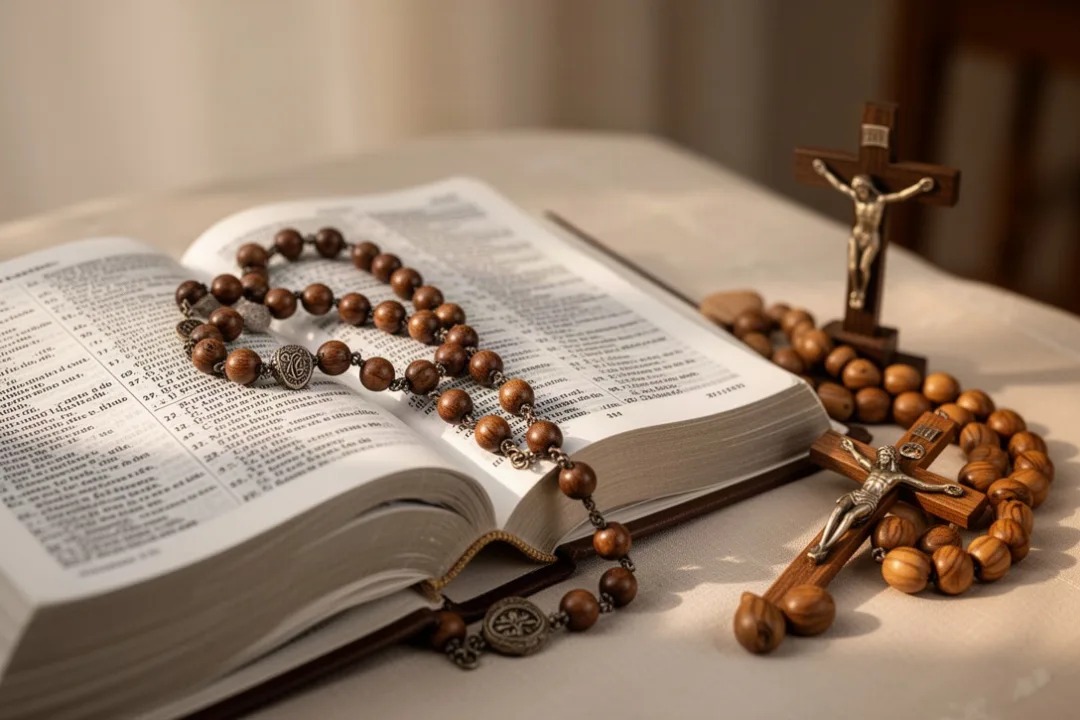
Some rosaries sold as Italian have a crucifix, a central medal, and beads connected by metal links. Others use olive wood, glass, crystal, ceramic, or colored stone. The materials can reflect local craftsmanship, a pilgrimage destination, or a particular devotion, but the materials do not change the prayers or make one rosary spiritually superior to another.
Italian Catholic culture has a long association with the Rosary. Families may pray it together, parish groups may gather for a communal rosary, and pilgrims may carry one to a shrine or church. In some homes, a rosary hangs near a religious image as a reminder to pray. These practices are expressions of devotion rather than requirements.
Helpful distinction: “Italian rosary” can describe a rosary made in Italy, a rosary prayed in the Italian language, or both. Check the product description or prayer guide if you need to know where a particular rosary was manufactured.
A standard five-decade rosary contains a familiar pattern:
A crucifix for beginning the prayer with the Sign of the Cross and the Apostles’ Creed.
One large bead for the Our Father.
Three small beads traditionally used for three Hail Marys.
Another large bead, often near the center medal, for the opening Our Father of the first decade.
Five groups of ten small beads, called decades, each preceded by an Our Father.
A central medal or connector, usually linked to the five decades and often showing Mary, Jesus, or a Marian title.
Bead arrangements can vary slightly, especially on handmade rosaries, but the prayer sequence remains recognizable. A one-decade Italian rosary can be useful for travel or for keeping in a pocket, while a full five-decade rosary is the usual form for the complete devotion.
Which prayers belong to the Italian Rosary
The core prayers of the Rosary are the Sign of the Cross, the Apostles’ Creed, the Our Father, the Hail Mary, and the Glory Be. Many people also include the Fatima Prayer after each decade. If you are praying in Italian, use an approved Catholic prayer book or a parish resource for the exact wording, since punctuation and minor wording can differ between editions.
The opening prayers in Italian
The Italian name for the Sign of the Cross is il segno della croce. Catholics make the sign while saying, “Nel nome del Padre e del Figlio e dello Spirito Santo. Amen.” In English, this names the Father, Son, and Holy Spirit and begins the prayer with the central Christian profession of faith.
The Apostles’ Creed is called il Credo or il Simbolo degli Apostoli. It is a concise statement of belief in God, Jesus Christ, the Holy Spirit, the Church, forgiveness, resurrection, and eternal life. Because it is a creed rather than a personal reflection, you can pray it slowly and treat each phrase as a declaration of faith.
The Our Father is il Padre nostro. It praises God, asks for the coming of God’s kingdom, requests daily bread, seeks forgiveness, and asks for protection from temptation and evil. The prayer is said once on the large bead before each decade.
The Hail Mary is l’Ave Maria. Its first part draws on the Gospel accounts of the Annunciation and Visitation, while its second part asks Mary to pray for those saying it. The prayer is repeated ten times for each decade, not as empty repetition, but as a steady rhythm for contemplation.
The Glory Be is il Gloria al Padre. It gives praise to the Father, Son, and Holy Spirit. The Fatima Prayer, often called la preghiera di Fatima, is commonly added after the Glory Be in many Catholic communities, though the basic Rosary can be prayed without it.
Praying in Italian when you are still learning
You do not need fluent Italian to pray an Italian rosary. Start with a bilingual prayer card that places Italian beside English. Read one line in Italian, reflect on its meaning, and then continue. Repetition will make the words familiar, but understanding should remain more important than perfect pronunciation.
Italian pronunciation is generally consistent, although individual sounds may be unfamiliar to English speakers. In a parish setting, listen to the leader and follow the rhythm rather than trying to speak louder. When praying alone, it is acceptable to pause, check a word, or continue in English if you lose your place.
A simple vocabulary guide can make a printed Italian rosary guide easier to follow:
Padre nostro: Our Father.
Ave Maria: Hail Mary.
Gloria al Padre: Glory Be.
Misteri: mysteries.
Decade: decade.
Intenzione: intention.
Preghiamo: let us pray.
Regina del Santo Rosario: Queen of the Holy Rosary.
Pronunciation guides can be useful, but they should not replace a reliable Italian text. Different websites sometimes spell out sounds inconsistently. A Catholic parish, diocese, prayer book, or recognized religious publisher is a better source for the wording of the prayers.
How to pray an Italian rosary step by step
Set aside a quiet period and decide whether you will pray one set of five mysteries or only one decade. Many people pray the complete five-decade Rosary, but a single decade can be a meaningful prayer when time or attention is limited. Hold the crucifix or begin with the first bead, depending on the design of your rosary.
Make the Sign of the Cross. Begin with the Italian formula or the language most natural to you.
Pray the Apostles’ Creed. Use the crucifix as the place to make this profession of faith.
Pray the Our Father. Use the first large bead after the crucifix.
Pray three Hail Marys. These traditionally ask for growth in faith, hope, and charity, although the Rosary does not require you to assign a separate intention to each bead.
Pray the Glory Be. Some people add the Fatima Prayer afterward.
Name the first mystery. State the mystery clearly, pause briefly, and bring the scene to mind.
Pray the Our Father. This begins the first decade.
Pray ten Hail Marys. Move one small bead at a time while reflecting on the mystery.
Pray the Glory Be and, if desired, the Fatima Prayer.
Repeat the pattern for four more decades. Announce the second, third, fourth, and fifth mysteries before each decade.
Finish with the customary closing prayers. These may include the Hail Holy Queen and a concluding prayer, depending on local or family practice.
The beads are a guide, not a test. If you lose count, continue from the bead you can identify, or finish the prayer without worrying about exactness. The purpose of the Rosary is prayerful meditation, not mechanical accuracy.
For a more focused experience, choose one intention before starting. You might pray for a family member, a person who is sick, peace in a difficult relationship, guidance about a decision, or the needs of your parish. You can also offer each decade for a different intention, keeping the intention short enough that it does not distract from the mystery.
When your attention wanders: return gently to the mystery rather than criticizing yourself. Look at a sacred image, repeat the name of the mystery, or slow the next Hail Mary. A distracted prayer can still become attentive prayer.
Posture and surroundings can support the devotion. You may sit, kneel, walk, or pray while traveling, provided you can do so safely. A candle, crucifix, icon, or quiet corner may help, but no special setting is necessary. The Rosary can be prayed privately or aloud with other people.
What the four sets of Rosary mysteries mean
The Rosary is organized around four groups of mysteries: Joyful, Sorrowful, Glorious, and Luminous. Each group contains five scenes from the life of Jesus and, in several cases, from Mary’s life alongside him. The traditional schedule varies by region and personal practice, so a prayer guide may assign different mysteries to different days.
The Joyful Mysteries focus on the beginning of Jesus’ earthly life and the hidden years of his childhood. They invite reflection on God’s call, Mary’s trust, and the ordinary family life surrounding Jesus.
The Annunciation: Mary receives the message that she will become the mother of Jesus.
The Visitation: Mary visits Elizabeth, and the meeting becomes a sign of joy and mutual support.
The Nativity: Jesus is born in Bethlehem.
The Presentation: Jesus is presented in the Temple, where Simeon and Anna recognize the significance of the child.
The Finding in the Temple: Mary and Joseph find Jesus among the teachers after searching for him.
These mysteries can be connected with decisions, family responsibilities, new beginnings, and the experience of waiting. When praying them in Italian, the repeated word gioiosi may help you remember that joy in the Rosary is not shallow cheerfulness; it includes trust amid uncertainty.
The Sorrowful Mysteries
The Sorrowful Mysteries accompany Jesus through suffering and death. They do not ask you to glorify pain. Instead, they bring fear, injustice, grief, sacrifice, and compassion into prayer while keeping the suffering of Jesus at the center.
The Agony in the Garden: Jesus faces anguish before his arrest.
The Scourging at the Pillar: Jesus endures brutal punishment.
The Crowning with Thorns: Jesus is mocked and humiliated.
The Carrying of the Cross: Jesus proceeds toward crucifixion under the weight of the cross.
The Crucifixion: Jesus dies on the cross.
These mysteries may be especially meaningful when you are praying for someone in pain or grieving a death. Keep the reflection grounded in compassion. The Rosary is not a substitute for medical care, counseling, or practical support, but it can give a structured place for sorrow and intercession.
The Glorious Mysteries
The Glorious Mysteries turn from death toward resurrection and the hope of eternal life. They are not a denial of suffering; they place suffering within the larger Christian belief that death does not have the final word.
The Resurrection: Jesus rises from the dead.
The Ascension: Jesus returns to the Father.
The Descent of the Holy Spirit: the apostles receive the Holy Spirit.
The Assumption of Mary: Mary is taken into heavenly glory.
The Coronation of Mary: Mary is honored as queen in the heavenly vision of Catholic devotion.
When praying these mysteries, you might reflect on hope, perseverance, the work of the Holy Spirit, and the promise of life with God. The Italian terms misteri gloriosi refer to this movement toward glory and fulfillment.
The Luminous Mysteries
The Luminous Mysteries, also called the Mysteries of Light, focus on significant moments in Jesus’ public ministry. They were added to the commonly used four-part arrangement in the modern era and are now included in many Catholic Rosary guides.
The Baptism of Jesus in the Jordan: Jesus is revealed at the beginning of his public ministry.
The Wedding at Cana: Jesus’ first sign points to his identity and brings help in a human need.
The Proclamation of the Kingdom of God: Jesus calls people to conversion and faith.
The Transfiguration: Jesus’ glory is revealed to selected disciples.
The Institution of the Eucharist: Jesus gives himself in the sacramental meal.
These mysteries can help you reflect on baptism, service, conversion, listening, and participation in the life of the Church. If an Italian prayer card lists misteri luminosi, it is referring to this set.
Choosing, caring for, and using an Italian rosary
If you are buying an Italian rosary, begin with its intended use. A sturdy corded or metal-link rosary may be practical for daily prayer, while a delicate glass-bead rosary may be better kept at home. For children or frequent travel, look for secure connections, smooth edges, and a size that is easy to hold.
Consider the following details before purchasing:
Material: olive wood, metal, glass, ceramic, and resin each have different weight and durability.
Bead size: larger beads are easier to count by touch, while smaller beads make a compact rosary.
Crucifix design: choose a crucifix that is comfortable to hold and clearly connected to the chain.
Center medal: this may show Mary, a saint, a shrine, or a Eucharistic symbol.
Length: check whether the rosary is intended to hang, carry, or wear around the hand.
Prayer language: confirm that the accompanying card uses Italian, English, Latin, or a bilingual format.
Claim of blessing: ask the seller for clear information rather than assuming every religious item has been blessed.
A rosary does not need to be expensive to be suitable for prayer. Its spiritual value is not measured by the price, material, or origin. A simple rosary received from a relative may carry deep personal meaning, while a handmade Italian rosary may help you establish a new habit of prayer.
Care for the beads gently. Store them in a small pouch or box so the chain does not tangle with other objects. Keep wood away from prolonged moisture, wipe metal carefully with a soft cloth, and avoid applying strong cleaners to painted or plated components. If a bead or link breaks, many religious-goods stores and jewelry repair services can restore it.
Some Catholics wear a rosary, but practices differ. For many people, carrying it in a pocket or bag is simply a reminder to pray. If you wear one, treat it respectfully and consider the cultural and religious context rather than using it only as a fashion accessory.
Italian Rosary traditions in homes, parishes, and pilgrimage places
The Rosary often has a communal dimension in Italian Catholic life. A parish may organize a public rosary, particularly during a Marian feast, a pilgrimage, or a month traditionally associated with Mary. The leader announces each mystery, and the group alternates the parts of the prayers. This makes the devotion accessible even when participants have different levels of familiarity.
At home, families may pray before dinner, during a family emergency, or at a regular time each evening. Older relatives sometimes teach children the prayers by having them lead one decade. The value of this practice is not simply preserving a custom; it creates a shared space for reflection, remembrance, and concern for other people.
When traveling to an Italian shrine or church, you may find rosaries associated with a particular image of Mary, saint, or local devotion. A rosary purchased there can serve as a pilgrimage keepsake, but you can pray it anywhere. If you want it blessed, ask a priest or deacon rather than assuming that a souvenir has received a blessing at the shrine.
Different families and parishes may use slightly different closing prayers, mystery schedules, or responses. That variety does not mean one group is automatically praying incorrectly. Follow the custom of the community you are joining, and use a trusted prayer guide when you are praying alone.
The most useful way to approach an Italian rosary is to let the beads support attention. Pray in Italian when that language connects you with family, culture, a parish, or a desire to learn. Pray in English when that allows you to understand more fully. The language and craftsmanship can enrich the experience, but the heart of the devotion remains meditating on Christ through the mysteries of the Rosary.
Frequently asked questions
Is an Italian rosary different from a regular Catholic rosary?
Usually, no. An Italian rosary normally has the same crucifix, beads, five decades, and prayer sequence used by Catholics elsewhere. “Italian” may refer to the language of the prayers, the place where the rosary was made, or its connection with an Italian parish, family, or pilgrimage site. The materials and design can vary without changing the devotion itself.
Can I pray an Italian rosary if I do not speak Italian?
Yes. You can use a bilingual prayer card, listen to a recorded guide, or pray the familiar responses in English while learning the Italian words gradually. Pronunciation does not need to be perfect for the prayer to be meaningful. Understanding the mysteries and prayers is more useful than forcing yourself to continue in Italian when you are confused.
Which mysteries should I pray with an Italian rosary?
You can pray any of the four groups: Joyful, Sorrowful, Glorious, or Luminous. Many people follow a customary weekday schedule, while others choose mysteries that relate to a particular need or season. A parish or prayer book may use a schedule different from another community, so follow the guide used by the people with whom you are praying.
Does an Italian rosary need to be blessed?
No. You can pray with an unblessed rosary, and its usefulness does not depend on a blessing. If you want a rosary blessed, bring it to a Catholic priest or deacon and ask. A blessing is a prayer for God’s grace and for the person using the object; it does not transform the rosary into a magical object or guarantee a particular outcome.












Leave a Reply