Our Lady of the Rosary: Meaning, history, and prayer
Our Lady of the Rosary: Meaning, history, and prayer
You may have heard the title Our Lady of the Rosary during a Catholic Mass, seen it on a church sign, or received a Rosary without knowing what the title means. The answer is straightforward: it is a name Catholics use for the Virgin Mary in connection with the Rosary, a prayer that reflects on the life, death, and Resurrection of Jesus Christ.
Our Lady of the Rosary is not a separate goddess or a different person from Mary. The title points to Mary’s role as the mother of Jesus and a guide who helps Christians contemplate the central events of the Gospel. Catholics honor Mary, but the Rosary ultimately directs prayer toward Christ.
The phrase Our Lady is a traditional Christian title for Mary. “Rosary” refers both to the familiar string of beads and to the structured prayer prayed with those beads. Together, the title identifies Mary as the woman associated with this form of meditation and devotion.
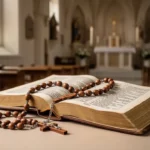
The Rosary is made up of repeated prayers, including the Our Father, the Hail Mary, and the Glory Be. Repetition is not meant to replace attention or thought. Instead, it creates a steady rhythm that allows you to focus on scenes from Christ’s life while asking Mary to pray with you and for you.
Each group of ten Hail Marys is called a decade. During a decade, the person praying recalls one mystery, or Gospel event. The mysteries include the Annunciation, the Nativity, the Crucifixion, the Resurrection, and other moments that connect Mary’s life with the saving work of her Son.
Central idea: The Rosary is a Christ-centered prayer with Mary. Its repeated words provide a framework for contemplating Jesus, rather than drawing attention away from him.
Why Catholics connect Mary with the Rosary
Mary appears at several decisive points in the New Testament. She receives the message that she will become the mother of Jesus, gives birth to him, accompanies important moments in his ministry, stands near the cross, and is present with the disciples after the Resurrection. The Rosary gathers these events into a sequence for prayerful reflection.
Catholic devotion sees Mary as a model of faithful listening. In the Gospel accounts, she responds to God’s call with trust, even when she does not know how every part of her life will unfold. Praying the Rosary invites you to consider that same posture: listening, remembering, and responding to God with greater faithfulness.
The Hail Mary also combines biblical references with a request for prayer. Its opening recalls the angel Gabriel’s greeting and Elizabeth’s greeting to Mary, both found in Luke’s Gospel. The second part asks Mary to pray for the person praying, both now and at the time of death.
For Catholics, asking Mary to pray does not mean treating her as equal to God. It is similar to asking another Christian to pray for you, with the distinction that Mary is honored as the mother of Jesus and a uniquely faithful disciple. The Church teaches that God alone is the source of grace and salvation.
How the Rosary reflects the life of Jesus
The Rosary is organized around four sets of mysteries. Each set offers a different way to contemplate the relationship between Mary and Christ. The familiar prayers remain the same, but the mystery changes the subject of meditation.
The Joyful Mysteries
The Joyful Mysteries focus on the beginning of Jesus’ earthly life and the hidden years surrounding his birth. They include the Annunciation, the Visitation, the Nativity, the Presentation in the Temple, and the Finding of Jesus in the Temple.
These mysteries invite reflection on humility, family life, obedience, service, and patient faith. They can be especially meaningful when you are preparing for Christmas, thinking about a new responsibility, caring for family members, or trying to recognize God’s presence in ordinary duties.
The Sorrowful Mysteries
The Sorrowful Mysteries recall Jesus’ suffering and death: his agony in the garden, his scourging, his crowning with thorns, his carrying of the cross, and his Crucifixion.
Praying these mysteries does not glorify suffering for its own sake. Instead, it remembers Christ’s loving self-giving and brings human pain into the presence of God. People often turn to these mysteries while grieving, enduring illness, facing injustice, or praying for someone who is suffering.
The Glorious Mysteries
The Glorious Mysteries celebrate the Resurrection, the Ascension, the descent of the Holy Spirit, the Assumption of Mary, and Mary’s Coronation in heaven. These mysteries emphasize that death and suffering do not have the final word.
They are prayers of hope, but not a denial of present hardship. The Resurrection gives the Christian life a direction beyond fear and loss. The other mysteries reflect Catholic beliefs about Christ’s triumph, the Holy Spirit’s work, and Mary’s participation in the glory promised to the faithful.
The Luminous Mysteries
The Luminous Mysteries were introduced by Pope John Paul II in 2002. They contemplate significant moments during Jesus’ public ministry: his Baptism in the Jordan, the Wedding at Cana, the proclamation of the Kingdom of God, the Transfiguration, and the institution of the Eucharist.
These mysteries highlight Jesus as the light of the world. They help bridge the traditional focus on his childhood and Passion by giving special attention to his preaching, signs, invitation to conversion, and sacramental presence.
Joyful Mysteries: the events surrounding Jesus’ birth and early life.
Sorrowful Mysteries: Jesus’ Passion and death.
Glorious Mysteries: the Resurrection and heavenly glory.
Luminous Mysteries: important events in Jesus’ public ministry.
When Catholics celebrate Our Lady of the Rosary
The Catholic Church celebrates the Memorial of Our Lady of the Rosary on October 7. The date is linked to the naval Battle of Lepanto in 1571, when a coalition of Christian forces defeated the Ottoman fleet. Pope Pius V asked Catholics to pray the Rosary for the Church’s protection, and the victory became associated with Mary’s intercession.
The feast was first connected with the title Our Lady of Victory. Later, the name developed into Our Lady of the Rosary, and the observance was extended within the Church over time. The historical connection does not mean that every military event should be interpreted simply or that prayer eliminates the tragedy of war. It reflects a particular moment when Catholics understood the Rosary as a communal plea for help.
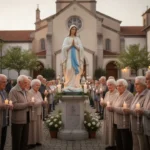
October is also widely observed as the Month of the Holy Rosary. Many parishes organize public recitations, Rosary groups, Marian processions, or special devotions during the month. Individuals may use October as a practical opportunity to begin praying one decade a day or to return to a practice they have set aside.
The feast is not primarily about a decorative object or a historical battle. Its purpose is to honor Mary while directing the Church to the mysteries of Christ. A parish celebration may include Mass, a homily, a Rosary, Eucharistic adoration, a procession, or another local custom.
How the devotion developed through Christian history
The Rosary grew gradually from older Christian habits of repeating prayers and meditating on sacred events. In medieval Europe, many Christians prayed the 150 Psalms as part of the Church’s daily prayer. People who could not read or did not have access to a psalter sometimes used repeated prayers as a simpler parallel practice.
Over time, groups of 150 Hail Marys became associated with the 150 Psalms and were sometimes called a “Psalter of Mary.” The prayer developed through the work of religious communities, laypeople, and local traditions rather than appearing all at once in its modern form.
Tradition strongly associates the Rosary with Saint Dominic and the Dominican Order. Catholics may rightly honor that tradition, but claims that Saint Dominic personally received the complete modern Rosary in one moment are not established as a simple historical fact. The devotion took shape over centuries.
The Rosary’s familiar structure became clearer as the number of prayers and mysteries were organized. In 1569, Pope Pius V formally described the Rosary in a way that helped establish its traditional form. Later popes encouraged the devotion, especially as a prayer for peace, family life, conversion, and the needs of the Church.
In 2002, Pope John Paul II added the Luminous Mysteries, while presenting them as an optional addition rather than a replacement for the existing pattern. This addition gave the Rosary a fuller connection to the public ministry of Jesus.
You do not need a special setting, a particular kind of beads, or a perfect level of concentration to begin. A Rosary can be prayed alone, with family, in a church, while traveling, or during a quiet walk. The beads are a helpful guide, but the prayer remains possible without them.
Begin with the Sign of the Cross. This marks the prayer as a Christian act and places it within the life of the Trinity.
Pray the Apostles’ Creed. This expresses the basic beliefs of the Christian faith.
Pray an Our Father, three Hail Marys, and a Glory Be. These opening prayers traditionally ask for growth in faith, hope, and love.
Announce the first mystery. Name the Gospel event and pause briefly to bring it to mind.
Pray one Our Father, ten Hail Marys, and one Glory Be. This completes the first decade.
Repeat the pattern for four more mysteries. Keep the mystery in mind as you pray each decade.
Finish with a customary Marian prayer. Many Catholics pray the Hail Holy Queen, though local customs may vary.
End with the Sign of the Cross. This marks the close of the Rosary.
The exact opening and closing prayers can differ according to cultural or parish practice. Some people add a prayer for the pope, a prayer for the deceased, or a personal intention. These additions can be meaningful, but they are not required for a valid Rosary.
Which mysteries are prayed on each day
A commonly used schedule assigns a set of mysteries to each day. The schedule is a practical aid, not a rule that determines whether your prayer is acceptable. If a particular mystery fits your circumstances, you may choose it regardless of the day.
Monday and Saturday: the Joyful Mysteries.
Tuesday and Friday: the Sorrowful Mysteries.
Wednesday and Sunday: the Glorious Mysteries.
Thursday: the Luminous Mysteries.
Some communities use different schedules, especially on Sundays or during particular seasons of the Church year. The essential practice is not memorizing a timetable. It is entering prayerfully into the mysteries and allowing them to shape your attention toward Christ.
Helpful starting point: If a full Rosary feels difficult, begin with one decade. A single decade prayed slowly and attentively can be a genuine act of prayer, especially when you are learning the structure.
Practical tips and common mistakes when praying
The Rosary is simple enough to learn quickly, but several habits can make it more fruitful. The goal is not to achieve a perfect performance. It is to pray with enough attention that the words and the mystery meet your real life.
Choose a realistic time. A regular ten or fifteen minutes may be more sustainable than promising yourself an hour every day.
Announce each mystery clearly. Naming the event helps prevent the prayer from becoming an empty sequence of words.
Use a Scripture reference. Reading a short passage related to the mystery can give your meditation a concrete focus.
Pray at a natural pace. Rushing through the Hail Marys can make it harder to remain attentive.
Let distractions pass without panic. Notice that your mind has wandered and gently return to the prayer.
Pray with a specific intention. You might pray for a family member, a difficult decision, a person who has died, or peace in a troubled community.
Use audio guidance if needed. A parish recording or group prayer can help you learn the order without having to remember every part immediately.
Do not treat the beads as magic. The beads are a devotional aid, not a charm that guarantees an outcome.
Do not measure prayer only by emotion. A dry or distracted Rosary can still be a faithful offering.
Do not assume you must finish a full Rosary every time. One decade prayed with care is better than abandoning prayer because the full form seems impossible.
One common mistake is to focus so much on counting that the mysteries disappear. Another is to turn the Rosary into a list of demands, as if repeating the prayers forces God to grant a particular result. Catholic prayer asks, hopes, and intercedes, but it also seeks trust in God’s wisdom.
A third mistake is to imagine that Marian devotion competes with devotion to Jesus. The Rosary’s mysteries correct that misunderstanding. Mary is present because her life is inseparable from the life of Christ, and her role in the prayer is to lead the person praying toward deeper knowledge of him.
What Our Lady of the Rosary means for family and parish prayer
The Rosary can be prayed privately, but it has a long history as a family prayer. A household might pray one decade before dinner, gather for a full Rosary once a week, or use the feast day in October as a time to renew a shared practice.
Families do not need to make every session long or formal. Children can take turns announcing mysteries, holding the beads, or leading a decade. The purpose is not to test their memory. It is to help them associate prayer with attention, gratitude, concern for others, and the story of Jesus.
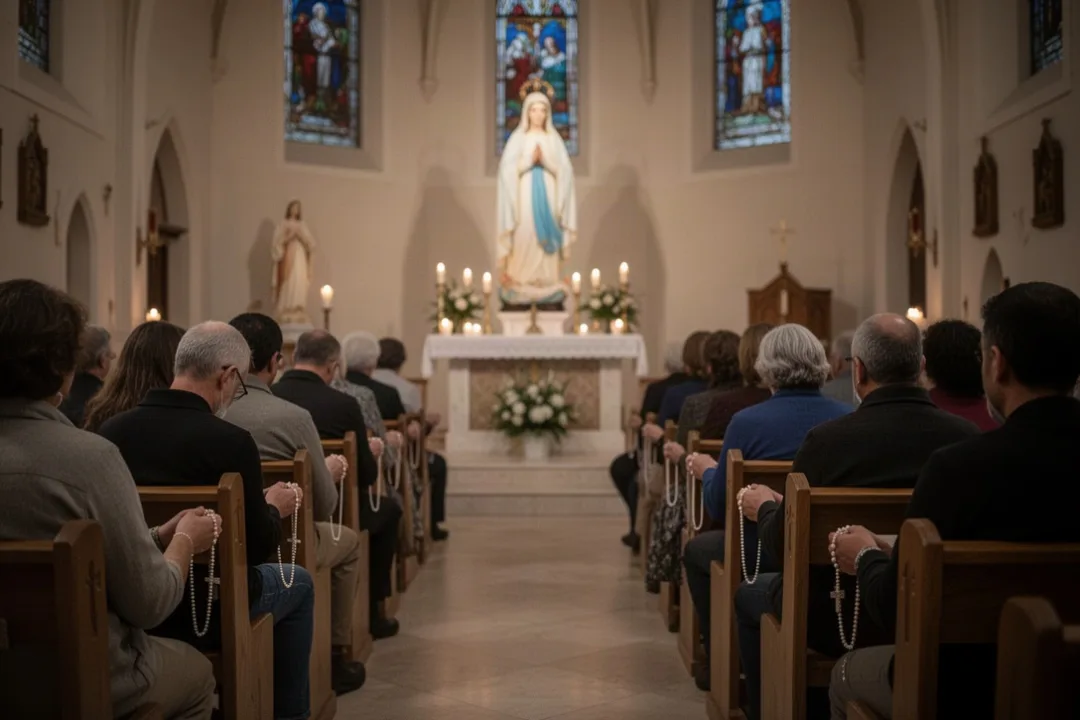
Parishes often pray the Rosary before Mass or during a Marian observance. A group setting can support people who find it difficult to maintain a private routine. It also expresses the belief that prayer is not only an individual activity but a practice shared by the communion of believers.
Public Rosary prayer should remain respectful and welcoming. People may come with different levels of familiarity, so a leader can announce the prayers, explain the mystery briefly, and avoid assuming that everyone knows the same local customs.
How to choose intentions for the Rosary
A prayer intention gives your meditation a concrete direction. It does not limit the meaning of the mystery; rather, it connects the Gospel event with a person or situation in need of grace. You can hold one intention throughout the Rosary or offer a different intention for each decade.
Pray the Annunciation for openness to a difficult calling or a new responsibility.
Pray the Visitation for a pregnant relative, a caregiver, or someone who needs companionship.
Pray the Sorrowful Mysteries for people experiencing violence, illness, grief, or injustice.
Pray the Glorious Mysteries for someone who has died and for renewed Christian hope.
Pray the Luminous Mysteries for conversion, wisdom, stronger faith, or a clearer understanding of Jesus’ teaching.
You may also pray for people with whom you disagree. The Rosary is not meant to turn another person into an enemy or to use religion as a way of condemning others. A sincere intention asks for mercy, truth, healing, and peace, including the grace to change your own attitudes and actions.
The Rosary is a devotional practice, not a sacrament. Catholics are not required to pray it in order to be Catholic, and failing to pray it does not mean that a person lacks faith. The Church encourages the Rosary because it can support contemplation, conversion, and a deeper life of prayer.
Its mysteries are rooted in Scripture and connected to central Christian beliefs. The Annunciation points to the Incarnation, the Sorrowful Mysteries to Christ’s Passion, the Glorious Mysteries to his Resurrection and the hope of eternal life, and the Luminous Mysteries to his public ministry and Eucharistic gift.
The Rosary should not replace participation in the Mass, regular reading of Scripture, works of mercy, or the responsibilities of Christian life. It works best as one practice within a broader relationship with God and the Church. Prayer that never affects compassion, honesty, forgiveness, or service has missed part of its purpose.
For Catholics, Mary’s intercession always depends on Christ. The title Our Lady of the Rosary therefore expresses both Marian honor and a firm focus on the Gospel. Mary is remembered as a disciple who points beyond herself to Jesus.
Ways to observe the feast on October 7
You can observe the feast of Our Lady of the Rosary in a simple and meaningful way. The most fitting choice depends on your circumstances, parish schedule, and level of familiarity with the devotion.
Attend Mass on or near October 7 if your parish offers a celebration.
Pray one or more decades with a family member or friend.
Read the Gospel passage connected with the mystery you are praying.
Ask for Mary’s intercession for peace, family needs, or people experiencing hardship.
Join a parish Rosary or learn the prayer from someone who prays it regularly.
Reflect on one quality seen in Mary, such as humility, courage, attentiveness, or trust.
A feast day does not require elaborate activity. Even a few quiet minutes can mark the occasion. What matters is remembering that the Rosary is a way of contemplating Christ with Mary’s help, not merely observing a date on the calendar.
What to remember about Our Lady of the Rosary
Our Lady of the Rosary is a title that joins Mary’s maternal and faithful presence to the prayer of the Rosary. The devotion developed over many centuries, received strong encouragement from the Catholic Church, and became especially associated with October 7 after the events of 1571.
The Rosary gives you a structured way to reflect on the life of Jesus. Its four sets of mysteries cover his birth, public ministry, suffering, death, Resurrection, and glory. Repeated prayers can steady your attention, while the mysteries connect prayer with Scripture and the realities of your own life.
If you are new to the devotion, begin simply: hold the beads, announce one mystery, and pray one decade at a pace that allows you to think about Christ. Over time, the practice may become a dependable form of prayer for gratitude, sorrow, hope, intercession, and peace.
Frequently asked questions
Is Our Lady of the Rosary the same person as the Virgin Mary?
Yes. Our Lady of the Rosary is a devotional title for Mary, the mother of Jesus. It highlights her association with the Rosary and her role as a model disciple who leads Christians toward Christ. Catholics do not understand this title as referring to a separate person or a different divine being.
Why is the feast of Our Lady of the Rosary celebrated on October 7?
October 7 is connected with the Christian naval victory at Lepanto in 1571, which Catholics associated with prayers asking for Mary’s intercession through the Rosary. The observance developed under the title Our Lady of Victory before becoming known as Our Lady of the Rosary.
Do I need Rosary beads to pray the Rosary?
No. Beads help you keep track of the prayers and decades, but they are not essential. You can use your fingers, a printed guide, or a prayer app, or simply pray one decade from memory. The spiritual value comes from meditating on the mysteries, not from owning a particular set of beads.
Can non-Catholics pray the Rosary?
Anyone may learn and pray the Rosary as a Christian devotion, although its prayers and Marian beliefs are specifically rooted in Catholic tradition. Someone unfamiliar with Catholic teaching can begin by meditating on the Gospel events and asking questions of a trusted Catholic parish or teacher.











Leave a Reply