Marian feasts: Dates, meanings, and Catholic traditions
Marian feasts: Dates, meanings, and Catholic traditions
Marian feasts honor Mary while directing attention to Jesus Christ and the salvation Christians believe he brings. These celebrations appear throughout the Catholic liturgical year, giving believers regular opportunities to remember Mary’s role in the Gospel, reflect on Christian discipleship, and ask for her prayers.
The word Marian refers to Mary, the mother of Jesus. Marian feasts may commemorate events recorded in the New Testament, such as the Annunciation and Visitation, teachings about Mary’s place in salvation history, such as the Immaculate Conception and Assumption, or titles and devotions that developed in particular regions and communities.
The list of observances can look complicated because not every Marian celebration has the same rank. Some are solemnities, the highest-ranking celebrations; others are feasts, memorials, optional memorials, or local observances. Their dates and names can also vary among Catholic, Orthodox, Anglican, and other Christian traditions.
How Marian feasts fit into the Catholic liturgical calendar
The Catholic Church’s liturgical year is not simply a calendar of historical anniversaries. It is a pattern of worship that moves through the life, death, Resurrection, and mission of Christ. Marian feasts belong within that pattern because Mary’s life is closely connected with the mystery of Christ.
For example, the Annunciation recalls the angel’s message to Mary and her consent to become the mother of Jesus. The Visitation remembers Mary’s visit to Elizabeth while both women were expecting children. The Assumption celebrates the belief that Mary was taken body and soul into heavenly glory at the end of her earthly life.
These celebrations do not place Mary beside God as an equal. Catholic worship gives adoration to God alone, while Mary receives a special form of honor because of her relationship to Jesus and her example of faith. Catholics commonly describe this distinction by reserving worship for God and giving Mary a unique honor among the saints.
Marian feasts also vary by geographical scope. A celebration may be observed by the entire Latin Catholic Church, by a country or diocese, by a religious order, or by a particular parish. A feast especially important in Mexico, for instance, may be less prominent in another country’s official calendar while still being celebrated by local communities and people with cultural ties to that tradition.
Calendar tip: A Marian feast may be moved or replaced when it falls near Easter or another major celebration. Check the calendar of your diocese or parish for the date and liturgical rank observed locally.
Liturgical rank affects what happens at Mass. A solemnity generally includes special prayers and readings and may receive priority over another celebration. A feast usually has its own readings or proper texts, while a memorial may use a saint’s prayers and readings within the structure of the day. An optional memorial can be observed when the calendar permits.
The same title may also appear in more than one form. Mary, Mother of God, for example, is a solemnity on January 1 in the Roman Catholic calendar. Other Marian titles may commemorate an apparition, a theological truth, a place of devotion, or a religious community’s particular history.
Major Marian feasts and their usual dates
The following celebrations are among the best-known Marian observances in the Roman Catholic calendar used in the United States. Some dates are fixed, while others are connected to the date of Easter or may be transferred when another important celebration takes precedence.
January 1 — Mary, the Holy Mother of God: This solemnity honors Mary’s motherhood of Jesus, who Christians confess as both truly human and truly divine.
February 11 — Our Lady of Lourdes: This optional memorial recalls the Marian apparitions associated with Lourdes, France, and the prayer, healing, and pilgrimage connected with that shrine.
March 19 — Saint Joseph, Spouse of the Blessed Virgin Mary: This is primarily a feast of Joseph, but it also highlights Mary’s place within the Holy Family.
March 25 — The Annunciation of the Lord: This solemnity commemorates the angel’s announcement to Mary that she would become the mother of Jesus.
May 31 — The Visitation of the Blessed Virgin Mary: This feast remembers Mary’s visit to Elizabeth and the recognition of God’s work in both women’s lives.
The Saturday after the Solemnity of the Sacred Heart of Jesus — The Immaculate Heart of the Blessed Virgin Mary: This memorial reflects on Mary’s interior life, faithful love, and complete dedication to God.
July 16 — Our Lady of Mount Carmel: This optional memorial is especially associated with the Carmelite tradition and its devotion to Mary.
August 15 — The Assumption of the Blessed Virgin Mary: This solemnity celebrates the belief that Mary was taken body and soul into heavenly glory.
August 22 — The Queenship of the Blessed Virgin Mary: This memorial presents Mary’s royal title as a consequence of her relationship to Christ the King.
September 8 — The Nativity of the Blessed Virgin Mary: This feast celebrates Mary’s birth and is traditionally connected with the beginning of her role in salvation history.
September 15 — Our Lady of Sorrows: This memorial remembers Mary’s suffering in union with the suffering of her Son.
October 7 — Our Lady of the Rosary: This memorial highlights the Rosary as a form of prayer centered on the mysteries of Christ with Mary.
November 21 — The Presentation of the Blessed Virgin Mary: This memorial recalls a longstanding tradition about Mary’s dedication to God as a child.
December 8 — The Immaculate Conception of the Blessed Virgin Mary: This solemnity teaches that Mary was preserved from original sin from the first moment of her conception.
December 12 — Our Lady of Guadalupe: This feast honors the Marian devotion associated with Guadalupe in Mexico and has special significance throughout the Americas.
This list includes celebrations that are particularly familiar in the United States, but it is not a complete list of every Marian observance. The Saturday memorial of the Blessed Virgin Mary, for example, may be used on Saturdays when the calendar permits. Many dioceses and religious communities also celebrate additional titles and patronal feasts.
Several dates have a close relationship with one another. The Annunciation falls nine months before Christmas, reflecting the traditional period of Mary’s pregnancy. The Nativity of Mary is celebrated nine months after the Immaculate Conception, while the Queenship of Mary follows the Assumption by one week.
Some celebrations have a fixed date but an adjustable liturgical observance. If March 25 falls during Holy Week or the Easter octave, the Annunciation is transferred according to the rules of the liturgical calendar. The date printed in a parish bulletin may therefore differ from the date listed in a general calendar.
What the principal Marian feasts mean
Mary, Mother of God and the Annunciation
The January 1 solemnity is not meant to suggest that Mary existed before God or caused Christ’s divinity. The title Mother of God protects the Christian belief that the child Mary bore is one person, Jesus Christ, who is truly God and truly human. The feast therefore says something fundamental about Jesus as well as about Mary.
The Annunciation on March 25 focuses on Mary’s response to God’s call. In the Gospel account, she receives a message that changes the direction of her life and accepts a difficult vocation with trust. Catholics often see this feast as an invitation to consider faithful consent, courage, and openness to God’s work in circumstances that cannot be fully understood in advance.
The Visitation and Mary’s active service
The Visitation shows Mary traveling to Elizabeth after the Annunciation. The scene connects two families, two expectant mothers, and two children whose lives are central to the Gospel story. Mary is not portrayed as remaining passive after receiving her vocation; she goes to help someone who may need practical and emotional support.
The feast commonly encourages Christians to connect prayer with service. Mary’s song of praise, traditionally called the Magnificat, celebrates God’s mercy and concern for the humble. Rather than reproducing the biblical wording, it can be described as a prayer that praises God for lifting up the lowly, remembering his promises, and acting with mercy across generations.
The Assumption and Mary’s destiny
The Assumption on August 15 is one of the most important Marian solemnities. Catholic teaching holds that Mary was taken body and soul into heavenly glory at the end of her earthly life. The doctrine does not claim that Mary is divine; it presents her as the first disciple to share fully in the future resurrection that Christians hope to receive.
This feast gives Catholic teaching about the human person a physical dimension. The body is not treated as disposable or spiritually irrelevant. Mary’s Assumption points toward resurrection, human dignity, and the promised renewal of creation, while also honoring the special place Catholics believe she holds in relation to Christ.
The Immaculate Conception and Mary’s beginning
The Immaculate Conception, celebrated on December 8, is frequently confused with the conception of Jesus. It refers to Mary’s own conception, not to the virginal conception of Christ. The teaching says that, by God’s grace and in view of Christ’s saving work, Mary was preserved from original sin from the beginning of her existence.
That teaching does not mean Mary had no need for salvation. Catholic theology understands her preservation from sin as a form of salvation received in an exceptional way. The feast therefore emphasizes God’s grace before it emphasizes human achievement.
The Nativity of Mary, Our Lady of Sorrows, and the Rosary
The Nativity of Mary on September 8 celebrates her birth. The New Testament does not provide a narrative of Mary’s birth, so the feast grows from early Christian tradition and the Church’s reflection on her role. Its placement near the beginning of the Church’s autumn cycle connects Mary’s birth with the unfolding story that leads to Christ.
Our Lady of Sorrows on September 15 remembers Mary’s suffering, especially her grief during the Passion and death of Jesus. The observance does not glorify suffering for its own sake. It presents Mary as a mother who remains faithful amid loss and as a person who shares deeply in the pain of her Son and of humanity.
Our Lady of the Rosary on October 7 honors a prayer that recalls episodes from the life of Jesus through a series of meditations. The Rosary includes prayers associated with Mary, but its central subjects are the joyful, luminous, sorrowful, and glorious mysteries of Christ’s life.
How Catholics observe Marian feasts
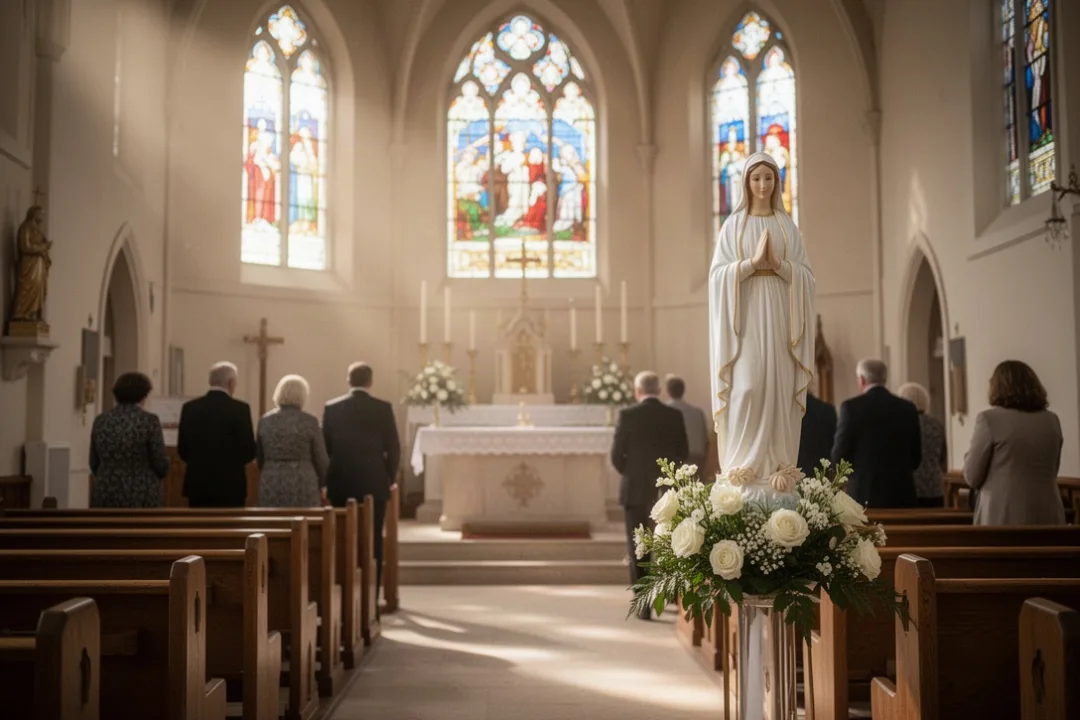
Mass is the central way Catholics observe a Marian feast. The readings, opening prayer, offertory prayer, and prayer after Communion may be chosen specifically for the celebration. Parish communities may also use hymns, processions, Marian images, or a homily that draws attention to Mary’s faith and mission.
Personal observance can be simple and need not involve elaborate devotions. A person might read the biblical passages connected with the feast, pray the Rosary, attend Mass, visit a church dedicated to Mary, or spend time considering one virtue reflected in the celebration.
Read the feast’s Gospel passages and identify what they reveal about Jesus, Mary, and Christian discipleship.
Attend Mass when the celebration is a holy day of obligation or when your schedule allows.
Pray with a Marian devotion, such as the Rosary, the Angelus, a litany, or a prayer associated with the feast.
Practice a concrete work of charity that fits the feast’s theme, such as visiting someone who is lonely or helping a family in need.
Learn the local tradition by asking your parish about processions, novenas, pilgrimages, or cultural celebrations.
Some Marian feasts are especially connected with pilgrimage and healing. Lourdes, for example, is known for prayer, sacramental life, service to sick pilgrims, and the use of water associated with the shrine. A Catholic may participate in that devotion without assuming that every illness will be physically cured. Prayer can include requests for healing, strength, peace, and wise medical care.
Marian processions and images can also carry cultural meaning. A statue, icon, or banner may represent a family’s heritage, a country of origin, a parish’s patroness, or a community’s experience of migration. These customs can be meaningful when they lead people toward prayer, solidarity, and service rather than treating an object as a magical source of power.
Novenas are another common practice. A novena is a pattern of prayer offered over nine days, often before a feast. It may ask for Mary’s intercession, but Catholic teaching understands the request as ultimately directed to God. The practice can also create a rhythm of preparation before the liturgical celebration.
Keep the focus clear: Catholic Marian devotion is meant to lead to Christ, not replace the sacraments, Scripture, charity, or trust in God. A healthy devotion joins affection for Mary with deeper Christian discipleship.
Families may mark a feast at home by displaying a simple image of Mary, preparing a meal connected with their heritage, praying together, or telling children the Gospel story behind the celebration. These customs do not have to be elaborate. Their value comes from helping ordinary life remember the Church’s prayer and teaching.
Marian feasts, seasons, and devotional practices
Mary is especially visible during Advent, the season of preparation for Christmas. The Annunciation, Mary’s pregnancy, her journey to visit Elizabeth, and her readiness to welcome Christ all make her a significant figure in Advent prayer. Many Catholics use the Angelus, a Marian hymn, or a short Gospel reflection during this season.
May is widely called the month of Mary in Catholic devotional practice. This does not mean every day in May is a Marian feast, nor does it change the official liturgical calendar. Parishes and families may nevertheless organize May crownings, Rosary gatherings, Marian hymns, or charitable activities during the month.
October is associated with the Rosary, especially because of the October 7 memorial of Our Lady of the Rosary. A parish may invite people to pray the Rosary before Mass or gather in homes for prayer. The practice is not limited to October; the month simply gives it particular emphasis.
Marian devotion also appears during the Christmas season. Mary, Joseph, and the infant Jesus are central to nativity scenes, and the January 1 solemnity continues the Church’s reflection on the child born at Christmas. The liturgical calendar keeps Mary connected to the mystery of Christ rather than treating her as an isolated religious figure.
Different Christian traditions observe different Marian days. Eastern Catholic and Eastern Orthodox churches have their own calendars, hymns, icons, and theological language. Anglican and other communities may observe some of the same events, while dates, titles, and levels of importance can differ.
Even within Roman Catholicism, a parish’s celebration may reflect its people. A community with Mexican roots may celebrate Our Lady of Guadalupe with music, food, and a procession. A Carmelite parish may give special attention to Our Lady of Mount Carmel. A parish named for the Assumption may hold a patronal celebration that includes activities beyond the official Mass.
When you are trying to understand a Marian feast, three questions provide a useful guide:
What event, teaching, or title does the feast remember? This identifies its basic content.
How does the feast point to Christ? Mary’s place in Catholic belief is understood through her relationship to Jesus.
What response does it invite? The answer may involve trust, service, compassion, repentance, prayer, or hope in the resurrection.
Approached this way, Marian feasts become more than a list of dates. They form a pattern of reflection on grace, discipleship, suffering, service, and hope. Mary is remembered not because she draws attention away from God, but because her life helps Christians contemplate how a human being can receive God’s grace and respond with faithful love.
Frequently asked questions
Are Marian feasts required days of Mass attendance?
Not all Marian feasts are holy days of obligation. In the United States, the Immaculate Conception and the Assumption are generally among the Marian celebrations that can carry this obligation, though the rule may be affected by the weekday on which a feast falls. Local diocesan calendars provide the applicable guidance, so check your parish or diocese for the current practice.
What is the difference between the Immaculate Conception and the Virgin Birth?
The Immaculate Conception concerns Mary’s conception and teaches that she was preserved from original sin from the first moment of her existence. The Virgin Birth concerns Jesus and the Christian belief that Mary conceived him through the Holy Spirit while remaining a virgin. They are separate teachings and are celebrated on different occasions.
Why does the Catholic Church honor Mary if worship belongs to God?
Catholics distinguish between adoration, which belongs to God, and honor given to Mary and the saints. Mary receives a unique honor because she is the mother of Jesus and an example of faithful discipleship. Marian prayer traditionally asks for her intercession, while the grace, salvation, and answers sought in prayer are understood to come from God.
Do all Marian feasts come directly from the Bible?
No. Feasts such as the Annunciation, Visitation, and events surrounding Jesus’ birth are rooted in New Testament accounts. Others, including the Nativity of Mary and her Presentation, developed through early Christian tradition and later reflection. Catholic liturgical practice can therefore draw from Scripture, theological teaching, longstanding tradition, and local devotion.









Leave a Reply