Advent begins on the fourth Sunday before Christmas, so its date changes each year but always falls between November 27 and December 3.
In the Western Christian calendar, Advent lasts from that Sunday until December 24, Christmas Eve. It includes four Sundays, although the number of weekdays varies. Advent is a season of preparation for Christmas, while also pointing Christians toward the promised return of Christ.
Advent does not begin on a fixed calendar date. Instead, churches count backward from Christmas Day and mark the four Sundays immediately before it. Because Christmas always falls on December 25, Advent can begin as early as November 27 or as late as December 3.
The first Sunday of Advent is always a Sunday. The season then continues through the fourth Sunday of Advent and ends on December 24. When Christmas Eve falls on a Sunday, that day may include both the final hours of Advent and the beginning of Christmas observances, depending on the church’s worship schedule.
Earliest possible start: November 27
Latest possible start: December 3
Length: 21 to 28 days
Number of Sundays: Four
End of the season: December 24, before Christmas Day begins
The simplest rule: Find Christmas Day, then count back four Sundays. The Sunday you reach is the first Sunday of Advent.
When Advent falls in 2026, 2027, and other nearby years
In 2026, Advent begins on Sunday, November 29, and its four Sundays are November 29, December 6, December 13, and December 20. Advent ends on December 24, followed by Christmas Day on December 25.
The dates around that year are:
2025: November 30 through December 24
2026: November 29 through December 24
2027: November 28 through December 24
2028: December 3 through December 24
2029: December 2 through December 24
2030: December 1 through December 24
The first Sunday moves because the weekday on which December 25 falls changes from year to year. A Christmas Day on a Sunday produces the earliest possible Advent start, while a Christmas Day on a Monday produces the latest possible start.
Why Advent has four Sundays
The four Sundays of Advent create a steady rhythm leading toward Christmas. Each Sunday gives churches and households another opportunity to reflect on the meaning of Christ’s coming rather than treating the holiday as a single day.
The Sundays are commonly identified as the First Sunday of Advent, Second Sunday of Advent, Third Sunday of Advent, and Fourth Sunday of Advent. Some traditions associate them with themes such as hope, peace, joy, and love, but the wording and order can differ between denominations.
The third Sunday is often called Gaudete Sunday. “Gaudete” comes from a Latin word associated with rejoicing. In churches that use a rose-colored candle or vestment, the lighter color on this Sunday signals a note of joy in the middle of a season that can otherwise emphasize waiting, repentance, and reflection.
Not every church uses the same themes, colors, or candle arrangement. The central pattern remains the same: four Sundays of expectation followed by the celebration of Christmas.
What the word Advent means
The word Advent comes from the Latin adventus, meaning “coming” or “arrival.” In Christian worship, the word refers to the coming of Jesus Christ and to the period of spiritual preparation before Christmas.
Advent holds more than one kind of expectation. It looks back to the birth of Jesus in Bethlehem, remembers that Christians believe Christ is present with his people now, and looks forward to Christ’s future return. That combination gives the season a broader focus than simply counting down to Christmas morning.
For many Christians, Advent is a time to slow down and consider hope, mercy, faithfulness, and renewal. Worship services may include readings from the Bible that point toward the Messiah, the ministry of John the Baptist, Mary’s response to the angel, or the birth narratives in Matthew and Luke.
Advent is a season of waiting that joins remembrance of Christ’s birth with hope for his coming again.
The mood of Advent can therefore be both serious and joyful. Churches may use quieter music, subdued colors, and prayers of repentance while gradually increasing the emphasis on celebration as Christmas approaches.
How Advent differs from Christmas
Advent is the season before Christmas; Christmas is the feast or celebration of Christ’s birth. The two are closely connected, but they are not interchangeable.
Advent begins in late November or early December and ends on December 24. Christmas begins on December 25 and, in many church traditions, continues for a longer season. The exact length of the Christmas season depends on the denomination and its calendar.
This difference explains why some churches do not sing every Christmas carol during Advent. They may reserve certain hymns and decorations for Christmas Day, preserving a gradual movement from anticipation to celebration. Other churches begin Christmas music and displays earlier as part of their local customs.
Secular traditions also follow different dates. An Advent calendar commonly begins on December 1 and has 24 or 25 numbered doors, even when the first Sunday of Advent occurs in November. That calendar is a December countdown, while the church season is based on Sundays and the date of Christmas.
How churches mark the Advent season
Advent practices differ widely, but many churches use visible signs to show the passage of time. These customs help worshipers connect the calendar with the season’s themes.
The Advent wreath and its candles
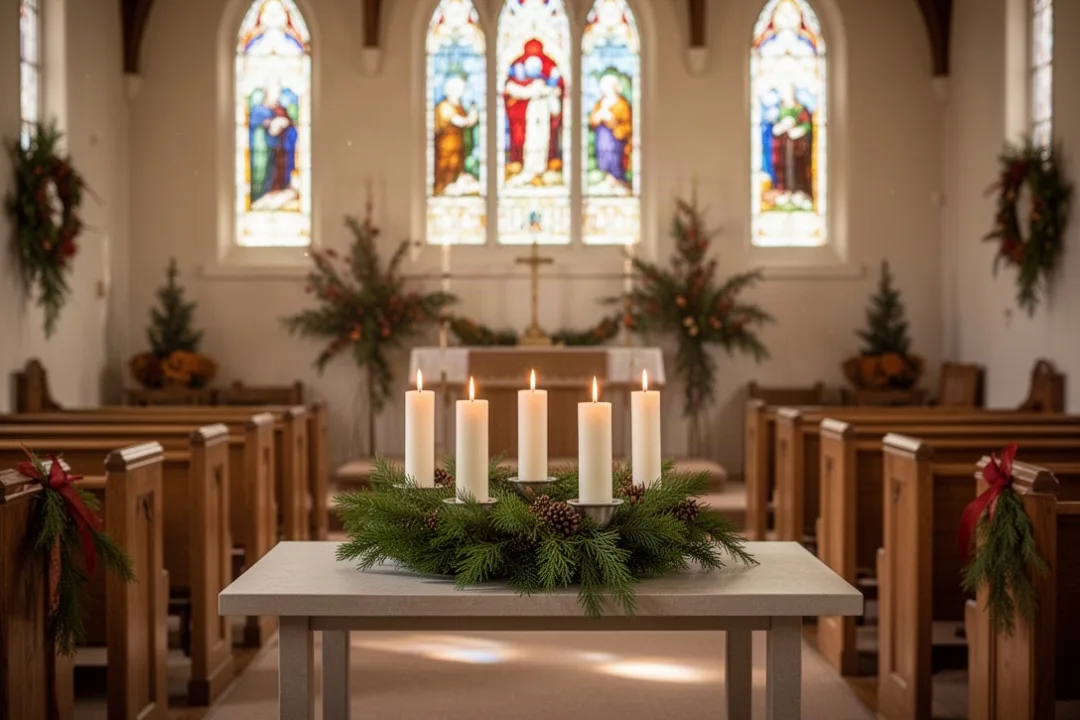
An Advent wreath is usually made from evergreen branches arranged in a circle. The circle can represent God’s enduring presence or eternal life, while the evergreen branches suggest life during the winter season.
Four candles are placed around the wreath, one for each Sunday. A candle is lit on the first Sunday, another is added on the second, and so on. By the fourth Sunday, all four candles are burning. Some churches add a white Christ candle in the center and light it on Christmas Eve or Christmas Day.
Many wreaths use three purple candles and one rose candle, but color choices vary. Some churches use blue candles, and some use four candles of the same color. The symbolism matters less than the practice of marking the weeks and preparing for Christmas.
Readings, prayers, and music
Worship services may feature readings about God’s promises, the prophets, John the Baptist, Mary, or the birth of Jesus. These passages are selected according to each church’s lectionary or local worship plan.
Prayers during Advent often express longing, repentance, trust, and hope. Music may begin with Advent hymns focused on waiting and expectation, then shift toward Christmas songs after December 24. Some congregations hold candlelight services, lessons and carols, or special prayer gatherings.
Many households and churches use Advent to practice generosity. They may collect food, support a shelter, visit someone who is isolated, or set aside money for a charitable gift. These actions are not required to observe Advent, but they reflect the season’s emphasis on compassion and preparation.
Advent can also be observed privately through a few quiet minutes of prayer, a daily reading, or a deliberate effort to repair a strained relationship. The practice does not need to be elaborate to be meaningful.
How to observe Advent at home
You can observe Advent in a way that fits your faith tradition, schedule, and household. The most useful approach is usually one that is simple enough to continue for all four weeks.
Mark the four Sundays. Write the dates on a calendar and set aside a short period for prayer, reading, or reflection.
Use an Advent wreath. Light one candle each Sunday, following the color and wording customary in your church if you have one.
Choose a short daily practice. Read a passage, pray for a specific person, or spend a few quiet minutes considering the season’s theme.
Include an act of generosity. Donate useful items, prepare a meal for someone, or support a local organization.
Reduce unnecessary pressure. Decide which events and traditions matter most instead of trying to do everything.
Make space for Christmas gradually. If your tradition separates Advent from Christmas, reserve some decorations or music for December 25.
Families with young children may use a picture book, a simple calendar, or a short candle-lighting ritual. Older children can help prepare the wreath, choose a service project, or keep track of the Sundays. The goal is not to create a perfect routine but to make waiting intentional.
Common Advent timing mistakes to avoid
Several calendar misunderstandings arise because popular Christmas customs and the church calendar do not use the same system. These distinctions make it easier to answer questions about when Advent starts.
Assuming Advent always starts December 1: The church season begins on a Sunday, not on a fixed date. December 1 is only the start of some Advent calendars.
Counting four calendar weeks: Advent contains four Sundays, but it may last fewer or more than 28 full days.
Calling the entire month of December Advent: Advent may begin in November and ends on December 24.
Confusing the Advent wreath with an Advent calendar: The wreath follows the four Sundays; the calendar usually follows numbered days in December.
Assuming every church uses identical colors: Purple, blue, rose, white, and other arrangements appear in different traditions.
Expecting every denomination to observe Advent in the same way: Liturgical calendars and worship customs vary among churches.
Calendar tip: If you need the exact date, check which day December 25 falls on, then count back four Sundays. Do not count backward four fixed seven-day periods from December 25 without checking the Sundays.
How Advent relates to different Christian traditions
Advent is especially prominent in Roman Catholic, Anglican, Lutheran, Methodist, Presbyterian, Episcopal, and other liturgical Protestant churches. These communities may use an official church calendar, prescribed readings, seasonal colors, and a structured series of services.
Other Protestant churches may observe Advent less formally or may focus on Christmas services without following every feature of the liturgical calendar. A congregation may use an Advent sermon series, candles, or Scripture readings even if it does not follow a traditional lectionary.
Eastern Orthodox Christians generally use the term Nativity Fast for the period of preparation before Christmas rather than Advent in the Western sense. The timing differs because many Orthodox churches follow a calendar in which Christmas is celebrated on January 7. The fast commonly begins on November 15, though practices and calendar use vary among Orthodox jurisdictions.
Some Eastern Christian communities do use forms of Advent language or customs, so a church’s own calendar is the best source for local dates. If you attend a particular congregation, its worship schedule will clarify when the season begins and which services are included.
What Advent means for people who do not follow a church calendar
You do not need to belong to a liturgical church to find value in the Advent season. The basic pattern—waiting, preparing, and moving toward celebration—can provide a thoughtful structure during a crowded part of the year.
Some people use Advent as a period for intentional reflection. They may focus on gratitude, make amends, limit unnecessary consumption, or create regular time for family and community. Others use the season to reconnect with Christian beliefs about the birth of Jesus and the hope associated with his coming.
For Christians, Advent is more than a general winter countdown. Its central focus is the person of Jesus Christ and the meaning of his birth. For people approaching the season culturally or devotionally, the practices can still offer a way to make Christmas more deliberate rather than allowing it to become only a series of errands and events.
The broad rule gives you the date in most Western churches, but a local congregation may publish additional services that affect how the season is observed. Check the church calendar, weekly bulletin, or denomination’s official worship resources for details.
Pay particular attention to services held on Christmas Eve. A morning service may still use Advent readings, while an evening candlelight service may begin the Christmas celebration. Churches may also hold an Advent procession, a service of lessons and carols, a children’s program, or a reconciliation service before Christmas.
If you are visiting a church, you can ask whether the congregation follows the Roman Catholic, Anglican, Lutheran, Orthodox, or another calendar. That question will usually clarify the start date, candle colors, music, and expectations for the season.
Frequently used Advent themes and symbols
Advent symbols help make an abstract season visible. Their meanings are not identical in every church, but several ideas appear often.
Light: Candles represent hope and the movement from darkness toward light.
Evergreen branches: These can symbolize enduring life and faithfulness.
The circle of the wreath: The unbroken shape may suggest eternity or continuity.
Waiting: The weeks encourage patience and attention rather than immediate celebration.
Hope: Advent points toward God’s promises and the expectation of renewal.
Joy: The third Sunday often introduces a stronger note of rejoicing as Christmas draws near.
These symbols support the season, but they are not the season’s entire meaning. The heart of Advent is preparing to celebrate Christ’s birth while looking toward the larger Christian hope of Christ’s presence and return.
What to remember when someone asks when Advent is
The clearest answer is: Advent begins four Sundays before Christmas. In the Western calendar, that means the first Sunday falls between November 27 and December 3, and the season ends on December 24.
For 2026, the first Sunday of Advent is November 29. If someone is referring to an Advent calendar, they may mean December 1 instead, so ask whether they mean the church season or the numbered holiday countdown.
The date is easy to calculate, but Advent is not only a scheduling detail. It creates a period for hopeful waiting, spiritual preparation, and gradual celebration before Christmas arrives.
Frequently asked questions
Does Advent always start on December 1?
No. In Western Christianity, Advent begins on the fourth Sunday before Christmas, so its first day can fall anywhere from November 27 through December 3. An Advent calendar often starts on December 1 because it follows the numbered days of the month, not the church’s Sunday-based calendar.
How long does Advent last?
Advent lasts from the first Sunday of Advent through December 24. Depending on the weekday on which Christmas falls, the season can last 21 to 28 days. It always includes four Sundays, but it does not always contain four complete calendar weeks.
When does Advent begin in 2026?
Advent begins on Sunday, November 29, 2026. The four Sundays are November 29, December 6, December 13, and December 20. The Advent season continues through December 24, after which Christmas Day is observed on December 25.
Is Advent the same as the Christmas season?
No. Advent is the preparation period before Christmas, while Christmas begins on December 25. Many churches deliberately keep the two seasons distinct through their readings, music, decorations, and worship colors, although family and cultural traditions often begin celebrating Christmas before Advent has ended.











Leave a Reply