Catholic holidays include holy days of obligation, major feasts, memorials, and the seasons of the liturgical year.
Some Catholic holidays are required days of worship, while others are important celebrations that Catholics may observe through Mass, prayer, fasting, family traditions, or acts of service. The calendar follows the life of Jesus Christ, honors Mary and the saints, and gives each part of the year a distinct spiritual focus.
How Catholic holidays differ from holy days of obligation
The phrase Catholic holidays can refer broadly to many celebrations on the Church calendar. A holy day of obligation is more specific: it is a day when Catholics are required to attend Mass, just as they are on Sundays, unless a serious reason prevents them.
Not every important Catholic celebration carries this obligation. For example, Ash Wednesday is one of the best-known Catholic observances, but it is not generally a holy day of obligation. Catholics commonly attend Mass and receive ashes on that day, yet the Church does not require Mass attendance in the same way it does for Christmas.
The exact list can vary by country and, in some cases, by region. The pope establishes the universal calendar, while national bishops’ conferences and dioceses may transfer or adjust certain celebrations. A local parish bulletin or diocesan website is the safest source for the obligation on a particular date.
Practical rule: Christmas is always a holy day of obligation in the United States. Other holy days can have local exceptions, especially when they fall near a weekend, so check your diocese before making plans.
The Catholic liturgical year follows the life of Christ
The liturgical year is the Church’s annual cycle of worship. It does not begin on January 1. Instead, it begins with the First Sunday of Advent and moves through the major events of Christ’s life, death, resurrection, and promised return.
The calendar uses different seasons, colors, readings, and prayers to give each period its character. The dates of several major celebrations change from year to year because they are connected to Easter, whose date varies.
Advent: a season of preparation for Christmas and expectation of Christ’s return.
Christmas season: the celebration of Christ’s birth and early manifestations.
Ordinary Time: periods focused on Jesus’ ministry and Christian growth.
Lent: a penitential season leading to Easter.
Holy Week: the final days of Lent and the remembrance of Christ’s Passion.
Easter season: the celebration of the resurrection through Pentecost and beyond.
The word ordinary does not mean unimportant. It comes from a term connected with counting or ordering the Sundays and weeks. Ordinary Time gives Catholics space to reflect on the teachings and actions of Jesus in the Gospels and to practice the Christian life throughout the year.
Major Catholic holidays in the United States
Several solemnities are commonly recognized as holy days of obligation in the United States. The obligation can change when a date falls on a Saturday or Monday, and the Ascension is transferred to Sunday in many dioceses.
Mary, Mother of God: January 1
New Year’s Day is also the Solemnity of Mary, the Holy Mother of God. The celebration honors Mary’s role in the mystery of Christ’s birth and reflects the Church’s teaching that Jesus is fully divine and fully human.
In the United States, the obligation to attend Mass may be removed when January 1 falls on a Saturday or Monday. The feast remains on the calendar even when the obligation is not in force.
The Ascension of the Lord
The Ascension commemorates Jesus’ return to the Father after his resurrection. The New Testament places this event after the resurrection and before Pentecost; references include Acts 1:1–11 and Luke 24:50–53, which describe Jesus blessing his disciples and leaving them with a mission.
The Ascension is traditionally celebrated on a Thursday, forty days after Easter. Many U.S. dioceses transfer it to the following Sunday, while others retain Thursday as the holy day of obligation. This is one of the clearest examples of why local information matters.
The Assumption of the Blessed Virgin Mary: August 15
The Assumption honors the belief that Mary was taken into heavenly glory at the end of her earthly life. It points to the Christian hope of resurrection and the full life with God promised to the faithful.
The date is fixed at August 15, although the Mass obligation may be affected when the solemnity falls on a Saturday or Monday. Churches often celebrate with special hymns, Marian prayers, and readings focused on Mary’s relationship to Christ and the Church.
All Saints’ Day: November 1
All Saints’ Day honors all the saints, including those formally recognized by the Church and the many holy people known only to God. It is a celebration of the communion of saints and the Christian calling to holiness.
All Saints’ Day is different from All Souls’ Day, which follows on November 2. All Saints’ Day focuses on those who share in heavenly glory; All Souls’ Day is dedicated to prayer for the dead who are being purified before entering heaven, according to Catholic belief.
The Immaculate Conception: December 8
The Immaculate Conception refers to Mary’s conception, not Jesus’ conception. Catholic teaching holds that Mary was preserved from original sin from the first moment of her existence in preparation for her role as the mother of Christ.
This feast is sometimes confused with the Annunciation, which is celebrated on March 25 and remembers the angel Gabriel’s announcement that Mary would become the mother of Jesus. The two celebrations concern different events.
Christmas: December 25
Christmas celebrates the birth of Jesus Christ and is the most widely recognized Catholic holy day of obligation. Masses may be offered on Christmas Eve and Christmas Day, and a person who attends an appropriately scheduled Christmas Eve Mass fulfills the Christmas obligation.
The celebration continues beyond December 25. The Christmas season includes the Feast of the Holy Family, Mary as the Mother of God, and the Epiphany, with local calendars determining the dates of some observances.
Important Catholic celebrations that are not usually holy days of obligation
Many Catholic holidays are spiritually significant without requiring Mass attendance under the universal or U.S. obligation. Catholics may still treat these days as major occasions for prayer, family worship, service, or participation in parish life.
Ash Wednesday
Ash Wednesday begins Lent. During the distribution of ashes, the priest or minister marks the forehead as a sign of repentance and human mortality. The day calls Catholics to turn toward God through prayer, fasting, and works of charity.
In the United States, Catholics generally fast and abstain from meat on Ash Wednesday. The fasting rule applies to adults within the prescribed age range, with exceptions for health, pregnancy, and other serious circumstances. Children, older adults, and people with medical needs should follow appropriate pastoral guidance rather than adopting a harmful fast.
Palm Sunday
Palm Sunday begins Holy Week and recalls Jesus’ entry into Jerusalem. Catholics receive blessed palms during Mass, but the celebration also turns toward the suffering and death of Christ through the reading of the Passion.
The palms are sacramentals rather than magical objects. Many families keep them in their homes as reminders of faith and return them to the parish when they are worn out so they can be burned for ashes used on a later Ash Wednesday.
Holy Thursday
Holy Thursday remembers the Last Supper, Christ’s institution of the Eucharist, and his example of humble service. The evening Mass of the Lord’s Supper often includes the washing of feet, echoing John 13, where Jesus teaches his disciples to serve one another.
After the liturgy, churches may provide a period of prayer before the altar of repose. Holy Thursday begins the Easter Triduum, the three-day celebration that reaches its climax at the Easter Vigil.
Good Friday
Good Friday commemorates Jesus’ Passion and death on the cross. Catholic services commonly include readings from the Passion, solemn intercessions, the veneration of the cross, and Holy Communion consecrated at the Mass of the Lord’s Supper on the previous evening.
Good Friday is not usually classified as a holy day of obligation, but it is one of the most solemn days of the year. Catholics in the required age groups observe fasting and abstinence, and many spend time in silence, attend the Stations of the Cross, or join the parish’s afternoon or evening service.
The Easter Vigil and Easter Sunday
Easter celebrates the resurrection of Jesus, the central event of the Christian faith. The Easter Vigil begins after nightfall on Holy Saturday and includes the blessing of the fire, the lighting of the Paschal candle, readings from salvation history, baptisms or receptions into the Church, and the first Eucharist of Easter.
Easter Sunday Masses proclaim the resurrection with joyful music and the renewal of baptismal promises. Easter is not limited to one day: the Easter season lasts for many weeks and concludes with Pentecost.
Pentecost
Pentecost celebrates the descent of the Holy Spirit upon the apostles and other disciples. Acts 2 describes the disciples receiving courage to proclaim the Gospel to people from many nations.
Pentecost is often called the birthday of the Church because it marks the public beginning of the apostles’ mission. Parish communities may use red vestments, special hymns, readings in multiple languages, or prayers for the gifts of the Holy Spirit.
Advent and Christmas celebrations on the Catholic calendar
Advent lasts for the four Sundays leading up to Christmas, although its length in calendar days varies. It has a double focus: preparing to celebrate Christ’s birth and remaining watchful for Christ’s return at the end of time.
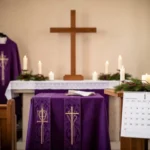
The liturgical color is usually violet or, in some places, a deep blue. The Advent wreath, with its gradually increasing candlelight, is a popular devotional practice. It can be used at home, but it is not required for a Catholic household to observe Advent faithfully.
Christmas Day begins a season rather than ending the celebration. The Epiphany honors the manifestation of Christ to the nations, traditionally represented by the visit of the Magi. Depending on the local calendar, Epiphany may be celebrated on January 6 or transferred to a nearby Sunday.
The Baptism of the Lord concludes the Christmas season in the Roman Catholic calendar. It recalls Jesus’ baptism in the Jordan and begins the transition into Ordinary Time.
Lent, Holy Week, and Easter practices
Lent is a forty-day season of preparation for Easter. Sundays are not counted in the same way as the weekdays of Lent, which is why the period from Ash Wednesday to Easter appears longer than forty calendar days.
The traditional Lenten practices are prayer, fasting, and almsgiving. Their purpose is not simply to give something up. They are meant to reorder priorities, deepen dependence on God, and increase concern for people in need.
Prayer: Attend an extra Mass, read a Gospel passage, pray the Rosary, or spend time in quiet reflection.
Fasting: Simplify meals or reduce a habit in a way that is safe and spiritually meaningful.
Almsgiving: Give money, time, food, or practical help to people facing hardship.
Reconciliation: Examine your life honestly and receive the Sacrament of Reconciliation when appropriate.
Abstinence from meat is required on Ash Wednesday and the Fridays of Lent for Catholics within the applicable age range, according to the discipline of the United States. Individual dioceses and countries may provide additional guidance or substitute practices outside these required days.
Feasts, solemnities, and memorials honor the saints
The Catholic calendar ranks celebrations according to their importance. A solemnity is the highest rank and includes major mysteries of Christ, Mary, and certain saints. A feast has a significant place in the calendar, while a memorial honors a saint or event with a more limited liturgical celebration.
Memorials may be obligatory or optional. An optional memorial can be observed at the discretion of the priest or parish, especially when another celebration takes precedence. The rank of a day affects the readings, prayers, hymns, and vestments used at Mass.
Examples of widely known celebrations include the Feast of Saint Joseph on March 19, the Annunciation on March 25, the Nativity of Saint John the Baptist on June 24, and the Feast of Saints Peter and Paul on June 29. These dates are important on the universal calendar, but they are not generally holy days of obligation for Catholics in the United States.
Local communities may also celebrate a patron saint, dedication anniversary, or regional feast with particular care. Immigrant Catholic communities often preserve celebrations connected to their home countries, including processions, special foods, music, and devotional prayers.
Common mistakes when planning around Catholic holidays
Knowing the name of a Catholic holiday does not always tell you whether Mass attendance is required or what the day means. These common mistakes can lead to confusion.
Assuming every major feast is obligatory: Ash Wednesday, Good Friday, and Easter-related observances are important, but not every one is a holy day of obligation.
Confusing the Immaculate Conception with Christmas: The Immaculate Conception concerns Mary’s conception; Christmas celebrates Jesus’ birth.
Treating All Saints’ Day and All Souls’ Day as the same: November 1 honors the saints in heaven, while November 2 focuses on prayer for the dead.
Using a generic calendar without checking the diocese: The Ascension and some weekend-adjacent holy days may follow different rules locally.
Forgetting that a vigil Mass can fulfill an obligation: A properly scheduled evening Mass before a solemnity may count for the following day, but the parish schedule should be confirmed.
Confusing a devotional custom with a Church requirement: Christmas trees, palms, fasting from particular foods, and home prayer traditions can be meaningful without being required for everyone.
Before traveling or scheduling an event: Check the parish Mass schedule, the diocesan calendar, and any notice about transferred celebrations. A national list may not reflect the rule where you live.
How families and parishes observe Catholic holidays
Catholic holidays can be observed through the Mass, but worship is only one part of how many families mark them. Home prayer, charitable giving, hospitality, religious education, and shared meals help connect the liturgical calendar with ordinary life.
A family might set up an Advent wreath, read the Gospel account of Jesus’ birth before Christmas dinner, attend the Stations of the Cross during Lent, or visit a cemetery around All Souls’ Day. These practices vary widely by culture and household, and none needs to be elaborate to be meaningful.
Parishes may organize processions, prayer services, retreats, food drives, confession times, and educational programs. A parish’s customs can also reflect its ethnic community. Filipino, Mexican, Polish, Italian, Vietnamese, Irish, African, and many other Catholic communities bring distinctive foods, music, art, and devotions to the same universal calendar.
The central purpose remains participation in the Church’s worship and attention to the mystery being celebrated. Decorations and traditions support that purpose when they point people toward Christ, prayer, community, and service.
How to find the right Catholic holiday dates
Fixed celebrations, such as Christmas on December 25, remain on the same calendar date each year. Celebrations connected to Easter move because Easter’s date changes annually. This affects Ash Wednesday, Palm Sunday, Holy Thursday, Good Friday, Easter Sunday, the Ascension, and Pentecost.
For reliable planning, use the following approach:
Identify the celebration: Determine whether you need the date of a solemnity, a season, a holy day of obligation, or a local feast.
Check a Catholic liturgical calendar: Look for the calendar year you need, since movable feasts change dates.
Confirm the local rule: Review your diocese or parish notice for transferred holy days and obligation changes.
Verify Mass times: A feast may have vigil and daytime liturgies, but schedules differ from parish to parish.
Ask the parish office when uncertain: This is especially useful for weddings, baptisms, travel, fasting requirements, or observances in another country.
Understanding the calendar makes Catholic holidays easier to recognize and observe. The days are not simply a list of dates: they form a yearly pattern of preparation, celebration, repentance, remembrance, and hope.
Frequently asked questions
What are the Catholic holy days of obligation in the United States?
The usual U.S. list includes January 1, the Ascension, August 15, November 1, December 8, and December 25. The Ascension is transferred to Sunday in many dioceses, and the obligation for some fixed dates may be removed when they fall on a Saturday or Monday. Check your diocese for the rule that applies locally.
Is Easter a holy day of obligation for Catholics?
Easter Sunday is already a Sunday, and Sunday Mass attendance is obligatory for Catholics unless a serious reason prevents it. Easter is the central celebration of the Catholic year, and many people attend the Easter Vigil on Saturday evening or a Mass on Sunday morning. The Vigil and Sunday services are both part of the Church’s Easter celebration.
Are Catholics required to attend Mass on Ash Wednesday?
No. Ash Wednesday is not generally a holy day of obligation, although it is an important beginning to Lent. Many Catholics attend Mass to receive ashes and observe fasting and abstinence according to Church discipline. Receiving ashes is a devotional practice, not a requirement for being Catholic or for beginning Lent faithfully.
What is the difference between a Catholic feast and a solemnity?
A solemnity has the highest liturgical rank and celebrates a central mystery of the faith, such as Christmas or the Assumption. A feast has a lower rank but remains a significant celebration, often honoring Christ, Mary, or an apostle. Memorials rank below feasts and may be obligatory or optional on the liturgical calendar.










Leave a Reply