What is Eastertide? Meaning, dates, and traditions
What is Eastertide? Meaning, dates, and traditions
Eastertide is the 50-day Christian season that begins on Easter Sunday and ends on Pentecost Sunday, focusing on the resurrection of Jesus and its meaning for Christian faith.
The name can sound unfamiliar because many people use Easter to mean one Sunday, while churches use Eastertide for the longer liturgical season that follows it. In that setting, Easter is not treated as a single event that ends when the holiday weekend is over. It is the central celebration of the Christian year, with several weeks devoted to its message and consequences.
The word Eastertide combines Easter with the suffix “-tide,” an older English term meaning a season or period of time. It therefore means the season of Easter, not a separate holiday and not a reference to ocean tides. You may also see it called the Easter season, especially in church calendars and worship guides.
For most Western Christian churches, Eastertide begins with the celebration of the Easter Vigil on Saturday night or with Easter Sunday worship. It continues through the days after Easter and concludes on Pentecost Sunday, the fiftieth day of the season. Because Easter Sunday is counted as the first day, Pentecost is the fiftieth.
The season’s central belief is that Jesus was raised from the dead. Christians understand the resurrection as God’s victory over death and as the foundation of Christian hope. During Eastertide, churches do not simply remember the resurrection as a past event; they consider how it shapes worship, baptism, community life, mission, and the promise of new life.
The essential definition: Eastertide lasts from Easter Sunday through Pentecost Sunday, a period of 50 days devoted to celebrating the resurrection of Jesus and the work of the Holy Spirit.
The season is longer than Lent for a reason. Lent traditionally has a penitential character and leads toward Holy Week, while Eastertide is marked by celebration and renewal. The contrast helps churches move from repentance and mourning into joy, confidence, and public witness.
When Eastertide begins and ends
Eastertide begins on Easter Sunday, whose date changes each year. Easter is a movable feast, so its date depends on the church’s method for calculating the spring date of the full moon and the following Sunday. As a result, Eastertide also shifts from year to year rather than falling on fixed calendar dates.
The season ends on Pentecost Sunday, fifty days after Easter. Pentecost commemorates the coming of the Holy Spirit upon Jesus’ disciples and the public beginning of the church’s mission, as described in Acts 2. In the story, the disciples receive power to speak and testify, and people from many places hear the message in their own languages.
Several important observances occur within the 50-day period:
The Easter Octave: the first eight days, counting Easter Sunday and the following seven days as one extended celebration.
The Sundays of Easter: the Sundays after Easter, which continue the season’s readings and themes.
Ascension Day: traditionally observed forty days after Easter, commemorating Jesus’ ascension into heaven.
Pentecost: the fiftieth day, marking the coming of the Holy Spirit and the end of Eastertide.
Ascension Day is traditionally observed on the Thursday forty days after Easter Sunday, following the chronology in the New Testament. Some churches transfer its main observance to the following Sunday so more worshipers can attend. That scheduling difference does not change the overall length of Eastertide or the connection between Ascension and Pentecost.
The first eight days have a special status in many traditions. The Easter Octave treats each day as part of the great Easter celebration rather than as an ordinary weekday. In Roman Catholic practice, the octave concludes with the Sunday now commonly known as Divine Mercy Sunday, also called the Second Sunday of Easter.
The number fifty connects Easter to the Jewish festival of Shavuot, which occurs fifty days after Passover. The New Testament places Pentecost during this Jewish festival, and Christian tradition came to associate the fiftieth day after Jesus’ resurrection with the outpouring of the Holy Spirit.
The length also gives the church time to tell a fuller story. The resurrection is followed by accounts of Jesus appearing to his disciples, teaching them, commissioning them, and preparing them for life and witness after his departure. Eastertide therefore moves from resurrection to mission, rather than stopping at the empty tomb.
How churches observe Eastertide in worship
Worship during Eastertide usually emphasizes joy, resurrection, baptism, and new life. The exact customs differ among denominations, but the season is often visibly and musically distinct from Lent. Churches may use brighter decorations, festive music, flowers, candles, and repeated declarations of Easter faith.
In many Western liturgical churches, the color associated with Eastertide is white or gold. These colors are used to represent celebration, light, purity, and resurrection. Red is commonly used for Pentecost, reflecting the Holy Spirit and the fire described in Acts 2. Local practice varies, and not every Christian church follows a formal color calendar.
The word “Alleluia” often returns prominently in worship at Easter. In some traditions, especially those that set the word aside during Lent, its reappearance makes the transition to Easter especially clear. Congregations may sing it more frequently, include it in responses, or use it in hymns and processions.
Scripture readings during Eastertide commonly focus on the resurrection appearances, the growth of the early Christian community, and the teaching of Jesus. The final chapters of the Gospels describe encounters between the risen Jesus and his followers. Readings from Acts then show the disciples becoming a public community shaped by prayer, teaching, shared life, and service.
Many churches also connect Eastertide with baptism and confirmation. Baptism symbolizes participation in Christ’s death and resurrection, so Easter is a natural time for baptisms, renewal of baptismal promises, or welcoming new members. Some congregations ask everyone to remember their baptism through a sprinkling rite or a spoken renewal of faith.
Common Eastertide worship practices may include:
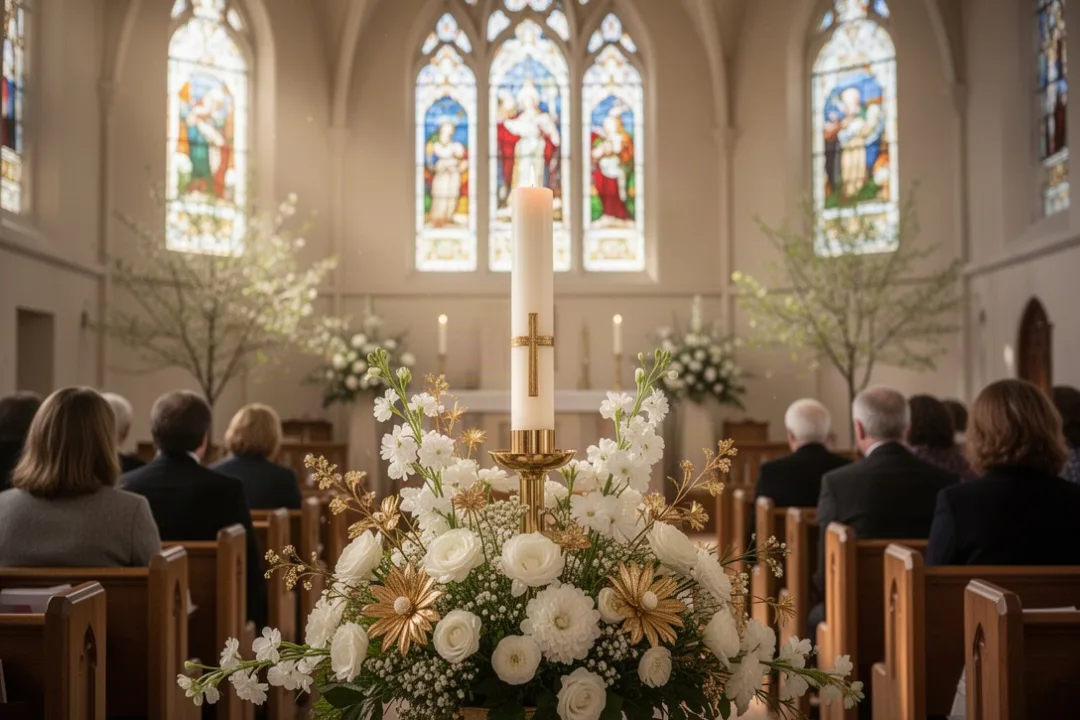
Lighting the Paschal candle, a large candle representing the risen Christ’s light.
Renewing baptismal promises or recalling the meaning of baptism.
Using resurrection hymns and other festive music throughout the season.
Reading from Acts and the Gospel accounts of Jesus’ resurrection appearances.
Celebrating Holy Communion as a sign of shared life in the risen Christ.
Decorating the sanctuary with white flowers, candles, banners, or other seasonal symbols.
The Paschal candle has a particularly prominent role in several traditions. It is often lit during the Easter Vigil and remains in a visible place throughout Eastertide. After Pentecost, it may be moved to another location in the church and used especially at baptisms and funerals, linking those occasions with the resurrection hope celebrated during Easter.
Some churches use the season to emphasize a pattern of learning and formation. New Christians may receive instruction after baptism, while the whole congregation explores what it means to live as a resurrection people. Sermons may focus on forgiveness, reconciliation, courage, service, community, and the promise that death does not have the final word.
The biblical themes behind Eastertide
Eastertide is based on more than the single account of the empty tomb. The New Testament presents a sequence of events: Jesus is raised, appears to his followers, teaches them, commissions them, ascends, and sends the Holy Spirit. The season follows that broad movement and asks how the first disciples were changed by what they experienced.
The Gospel accounts describe different encounters with the risen Jesus. Mary Magdalene and other women discover the empty tomb in the Gospel narratives, and the disciples later encounter Jesus in various settings. The details differ among Matthew 28, Mark 16, Luke 24, and John 20–21, but each account points to the same central Christian claim: Jesus has been raised.
Another major theme is the transformation of the disciples. Before Easter, the Gospel stories portray followers who are frightened, confused, grieving, or uncertain. After their encounters with the risen Jesus and the coming of the Holy Spirit, Acts presents them as people who speak publicly, care for one another, and carry the message beyond Jerusalem.
The season also highlights recognition. In several resurrection narratives, people do not immediately understand who Jesus is. They recognize him through a voice, an explanation of Scripture, a shared meal, or a familiar action. These scenes invite Christians to consider how faith may grow through worship, community, Scripture, and acts of love.
Mission becomes increasingly important as Eastertide continues. The risen Jesus sends his followers to teach and make disciples, a commission expressed in Matthew 28. In John 20, Jesus connects the disciples’ sending with the gift of the Holy Spirit. The message is not meant to remain private; resurrection leads to testimony and service.
Ascension adds another dimension. The New Testament accounts do not describe Jesus’ departure as the cancellation of his presence or the end of his work. Instead, they connect the ascension with the disciples’ responsibility and with the promised arrival of the Holy Spirit. Eastertide thus makes room for both celebration of Christ’s reign and recognition of the church’s calling.
Pentecost completes the season by focusing on the Holy Spirit. In Acts 2, the Spirit empowers the disciples and enables communication across language and cultural boundaries. The event is often understood as the beginning of the church’s public mission, which is why Pentecost serves as a fitting climax to Eastertide.
How the season develops: Eastertide moves through a clear pattern—Jesus is raised, the disciples encounter and learn from him, he commissions them, and the Holy Spirit empowers them for witness.
How Eastertide differs across Christian traditions
The basic idea of Eastertide appears across many Christian traditions, but the name and emphasis are not universal. Roman Catholic, Anglican, Episcopal, Lutheran, Methodist, and other liturgical churches often describe the period formally as the Easter season or Eastertide. Churches with less structured liturgical calendars may celebrate the resurrection for several weeks without using the term.
In the Roman Catholic Church, the Easter season runs from the Easter Vigil or Easter Sunday through Pentecost. The liturgy emphasizes the Paschal Mystery—the suffering, death, resurrection, and glorification of Christ. The season is also a traditional time for Christian initiation, including baptism, confirmation, and first Communion for people who have prepared through the catechumenate.
In Anglican and Episcopal churches, Eastertide is usually a major season of the liturgical year. The Easter Vigil, baptismal renewal, white or gold vestments, Ascension, and Pentecost all commonly have a place in the calendar. The exact terminology and local customs depend on the church’s prayer book and parish practice.
Many Protestant churches observe the weeks after Easter through sermon series, resurrection hymns, communion, baptism, and readings from Acts. Some use the formal seasons and colors of the church year, while others focus on Easter Sunday and then continue teaching about the resurrection without calling the period Eastertide.
Eastern Orthodox Christians also celebrate a season extending from Pascha, the Orthodox name for Easter, to Pentecost. Orthodox Pascha often falls on a different date from Western Easter because many Orthodox churches use a different calendar method for calculating the feast. The season includes its own distinctive services, hymns, fasting customs, and commemorations.
The differences do not mean that one church has a completely separate understanding of the season. They reflect different calendars, worship traditions, and ways of organizing the Christian year. If you are trying to identify the dates in a particular church, check that denomination’s calendar rather than relying only on a general Easter date.
You do not need to belong to a church with a formal liturgical calendar to observe Eastertide. The 50-day period can provide a practical rhythm for continuing the celebration of Easter after the holiday weekend. The focus is not on keeping decorations in place for a prescribed number of days, but on giving sustained attention to resurrection faith and its effect on daily life.
A simple home practice is to read one resurrection or early-church passage each week. You might begin with one of the Gospel accounts and then read selected passages from Acts. Pay attention to how the disciples respond to fear, loss, forgiveness, community, and responsibility.
You can also mark the season through prayer and ordinary actions:
Keep a weekly Easter prayer: Give thanks for new life, ask for courage, and pray for people who need hope or restoration.
Notice signs of renewal: Look for opportunities to repair a relationship, begin a helpful habit, or support someone who is struggling.
Practice shared celebration: Eat with family, friends, or members of your congregation as a reminder that Christian faith is lived in community.
Serve someone else: Choose a practical act of care, such as preparing a meal, visiting someone who is isolated, or helping with a local need.
Prepare for Pentecost: Pray about your gifts, responsibilities, and the ways you can contribute to the life of your community.
The season can also help you avoid treating Easter as only a cultural holiday. Easter eggs, family meals, and spring clothing may be meaningful traditions, but Eastertide directs attention to the resurrection’s continuing significance. It asks what changed because of Easter and how that change should shape the way Christians live with one another.
For families, a short weekly practice may work better than a lengthy daily plan. Read a Gospel passage, light a candle safely, sing a hymn, or talk about one question: What does new life look like here? The answer may involve forgiveness, generosity, courage, patience, or renewed commitment to a faith community.
The weeks after Easter can also be a time to learn the basic shape of the Christian year. Seeing the connection among Lent, Holy Week, Eastertide, Ascension, and Pentecost makes the calendar easier to understand. Each season has its own emphasis, but together they tell a continuing story of Christ’s death, resurrection, presence, and mission through the church.
Ultimately, Eastertide is a season for letting Easter extend beyond one date on the calendar. It begins with the resurrection and moves toward a community empowered to live and speak in light of it. Its final Sunday, Pentecost, sends the church forward with a message of hope, a responsibility to serve, and trust in the Spirit’s work.
Frequently asked questions
Is Eastertide the same thing as the Easter holiday?
Not exactly. Easter usually refers to Easter Sunday and the surrounding observances, while Eastertide means the longer church season that begins on Easter Sunday and continues for 50 days through Pentecost. Easter is the central feast within Eastertide, which gives churches additional time to explore the resurrection and its meaning for Christian life.
Does Eastertide last 40 or 50 days?
Eastertide lasts 50 days, counting Easter Sunday as the first day and Pentecost Sunday as the fiftieth. The number 40 is associated with the period from Easter to Ascension Day, traditionally observed on the fortieth day. Ascension occurs within Eastertide; it does not mark the season’s end.
Why do some churches use the term “Easter season” instead?
“Easter season” is a clearer modern phrase for the same general period. “Eastertide” comes from older English usage, in which “-tide” means a season or time. Liturgical churches may use either term, while churches with less formal calendars may celebrate the weeks after Easter without giving them a specific seasonal name.
What is the connection between Eastertide and Pentecost?
Pentecost is the final day of Eastertide and provides its climax. Easter celebrates Jesus’ resurrection, while Pentecost commemorates the Holy Spirit coming upon the disciples and empowering their public mission. The sequence shows how the first Christians moved from encountering the risen Jesus to becoming an active, witnessing community.











Leave a Reply