Pentecost Sunday is May 24, 2026, for most Western Christian churches. It comes 50 days after Easter Sunday, which falls on April 5, 2026.
In Eastern Orthodox churches, Pentecost is observed on May 31, 2026, because Orthodox Easter falls later that year. The difference comes from the calendars and Easter calculation used by each Christian tradition.
The date of Pentecost is tied directly to the date of Easter. In the Western Christian calendar, Easter Sunday in 2026 is April 5. Counting Easter as day one, Pentecost arrives seven weeks later, on Sunday, May 24.
The name Pentecost comes from a Greek word meaning “fiftieth.” The holiday is traditionally described as the fiftieth day of Easter, although the counting method is often explained as 50 days after Easter Sunday.
Pentecost always falls on a Sunday in the Western liturgical calendar. It is also known as Whitsunday in some English-speaking traditions, although that name is more common in certain churches and regions than in everyday American usage.
Quick answer: Western Pentecost is Sunday, May 24, 2026. Orthodox Pentecost is Sunday, May 31, 2026.
What Pentecost commemorates in Christianity
Pentecost commemorates the descent of the Holy Spirit upon Jesus’ apostles and other disciples. The account appears in Acts 2, where the disciples gather in Jerusalem and experience signs associated with the Spirit, including a powerful sound, what appears like flames, and the ability to speak in languages they had not previously known.
People from many regions hear the disciples speaking and understand them in their own languages. The event is presented as a public proclamation of the Christian message and as a moment when the disciples begin to speak openly about Jesus after his death, resurrection, and ascension.
Many Christians call Pentecost the birthday of the church. That phrase does not mean that Christianity began as a fully organized institution on one precise day. Rather, it describes Pentecost as the moment when the disciples receive power for their mission and the Christian community begins its public witness in a new way.
The story emphasizes that the message is heard across language and cultural boundaries. For many churches, this makes Pentecost a celebration of unity in diversity, communication, mission, and the continuing work of the Holy Spirit in the church.
How the Bible describes the first Pentecost
The main biblical account is found in Acts 2:1–41. It takes place during the Jewish festival of Shavuot, called the Feast of Weeks in the Hebrew Bible. Jerusalem is filled with Jewish pilgrims who have come from different parts of the Mediterranean world and beyond.
Acts describes the disciples as being together when a sound like a strong wind fills the house. Something resembling tongues of fire appears over them, and they begin speaking in other languages. The passage connects these signs with the Holy Spirit rather than presenting them as ordinary human skill.
Peter then addresses the crowd. His speech explains the event in light of the Hebrew Scriptures and proclaims Jesus as the risen Messiah. Acts says that many listeners respond to the message and are baptized, creating a large and visible community of believers in Jerusalem.
Bible passages connected with Pentecost commonly include Acts 2, John 14–16, and 1 Corinthians 12. These passages discuss the Holy Spirit’s presence, guidance, gifts, and role in forming the Christian community. Churches may select different readings depending on their denomination and worship calendar.
How Pentecost relates to Easter and the Ascension
Pentecost is part of a larger sequence in the Christian year. Easter celebrates Jesus’ resurrection. The Ascension commemorates his departure from the disciples and is traditionally observed 40 days after Easter. Pentecost follows 10 days after the Ascension, making it the fiftieth day of the Easter season.
Some churches transfer Ascension Day to the following Sunday so more worshipers can attend. That local scheduling choice does not change the date of Pentecost, which remains May 24 in Western calendars in 2026.
The sequence gives the season a theological shape. Easter focuses on resurrection, the Ascension points to Christ’s exaltation and continuing presence with God, and Pentecost focuses on the Spirit’s work among the disciples and the church.
Why Western and Orthodox Pentecost dates can differ
Western churches generally calculate Easter using the Gregorian calendar. Eastern Orthodox churches use a different traditional calculation, often based on the Julian calendar and related rules for determining Easter. Since Pentecost is counted from Easter, a different Easter date produces a different Pentecost date.
In 2026, Western Easter is April 5, while Orthodox Easter is April 12. As a result, Western Pentecost is May 24, and Orthodox Pentecost is May 31.
The Orthodox celebration is also called Holy Trinity Sunday in some traditions, particularly in connection with the liturgical observance on the day after Pentecost. Customs and names vary among Eastern Orthodox churches, Oriental Orthodox communities, and Eastern Catholic churches.
When checking a church bulletin or local event listing, use the calendar of that particular congregation. A church’s tradition, country, and liturgical practice can affect the name used for the feast and the services held around it.
What happens during Pentecost worship
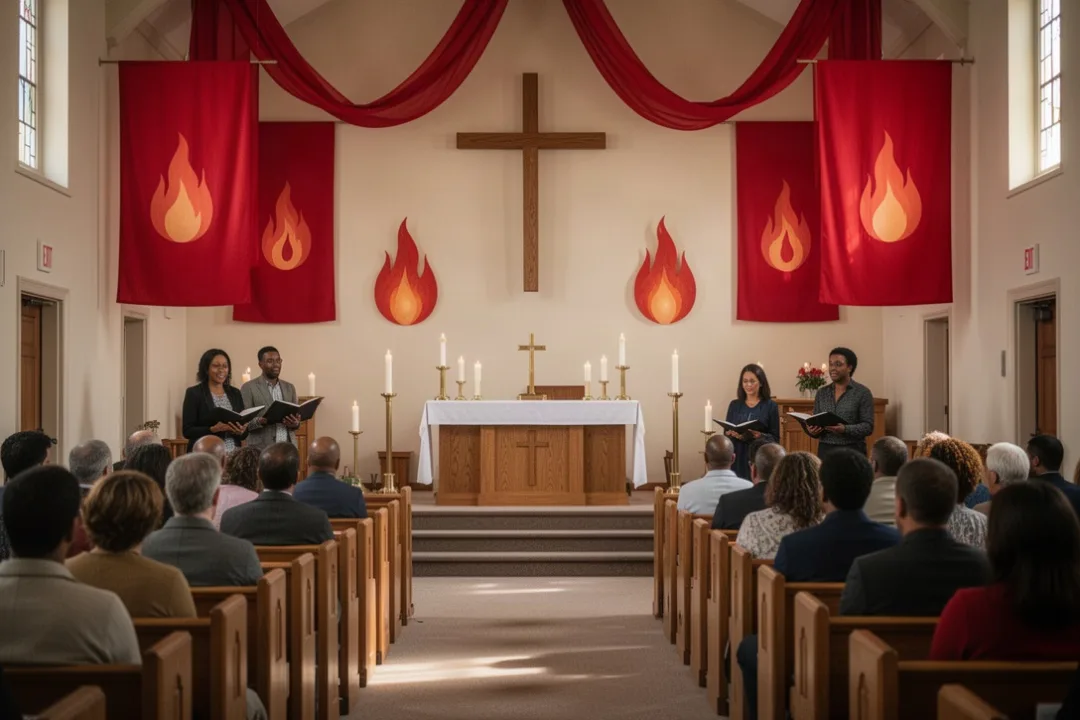
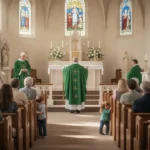
Worship practices differ, but many churches use red vestments, banners, or flowers to represent fire and the work of the Holy Spirit. Red is especially common in Catholic, Anglican, Lutheran, and other liturgical churches, though a congregation may use different colors or decorations.
Readings often come from Acts 2 and focus on the coming of the Spirit. Hymns and prayers may mention wind, fire, breath, spiritual gifts, witness, and the church’s mission. Some services include a renewal of baptismal promises or a special prayer for the Spirit’s guidance.
Churches may also highlight the many languages represented in their congregation. A service could include Scripture readings, prayers, music, or greetings in several languages. This practice reflects the Pentecost account’s emphasis on people hearing the message in languages they understand.
In some congregations, Pentecost is connected with baptisms, confirmations, and receptions into membership. These ceremonies fit the themes of new life, spiritual growth, and belonging to the Christian community, although they are not required for every Pentecost service.
Children’s programs may use simple symbols such as paper flames, wind, doves, or many-colored streamers. Adults may participate in prayer services, educational programs, community meals, or mission projects. The form changes from church to church, but the central focus remains the Holy Spirit and the church’s calling.
What the symbols of Pentecost mean
Fire represents God’s presence and transformation
Fire is one of the most recognizable Pentecost symbols because Acts describes something like flames appearing over the disciples. Fire can suggest God’s presence, purification, courage, and energy. It also conveys the idea that the Spirit changes the disciples from fearful followers into public witnesses.
Church decorations may use candles, red fabric, or flame-shaped designs. These symbols point back to the biblical account without claiming that every modern service should recreate the event physically.
Wind represents the Spirit’s unseen power
The sound in Acts is compared with a strong wind. Wind cannot be seen directly, but its movement can be felt and its effects can be observed. For Christians, this makes wind a fitting symbol for the Holy Spirit’s invisible but active presence.
Some congregations use fabric, fans, or moving streamers in children’s lessons to illustrate wind. These teaching tools are symbolic and should support the biblical message rather than replace it.
Many languages represent a worldwide message
The disciples’ speech in different languages is central to the Pentecost account. The point is not simply that a miraculous linguistic ability appeared. The event shows the Christian message being heard by people from many places and cultures.
For many churches, this symbol encourages hospitality, translation, cross-cultural ministry, and respect for different communities. It can also prompt a congregation to ask whether its worship and outreach are accessible to the people who live nearby.
The dove points to the Holy Spirit
A dove is often used as a Christian symbol for the Holy Spirit, especially because of the Spirit’s association with Jesus’ baptism in the Gospel accounts. However, the Acts 2 Pentecost narrative emphasizes wind and fire rather than a dove.
Using a dove at Pentecost is therefore a broader Christian symbol, not a direct detail from the main Pentecost scene. Churches may use several symbols together to teach about the Spirit across different passages of the Bible.
Practical ways to observe Pentecost in 2026
You do not need to belong to a particular denomination to learn about Pentecost or attend a service. Churches often welcome visitors, but their schedules and customs differ. Check the congregation’s website or call ahead for service times, especially if you are looking for a baptism, multilingual service, or community event.
Useful ways to mark Pentecost include:
Attend worship on May 24, 2026, or on the date observed by your church.
Read Acts 2 and compare it with passages about the Holy Spirit in John and 1 Corinthians.
Pray for wisdom, courage, compassion, and guidance in serving other people.
Learn about the languages and cultures represented in your community.
Support a local ministry that helps immigrants, refugees, students, or people experiencing hardship.
Use red flowers, candles, or artwork to create a simple Pentecost display at home.
Talk with children about how people can be united without all being identical.
Ask your church how it recognizes spiritual gifts and encourages members to use them responsibly.
Some families prepare a meal that reflects several cultures or invite neighbors from different backgrounds. Others spend time volunteering or praying for churches and Christian communities around the world. These practices connect Pentecost’s biblical themes with ordinary acts of welcome and service.
Planning tip: If you are attending a church for the first time, confirm whether it follows the Western or Orthodox calendar. In 2026, that determines whether its main Pentecost service is May 24 or May 31.
Common Pentecost date mistakes to avoid
Pentecost is easy to misdate because its position depends on Easter, and the words “50 days after Easter” can create a counting question. The following checks help you identify the correct date for your church or event.
Do not count 50 ordinary calendar days after Easter without checking the convention. Pentecost is the fiftieth day of the Easter observance, which places it seven weeks after Easter Sunday.
Do not assume every Christian church uses the same date. Western and Orthodox traditions can celebrate Pentecost on different Sundays.
Do not confuse Pentecost with Ascension Day. Ascension Day is traditionally 40 days after Easter; Pentecost is 50 days after Easter.
Do not rely on a recurring annual date. Pentecost moves each year because Easter moves.
Do not mistake Shavuot for the Christian feast itself. Pentecost has historical and biblical connections with Shavuot, but the observances belong to different religious traditions.
Do not assume a local service will happen on the exact feast day. Some churches move celebrations, combine services, or hold related events on another weekend.
A simple way to verify the date is to identify Easter for the calendar your church uses and count seven Sundays, beginning with Easter Sunday. For Western Christianity in 2026, those Sundays are April 5, April 12, April 19, April 26, May 3, May 10, May 17, and May 24.
How Pentecost differs from the Jewish festival of Shavuot
Pentecost is related historically to Shavuot, the Jewish Feast of Weeks. In the Hebrew Bible, Shavuot is associated with the grain harvest and is later connected in Jewish tradition with the giving of the Torah. Acts places the first Christian Pentecost during this Jewish festival.
The shared timing is significant because Jerusalem was crowded with Jewish pilgrims when the disciples received the Holy Spirit. Acts uses that setting to show the message reaching people from many regions and language groups.
Christian Pentecost and Jewish Shavuot are not interchangeable holidays. They have different theological meanings, liturgical practices, and communities of observance. Respectful explanation should recognize the connection without treating one celebration as simply another form of the other.
What Pentecost means for Christian life today
For Christians, Pentecost is more than a date on the church calendar. It asks how the church receives guidance, speaks truthfully, serves its neighbors, and makes room for people from different backgrounds. The celebration links spiritual life with public responsibility.
The biblical account presents the disciples as people who need courage and direction. Pentecost marks a change in how they act: they move from waiting together in uncertainty to speaking and serving as a community. Many Christians therefore connect the feast with renewed commitment to worship, witness, justice, mercy, and reconciliation.
The emphasis on spiritual gifts also shapes Christian teaching. First Corinthians 12 describes different gifts and forms of service within one body. The passage is commonly interpreted as a reminder that a church needs many kinds of contributions, not just one kind of leader or ability.
Pentecost can also encourage a church to examine how it communicates. If people are supposed to hear and understand, then clear language, hospitality, translation, accessible spaces, and attention to those who are often overlooked become practical expressions of the feast’s themes.
Dates connected with Pentecost in 2026
The main Western observances surrounding Pentecost include several dates that may appear on church calendars:
Sunday, April 5: Easter Sunday and the beginning point for counting the Pentecost season.
Thursday, May 14: Ascension Day, traditionally observed 40 days after Easter.
Sunday, May 24: Pentecost Sunday in Western Christianity.
Monday, May 25: The day after Pentecost, which may be observed in some churches or countries with special services.
In Eastern Orthodox calendars, the corresponding Pentecost Sunday in 2026 is May 31. Some Orthodox communities observe the Monday after Pentecost as Holy Spirit Monday, while other churches may use different names or customs.
If you are making travel plans, arranging a baptism, or looking for a special service, verify the congregation’s schedule rather than relying only on a general holiday calendar. Pentecost is a major feast, but local programs may extend across several days or be celebrated on a nearby weekend.
Frequently used names for the holiday
Pentecost Sunday is the clearest name in American English. You may also see Whitsunday, especially in Anglican, Episcopal, or historic English Christian contexts. Some traditions refer to the feast as the Descent of the Holy Spirit.
In Orthodox settings, the feast may be called Trinity Sunday or the Feast of Pentecost, depending on the calendar and local custom. The day after Pentecost can have a separate name and observance.
These labels generally point to the same central Christian event, but they do not guarantee identical worship practices. The most reliable clue is the tradition of the church using the term.
For Western Christians, the direct answer remains May 24, 2026. For Orthodox Christians following the later Easter date, it is May 31, 2026. Both dates commemorate Pentecost according to their respective liturgical calendars.
Frequently asked questions
Is Pentecost always on a Sunday?
In the Western Christian calendar, Pentecost is observed on a Sunday. Its date moves because it is calculated from Easter, but the feast itself remains a Sunday celebration. In 2026, Western Pentecost is May 24. Eastern Orthodox churches also celebrate Pentecost on Sunday, May 31, although local services and related observances may continue on the following day.
How many days after Easter is Pentecost?
Pentecost is traditionally the fiftieth day of the Easter season. It is commonly described as occurring 50 days after Easter Sunday, or seven weeks after Easter. The counting can sound confusing because some people count Easter as the first day, but the practical calendar result is May 24, 2026, for Western Christianity.
Is Pentecost a federal holiday in the United States?
No. Pentecost is an important Christian observance, but it is not a U.S. federal holiday. Churches may hold special worship services, baptisms, meals, or community programs, while schools, businesses, and government offices generally follow their normal schedules unless another local holiday applies.
What color is associated with Pentecost?
Red is the color most commonly associated with Pentecost in churches that use liturgical colors. It represents fire, energy, and the Holy Spirit. Some congregations use red clothing, altar coverings, banners, flowers, or candles. Practices vary, and churches without a formal liturgical color system may use different visual symbols.












Leave a Reply