The Feast of the Sacred Heart 2026 will be celebrated on Friday, June 12, 2026. In the Roman Catholic calendar, this solemnity is observed on the Friday after the second Sunday after Pentecost, which places it on June 12 in 2026.
The feast honors the merciful love of Jesus Christ, represented by his Sacred Heart. It is commonly marked by Mass, Eucharistic adoration, the Litany of the Sacred Heart, personal prayer, and acts of charity. Some parishes also hold a novena leading up to the feast or celebrate it as a patronal day.
Why the Feast of the Sacred Heart falls on June 12, 2026
The date of this feast changes each year because it is linked to Pentecost, rather than a fixed date on the civil calendar. Pentecost Sunday in 2026 falls on May 24. The second Sunday after Pentecost is June 7, so the Solemnity of the Most Sacred Heart of Jesus is the following Friday, June 12.
The sequence can be followed simply:
Easter Sunday begins the calculation of the movable Easter season.
Pentecost Sunday is celebrated on May 24, 2026.
The second Sunday after Pentecost falls on June 7.
The Feast of the Sacred Heart is observed on Friday, June 12.
Date to remember: The Feast of the Sacred Heart is Friday, June 12, 2026. Local parish schedules may include a vigil, novena, procession, or special Mass at a different time.
What the Sacred Heart represents in Catholic devotion
The Sacred Heart is a visible symbol of Jesus’ love for humanity. Catholic devotion does not treat the heart as merely a physical organ or decorative image. It points to the whole inner life of Christ: his compassion, mercy, faithfulness, suffering, generosity, and complete relationship with the Father.
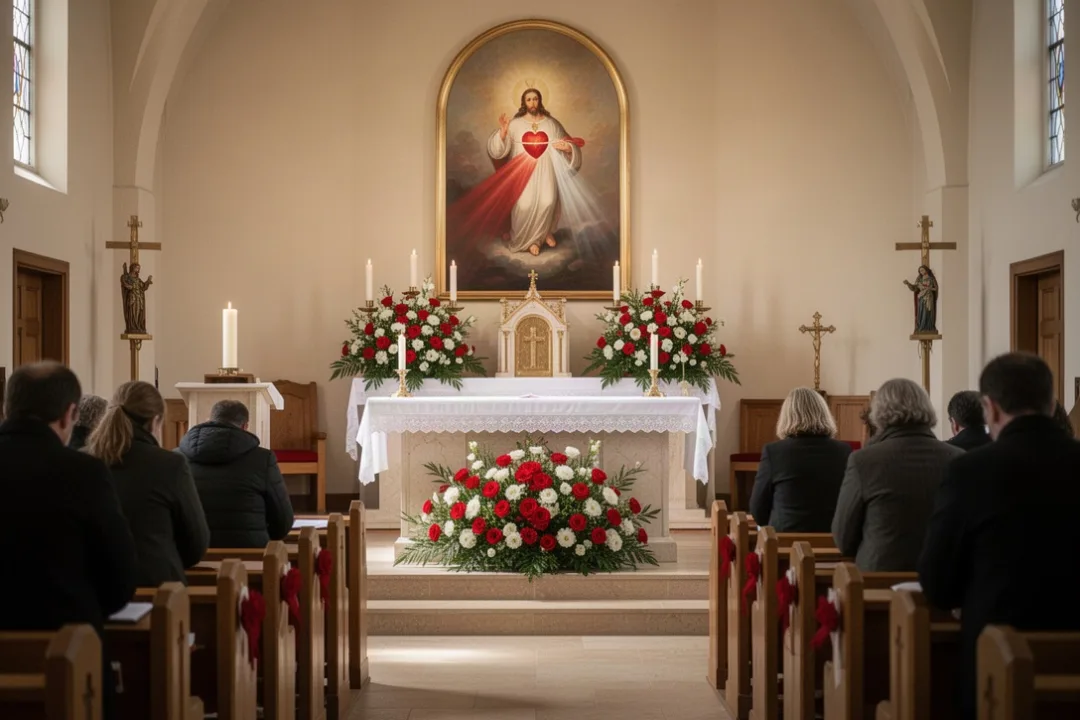
Images of the Sacred Heart often show a heart surrounded by light, crowned with thorns, marked by a cross, and burning with flame. Each element communicates part of the devotion. The flame suggests ardent love; the thorns recall human sin and rejection; the cross points to Christ’s sacrifice; and the light expresses the love that continues to reach the world.
The heart is also shown outside or visibly presented because the devotion emphasizes a love that is given openly. The image invites a response: trust in Christ, gratitude for his mercy, repentance for sin, and practical love toward other people.
How to observe the Feast of the Sacred Heart in 2026
You do not need an elaborate event to keep the feast meaningfully. The central practice is to turn your attention toward Christ’s love and allow that prayer to shape your choices. A parish Mass is the ordinary starting point, but private prayer and service can also be part of the day.
A simple plan for June 12 might include these steps:
Check the local Mass schedule. The feast is a solemnity, so many parishes offer an additional morning or evening Mass.
Read the appointed Scripture passages. Reflect on what they reveal about Christ’s love, sacrifice, and invitation to remain close to him.
Pray before an image of the Sacred Heart. This can be in a church, at home, or in another quiet place.
Make an act of trust or repentance. Bring a particular fear, sin, grief, or relationship to Christ honestly.
Choose one work of mercy. Visit someone who is isolated, forgive an injury, give practical help, or support a person in need.
End the day with thanksgiving. Name specific gifts rather than offering only a general prayer.
Families can mark the feast with a short prayer at home, a meal shared without distractions, or an act of kindness chosen together. A household may place a Sacred Heart image in a prayer space, but the image is meant to lead people to prayer rather than replace it.
Prayers commonly associated with the Sacred Heart
Several traditional prayers are connected with this feast. The Litany of the Sacred Heart of Jesus uses a series of titles that praise Christ as patient, holy, generous, and rich in mercy. It can be prayed alone or with a group, especially after Mass or during Eucharistic adoration.
An Act of Consecration to the Sacred Heart offers a person, family, or community to Christ. The wording varies among approved versions, but the basic intention is to place one’s life under Christ’s loving care and to seek a more faithful response to his grace.
The Prayer of Trust in the Sacred Heart is often used by people facing anxiety, illness, family conflict, or uncertainty. It does not promise that every difficulty will disappear. Instead, it expresses confidence that Christ remains present and that his mercy is stronger than fear.
You can also pray in your own words. A brief prayer may be enough:
Jesus, make my heart more faithful to your love and more attentive to the needs of others.
Personal prayer is especially useful when it becomes specific. Rather than thinking only about the idea of love, ask where you have resisted forgiveness, ignored someone’s need, or allowed resentment to shape your behavior. Then ask for the grace to take one concrete step.
The biblical meaning behind the Sacred Heart
The Bible does not present the Sacred Heart as a separate object of worship. Instead, the devotion grows from biblical themes about Christ’s compassion, self-giving, and wounded love. The Gospel accounts show Jesus responding to suffering, welcoming those pushed aside, weeping at death, and giving himself for the salvation of others.
John’s Gospel describes the piercing of Jesus’ side after his death and connects the scene with Scripture. Catholic tradition sees this image of the open side as closely related to the Sacred Heart: Christ’s life is poured out, and his love is offered without reserve. The passage is read at the feast because it directs attention to the crucified Lord rather than to sentiment alone.
Other readings associated with the solemnity emphasize God’s care for his people, Christ’s humility, and the invitation to learn from him. References may include Deuteronomy 7:6-11, Ephesians 3:8-19, and John 19:31-37, depending on the liturgical cycle and local lectionary. These passages should be read in context and prayed with rather than treated as isolated quotations.
The biblical picture of love is active. It includes mercy, patience, sacrifice, truth, and a willingness to serve. Devotion to the Sacred Heart therefore asks more than emotional comfort. It asks whether your relationships, priorities, and treatment of vulnerable people reflect the love you say you have received from Christ.
How the devotion developed through Christian history
Christians have long reflected on Jesus’ heart as a sign of his love. Early Christian writers and medieval theologians spoke about the heart of Christ in connection with the Incarnation, the Passion, and the Eucharist. Their reflections helped establish a language of prayer centered on Christ’s inner life and saving love.
In the medieval period, women such as Saint Mechtilde of Hackeborn and Saint Gertrude the Great were associated with strong devotion to Christ’s heart. Their spiritual writings encouraged prayerful attention to Christ’s compassion and closeness. The devotion continued to develop through the work of other saints and religious communities.
Saint Margaret Mary Alacoque, a seventeenth-century Visitation nun in France, became especially associated with the modern spread of the devotion. Her spiritual experiences and the guidance of Saint Claude de la Colombière helped encourage wider observance, including prayer, reparation, and reception of the Eucharist.
The devotion gained a distinct liturgical place gradually. The feast was extended more broadly in the Catholic Church in the nineteenth century, and Pope Pius IX established it as a solemnity. The calendar and liturgical wording have developed over time, but the central focus remains Christ’s love revealed through his life, death, and resurrection.
Keep the focus balanced: Sacred Heart devotion is not simply about a religious image or a list of promises. Its purpose is to draw you toward Christ, the sacraments, conversion, mercy, and loving service.
What the Sacred Heart promises mean
Many Catholics encounter a list of the Twelve Promises of the Sacred Heart, traditionally connected with Saint Margaret Mary Alacoque. These promises are often presented as assurances of grace, peace, blessing, consolation, and spiritual help for those devoted to Christ’s heart.
They should be understood within the wider Catholic teaching about prayer and discipleship. They are not a formula for guaranteed success, protection from every illness, or freedom from hardship. Christian prayer does not turn devotion into a transaction in which a particular practice obliges God to provide a desired result.
The promises are better read as encouragement to trust Christ’s mercy and to remain faithful. They point toward conversion, perseverance, sacramental life, and final union with God. A person may receive comfort through the devotion, but the deepest gift is a heart gradually reshaped by grace.
If you use a traditional promise list, read it alongside the Gospels and the teaching of your parish or diocese. Avoid interpretations that suggest a medal, picture, or prayer guarantees material prosperity. The Sacred Heart points to a relationship with Christ, not a spiritual shortcut.
The role of the First Friday devotion
The Feast of the Sacred Heart is closely connected with the First Friday devotion. Catholics who practice it commonly attend Mass, receive Communion, spend time in prayer, and offer reparation on the first Friday of each month for a series of consecutive months. The exact customs vary, and the practice should be shaped by sound pastoral guidance.
In 2026, the first Fridays include January 2, February 6, March 6, April 3, May 1, June 5, and July 3. June 5 is a First Friday, one week before the feast. The feast itself is June 12, so it is not a First Friday even though it has the same Sacred Heart focus.
Some people begin or renew a First Friday practice during the month of the feast. A good observance includes more than attending a ritual mechanically. It can involve examining your conscience, receiving the Sacrament of Reconciliation when appropriate, praying for those who suffer, and making a deliberate effort to practice Christlike love.
Attend Mass when your schedule and health permit.
Receive the Eucharist reverently according to Catholic teaching and your parish’s guidance.
Spend quiet time in prayer instead of treating the practice as a rushed obligation.
Repair harm where possible through an apology, restitution, or patient service.
Continue the devotion through ordinary life, especially in difficult relationships.
Ways parishes and communities may celebrate June 12
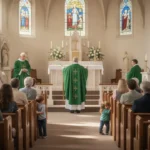
Parish observances differ, but a special Mass is usually the most visible feature. A church may include the Litany of the Sacred Heart, exposition of the Blessed Sacrament, a period of adoration, or a blessing with the Eucharist. Some communities organize a procession or a shared meal after the liturgy.
Religious communities and Catholic schools may use the feast to teach about mercy and service. Students might pray for people who are sick or lonely, collect supplies for a shelter, or write notes of encouragement. Adults may organize a visit to a nursing facility or support a local food pantry.
If your parish has no special event, you can still observe the day fully. Attend the scheduled Mass, set aside fifteen or twenty minutes for prayer, and choose a concrete act of charity. The strength of the feast does not depend on the size of the gathering.
Contact the parish office or check its bulletin in the weeks before June 12. Schedules can change because of weddings, school calendars, clergy availability, or diocesan events. A nearby parish may offer adoration or an evening service if your own church has only its regular Mass schedule.
Ideas for a personal or family observance
A home observance works best when it is simple enough to complete and meaningful enough to remember. You might begin with a short reading from one of the Gospel accounts of Jesus’ Passion, followed by silence. Each person can then name one way Christ has shown mercy and one way the family can show mercy during the coming week.
Consider these practical options:
Place a Sacred Heart image in a clean, quiet prayer area for the month of June.
Pray the Lord’s Prayer and the Litany of the Sacred Heart together.
Call a relative or friend who may be lonely.
Prepare a meal for someone who is ill, grieving, or overwhelmed.
Set aside money for a parish charity or a trusted local service organization.
Ask forgiveness for a specific wrong instead of offering only a general apology.
Spend time in Eucharistic adoration if a nearby church offers it.
Children can understand the feast through the language of love that is kind, brave, patient, and generous. Avoid presenting the Sacred Heart only as a picture to memorize. Help children connect the symbol with actions such as telling the truth, including someone left out, caring for a sibling, and praying for people who are suffering.
Common misunderstandings about the Feast of the Sacred Heart
One misunderstanding is that the feast celebrates only Christ’s physical heart. The physical image matters because Christianity affirms that Jesus truly became human, suffered, and died. Yet the devotion also speaks about his personal love and will, so it includes the whole mystery of Christ rather than one part of his body considered in isolation.
Another misunderstanding is that the feast is primarily a celebration of romantic or emotional affection. The love represented by the Sacred Heart is personal and tender, but it is also holy, sacrificial, truthful, and directed toward the salvation and dignity of every person.
Some people also assume that special prayers remove the need for ordinary Christian responsibilities. They do not. Devotion should lead to Mass, moral conversion, forgiveness, care for the poor, and respectful treatment of others. If a practice makes someone less compassionate or more superstitious, it has been separated from the purpose of the feast.
Finally, the feast is not identical to the memorial of the Immaculate Heart of Mary. The two observances are closely related in the Catholic calendar, but they honor different mysteries. The Immaculate Heart of Mary is celebrated on the Saturday after the Solemnity of the Sacred Heart, which in 2026 falls on June 13.
How the Feast of the Sacred Heart can shape ordinary life
The most lasting observance continues after June 12. The feast asks you to consider what kind of heart you are forming through repeated choices. Prayer can reveal resentment that needs healing, indifference that needs correction, or fear that needs to be entrusted to God.
A practical way to continue the devotion is to select one virtue connected with Christ’s heart: patience, compassion, courage, humility, purity of intention, or forgiveness. Identify a situation where that virtue is needed, and revisit the choice in prayer each day for a week.
Another practice is to connect devotion with the corporal and spiritual works of mercy. Feed someone who lacks food, visit the sick, comfort a grieving person, teach patiently, correct a wrong with gentleness, or pray for someone who has no one else to pray for. These actions give visible form to the love represented by the Sacred Heart.
The June 12 feast offers a clear annual opportunity to return to the center of Christian faith: God’s love is revealed in Jesus Christ and received through trust, repentance, worship, and service. A quiet Mass, a sincere prayer, and one merciful action can provide a fitting way to keep the day.
Frequently asked questions
Is the Feast of the Sacred Heart a holy day of obligation in 2026?
The feast is a solemnity, but it is not generally one of the universal holy days of obligation for Catholics. Attendance at Mass is strongly encouraged, and a diocese or religious community may have its own customs. Check your parish or diocesan calendar for local guidance, particularly if the feast is celebrated with a special evening liturgy.
What color does the priest wear for the Feast of the Sacred Heart?
White is normally used for the Solemnity of the Most Sacred Heart of Jesus because it is a celebration of the Lord. Liturgical practice can vary in details according to the Roman Catholic calendar and local customs. The sanctuary, vestments, music, and devotional images may also reflect the feast’s emphasis on Christ’s love and mercy.
Can I begin a Sacred Heart novena before June 12, 2026?
Yes. A commonly used novena begins nine days before the feast, although different prayer traditions use different schedules and texts. You can pray the Litany of the Sacred Heart, read a Gospel passage, or offer a personal prayer each day. A novena is an aid to preparation, not a requirement for celebrating the solemnity.
Is the Sacred Heart devotion only for Catholics?
The feast belongs specifically to the Catholic liturgical calendar, but anyone may learn about its themes of compassion, forgiveness, sacrifice, and care for others. Christians from other traditions may find related biblical ideas meaningful. If you are attending a Catholic Mass as a visitor, follow the parish’s guidance about receiving Communion and participating in devotional practices.













Leave a Reply