Sacred Heart of Jesus: meaning, history, and devotion
Sacred Heart of Jesus: meaning, history, and devotion
The Sacred Heart of Jesus represents Christ’s human and divine love, offered to humanity with compassion, mercy, and complete self-giving.
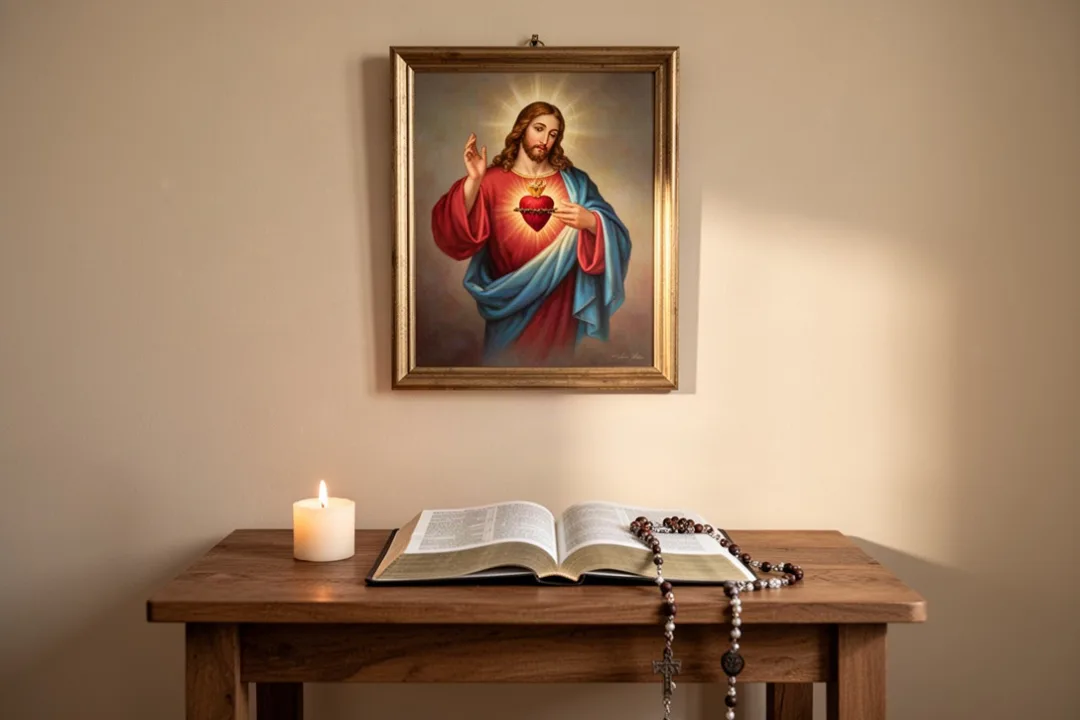
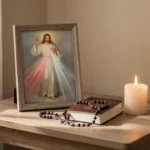
In Catholic devotion, the heart is not treated as a sentimental symbol separated from Jesus himself. It points to the whole person of Christ: his love for the Father, his concern for every human being, his suffering, and his desire to draw people into communion with God. The familiar image usually shows Jesus with a visible heart surrounded by flames, encircled by thorns, and topped with a cross.
Each detail carries meaning. The flames suggest ardent love, the thorns recall rejection and sin, and the cross identifies the love of Jesus with his death and resurrection. A wound often appears in the heart, referring to the wound in Christ’s side described in the Gospel of John and connecting the devotion with his sacrificial love.
What the Sacred Heart of Jesus means in Catholic faith
The devotion centers on the conviction that Jesus truly loves humanity and invites a personal response. Catholics honor the Sacred Heart not as a separate divine figure, but as a sign of the love of the incarnate Son of God. Because Jesus is one person, his human heart is united to his divine person.
This teaching gives the devotion a deeper meaning than an image of kindness alone. The Sacred Heart expresses the love of Jesus in his human experience: a love capable of friendship, grief, compassion, anger at injustice, and sorrow over sin. It also expresses divine love, because the person who loves through Christ’s human heart is the eternal Son.
The Gospels frequently portray Jesus responding to people with mercy. He welcomes those who are excluded, heals the sick, forgives sinners, weeps at the death of Lazarus, and feels compassion for crowds in need. These scenes help explain why the heart became such a powerful Christian symbol: it represents a love that is not abstract, distant, or indifferent.
The devotion also includes reparation, a word that can sound unfamiliar outside Catholic practice. Reparation means responding to Christ’s love while bringing sorrow, prayer, and practical acts of charity for the harm caused by sin. It does not imply that human beings can improve on Christ’s sacrifice. Rather, it expresses solidarity with his wounded love and a desire to make amends where possible.
Central idea: The Sacred Heart is a visual and devotional way of contemplating who Jesus is and how he loves, not an object of worship detached from Christ.
Many prayers to the Sacred Heart ask for a heart shaped by Jesus’ own qualities. They seek patience, humility, courage, forgiveness, and concern for people who suffer. A person practicing the devotion is therefore encouraged to do more than display an image or repeat a prayer. The devotion should influence choices, relationships, and treatment of neighbors.
How the devotion developed through Christian history
Christians have reflected on Jesus’ heart since the earliest centuries, especially through the Gospel accounts of his pierced side. Early Christian writers considered the blood and water flowing from Christ’s side to be signs connected with the Church and the sacraments. Medieval Christians increasingly meditated on Jesus’ humanity, his wounds, and the love shown in his Passion.
Important medieval figures helped shape this spiritual tradition. Saint Bernard of Clairvaux and Saint Bonaventure wrote about entering into the mystery of Christ through his wounds and love. Later, women mystics such as Saint Gertrude the Great and Saint Mechtilde of Hackeborn contributed to a spirituality focused on the heart of Jesus. These earlier traditions existed before the devotion received its later, more recognizable form.
The modern development of the devotion is closely associated with Saint Margaret Mary Alacoque, a Visitation nun who lived in France during the seventeenth century. At the monastery of Paray-le-Monial, she reported a series of visions of Christ between 1673 and 1675, with further spiritual experiences described afterward. In these accounts, Jesus emphasized his love and asked for a particular devotion to his heart.
Saint Margaret Mary’s reports included practices such as receiving Communion, especially on the First Fridays of the month, and observing an hour of prayer connected with Christ’s Passion. She also described a request for a feast honoring the Sacred Heart. These practices spread gradually and were supported by religious communities and spiritual directors.
Saint Claude de la Colombière, a Jesuit priest and spiritual director of Saint Margaret Mary, played an important role in promoting the devotion. His writings and example helped communicate its meaning beyond the convent. The Jesuits later became influential in spreading the Sacred Heart devotion through preaching, schools, missions, and publications.
Church approval developed over time rather than appearing all at once. The feast was granted to particular places and religious communities before being extended more widely. Pope Pius IX extended the feast to the universal Church in the nineteenth century. In 1956, Pope Pius XII published Haurietis Aquas, an encyclical that presented the devotion as a profound meditation on Christ’s love.
The historical development shows that the devotion has both ancient roots and a distinct modern form. The idea of contemplating Christ’s heart is deeply connected with Scripture and early Christian reflection, while the specific practices associated with Saint Margaret Mary belong to a later period of Catholic spirituality.
What the Sacred Heart image symbolizes
Traditional Sacred Heart artwork is deliberately rich in symbols. It is meant to help people pray by giving visible form to realities that cannot be seen directly. While artistic styles vary, the main features usually communicate the following ideas:
The heart: Christ’s personal love, compassion, and inner life, united to his divine person.
Flames: the intensity and warmth of Jesus’ love for God and humanity.
Thorns: the wounds caused by sin, rejection, ingratitude, and indifference.
The cross: Christ’s sacrifice and the connection between love, suffering, death, and resurrection.
The wound: the pierced side of Jesus and the love revealed through his Passion.
Rays of light: grace, holiness, and the life-giving radiance associated with Christ.
The crown: in some images, Christ’s kingship and the honor given to his love.
The image should not be read as a diagram of anatomy. Its purpose is theological and devotional. The visible heart tells the viewer to contemplate the interior love of Jesus, while the surrounding symbols connect that love to the cross, human sin, mercy, and divine grace.
Some depictions show Jesus pointing toward his heart or holding it before the viewer. This gesture suggests an invitation: look at the love he offers and respond to it. Other images show the heart alone, often surrounded by a halo or placed beneath a cross. Both forms can serve as aids to prayer.
Devotional art can also raise questions about cultural style. European Sacred Heart images may look very different from images created in Latin America, Africa, Asia, or the United States. The clothing, facial features, colors, and surrounding details can reflect local traditions while preserving the central symbols.
Respectful use of the image means allowing it to lead toward prayer rather than treating it as a lucky charm. A picture or statue has no magical power. Its value lies in the reality it represents and in the way it helps a person remember Christ’s presence and love.
How Catholics observe the feast and common practices
The liturgical feast of the Sacred Heart of Jesus is celebrated on the Friday after the solemnity of Corpus Christi. Since Corpus Christi is observed on a movable date, the Sacred Heart feast also changes from year to year. In the Roman Catholic calendar, it normally falls in late May or June.
The feast invites Catholics to celebrate Christ’s love as revealed especially through the Eucharist and the Paschal Mystery. Parish observances may include Mass, Eucharistic adoration, a procession, devotional prayers, or a novena leading up to the feast. Local customs differ, so a parish schedule is the best guide for participation.
First Friday devotion
One of the best-known practices is attending Mass and receiving Communion on the First Friday of the month. The practice is commonly associated with the requests reported by Saint Margaret Mary. Many Catholics also spend time in adoration, go to confession, or pray for a deeper conversion of heart.
Traditional accounts speak of promises connected with persevering in this devotion. Catholics should understand these promises as invitations to trust in Christ’s mercy, not as a mechanical guarantee obtained by completing a checklist. The spiritual purpose is a steady return to Jesus, sincere repentance, and growth in love.
A Holy Hour is a period of prayer before the Blessed Sacrament, often connected with Jesus’ agony in the garden and his request that the disciples remain watchful. People may read a Gospel passage, sit in silence, pray a rosary, use a litany, or simply remain attentive to God.
When adoration is not available, the same form of prayer can be practiced at home before a crucifix or Sacred Heart image. The setting matters less than the intention to remain with Christ. A quiet fifteen or thirty minutes can be a realistic beginning for someone with work, family, or health responsibilities.
First Friday practices that may accompany Mass
Prepare through a brief examination of conscience and, when needed, the Sacrament of Reconciliation.
Attend Mass and receive Communion with a sincere desire to grow in love.
Spend time in quiet prayer, either before the Blessed Sacrament or at home.
Read a Gospel passage about Jesus’ mercy, suffering, or compassion.
Perform a concrete act of charity or reconciliation.
Pray for people who feel distant from God, forgotten, or burdened by suffering.
These practices are not meant to turn devotion into a burden. A person who cannot follow every custom can still honor the Sacred Heart through prayer, repentance, kindness, and participation in the Church’s sacramental life. The quality of the response matters more than treating devotional actions as a transaction.
How to pray with the Sacred Heart of Jesus
Prayer to the Sacred Heart can be formal or spontaneous. A person may use a traditional litany, a short invocation, Scripture meditation, silent prayer, or words spoken from personal experience. The central movement is simple: recognize Christ’s love, acknowledge your need for mercy, and ask to become more loving toward others.
A short personal prayer might include four parts:
Adoration: praise Jesus for his holiness, mercy, and faithful love.
Repentance: acknowledge specific ways you have resisted love or harmed others.
Trust: place your fears, failures, and hopes in Christ’s care.
Offering: ask for grace to serve God and your neighbor through practical actions.
You can use Gospel passages that show Jesus’ compassion and self-giving without needing to quote them aloud. The account of Jesus welcoming the weary in Matthew 11:28–30 is often connected with the gentleness of his heart. Luke 15 presents God’s joy over the return of the lost. John 19:31–37 describes the piercing of Jesus’ side, a passage closely associated with the symbolism of the Sacred Heart.
Another traditional prayer is the Litany of the Sacred Heart of Jesus. It calls Jesus the source of life, consolation, mercy, and peace. The repeated titles create a slow rhythm that can help people pray when they are distracted or unable to find their own words.
Families may place an image of the Sacred Heart in a prayer corner, near a dining area, or in another respectful location. The image can become a reminder to pause before meals, pray together, forgive one another, and make the home more hospitable. Its presence should encourage Christian conduct rather than serve as a decorative substitute for it.
Practical suggestion: If formal devotions feel unfamiliar, begin with five quiet minutes, one Gospel passage, and one specific act of mercy. Consistent prayer can grow from a modest practice.
People also connect the Sacred Heart with consecration, meaning a deliberate act of entrusting oneself, a family, or a community to Christ. Consecration is not a promise that difficulties will disappear. It is a commitment to let Jesus’ love shape daily decisions and to return to him after failure.
How the Sacred Heart shapes daily Christian life
The devotion has practical consequences because it joins prayer with the way a person treats other people. If the heart of Jesus is contemplated as merciful and self-giving, then the believer is challenged to show patience, defend human dignity, forgive wisely, and notice people who are isolated or in need.
This does not mean accepting abuse or ignoring injustice. Christian compassion includes truth and appropriate boundaries. A person can forgive while seeking safety, report wrongdoing, or refuse to cooperate with harmful behavior. The Sacred Heart points toward love that protects the vulnerable rather than mere politeness.
In family life, the devotion can encourage habits such as listening before reacting, apologizing without excuses, and making time for prayer. In parish life, it can inspire care for the sick, the grieving, the poor, and people who feel unwelcome. In professional life, it can influence honesty, fairness, and respect for coworkers.
The devotion also speaks to people who carry shame. Because the Sacred Heart emphasizes mercy, it invites people to bring failure into the light rather than hide from God. Catholic teaching does not treat mercy as permission to continue harming others. Mercy offers forgiveness and the grace to change, while genuine repentance includes a willingness to repair damage where possible.
For someone facing grief or loneliness, the Sacred Heart can provide a language for bringing pain to Christ. The image of the wounded heart acknowledges that love and suffering can exist together. It does not promise a quick explanation for loss, but it can support honest prayer, patient hope, and companionship with a God Christians believe has entered human suffering.
The devotion also encourages gratitude. Christ’s love is not remembered only during a crisis or on the feast day. A person may use ordinary moments—waking, commuting, preparing food, caring for a child, or sitting with someone who is ill—to offer a brief prayer of thanks and ask for a more generous heart.
For Catholics, the Eucharist remains especially important because the Sacred Heart is inseparable from Christ’s self-gift. The devotion should therefore lead beyond private feeling toward participation in the Church’s worship and service. Prayer before an image, Mass, confession, Scripture, and acts of charity can reinforce one another.
Although the Sacred Heart is a specifically Catholic devotion, Christians from other traditions may recognize its central themes: Jesus’ compassion, his sacrifice, his welcome to sinners, and his call to love God and neighbor. Catholics who practice it can explain the devotion clearly while respecting differences in theology and worship.
The most faithful response to the Sacred Heart is not simply to admire an image. It is to receive Christ’s mercy, turn away from sin, and let that mercy become visible in ordinary life. The devotion reaches its purpose when contemplation of Jesus produces greater trust in God and more generous love for other people.
Frequently asked questions
Is the Sacred Heart of Jesus a separate person or saint?
No. The Sacred Heart refers to Jesus Christ himself, especially his human love united to his divine person. Catholics do not worship the heart as an independent being. The image and prayers direct worship toward Christ, whose compassion, suffering, mercy, and self-giving love are represented through the heart.
When is the feast of the Sacred Heart celebrated?
The feast is observed on the Friday after Corpus Christi, so its date changes each year. It usually falls in late May or June. Parishes may mark it with Mass, adoration, a procession, a novena, or other local customs. Check your parish calendar for the specific schedule.
Do Catholics have to complete the First Friday devotion?
No. First Friday observance is a voluntary devotion, not a requirement for being Catholic. It traditionally involves Mass and Communion, often alongside confession and prayer. Its purpose is to encourage trust, repentance, and love for Christ, not to provide a guaranteed result through mechanically completing a set number of practices.
Can someone practice this devotion at home?
Yes. You can pray before a Sacred Heart image, read a Gospel passage, make an act of repentance, or spend quiet time thanking Jesus for his mercy. A home practice can also include family prayer and a concrete act of service. Participation in parish worship and the sacraments remains valuable when it is available.













Leave a Reply