Image of Divine Mercy: Meaning, History, and Prayer
Image of Divine Mercy: Meaning, History, and Prayer
You may have seen the image of Divine Mercy in a church, prayer book, or relative’s home and wondered what the rays, inscription, and raised hand mean. The image shows Jesus standing with one hand lifted in blessing and the other pointing toward his heart, from which two rays extend. Its central message is simple: Jesus offers mercy, and the proper response is trust.
For Catholics, this is not meant to be treated as a lucky object or a replacement for prayer. It is a visual aid that directs attention to Christ’s compassion, the forgiveness of sins, and the call to show mercy to other people. Understanding its history and symbols can make the image more meaningful when you pray with it.
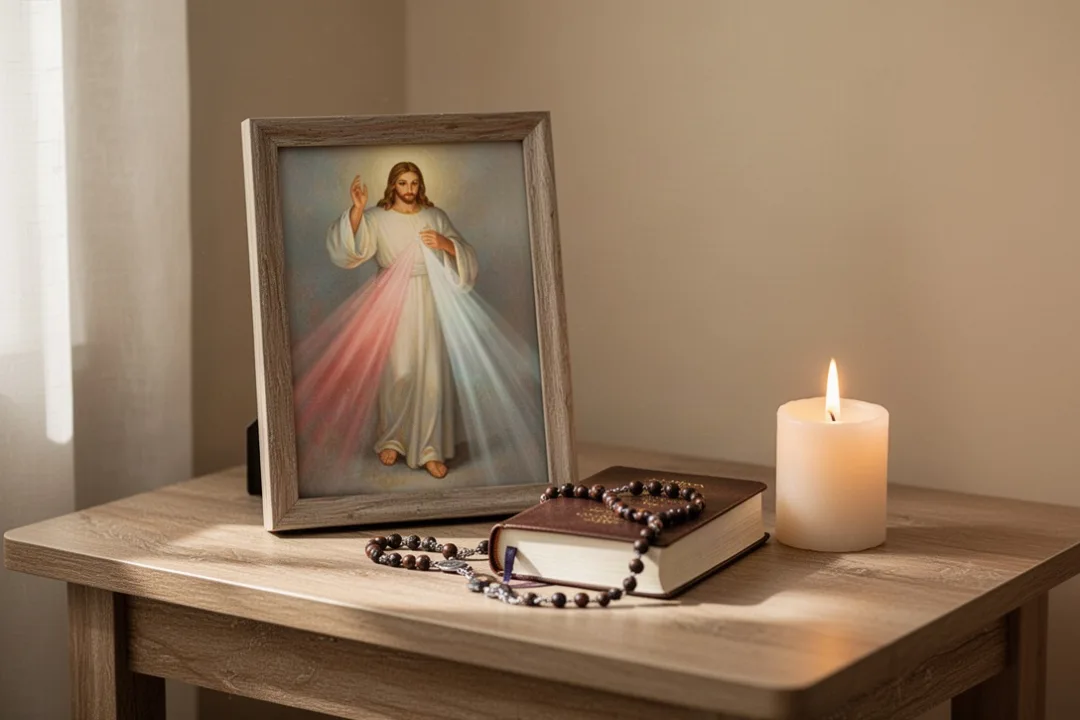
The familiar image presents Jesus facing the viewer. His right hand is raised in a gesture of blessing, while his left hand touches or points toward the area of his heart. Two rays emerge from that region and fall toward the lower part of the image. At the bottom, the words “Jesus, I trust in you” appear in many versions.
The image is based on a vision reported by Saint Maria Faustina Kowalska, a Polish nun who lived in the early 20th century. In her diary, she described seeing Jesus in this form and receiving a request that an image be painted according to what she saw. The image became associated with a message of mercy directed toward all people, especially those who feel distant from God or burdened by sin.
Artists have created many versions over the years. Some show Jesus with a lighter or darker background, different facial features, or rays that vary in color and shape. These artistic differences do not change the essential meaning. The important elements are the risen Christ, the gesture of blessing, the rays from his heart, and the invitation to trust in his mercy.
Jesus’ face and posture: They present Christ as approaching the viewer with compassion rather than rejection.
The raised right hand: It represents blessing and forgiveness.
The left hand near the heart: It draws attention to the source of divine love and mercy.
The two rays: They symbolize the graces associated with Christ’s saving work.
The inscription: It expresses the prayerful attitude the image encourages.
The image should not be understood as a photograph or physical portrait of Jesus. No one knows exactly what Jesus looked like, and the work is not intended to provide a historically verified likeness. Instead, it is a devotional image: a visible reminder of the Gospel message that God’s mercy is offered through Christ.
Central message: The image of Divine Mercy is meant to lead you toward trust in Jesus, repentance, prayer, and merciful action—not toward superstition or the belief that the picture itself has magical power.
What the rays, colors, and inscription mean
The two rays are the most recognizable feature of the Divine Mercy image. According to the meaning traditionally connected with Saint Faustina’s vision, the pale ray represents water and the red ray represents blood. These images point to the sacraments and to the saving work of Christ, especially the cleansing and life-giving grace associated with baptism and the Eucharist.
The rays also recall the scene described in John 19:34, when blood and water are associated with the wounded side of Jesus after his death on the cross. Rather than reproducing the verse, the image presents its meaning visually: mercy flows from Christ, whose death and resurrection bring reconciliation and new life.
Different explanations of the rays emphasize slightly different aspects of Catholic teaching. Some focus on baptism and the Eucharist. Others describe the rays more broadly as signs of God’s grace reaching humanity. These interpretations work together because the image is centered on Christ’s self-giving love, not on the colors alone.
The inscription, “Jesus, I trust in you,” is a short act of faith. It does not mean that a Christian will never feel afraid, confused, or discouraged. Trust can include bringing those feelings honestly to prayer while choosing to rely on Christ rather than treating personal control as the source of salvation.
Trust also has a moral meaning. Someone who asks for mercy is called to become more merciful. That may involve forgiving an injury, speaking patiently to a family member, helping a person in need, or refusing to answer cruelty with cruelty. The image therefore connects private prayer with daily conduct.
How the image relates to the heart of Jesus
The area near Jesus’ heart is not simply a decorative center point. It represents the love from which his mercy comes. Catholic devotion often speaks of Christ’s heart as a sign of his deep, personal love for humanity. In the Divine Mercy image, that love is shown as active and outward-moving through the rays.
This symbolism can be especially meaningful when you are praying about guilt or shame. The image does not deny the seriousness of sin, but it places sin within a larger message of forgiveness and restoration. It invites you to turn toward God instead of assuming that failure has made prayer impossible.
How the image originated and spread
The modern Divine Mercy devotion is closely associated with Saint Faustina Kowalska, who belonged to the Congregation of the Sisters of Our Lady of Mercy. She recorded spiritual experiences and messages in her diary, including the account that became the basis for the image. Her writings emphasized God’s mercy, confidence in Christ, repentance, and practical charity.
The first well-known painting connected with her vision was created in Vilnius in the 1930s by Eugeniusz Kazimirowski, working with Faustina’s guidance. The painting did not become the only accepted artistic form. A later version by Adolf Hyła became widely reproduced and helped make the image familiar in many countries.
The popularity of the image grew alongside the spread of the Divine Mercy devotion. This included the Chaplet of Divine Mercy, reflection on God’s mercy, and observance of Divine Mercy Sunday. The devotion later received broad recognition within the Catholic Church, and Faustina was canonized by Pope John Paul II in 2000.
These historical details explain why you may encounter several different images labeled “Divine Mercy.” They are not necessarily copies of one exact painting. Some are based on the Kazimirowski image, some on the Hyła version, and others adapt the same symbols for different artistic or devotional settings.
When choosing an image, it can help to consider what you want it to do. A small card may be useful for a prayer book or wallet. A framed print may suit a home prayer space. A large painting may be appropriate for a parish, chapel, or devotional gathering. In every case, the image should support reverent attention rather than compete with the prayer itself.
Look for a clear image that preserves the traditional symbols.
Check whether the source identifies the artist or provides permission for reproduction.
Choose a size and format that fit the place where it will be displayed.
Consider whether the image encourages prayer rather than serving only as decoration.
If purchasing a religious item, select a reputable Catholic bookstore, parish source, or artist.
Digital copies are common, but not every image found online is free to download, print, or sell. A painting may be old enough to be in the public domain while a modern photograph, scan, design, or edited version may still be protected by copyright. If you plan to reproduce the image for a church bulletin, website, classroom, or product, review the stated permissions instead of assuming that online availability means unrestricted use.
How Catholics use the image in prayer
The image can be placed in a prayer corner, near a crucifix, in a bedroom, or in another quiet area of the home. Its purpose is to help you remember Christ during prayer. You do not need a special room or elaborate arrangement. A few minutes of silence, a simple prayer, and an honest examination of your day can be enough.
One straightforward practice is to sit before the image and notice what it communicates. The raised hand can remind you of blessing. The rays can direct your thoughts toward Christ’s saving mercy. The inscription can become a repeated prayer when you are anxious, regretful, or uncertain about what to do next.
You can also pray using Scripture references connected to mercy. For example, Luke 15 presents God’s willingness to receive the repentant, while Matthew 25 connects love of Christ with care for people in need. Psalm 51 expresses sorrow for sin and a desire for renewal. Read or paraphrase a passage in your own words, then allow a period of quiet reflection.
A simple prayer routine
Begin with stillness. Put aside distractions and look at the image for a moment without trying to produce a particular feeling.
Name your need. Speak honestly to Jesus about fear, guilt, grief, conflict, or another concern.
Ask for mercy. Request forgiveness and the grace to make any necessary change.
Pray for another person. Bring someone who is suffering, difficult to forgive, or in need of help before God.
Choose one merciful action. Decide how you can practice patience, honesty, generosity, or reconciliation that day.
Many people pray the Chaplet of Divine Mercy while looking at the image. The chaplet uses familiar Catholic prayer forms and reflects on Christ’s mercy for the world. Others pray the Divine Mercy Novena, which traditionally begins on Good Friday and leads toward Divine Mercy Sunday, although private prayer with the image does not depend on following a novena.
The image can also be used during the 3 o’clock prayer hour, associated with the time of Jesus’ death. Some people pause at that time to remember the Passion and ask for mercy. If your schedule does not allow prayer at exactly 3 p.m., the devotion is not invalid. A sincere prayer at another time still turns your attention toward God.
Prayer with the image should not replace the sacraments or the responsibilities of Christian life. A person seeking forgiveness for serious sin should consider confession according to Catholic practice. Someone who is suffering emotionally may also need support from trusted people or a qualified professional. Devotion works best when it leads to concrete care, truthfulness, and healing.
Practical use: If you feel distracted, keep the prayer brief: look at the image, repeat “Jesus, I trust in you,” name one person or concern, and ask for the grace to respond with mercy.
Where to display an image of Divine Mercy
There is no required place in a home for the image. Many people put it in a home altar or prayer corner with a Bible, crucifix, rosary, or candle. Others keep a small card beside a bed, on a desk, or in a vehicle. The best location is one that helps you remember prayer without creating a safety problem or distracting from the purpose of the space.
A framed image can also be displayed in a parish meeting room, classroom, retreat center, or chapel. In a church setting, local clergy or parish leaders may have guidelines about placement, size, lighting, and the relationship between the image and the sanctuary. A devotional image should not be positioned in a way that confuses it with the Eucharist, the altar, or the central liturgical symbols.
When placing an image near a candle, use a stable holder and keep paper, fabric, and wood away from the flame. Avoid direct moisture and prolonged harsh sunlight, which can damage prints and paintings. Dust the frame gently, and use appropriate archival materials if the image has sentimental or artistic value.
Some families give a Divine Mercy image as a gift for a baptism, confirmation, wedding, house blessing, or time of illness. The gift can be accompanied by a brief explanation of the symbols or a handwritten prayer. Its value comes from the meaning it carries and the prayer it encourages, not from its size, price, or rarity.
How to understand Divine Mercy without superstition
A religious image can be treated in unhealthy ways if it is viewed as an object that guarantees protection, success, or a particular outcome. The Divine Mercy image does not function as a charm. It does not remove the need for repentance, wise decisions, medical care, reconciliation, or practical help.
Its message is also not that wrongdoing has no consequences. Mercy and justice are not opposites in the simplistic sense. Forgiveness can require acknowledging harm, telling the truth, repairing damage, accepting appropriate consequences, and protecting people who may be vulnerable. A prayer before the image should make you more willing to do what love and responsibility require.
Nor does trust mean pretending that pain is easy. The image can be brought into seasons of grief, illness, family conflict, or doubt. You may pray with confidence one day and barely manage a few words the next. The devotional message allows room for that struggle while keeping your attention on Christ’s compassion.
For Catholics, the most fruitful response to the image is a pattern of life shaped by mercy:
Receive forgiveness honestly rather than hiding behind shame.
Ask for help when a harmful habit or serious burden cannot be handled alone.
Refuse gossip, contempt, and unnecessary retaliation.
Practice both spiritual and practical works of mercy.
Seek reconciliation when it is safe and appropriate.
Protect yourself and others from abuse while still rejecting hatred.
The image remains meaningful when it points beyond itself. Its rays direct your thoughts to Christ’s saving love, the inscription teaches trust, and the blessing invites you to receive grace. From there, prayer should move outward into patience, repentance, service, and compassion for people whose needs may not be visible.
Frequently asked questions
Is the image of Divine Mercy the same as the Sacred Heart image?
They are related Catholic devotions, but they are not the same image. The Sacred Heart devotion centers on Christ’s heart as a sign of his loving self-gift. The Divine Mercy image shows Christ blessing the viewer with two rays coming from the area of his heart and emphasizes trust in his mercy. Both point toward Christ’s compassionate love, but they have different histories and visual traditions.
What do the red and pale rays in the image represent?
The rays traditionally represent blood and water flowing from Christ. They are commonly connected with the grace of salvation and with the sacraments, especially baptism and the Eucharist. The red and pale colors are symbolic rather than a scientific depiction. Their purpose is to remind worshipers that mercy comes through Christ’s self-giving love.
Can I pray to the image of Divine Mercy?
Catholics do not worship a painting or paper print. You pray to God while using the image as a visual reminder of Jesus Christ. You can ask Jesus for forgiveness, comfort, guidance, and the grace to show mercy. Respect for the image is appropriate, but the physical object itself has no magical power and should not replace the sacraments or responsible action.
When is Divine Mercy Sunday observed?
Divine Mercy Sunday is observed on the Sunday after Easter, also called the Second Sunday of Easter. It provides a special occasion to reflect on Christ’s resurrection and mercy. Parish practices vary, but celebrations may include confession, Eucharistic adoration, the Chaplet of Divine Mercy, Scripture, and communal prayer. You can also use the day for personal repentance and works of mercy.













Leave a Reply