St. Faustina: her life, message, and Divine Mercy devotion
St. Faustina: her life, message, and Divine Mercy devotion
St. Faustina Kowalska was a Polish nun whose spiritual diary helped spread devotion to God’s mercy throughout the Catholic Church. Born Helena Kowalska in 1905, she lived a mostly hidden life of prayer, work, illness, and service before her death in 1938. Her message centered on trust in God, compassion toward others, repentance, and confidence in Christ’s mercy.
Her full religious name was Sister Maria Faustina of the Blessed Sacrament. Catholics often call her simply St. Faustina. She is especially associated with the Divine Mercy image, the Chaplet of Divine Mercy, the Divine Mercy novena, and the prayer traditionally connected with the hour of Christ’s death.
St. Faustina was born on August 25, 1905, in the village of Głogowiec, near Łęczyca in central Poland. Her baptismal name was Helena Kowalska. She grew up in a poor Catholic family and was the third of ten children. Her parents taught her practical responsibility and religious devotion, but her family’s limited means meant that she received only a basic education.
As a young woman, Helena worked as a domestic servant before entering religious life. She had wanted to dedicate herself to God from an early age, although her path to the convent was not immediate. In 1925, she joined the Congregation of the Sisters of Our Lady of Mercy, where she received the religious name Sister Maria Faustina.
Her assignments were ordinary: she worked as a cook, gardener, porter, and housekeeper in several convent communities. Those duties matter when understanding her spirituality. Faustina did not become known because she held a public office or taught in a university. Her reputation grew from a life that combined small acts of service with intense prayer and a strong sense of responsibility for other people’s spiritual well-being.
She experienced poor health, including tuberculosis, and died in Kraków on October 5, 1938, at the age of 33. She was buried at the convent cemetery in Kraków-Łagiewniki. Her relics are now venerated at the Sanctuary of the Divine Mercy there, which became an important pilgrimage site.
What St. Faustina taught about Divine Mercy
The central idea of Faustina’s message is that God’s mercy is offered to every person, especially those who recognize their need for forgiveness. Mercy does not mean pretending that sin does not matter. Instead, it means that God reaches toward the sinner with forgiveness and healing when the person turns back to him.
Faustina repeatedly connected mercy with trust. In her writings, trust is more than a positive feeling or a vague hope that life will improve. It means relying on God’s character even when you feel guilty, frightened, spiritually dry, or unable to see a clear way forward. The familiar phrase associated with her message, “Jesus, I trust in you,” expresses that posture.
Her spirituality also insists that devotion cannot remain private. A person who asks for mercy should become more merciful toward others. Faustina wrote about three practical ways of showing mercy: through kindness in actions, through words, and through prayer. The particular form may change according to your circumstances, but the responsibility remains.
The heart of Faustina’s message: Trust in God’s mercy, receive forgiveness sincerely, and let that mercy shape the way you treat people who are suffering, difficult, or in need.
This teaching fits closely with the Christian command to love one’s neighbor. In Matthew 25:31-46, Jesus identifies acts of care for people in need with service to him. In Luke 6:36, he calls his followers to be merciful. These passages help explain why Faustina’s devotion includes both prayer and concrete compassion.
What Faustina’s diary reveals about her spiritual life
Faustina recorded her experiences, prayers, struggles, and instructions from her spiritual life in a diary at the request of her confessors and superiors. The work is commonly published in English as Diary: Divine Mercy in My Soul. It is not a conventional autobiography. The entries move between personal events, meditations, prayers, descriptions of visions, and reflections on religious obedience.
The diary shows a woman who took her interior life seriously but did not consider herself spiritually impressive. She describes temptations, discouragement, physical suffering, misunderstandings, and the difficulty of discerning what God wanted from her. Her writing includes confidence, but it also includes struggle. That combination is one reason many readers find it approachable.
Faustina often emphasized obedience to the Church, humility, and consultation with her confessors. She did not present private spiritual experiences as a replacement for Scripture, the sacraments, or the Church’s ordinary life. Her diary also shows that she tested her impressions and accepted correction, rather than treating every internal experience as automatically authoritative.
Readers should remember that a diary of private revelation is interpreted within the broader Christian faith. Catholics are not required to accept every private revelation in the same way they accept the central teachings of Christianity. The Church’s recognition of Faustina’s message supports devotion to Divine Mercy, but it does not turn every personal interpretation of her diary into official doctrine.
How the Divine Mercy image is understood
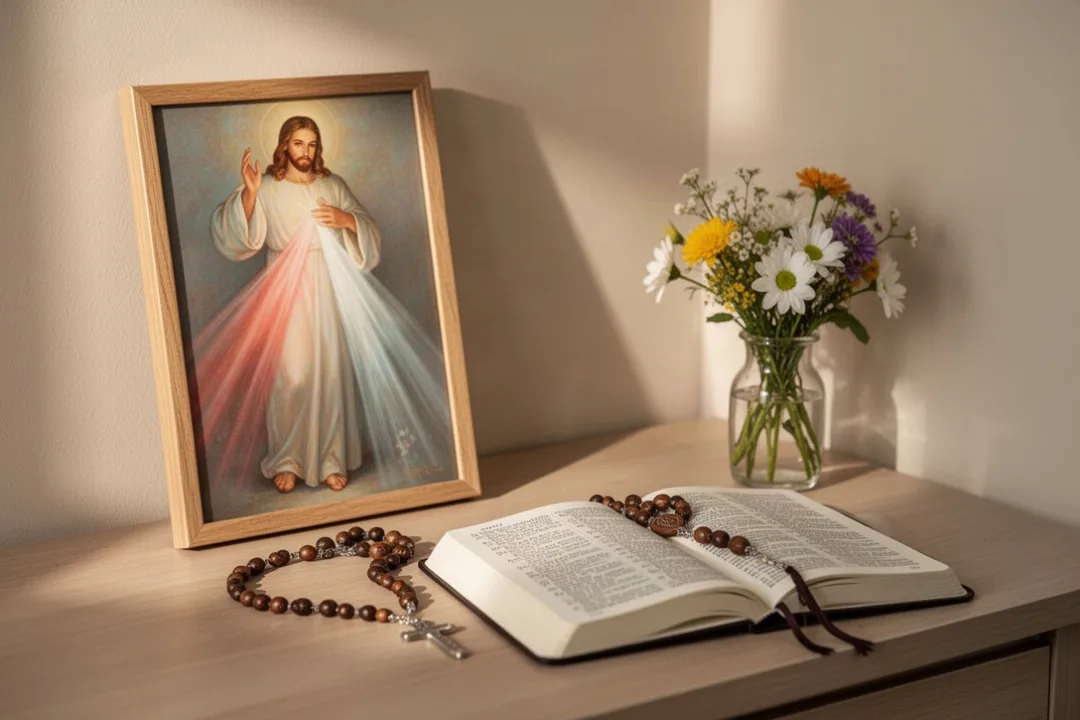
The Divine Mercy image associated with Faustina portrays the risen Christ with one hand raised in blessing and the other near his chest. Rays extend from the area of his heart, traditionally shown as pale and red. The image usually includes the words “Jesus, I trust in you.”
Faustina reported that she saw this image in a vision and was instructed to have it painted. The rays are commonly understood as signs of the blood and water associated with Christ’s Passion and the Gospel of John, chapter 19. The image is not treated as a magical object. Its purpose is to direct attention toward Christ, his sacrifice, and the mercy offered through him.
The image may be displayed in a church, home, or prayer space. For many Catholics, looking at it becomes a prompt to pray for forgiveness and to remember the needs of other people. It should not be used as a guarantee that a particular outcome will happen or as a substitute for honest repentance and responsible action.
Different versions of the image exist because several artists painted representations connected with Faustina’s reported vision. The details may vary, but the essential focus remains Christ, the rays of mercy, and the invitation to trust.
What the Chaplet of Divine Mercy means
The Chaplet of Divine Mercy is a prayer usually prayed on ordinary rosary beads. It begins with familiar Christian prayers and includes petitions offering Christ’s body and blood, soul and divinity to the eternal Father. The repeated prayer asks for mercy for the person praying, for loved ones, and for the whole world.
The Chaplet is especially connected with Christ’s Passion. Its language points to the sacrifice of Jesus and asks that mercy be extended through that sacrifice. This makes the prayer penitential and intercessory: you acknowledge human sin while asking God to bring forgiveness and healing to others.
Many people pray the Chaplet at the 3 o’clock hour, associated with the time of Christ’s death. Faustina’s diary gives special attention to remembering the Passion at that time. However, the Chaplet may be prayed at any time. A person who cannot observe the traditional hour has not failed in the devotion.
The prayer can be used during personal prayer, in a family, at a parish, or beside someone who is dying. It can also become a short way to pray for victims of violence, people who have died, those struggling with addiction, or anyone whose needs are not known to you. Its repeated form makes it possible to pray even when you are tired or have difficulty finding words.
How to pray the Chaplet of Divine Mercy
The Chaplet is prayed on a standard five-decade rosary. The sequence may vary slightly in presentation, but these steps describe the usual structure:
Begin with the Sign of the Cross.
Pray the Our Father, Hail Mary, and Apostles’ Creed.
On the large beads, pray the offering prayer that presents Christ’s body, blood, soul, and divinity to the Father.
On each group of ten small beads, repeat the prayer asking for mercy for you and the whole world.
Repeat the large-bead and small-bead prayers for all five decades.
Finish with the customary closing invocation, asking for mercy and repeating the trust expressed by the devotion.
You do not need special beads to begin. If you are unfamiliar with the wording, use a trusted Catholic prayer book or parish resource. The purpose is not to complete the prayer mechanically but to unite the repeated words with attention to Christ’s mercy and the needs of the world.
What Divine Mercy Sunday celebrates
Divine Mercy Sunday is observed on the Sunday after Easter. The celebration is closely associated with Faustina because her diary records Christ’s request for a feast devoted to Divine Mercy. Pope John Paul II formally established the feast for the universal Church in 2000, the same year he canonized Faustina.
The feast is connected to the Easter mystery: Christ’s death and resurrection reveal God’s mercy and offer new life. The day does not create a separate form of mercy apart from Easter. Instead, it gives the Church a particular occasion to contemplate the mercy already proclaimed in the Gospel.
Many parishes mark the day with confession, Eucharistic adoration, the Chaplet, readings about mercy, and prayers for the sick or suffering. Catholic teaching about indulgences may also be associated with the feast under the conditions established by the Church. Anyone considering an indulgence should consult current guidance from a parish, diocese, or other reliable Catholic source, since the required conditions matter.
Why Faustina’s canonization matters
Pope John Paul II canonized Faustina on April 30, 2000. The canonization recognized her as a saint for the universal Church and gave special prominence to her witness to Divine Mercy. It also reflected the Church’s judgment that her life displayed heroic Christian virtue and that her message could help people return to Christ.
Her canonization did not mean that every unusual experience described in her diary must be copied or expected. The lasting value of a saint is found in faithful discipleship. Faustina’s example points toward prayer, the sacraments, patience in suffering, obedience, humility, and compassion rather than toward fascination with extraordinary experiences.
In 2025, the Catholic Church marked the twentieth-fifth anniversary of her canonization and the establishment of Divine Mercy Sunday as a universal feast. The anniversary offered an opportunity to revisit her writings and the place of mercy in Christian life, but the devotion itself remains centered on the Gospel rather than on a single historical commemoration.
How Faustina’s message relates to confession and the Eucharist
Faustina’s spirituality is sacramental. She wrote frequently about the Eucharist and confession, viewing them as concrete ways Christ gives grace and restores sinners. Private prayer can prepare you for these sacraments, but it does not replace them within Catholic practice.
Confession is particularly relevant to a devotion focused on mercy. A sincere confession includes examining your actions, acknowledging sin without excuses, expressing repentance, and accepting the penance given by the priest. The point is not to perform perfectly but to approach God truthfully and receive reconciliation through the Church.
The Eucharist directs the believer toward communion with Christ and with the Church. Prayer before or after Mass can include the Chaplet, but the Chaplet should support participation in the liturgy rather than compete with it. When the devotion leads someone toward forgiveness, worship, and service, it is functioning in the spirit associated with Faustina.
Practical ways to live the message of St. Faustina
Devotion to Faustina does not require a dramatic religious routine. You can apply her emphasis on mercy through small, deliberate choices that fit your responsibilities. The following practices keep the message grounded:
Pray for one person who is suffering, especially someone you find difficult to understand.
Make a specific act of mercy, such as bringing food to someone, checking on an isolated neighbor, or helping without seeking recognition.
Use the short prayer “Jesus, I trust in you” when anxiety or shame makes prayer difficult.
Set aside a regular time for the Chaplet, Scripture, silent prayer, or spiritual reading.
Examine whether your words about forgiveness are matched by patience and restraint in daily relationships.
Seek reconciliation when you have caused harm, rather than using religious language to avoid an apology.
Bring serious guilt, repeated sin, or spiritual confusion to a trustworthy priest or qualified pastoral counselor.
Mercy does not require you to remain in an abusive situation or ignore injustice. Forgiveness and reconciliation may require boundaries, protection, accountability, or professional help. A person can refuse revenge while still reporting harm, seeking safety, and insisting that wrongdoing be addressed.
A necessary distinction: Christian mercy is not the same as approving harmful behavior. It can include forgiveness, truthful confrontation, firm boundaries, and practical protection for people at risk.
Common mistakes when learning about St. Faustina
Interest in Faustina can become unbalanced if the devotion is separated from sound religious judgment. These common mistakes can make the message less faithful to its purpose:
Treating the image as a talisman: The Divine Mercy image points to Christ; it does not guarantee protection, success, or a particular answer to prayer.
Reducing mercy to feelings: Mercy includes concrete choices, truthfulness, responsibility, and care for people in need.
Ignoring the sacraments: The Chaplet and other prayers should lead Catholics toward the life of the Church, not replace Mass or confession.
Reading the diary without context: The diary contains personal spiritual experiences and should be read alongside Scripture and reliable Catholic guidance.
Expecting visions or special signs: Faustina’s extraordinary experiences were not presented as a requirement for ordinary believers.
Using forgiveness to excuse abuse: Mercy never demands that a victim surrender safety or remain silent about serious wrongdoing.
Assuming prayer removes every hardship: Faustina’s own life included illness, opposition, and suffering. Trust does not promise an easy life.
Another mistake is focusing so heavily on private revelations that the basic Christian message disappears. Faustina’s distinctive contribution is her language and devotional forms, but the underlying call to repentance, trust, prayer, and love of neighbor is deeply rooted in the Gospel.
Where to start with St. Faustina’s writings
If you want to read Faustina, begin with a reliable edition of Diary: Divine Mercy in My Soul. The diary is extensive, and some sections may be easier to understand with notes or a guide. Read slowly rather than trying to finish it quickly. A few pages followed by quiet prayer may be more fruitful than reading many entries without reflection.
Keep a notebook with two columns: one for what the passage says about God’s mercy and another for the response it invites from you. This approach helps prevent the diary from becoming only a record of supernatural experiences. It draws attention to the practical virtues Faustina emphasizes, including humility, patience, obedience, and generosity.
You can also read selected Gospel passages that illuminate the theme of mercy. Luke 15 presents God’s welcome for the lost; John 20 connects the risen Christ with forgiveness; Matthew 18 teaches about forgiveness and responsibility; and James 2 links faith with action. Read these references directly in a Bible you trust, since translations use different wording.
For historical or doctrinal questions, choose sources from Catholic dioceses, recognized religious communities, or official Church publications. Online material about Faustina varies widely, and some accounts mix her actual writings with later legends, exaggerated promises, or claims that the Church has not made.
Why St. Faustina remains relevant to prayer today
Faustina speaks to people who carry guilt, fear, grief, illness, or concern for a troubled world. Her emphasis on mercy offers a way to pray when you cannot solve a problem yourself. At the same time, her example prevents mercy from becoming passive: prayer should lead toward service, honest repentance, and concern for those who suffer.
Her life also challenges the assumption that spiritual significance depends on public visibility. She served in ordinary convent roles and endured physical weakness, yet her witness reached far beyond the places where she lived. The value of her example lies not in status but in faithfulness in ordinary duties.
For a Catholic, a simple beginning might be to pray briefly before an image of Christ, read a short passage from Faustina’s diary, and identify one merciful action to take that day. Over time, the devotion can become part of a broader pattern of Mass, confession, Scripture, prayer, and service. That pattern keeps the focus where Faustina placed it: on trusting Christ and becoming a more merciful person.
Frequently asked questions
Is St. Faustina the patron saint of anything?
St. Faustina is widely associated with Divine Mercy and is often invoked by people seeking God’s forgiveness, spiritual renewal, or help for the suffering. The Catholic Church does not always assign a formal patronage to every situation connected with a saint, so it is more precise to call her the apostle or messenger of Divine Mercy rather than claim a broad official patronage.
What is St. Faustina’s feast day?
St. Faustina’s liturgical feast day is October 5, the anniversary of her death. Parishes and religious communities may mark the day with Mass, prayers from the Chaplet of Divine Mercy, readings from her diary, or other services. Local customs differ, so the exact observance depends on the parish or diocese.
Can non-Catholics pray the Chaplet of Divine Mercy?
Anyone may learn about or pray the Chaplet as a Christian prayer asking for mercy. Catholics understand it within the teachings of the Church, Christ’s Passion, and the sacraments. People from other traditions may use it devotionally while respecting that some language and practices reflect specifically Catholic beliefs.
Did St. Faustina really see Jesus?
Faustina reported visions and conversations with Jesus in her diary. The Catholic Church accepted her as a saint and supports the Divine Mercy devotion, but private revelations are not required beliefs for Catholics. They should be approached with humility and interpreted alongside Scripture, Church teaching, and the ordinary means of Christian prayer.











Leave a Reply