October feast days: Catholic saints and celebrations
October feast days: Catholic saints and celebrations
Are you looking at the October calendar and wondering which saint feast days your parish may celebrate? October is filled with memorials, feasts, and optional observances that honor apostles, missionaries, mystics, popes, and people whose lives reflected the Gospel in very different ways.
The most widely recognized Catholic October observances include St. Thérèse of Lisieux on October 1, the Memorial of the Guardian Angels on October 2, St. Francis of Assisi on October 4, Our Lady of the Rosary on October 7, St. Teresa of Ávila on October 15, St. Luke the Evangelist on October 18, and Sts. Simon and Jude on October 28. October is also traditionally dedicated to the Holy Rosary.
A feast day is not always a holy day of obligation. In the Catholic calendar, celebrations have different ranks, including solemnities, feasts, memorials, and optional memorials. The rank affects the Mass texts and the prominence of the observance, while a local diocese or religious community may add its own celebrations.
Calendar reminder: October feast days can be transferred, omitted, or given a different rank when they fall on a Sunday or another important liturgical celebration. Check your parish bulletin or diocesan calendar for the exact schedule in your area.
Why October has a special connection with the Rosary
October is commonly called the Month of the Holy Rosary because of the Church’s long connection between this month and the Rosary devotion. The annual observance is especially associated with the Memorial of Our Lady of the Rosary on October 7, a day that invites Catholics to reflect on Mary’s role in leading Christians toward her Son.
The Rosary is a form of prayer that combines repeated prayers with meditation on events from the lives of Jesus and Mary. Its structure gives you a set pattern, but the central purpose is not simply to recite words. It is to contemplate the mysteries of Christ while asking Mary to pray with and for you.
The traditional groups of mysteries are the Joyful, Sorrowful, Glorious, and Luminous Mysteries. Each group presents a different part of the Christian story:
Joyful Mysteries: the Annunciation, Visitation, Nativity, Presentation, and Finding of Jesus in the Temple.
Sorrowful Mysteries: Jesus’ agony, scourging, crowning with thorns, carrying of the cross, and crucifixion.
Glorious Mysteries: the Resurrection, Ascension, descent of the Holy Spirit, Assumption of Mary, and Coronation of Mary.
Luminous Mysteries: significant moments in Jesus’ public ministry, including his Baptism, the wedding at Cana, proclamation of the Kingdom, Transfiguration, and institution of the Eucharist.
You do not need to wait for October 7 to pray the Rosary. Many people pray one decade during a commute, before bed, or while walking. A full Rosary traditionally includes five decades, but praying even one decade can create a quiet space for Scripture, reflection, and intercession.
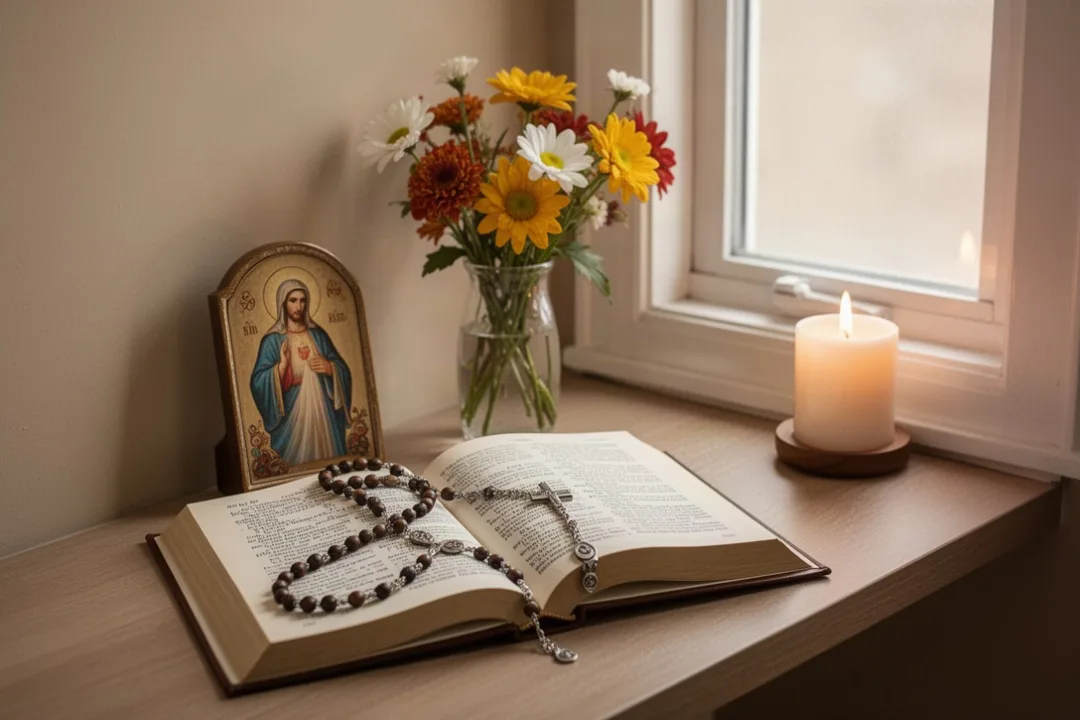
Families can mark the month by praying together once a week, displaying a rosary in a prayer corner, or choosing one mystery to consider during the day. A parish might organize a public Rosary, offer instruction for children, or invite people to pray for specific needs such as peace, healing, vocations, or those who are grieving.
Major October feast days and the saints they honor
October 1: St. Thérèse of Lisieux
St. Thérèse of Lisieux, also known as St. Thérèse of the Child Jesus and the Holy Face, is remembered for her “little way.” She entered the Carmelite convent as a young woman and sought holiness through ordinary acts of love, trust, humility, and service rather than through remarkable public achievements.
Her spiritual teaching emphasizes that small actions can have great value when they are offered with love. She is also known as the Little Flower, a title connected with her image of living simply and confidently in dependence on God. She was declared a Doctor of the Church, a title recognizing the significance of her teaching for the wider Catholic community.
October 1 is a useful day to examine the way you treat routine responsibilities. A patient response, a hidden act of service, or a prayer for someone who is difficult to love can become a practical expression of Thérèse’s spirituality.
The Memorial of the Guardian Angels focuses on the Christian belief that God gives angelic care and guidance. Angels appear throughout Scripture as messengers and servants of God, and the tradition of guardian angels encourages believers to remember that divine care is not limited to what can be seen.
This observance is especially familiar to children because of the traditional Guardian Angel prayer. Adults can also use the day to pray for protection, wisdom, and attentiveness to the ways God may work through other people. The celebration is not an invitation to treat angels as objects of superstition. Instead, it points beyond them to God’s providence and care.
October 4: St. Francis of Assisi
St. Francis of Assisi is one of the best-known saints in Christian history. He gave up a wealthy lifestyle, embraced poverty, served people who were sick and marginalized, and founded a movement centered on the Gospel. His life is closely associated with peace, simplicity, care for creation, and compassion for the poor.
Francis is often remembered for his love of animals and the natural world, but reducing him to a patron of pets misses the depth of his vocation. His relationship with creation flowed from his belief that all creatures depend on God. His witness also challenged Christians to examine attachment to wealth, status, and comfort.
Many churches offer a blessing of animals around October 4. The service is a way to thank God for the companionship and responsibilities connected with animals, not a substitute for the Church’s worship. You might also honor Francis by supporting a food pantry, helping an animal shelter, reducing waste, or making peace in a strained relationship.
October 7: Our Lady of the Rosary
The Memorial of Our Lady of the Rosary highlights a devotion that has been used by Christians for centuries. The day is a natural opportunity to pray the Rosary, learn how the devotion developed, or reflect on Mary’s faithful response to God.
Mary is honored in Catholic teaching because of her unique relationship to Jesus and her example of trust. The Rosary does not place Mary at the center instead of Christ. Its prayers repeatedly direct attention to the events of Jesus’ life, death, and resurrection while asking Mary to accompany the person who prays.
October 15: St. Teresa of Ávila
St. Teresa of Ávila was a Carmelite nun, reformer, writer, and Doctor of the Church. Her books and letters explore mental prayer, spiritual growth, humility, and friendship with Christ. She worked to renew Carmelite religious life and helped establish communities committed to prayer and a simpler way of living.
Teresa wrote about prayer as a relationship rather than a performance. Her teaching can help people who feel distracted or uncertain when they pray. Instead of expecting every prayer period to feel peaceful or spiritually intense, she encouraged perseverance, honesty, and a willingness to remain present to God.
Her feast day can be observed by setting aside ten quiet minutes, reading a short passage from one of her works, or asking what keeps you from being truthful in prayer. Her witness is especially relevant when you need to distinguish genuine spiritual growth from a desire to appear devout.
October 18: St. Luke the Evangelist
The Feast of St. Luke the Evangelist honors the traditional author of the Gospel according to Luke and the Acts of the Apostles. Luke’s Gospel gives particular attention to mercy, prayer, the poor, women, outsiders, and the work of the Holy Spirit.
Luke is also traditionally identified as a physician, so he is associated with doctors, nurses, medical workers, and caregivers. Parishes and hospitals may observe his feast by praying for those who provide medical care and for patients facing illness or recovery.
Reading a passage from Luke is one of the most direct ways to observe the day. You might choose a story about healing, the Good Samaritan, the Prodigal Son, or the disciples on the road to Emmaus. Read slowly and ask what the passage reveals about mercy and how it could shape your response to someone in need.
The Feast of Sts. Simon and Jude honors two of the Twelve Apostles. Simon is traditionally called the Zealot, while Jude is also known as Thaddeus. Because Jude’s name can be confused with Judas Iscariot, his identity is sometimes overlooked, even though he is honored as a faithful apostle and a patron of difficult or seemingly hopeless causes.
The two apostles remind Christians that the Church’s foundation includes many people whose personal histories are not described in detail. Their mission was still essential. Their feast can encourage prayer for people who serve without recognition and for situations that seem resistant to change.
Other October memorials worth knowing
The major dates receive the most attention, but the October calendar includes many other saints. Some are celebrated as optional memorials, meaning a parish or priest may observe them when the liturgical calendar permits. These commemorations broaden the month beyond the best-known figures.
October 5: St. Faustina Kowalska, a Polish religious sister associated with the message of Divine Mercy.
October 6: St. Bruno, founder of the Carthusian order and a witness to a life of solitude and prayer.
October 9: St. Denis and companions, remembered among the early Christian martyrs of Gaul, along with St. John Leonardi.
October 11: St. John XXIII, the pope who convoked the Second Vatican Council.
October 14: St. Callistus I, an early pope and martyr.
October 16: St. Hedwig and St. Margaret Mary Alacoque, two women associated with Christian service and devotion.
October 17: St. Ignatius of Antioch, an early bishop and martyr whose letters expressed strong devotion to Christ and the Eucharist.
October 19: Sts. Isaac Jogues, John de Brébeuf, and companions, North American martyrs, along with St. Paul of the Cross.
October 22: St. John Paul II, remembered for his long service as pope and his emphasis on human dignity and Christian discipleship.
October 23: St. John of Capistrano, a Franciscan preacher and reformer.
October 24: St. Anthony Mary Claret, a missionary, bishop, and founder of a religious congregation.
Not every parish will celebrate each of these memorials at Mass. A memorial may be replaced by a Sunday celebration, a local patronal feast, or another observance with a higher rank. Some religious orders also honor saints who do not appear prominently on the general calendar.
These lesser-known days can be valuable for personal prayer because they offer a wider range of examples. St. Bruno points toward silence, St. John XXIII toward pastoral leadership, St. Ignatius of Antioch toward courage, and St. Faustina toward confidence in divine mercy.
For families: Choose one saint each week, learn one fact about that person, and name one concrete virtue to practice. A short conversation over dinner can make the calendar more meaningful than simply reading a list of names.
How feast days differ from memorials and holy days of obligation
Catholic liturgical celebrations are not all equal in rank. The three principal categories in the Roman Rite are solemnities, feasts, and memorials, with optional memorials providing additional flexibility. A saint’s importance is not measured only by the category assigned to the day; the rank reflects how the liturgical calendar organizes worship.
A solemnity is the highest-ranking celebration and often marks a central mystery of the faith or a particularly significant title of Jesus, Mary, or a saint. A feast has a substantial liturgical celebration, often including special readings or prayers. A memorial usually honors a saint through designated prayers and readings, while an optional memorial may be observed when no higher-ranking celebration takes precedence.
October includes several memorials and feasts, but it generally does not contain a universal holy day of obligation in the United States. A holy day of obligation is a separate matter from a feast day. The obligation to attend Mass depends on the Church’s universal law and the decisions of the bishops in a particular country, as well as how a date falls in a given year.
When a feast day falls on Sunday, the Sunday celebration normally takes precedence. The same can happen when a date coincides with a solemnity or another major observance. This explains why a saint’s day may appear on a calendar but not be mentioned at the weekend Mass you attend.
Liturgical colors can also change according to the celebration. White is commonly used for saints who were not martyrs, red for martyrs and celebrations of the Holy Spirit, and green for Ordinary Time. Local customs and the specific liturgical celebration determine the actual color used.
Practical ways to observe October feast days
You do not need an elaborate event to participate in the Church’s calendar. A feast day can be observed through prayer, learning, service, or a small change in how you treat another person. Choose an approach that fits your household, parish, school, or personal routine.
Read the saint’s story. Use a reliable Catholic calendar, parish resource, or approved biography. Pay attention to the person’s choices, struggles, and relationship with God rather than collecting unusual facts.
Pray with the saint’s particular witness. Ask for help with the virtue associated with that day, such as humility, courage, mercy, simplicity, or perseverance.
Attend Mass when possible. A weekday Mass may use the saint’s prayers and readings when the calendar permits, giving the celebration a communal setting.
Serve someone connected to the feast. Visit a sick person, support a food pantry, encourage a caregiver, or make a peaceful gesture toward someone with whom you have a conflict.
Use a symbol thoughtfully. A rosary, a small image, a candle, or a book can help children and adults remember the day without turning devotion into decoration alone.
Share the story. Ask children what they noticed, invite a friend to pray one decade, or discuss a saint’s example with a parish group.
For children, keep the activity concrete. On St. Francis’ feast, they might help care for an animal or thank God for creation. On St. Luke’s feast, they could write a note to a doctor or nurse. On the Memorial of the Guardian Angels, they might pray for classmates, relatives, emergency workers, and people who need protection.
Adults may prefer a more reflective practice. Read one chapter of a saint’s writing, examine one habit that needs reform, or schedule a regular Rosary during October. The goal is not to complete every possible devotion. It is to let the calendar connect faith with ordinary decisions.
What October’s saints can teach about Christian life
Taken together, the October saints present a broad picture of holiness. Thérèse teaches the value of small acts, Francis challenges excessive attachment to possessions, Teresa of Ávila calls people to honest prayer, and Luke emphasizes mercy and attention to those who are overlooked.
The month also shows that Christian service takes many forms. Some saints preached publicly, some wrote, some cared for the sick, some lived in silence, and some endured persecution. Their examples do not suggest that everyone should copy the same lifestyle. They show that faithfulness can be lived through different gifts and responsibilities.
October also places prayer beside action. The Rosary encourages contemplation, while the saints’ lives demonstrate concrete love of neighbor. A person may pray for peace and still need to apologize, pray for the poor and still need to share resources, or pray for healing and still need to visit someone who is ill.
The month ends near the celebrations of All Saints’ Day on November 1 and All Souls’ Day on November 2. That transition moves the Church’s attention from individual October commemorations toward the communion of saints and prayer for the dead. October can therefore serve as a period of preparation: learning from particular lives before celebrating the wider holiness of the Church.
If you want a simple plan, select four dates: St. Thérèse on October 1, St. Francis on October 4, Our Lady of the Rosary on October 7, and St. Luke on October 18. Pair each with one prayer and one action. That modest practice can help the names on the calendar become living examples of trust, mercy, service, and hope.
Frequently asked questions
Are October feast days the same every year?
Most October saint celebrations fall on fixed dates, so their dates remain the same annually. Their liturgical rank or visibility can change when a date falls on Sunday or overlaps with a higher-ranking celebration. Local dioceses, religious orders, and parishes may also observe additional saints. For the exact readings and Mass schedule, consult the current calendar used by your parish.
Is October 7 a holy day of obligation?
The Memorial of Our Lady of the Rosary on October 7 is generally not a holy day of obligation in the United States. Catholics may attend Mass, pray the Rosary, or join a parish devotion as a voluntary observance. Attendance requirements are determined separately from the saint or Marian celebration listed on the calendar.
Why are St. Francis and the Rosary especially popular in October?
St. Francis is honored on October 4 and is widely loved for his care for the poor, peace, simplicity, and creation. October is also traditionally devoted to the Rosary, with Our Lady of the Rosary celebrated on October 7. These observances are well suited to parish prayer, family activities, and charitable service.
Can I celebrate a saint’s feast day at home?
Yes. You can read about the saint, pray for the needs connected with that person’s witness, prepare a simple meal, display an image, or perform an act of service. Families may choose one virtue to practice during the day. Home observance complements parish worship but does not replace the Church’s official liturgical celebration.












Leave a Reply