Saint Thérèse feast day: October 1 traditions and meaning
Saint Thérèse feast day: October 1 traditions and meaning
Saint Thérèse of Lisieux’s feast day is October 1, when Catholics honor the Carmelite nun known as the Little Flower and remember her teaching that ordinary acts can become expressions of great love for God.
Thérèse lived a hidden life in a French convent, yet her spiritual writing reached readers around the world. She did not lead a school, preach to crowds, or travel as a missionary. Instead, she described a humble path of confidence, patience, prayer, and love in daily responsibilities.
What Catholics celebrate on Saint Thérèse feast day
The October 1 memorial celebrates Thérèse’s life, vocation, and spiritual message. Her full religious name was Saint Thérèse of the Child Jesus and the Holy Face, and she is also widely called Thérèse of Lisieux after the French town where she entered the Carmelite convent and died.
Her feast day is not primarily a celebration of dramatic achievements. It points toward the value of small acts done with love: listening instead of interrupting, accepting an inconvenience without resentment, praying for someone who is struggling, or completing an unglamorous duty faithfully.
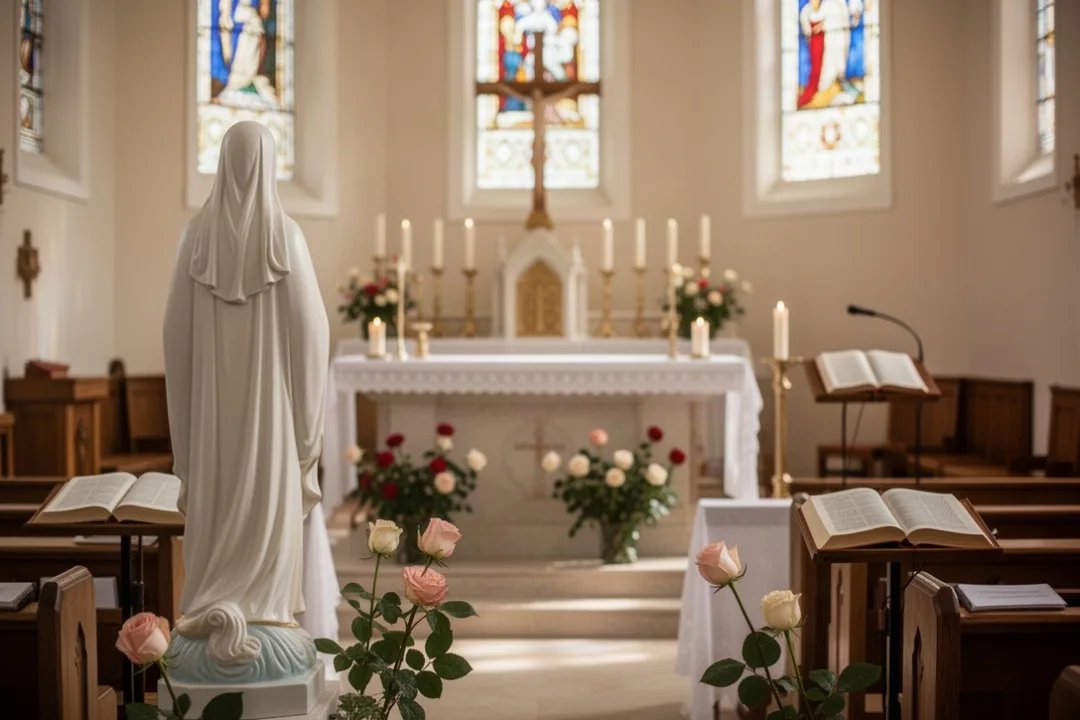
For many Catholics, the day includes Mass, personal prayer, reading from Thérèse’s autobiography, or asking for her intercession. Some churches display roses, since roses became associated with her promise to “send a shower of roses” after her death. That expression is best understood as a poetic image for the graces and help she hoped God would give through her intercession, not as a guarantee of a supernatural sign.
The date to remember: The Roman Catholic Church celebrates Saint Thérèse of Lisieux on October 1. Her memorial is also observed by many religious communities and churches that draw on her spirituality.
Who Saint Thérèse of Lisieux was
Thérèse Martin was born in Alençon, France, in 1873. Her parents, Louis and Zélie Martin, were later canonized together, and several of Thérèse’s sisters also entered religious life. Her childhood included strong family faith as well as grief, illness, and the loss of her mother when Thérèse was young.
She entered the Carmelite monastery at Lisieux at the age of 15 after receiving permission from church authorities. In the convent, she lived the ordinary rhythm of a contemplative nun: prayer, work, community responsibilities, silence, and sacrifice. She remained there until her death from tuberculosis in 1897 at age 24.
Thérèse wrote about her life at the request of her religious superiors. These writings were later published as Story of a Soul, a spiritual autobiography that made her known far beyond the convent. The book describes her childhood, her desire for holiness, her struggles, and her growing trust in God.
Her short life can seem quiet when measured by public accomplishments. Yet the Church recognized her influence by canonizing her in 1925 and naming her a Doctor of the Church in 1997. That title is given to saints whose teaching offers particular importance for the life and faith of the Church.
Why October 1 is Saint Thérèse’s feast day
A saint’s feast day usually marks a significant date in that person’s life, often the day of death, understood in Christian tradition as entrance into eternal life. Thérèse died on September 30, 1897, so September 30 was originally associated with her liturgical remembrance.
Her memorial was later moved to October 1 in the Roman Catholic calendar. The exact liturgical treatment can vary by country, diocese, parish, or religious community. Some places celebrate it as a memorial, while communities with a special connection to her may observe it with greater solemnity.
This means the date shown on a parish calendar may not always look identical everywhere. A local church might transfer a celebration if October 1 conflicts with a Sunday or another major liturgical observance. The universal date remains October 1, but the Mass schedule and level of celebration depend on the local calendar.
Thérèse’s feast day also falls near the beginning of the month traditionally associated with the Rosary. That timing makes it natural for some parishes and families to connect her memory with prayer, Mary, trust, and the simple repetition of faithful acts.
What the “little way” means in everyday life
Thérèse’s best-known spiritual contribution is her little way. She wanted to become holy but recognized that she did not have the opportunity or strength to perform heroic public deeds. Her response was to place confidence in God and offer small actions with love.
The little way does not mean that actions are automatically good simply because they are small. It also does not mean ignoring serious responsibilities or accepting harmful treatment. It is a way of approaching ordinary life with humility, intention, and trust rather than waiting for an impressive opportunity to become a better person.
For Thérèse, a small act could matter because of the love behind it. A person might complete an unpleasant task without seeking praise, show courtesy to someone difficult, or continue praying during a dry period. The outward action may look insignificant, but it can express a deliberate choice to love.
Her approach is especially meaningful for people whose daily lives involve repetitive work, caregiving, study, illness, family obligations, or limited mobility. The little way says that holiness is not reserved for public leaders or visibly successful people. Faithfulness can grow through the circumstances already in front of you.
Choose one ordinary duty and perform it attentively rather than rushing through it resentfully.
Offer a hidden kindness without explaining it or expecting recognition.
Pray briefly and honestly for a person who frustrates or worries you.
Accept a small inconvenience without turning it into a complaint.
Trust God with a limitation instead of treating weakness as proof of spiritual failure.
Thérèse’s spirituality is not built on pretending that pain, doubt, or frustration do not exist. Her writings describe genuine struggles. The distinctive emphasis is that a person can bring those struggles to God with confidence instead of believing that only emotional certainty or extraordinary discipline makes prayer worthwhile.
How Saint Thérèse’s feast day connects to missions
Thérèse is strongly associated with missionary work even though she never left her Carmelite monastery. She prayed for missionaries, supported them spiritually, and developed a deep concern for people who had not come to know Christ. The Church later named her a patroness of missions, alongside Saint Francis Xavier.
This connection may seem surprising at first. Missionary patronage is often associated with travel, preaching, language study, and direct service in distant places. Thérèse’s example broadens that understanding by emphasizing the spiritual support that can sustain visible ministry.
Her feast day therefore invites prayer for missionaries, parish workers, translators, teachers, chaplains, and people serving communities under difficult conditions. It can also remind you that prayer and quiet sacrifices are not meaningless simply because they happen away from public view.
A parish might mark the day by collecting money for missions, praying for a missionary family, learning about a Catholic mission, or including missionary intentions in the prayers of the faithful. These activities reflect Thérèse’s belief that love can reach beyond the boundaries of one’s immediate surroundings.
“I will spend my heaven doing good on earth.”
This well-known saying expresses her desire to continue helping others after death. It should be read as part of her trust in God’s mercy and her concern for souls, not as a claim that she would act independently of God. Catholics ask for a saint’s intercession because they believe the saint’s prayer participates in God’s grace.
Ways to observe Saint Thérèse feast day
You do not need an elaborate program to observe October 1 meaningfully. A simple practice can fit the day’s spirit better than a crowded schedule. Begin with prayer, then choose one concrete act that turns Thérèse’s teaching into behavior.
Attend Mass if possible. Check your parish calendar because the liturgical celebration may be held at a time different from the date itself.
Read a short passage from her writings. Choose a section about trust, prayer, suffering, community life, or her desire to love.
Pray for missionaries. Include a particular person, organization, or region rather than keeping the intention abstract.
Practice one hidden act of charity. Keep it realistic and specific, such as washing dishes, making a needed phone call, or encouraging someone privately.
Ask for Thérèse’s intercession. Bring a personal concern to prayer while remaining open to patience, wisdom, and practical action.
Share her message with children or family members. Explain that the little way means loving God and other people through small faithful choices.
Some people mark the feast day with roses or a rose-colored prayer card. Others make a novena leading up to October 1, beginning on September 23. A novena is a period of prayer, often lasting nine days, but there is no requirement that every devotion to Thérèse follow one particular format.
You might also write down one recurring irritation and choose a peaceful response to it. This practice keeps the feast day from becoming only a sentimental memory. It asks how Thérèse’s teaching might affect the next conversation, task, disappointment, or act of service.
Common mistakes when observing Saint Thérèse feast day
Devotion to a saint can become less helpful when the person’s message is reduced to a slogan or treated as a way to obtain a guaranteed result. Thérèse’s life calls for confidence, but it also calls for honesty, perseverance, and love of neighbor.
Confusing the feast date with her death date: Thérèse died on September 30, while her Roman Catholic feast day is October 1.
Treating roses as a required sign: A rose may be a meaningful symbol, but a person should not measure God’s care by whether a rose appears.
Reducing the little way to passivity: Humility does not excuse avoiding necessary work, reconciliation, medical care, or responsible decisions.
Expecting instant answers to prayer: Asking for a saint’s intercession is not a spiritual transaction or a promise that every request will happen as desired.
Ignoring Thérèse’s suffering: Her spirituality included illness, grief, fear, spiritual darkness, and difficult community relationships.
Assuming hidden acts are always easy: A quiet sacrifice may still require real discipline, forgiveness, or endurance.
Using her story to dismiss serious pain: Encouraging trust should not replace compassion, professional help, or practical support.
A sound approach: Let the rose remain a symbol, not a test. The heart of Thérèse’s spirituality is loving trust expressed through faithful action, especially when no one else sees it.
Prayers and devotions associated with Saint Thérèse
There is no single required prayer for her feast day. You can use a traditional prayer to Saint Thérèse, pray the Rosary, read from Story of a Soul, or speak to God in your own words. The most appropriate choice is one that encourages trust and love rather than superstition.
A short prayer might ask God to teach you Thérèse’s humility, courage, and confidence. You could then name a specific need: patience with a family member, strength during illness, guidance in a vocation, help for a missionary, or peace during uncertainty.
Many Catholics also pray a novena to Saint Thérèse. Novenas often include a daily intention and a closing prayer. If you follow one, pay attention to the meaning of the words and connect them to an actual act of charity or responsibility each day.
The Chaplet of Saint Thérèse is another devotion associated with her. As with other private devotions, it is optional. It should support a life of faith, not replace participation in the sacraments, care for others, or the ordinary duties of Christian life.
When praying for a favor, it can help to leave room for an answer different from the one you imagined. Christian prayer seeks God’s grace and wisdom, not merely a desired outcome. Thérèse’s own spirituality emphasizes trust even when circumstances remain painful or unclear.
Saint Thérèse’s importance as a Doctor of the Church
Thérèse became one of the youngest and most widely known Doctors of the Church. The title does not mean that she taught theology in a university or wrote large scholarly works. It recognizes the lasting value of her spiritual teaching for the Church.
Her contribution is accessible because it addresses a question many people face: How can I seek holiness when my life appears ordinary and my abilities feel limited? Thérèse answers through confidence in God’s mercy, love expressed in small things, and a willingness to remain faithful without demanding visible success.
That teaching has particular relevance for people who feel overlooked. Parents caring for children, workers doing repetitive jobs, people living with chronic illness, and those serving quietly in their churches may not see dramatic results. Thérèse’s example insists that hidden faithfulness has spiritual value.
At the same time, her teaching should not be separated from the wider Christian life. The little way is not a shortcut around conversion. It involves learning to forgive, accepting correction, resisting selfishness, praying through difficulty, and treating every person with dignity.
Children often respond well to Thérèse’s symbols: roses, a convent, a missionary prayer, and the idea that small loving actions matter. A family can tell a simplified account of her life, look at a picture of the Basilica of Sainte-Thérèse in Lisieux, or choose a small act of service together.
Adults can focus on the less sentimental parts of her witness. Read a passage about her doubts or illness, then discuss how faith can remain real when a person does not feel peaceful. This approach presents a fuller saint than the familiar image of flowers alone.
A parish celebration might include a Mass, a rosary, a talk, a display of books, or a service project connected to missions. Parish leaders can also explain that October 1 is her universal feast day while local calendars may adjust the celebration.
Schools and religious education programs can invite students to keep a “little way” list for the day. Each student might record one act of patience, one act of service, and one prayer for someone outside the classroom. The exercise works best when it emphasizes sincerity rather than competition.
What Saint Thérèse’s feast day can mean for you
October 1 can be a reminder that spiritual growth is often hidden inside repeated choices. You may not be able to change every circumstance, solve every problem, or serve in a visible role. You can still choose honesty, patience, prayer, and kindness in the situation you have.
Thérèse’s message also gives permission to approach God with dependence. Instead of measuring your faith by how strong or productive you feel, you can acknowledge your need for mercy. Trust does not eliminate effort; it changes the reason for effort, moving it away from self-display and toward love.
The feast day is therefore both personal and outward-looking. It can lead you to prayer for your own struggles, but also to concern for missionaries, people who are ill, family members who need forgiveness, and neighbors whose burdens are invisible.
On October 1, one faithful action may be enough to begin: attend Mass, pray for a missionary, read a page from Thérèse’s writings, or do an ordinary duty without seeking praise. The action is small, but the intention behind it reflects the heart of the Little Flower’s teaching.
Frequently asked questions
Is Saint Thérèse feast day always October 1?
Yes. The Roman Catholic Church celebrates Saint Thérèse of Lisieux on October 1. Her death occurred on September 30, 1897, which can cause confusion. A parish or diocese may transfer the liturgical observance when another major celebration affects the local calendar, but October 1 remains her established universal feast date.
Why is Saint Thérèse called the Little Flower?
The name comes from the flower imagery she used when describing her relationship with God and her desire to live simply and faithfully. It suggests humility, dependence, and beauty in ordinary life. The title does not mean that her faith was shallow; it points to her teaching that small acts of love can have lasting spiritual significance.
What should I pray for on Saint Thérèse’s feast day?
You may ask for her intercession for a personal need, spiritual growth, healing, family concerns, or greater trust in God. Many people also pray for missionaries because Thérèse is a patroness of missions. Choose a specific intention, then pair prayer with a practical act of charity, patience, or service.
Do I need roses or a novena to celebrate the feast day?
No. Roses and novenas are popular devotional practices, but neither is required. You can observe the day by attending Mass, reading Thérèse’s writings, praying for others, or doing a quiet act of love. The central point is her “little way,” not a particular object, ritual, or expected sign.

















Leave a Reply