If you are choosing vestments, preparing a church bulletin, or simply wondering why the sanctuary looks different today, the answer depends on the liturgical calendar and the Christian tradition you follow. For the Roman Catholic calendar in the United States, Saturday, October 3, 2026, falls during Ordinary Time.
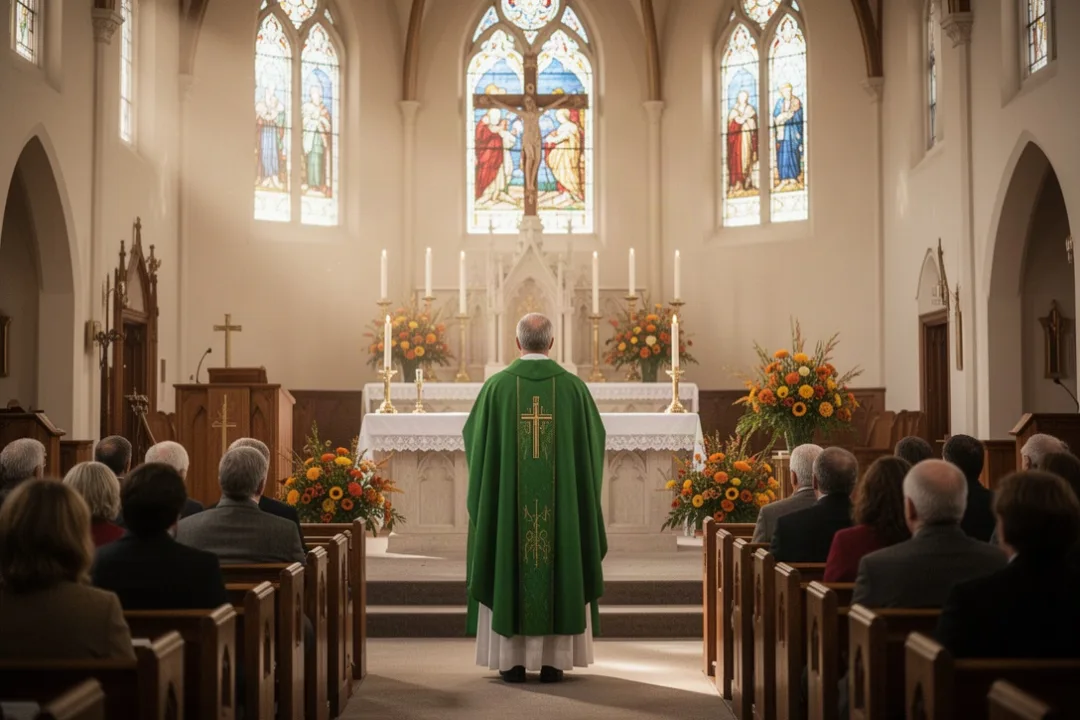
The usual liturgical color today is green. A priest may instead use white if the parish celebrates the optional memorial of Saint Francis Borgia. The exact choice can also depend on local calendars, a parish’s approved schedule, and the time zone where you are located.
Today’s quick answer: In the Roman Catholic calendar, use green for Saturday, October 3, 2026, unless the parish celebrates an optional memorial assigned a different color, such as white.
Green is the color associated with Ordinary Time, the longest season in the Roman Catholic liturgical year. “Ordinary” does not mean unimportant or routine in a dismissive sense. It comes from the idea of counted or ordered time, referring to the numbered weeks outside the major seasons.
Ordinary Time gives the Church space to reflect on Christ’s public ministry, teaching, healing, death, and resurrection. The Sunday and weekday readings move through the Gospel over the course of the year, helping worshipers consider how Christian discipleship develops through ordinary days and responsibilities.
October 3, 2026, is a Saturday in the 26th week of Ordinary Time. Because it is not a Sunday, a major solemnity, or a required feast that normally calls for another color, the weekday’s standard color is green.
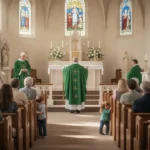
Green vestments may appear on the priest and deacon, while the altar frontal, pulpit cloth, and other textile decorations may use a matching shade. Churches do not always display the color in exactly the same way, especially when local decoration customs or practical considerations affect what is visible.
When white may be used on October 3, 2026
The Roman Catholic calendar also assigns October 3 as an optional memorial of Saint Francis Borgia. An optional memorial is not celebrated in every parish or at every Mass. If a priest or community chooses to celebrate it, the liturgical color is generally white, because Saint Francis Borgia was a saint who was not a martyr.
This creates a legitimate difference between two Catholic churches on the same day. One parish may celebrate the weekday of Ordinary Time and use green. Another may observe the optional memorial and use white. Neither choice automatically indicates an error.
White represents joy, holiness, light, and resurrection. It is commonly used for celebrations of the Lord, the Virgin Mary, angels, and saints who were not martyred. Gold may sometimes be used in place of white as a particularly festive color.
The decision can be influenced by the parish’s schedule, the priest’s choice, a religious community’s calendar, or a local observance. A diocesan or national calendar can also include celebrations that do not appear in the universal calendar.
What each major liturgical color means
Liturgical colors are visual signs that help worshipers recognize the character of a celebration. They do not function as a complete code for every theological idea, and their symbolism can be explained in slightly different ways. Still, the colors provide a helpful connection between the church’s calendar and its worship.
Green: Used during Ordinary Time, especially on regular weekdays and Sundays that are not assigned another color. It is associated with growth, hope, and the continuing life of faith.
White: Used for celebrations of Christ, Mary, angels, and non-martyr saints. It expresses joy, glory, purity, and resurrection.
Red: Used on Palm Sunday, Good Friday, Pentecost, and celebrations of the Passion of Christ or the memory of martyrs. It can suggest both the fire of the Holy Spirit and the blood of martyrdom.
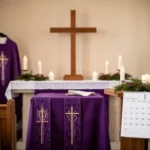
Violet or purple: Used during Advent and Lent, and often for Masses for the Dead. It is connected with preparation, repentance, and solemn reflection.
Rose: May be used on the Third Sunday of Advent and the Fourth Sunday of Lent. It signals a temporary lightening of the penitential tone.
Black: May be used where permitted for funerals and Masses for the Dead. Many communities use violet or white instead, depending on local practice.
The color applies primarily to the liturgical vestments, including the chasuble worn by the priest and the stole worn by ordained ministers. Other elements may coordinate with it, but not every cloth or decoration in the church must match perfectly.
How the liturgical year determines the color
The liturgical year does not begin on January 1. In the Roman Catholic tradition, it begins with the First Sunday of Advent and proceeds through Advent, Christmas, Lent, the Paschal Triduum, Easter, and Ordinary Time. The calendar then starts again with the next Advent.
Several factors determine the color assigned to a particular day. The first is the season. The second is the rank of the celebration, such as a solemnity, feast, memorial, or weekday. The third is the local calendar, which may give special prominence to a patron saint, anniversary, dedication, or regional celebration.
A simplified order of decision-making looks like this:
Identify the date and the local time zone.
Determine the liturgical season and numbered week.
Check whether the day has a solemnity, feast, memorial, or optional memorial.
Look at the approved calendar for the diocese, country, religious order, or parish.
Apply the color assigned to the celebration that is actually being observed.
This is why a simple internet search for “liturgical color today” may produce different answers if the searcher is in another country or using a different Christian tradition. The date may be the same, but the proper calendar may not be.
What happens when a Sunday or feast changes the expected color
Some days have a color that is easy to identify because the celebration is universal. Christmas and Easter, for example, normally use white or gold. Pentecost and Palm Sunday normally use red. The days within Ordinary Time are more variable because a weekday may be replaced by a feast or memorial.
The ranking of celebrations matters. A solemnity or feast can take precedence over a regular weekday. A required memorial generally takes precedence over an ordinary weekday, while an optional memorial may be observed only when the celebrant or community chooses it. Local rules determine how competing celebrations are handled.
For October 3, the practical question is not simply, “What color belongs to October?” It is, “Which celebration is this parish observing on October 3?” If the answer is the Saturday weekday of Ordinary Time, the color is green. If the answer is Saint Francis Borgia’s optional memorial, white is appropriate.
Check the parish’s actual Mass listing: A bulletin, parish website, diocesan calendar, or worship aid usually reveals which celebration is being observed. That information is more reliable than assuming every church follows the same optional memorial.
How Catholic, Anglican, Lutheran, and other calendars differ
“Liturgical color” is not limited to Roman Catholic worship. Anglican, Episcopal, Lutheran, Methodist, and other traditions also use colors, but their calendars and local practices may differ. A church in another tradition may call October 3 part of a different season, observe another saint, or use a different convention for optional commemorations.
Many Western churches use broadly similar colors. Green is often associated with the season after Pentecost or another extended period of ordinary worship. White is widely used for Christmas, Easter, and celebrations connected with Christ. Red commonly appears for Pentecost, Holy Week, or martyrs.
The similarities can be useful, but they should not be treated as proof that every church assigns the same color on the same day. Some traditions use blue during Advent or for Marian celebrations. Some use scarlet rather than red in particular seasons. Others give less emphasis to vestment colors or do not use them at all.
If you are asking about a specific congregation, identify its denomination and local calendar before choosing a color. A Roman Catholic answer is not automatically the correct answer for an Episcopal or Lutheran service.
Practical tips for checking the color correctly
Finding the right color is usually straightforward when you check the celebration rather than relying on the date alone. These habits help avoid the most common mistakes:
Use the complete date: Include the year, month, and day. “Today” changes according to the calendar and your location.
Confirm your tradition: Search the Roman Catholic, Episcopal, Lutheran, or other calendar that matches the church you attend.
Check the location: National and diocesan calendars can include different celebrations or rank the same commemoration differently.
Read the Mass listing: The parish bulletin often names the weekday, feast, memorial, or saint being celebrated.
Distinguish required from optional: An optional memorial may not be observed at every parish, so its color is not always the day’s only possibility.
Check the season first: Green is a strong starting point during Ordinary Time, but a feast or memorial may replace it.
Ask the sacristan or parish office: For a wedding, funeral, school liturgy, or special service, local instructions take priority.
Common mistakes when identifying the color
One frequent mistake is treating the liturgical color as a fixed color for each month. The calendar does not work that way. October is not automatically green, white, or purple; the color changes according to the season and celebration assigned to each date.
Another mistake is assuming that a saint’s name on a calendar means every parish must celebrate that saint. Some entries are optional memorials, and a priest may celebrate the weekday instead. The parish’s approved calendar and worship plan provide the clearest answer.
People also sometimes confuse the color for the day’s Mass with the color used for a special event. A funeral, wedding, confirmation, or votive Mass may have different rules from the weekday observance that would otherwise be celebrated.
Finally, a church’s visible decorations may not tell the whole story. A parish might use white flowers throughout a season, keep a permanent cloth on the altar, or display a banner that does not match the vestments. The priest’s vestment is usually the clearest visual indicator of the day’s liturgical color.
How the color can differ for funerals, weddings, and special Masses
A calendar lookup usually assumes the ordinary Mass of the day. Special celebrations can change that assumption. Funeral Masses, for example, may use white, violet, or black according to the norms and customs of the church or region. The color expresses Christian hope while also acknowledging grief and death.
Wedding Masses may use white or another suitable color, but the celebration must follow the liturgical rules for that date. A wedding held during a major season or on a day with a significant celebration may require consultation with the parish priest before the service is planned.
Votive Masses and Masses for particular needs can also have their own color. A votive Mass is selected for a devotional or pastoral reason rather than simply following the calendar’s ordinary entry. Permission, rank, and local regulations may determine whether that Mass can be used.
For this reason, someone preparing vestments should not rely only on a general color chart. The Order of Mass, the parish calendar, and the celebrant’s instructions all matter, particularly for services outside the normal Sunday or weekday schedule.
What the readings and prayers have to do with the color
The color does not replace the readings, prayers, or central focus of worship. Instead, it supports them with a visible sign. During Ordinary Time, the green vestment can reinforce the steady rhythm of hearing the Gospel and practicing faith through everyday life.
On a memorial of a saint, white can direct attention to the saint’s witness and the hope of sharing in eternal life. Red can underline the cost of discipleship when the Church remembers a martyr or celebrates the Holy Spirit. Violet can create a more restrained visual setting for repentance and preparation.
These meanings are aids rather than rigid formulas. Green does not mean that a particular day lacks spiritual importance, and white does not mean that every worshiper must feel cheerful. Liturgical color works alongside the prayers, Scripture readings, music, architecture, and gestures of the service.
How to answer “what is the liturgical color today?” for another date
If you are checking a date other than October 3, 2026, start by writing the date in full and identifying the church calendar you need. The word “today” is useful in conversation but unreliable in a saved bulletin, recurring search, or international setting.
Next, look for the celebration listed for that day. A reliable calendar will normally tell you whether it is a weekday, Sunday, solemnity, feast, memorial, or optional memorial. Once you know the celebration, its liturgical color is usually clear.
When two sources disagree, compare their location and denomination before assuming that one is wrong. An American Roman Catholic calendar, a Roman Catholic calendar from another country, and an Anglican calendar may all produce different results for the same date.
For the date at hand, the concise Roman Catholic answer remains: green for the Saturday weekday of Ordinary Time, or white if the optional memorial of Saint Francis Borgia is observed. The parish’s own schedule tells you which of those possibilities applies at a particular Mass.
Frequently asked questions
Is the liturgical color green everywhere on October 3, 2026?
No. Green is the usual Roman Catholic color for the Saturday weekday of Ordinary Time in the United States. A parish may celebrate the optional memorial of Saint Francis Borgia and use white instead. Other countries, dioceses, religious communities, or denominations may follow calendars with different celebrations, so the local church schedule is the best final check.
Why can two Catholic churches use different colors on the same day?
The difference usually comes from optional memorials or local calendars. One parish may celebrate the regular weekday of Ordinary Time, while another observes a saint’s memorial. A diocese, religious order, or national bishops’ conference may also have an approved celebration that changes the day’s rank and color. Both practices can be legitimate within their calendars.
Can a church use gold instead of white?
Yes. Gold may be used in place of white for particularly joyful or solemn celebrations, depending on local custom and available vestments. It does not normally create a separate liturgical season or celebration. The color assigned to the day remains white in meaning, while gold serves as a more festive visual variation.
Does the color of the altar cloth have to match the priest’s vestment?
The vestments are the clearest indicator of the liturgical color, but every church textile does not necessarily need to match exactly. Local guidelines, permanent altar coverings, flowers, banners, and seasonal decorations can affect what you see. For a formal service, follow the parish’s instructions rather than trying to coordinate every visible item independently.










Leave a Reply