St Cosmas and Damian: Saints, symbols, and feast days
St Cosmas and Damian: Saints, symbols, and feast days
St Cosmas and Damian are traditionally remembered as Christian physicians who treated the sick without charging money and died as martyrs for their faith.
The brothers are known in Greek as the Anargyroi, meaning “the moneyless ones” or “those without silver.” That name reflects the central feature of their witness: they used medical knowledge as an act of mercy rather than as a way to accumulate wealth. Their story joins two forms of healing—care for the body and concern for the spiritual life—and has made them enduring patrons of doctors, pharmacists, surgeons, hospitals, and patients.
According to longstanding Christian tradition, Cosmas and Damian were brothers who practiced medicine in the region of Syria, probably in or near the city of Cyrrhus. Some accounts describe them as twins, although the surviving historical traditions do not establish every detail of their family background with certainty. They are generally placed in the late third or early fourth century, during the period when Christians faced persecution under the Roman Empire.
The brothers were Christians who believed that medical treatment could be an expression of love for one’s neighbor. They treated people from different social backgrounds and, according to their traditional biography, refused payment for their services. Their generosity did not mean that they considered medicine unimportant or unskilled. Instead, their profession became the practical way they served people who were ill, poor, frightened, or unable to repay them.
Cosmas and Damian are often called unmercenary physicians because they offered their work freely. In Eastern Christian traditions, this title is especially significant. It presents them as examples of people who did not allow money, status, or professional advantage to determine whom they would help.
The central idea: Cosmas and Damian are honored not simply because they were physicians, but because they joined professional skill with compassion, generosity, and faithfulness under pressure.
Historical context surrounding the two physicians
The earliest details about Cosmas and Damian are difficult to separate from later devotional stories. Several versions of their life circulated, and some differ in their account of where the brothers lived, who trained them, and how they died. Their names and cult were established early enough to become important in both Eastern and Western Christianity, but historians cannot verify every episode preserved in later biographies.
Christian communities in the Roman world often remembered martyrs through liturgical celebrations, prayers, churches, and accounts of their courage. Physicians held a respected position because medical care required learning and practical experience, yet treatment was not equally available to everyone. A doctor who cared for the poor without payment would have been remembered as an especially striking example of Christian charity.
The brothers’ traditional setting also helps explain why their story emphasizes both healing and persecution. They belonged to a profession associated with knowledge and service, but they were not prepared to hide their Christian identity when challenged. In the stories, their refusal to renounce Christ eventually brought them before Roman authorities.
Some accounts name the persecuting ruler as Diocletian and describe the brothers as being condemned after accusations connected with their Christian faith. The exact sequence of their arrest and execution varies among sources. The consistent theme is that they remained faithful and were killed as martyrs rather than abandoning their beliefs.
Cosmas and Damian’s story in traditional points
They came from a Christian family. Their mother, often named Theodota in traditional accounts, is remembered as a devout woman who helped form their religious character after the death of their father.
They learned medicine. The brothers developed the skills needed to treat illness and injury, and their profession gave them regular contact with people in need.
They treated people without demanding payment. Their title, the Anargyroi, preserves this distinctive practice of free medical care.
They served people beyond their own community. Their generosity is traditionally presented as open to rich and poor, Christian and non-Christian alike.
They were accused because of their faith. The traditional accounts place their arrest during a period of Roman persecution.
They survived several attempted methods of execution in the stories. These episodes are part of devotional tradition and should not be treated as independently verified historical records.
They were finally martyred. Their death established their reputation as saints whose charitable work was sealed by courage and fidelity.
Their memory spread through churches and prayers. Communities in the East and West began honoring them as healers, martyrs, and protectors of the sick.
Why they are called the unmercenary saints
The term unmercenary describes someone who does not use a service primarily for financial gain. In the case of Cosmas and Damian, it points to their refusal to charge for medical treatment. Their example is not a general condemnation of earning a living or of the costs involved in modern health care. Rather, it highlights a particular form of Christian charity: giving expert help to someone who cannot afford it.
The brothers’ title also offers a useful way to understand professional ethics. A medical practitioner may need to earn a living, manage a clinic, pay staff, and maintain equipment. At the same time, the ideal represented by Cosmas and Damian asks whether financial circumstances should determine a person’s access to compassion and competent care.
For that reason, their patronage has significance beyond private devotion. Physicians and other health professionals may look to them when reflecting on service, integrity, patient dignity, and responsibility. Their example encourages care that sees the patient as a person rather than as a diagnosis, a payment source, or a problem to be processed quickly.
Their witness can also be applied to people outside the medical profession. A person may imitate their spirit by sharing knowledge, volunteering, supporting a sick neighbor, visiting someone in a hospital, or offering practical assistance without expecting recognition. The underlying principle is generous service shaped by respect for human life.
The healing miracle associated with Cosmas and Damian
One of the best-known stories connected with the saints describes the healing of a man whose leg was seriously diseased. In the traditional account, Cosmas and Damian replaced the affected leg with the leg of a recently deceased person. This scene became a powerful subject in medieval and Renaissance art, especially in Europe.
The story is commonly called the miracle of the black leg because the donor’s leg is often described as belonging to a person from Africa or Ethiopia. Artists frequently show the two physicians working beside a sleeping patient, with one leg appearing darker than the other. The image was meant to display divine intervention and the saints’ healing power, not to provide a medical explanation in modern terms.
The legend should be approached as a religious miracle story rather than as a documented surgical procedure. It reflects the deep hope of sick people who pray for restoration and the belief that God can work through the intercession of saints. The account also gave artists a memorable visual way to represent the brothers as healers.
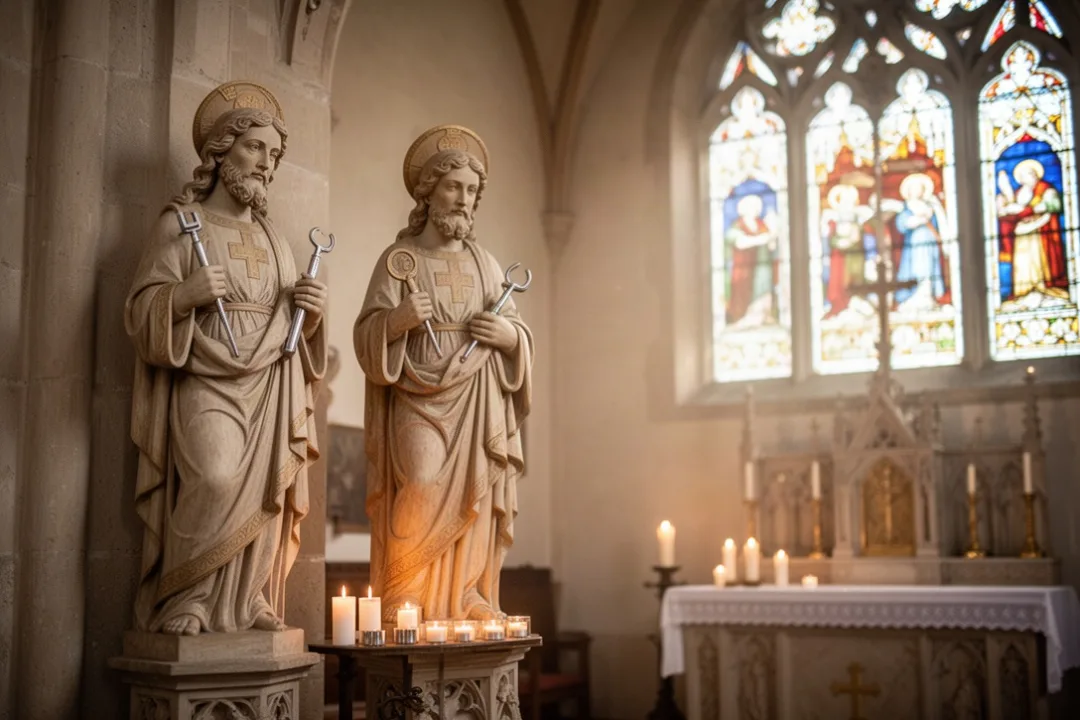
Several works of art depict this episode, but the most familiar versions belong to later European artistic traditions. In these images, Cosmas and Damian may be shown with medical instruments, containers, knives, or other objects associated with their profession. Such details helped viewers recognize the saints and connect their holiness with practical care for the body.
What their symbols mean in Christian art
Cosmas and Damian can be identified through symbols that point to their medical profession, martyrdom, or charitable work. Their appearance varies according to the artistic tradition, the region, and the period in which an image was created.
Medical instruments: Surgical tools, jars, boxes, or other implements represent their work as physicians.
Medicine containers: Vessels and bottles suggest the preparation and administration of treatments.
Books: A book may represent medical learning, Christian teaching, or both kinds of wisdom.
Martyr’s palm: A palm branch signifies victory through martyrdom and fidelity to the faith.
Red or richly colored garments: These may refer to martyrdom, dignity, or the conventions of sacred art.
The transplanted leg: In scenes of the famous miracle, the contrasting leg identifies the healing story.
Paired figures: Their placement together emphasizes their brotherhood and shared ministry.
When looking at an image of the saints, the medical objects are not merely historical decoration. They make a theological point: ordinary work can become a form of holiness when it is carried out with skill, humility, and concern for others. The brothers are not portrayed as separating religious life from professional life; their medical vocation is part of the way they serve God.
Feast days and differences between traditions
The feast of St Cosmas and Damian is observed on different dates in different Christian traditions. In the Roman Catholic calendar, their principal feast is generally celebrated on September 26. In many Eastern Orthodox churches, they are commemorated on November 1, with additional commemorations in some local calendars.
Orthodox calendars may also include other saints with the same names or related commemorations. Dates can differ because churches follow distinct liturgical calendars and preserve more than one tradition about the physicians. If you are attending a particular parish, its calendar is the best guide to the date and form of the local observance.
A feast day may include a Divine Liturgy or Mass, readings about Christian witness, prayers for the sick, and remembrance of health professionals. Some communities hold processions, bless medical instruments, or organize charitable activities. The purpose is not simply to recall two people from the past but to connect their example with the needs of patients, families, and caregivers now.
People may also observe the feast privately by praying for someone who is ill, thanking a physician or nurse, visiting a patient, or making a donation to a health-related charity. These practices reflect the saints’ combination of prayer and practical service.
For a feast-day prayer: You can ask Cosmas and Damian to intercede for patients, medical workers, families facing serious illness, and everyone who needs wisdom, patience, or humane care.
Why physicians and health workers honor them
Medical professionals face ethical decisions, emotional strain, uncertainty, and the limits of what treatment can accomplish. Cosmas and Damian offer a model that does not pretend illness is simple or that every patient can be cured. Instead, their example emphasizes the duties that remain even when a cure is impossible: truthful communication, comfort, competent attention, respect, and presence.
Their story also gives spiritual language to the idea that healing is broader than eliminating disease. A physician may cure an infection, control pain, repair an injury, or extend life. Nurses, therapists, pharmacists, chaplains, and caregivers may help a person regain independence, face a diagnosis, or die with dignity. The tradition surrounding the saints leaves room for all of these forms of care.
For Christians working in medicine, the brothers may symbolize a profession practiced as a vocation. That does not mean ignoring boundaries, training, compensation, or evidence-based care. It means refusing to let efficiency and financial concerns erase the person at the center of the clinical encounter.
Their witness can be especially meaningful in settings where patients are vulnerable. A hospital room can involve fear, loss of privacy, physical pain, and difficult decisions. The memory of two physicians who served without discrimination encourages health workers to protect dignity in small, concrete ways: listening carefully, explaining clearly, preserving privacy, and treating every patient with patience.
Prayers and devotions connected with the saints
Devotion to Cosmas and Damian often centers on intercession for healing. A person may ask for their prayers before surgery, during a serious illness, while awaiting test results, or when supporting someone receiving long-term treatment. The prayer may ask for recovery, but it can also ask for strength, wisdom, peace, and the grace to endure uncertainty.
In Catholic and Orthodox practice, asking a saint to intercede does not mean treating the saint as a substitute for God or for medical care. The saint is understood as someone who prays with and for the faithful. Medical evaluation, prescribed treatment, and urgent care remain necessary when illness or injury requires them.
A simple devotion might include these steps:
Name the person or situation honestly. Pray for a patient, caregiver, medical team, or family rather than speaking only in general terms.
Ask for the saints’ intercession. Request their prayers for healing, courage, wise decisions, and compassionate care.
Pray for the health professionals involved. They may need steadiness, clear judgment, rest, and emotional support.
Pair prayer with practical help. Offer transportation, meals, a visit, childcare, or assistance with an appropriate charitable need.
Accept that healing can take different forms. Continue to hope for recovery while also asking for peace, reconciliation, and dignity.
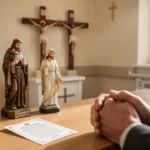
Many people also pray before an image of the saints or light a candle in a church. These visible actions can help focus attention, especially during a stressful period. Their value lies in directing the heart toward trust and compassionate action, not in treating an object as a magical guarantee.
Churches, hospitals, and places associated with their devotion
Churches dedicated to Cosmas and Damian exist in many parts of the Christian world. One especially significant early site is the Basilica of Saints Cosmas and Damian in Rome, located in the ancient Roman Forum. The church has long connected the saints’ memory with Christian worship, healing, and care for the vulnerable.
In the Eastern Christian world, the brothers are frequently represented in icons as paired physicians and martyrs. They may appear holding medical instruments, crosses, or scrolls. Their images can be found in churches, monasteries, hospitals, and homes where people ask for protection and healing.
Local traditions sometimes connect the saints with springs, chapels, pilgrimages, or charitable institutions. These customs vary widely and should not be assumed to belong to every community that honors them. What they share is the desire to make the saints’ charitable example visible through worship and care for others.
Their patronage has also influenced professional and community organizations connected with medicine. A hospital or medical association named for Cosmas and Damian may be invoking more than a historical connection. The name can express a commitment to patient-centered service, ethical responsibility, and care offered without discrimination.
How to understand their legacy today
Cosmas and Damian remain relevant because their story addresses a permanent human need: people become sick, families become anxious, and caregivers must make difficult choices. Their legacy does not depend on pretending that modern medicine is identical to ancient medicine. It rests on the enduring question of how knowledge and power should be used when another person is vulnerable.
The brothers’ example offers several practical principles:
Skill should serve people. Learning becomes more meaningful when it is used responsibly and competently.
Care should not depend entirely on wealth. Communities can create ways for people with limited resources to receive help.
Patients deserve dignity. Illness does not reduce a person’s value or right to respectful treatment.
Professional ethics require courage. Good care may involve speaking up, protecting a patient, or resisting unfair pressure.
Healing includes presence. Listening and accompanying someone can matter even when a cure is unavailable.
Faith and medicine need not be enemies. Prayer can support a person spiritually while trained professionals provide appropriate medical treatment.
Remembering the saints does not require idealizing every detail of the legends or dismissing historical questions. A mature devotion can distinguish between verified history, traditional biography, miracle accounts, and the spiritual meaning communities have drawn from them. The result is a richer understanding of why their memory has lasted.
For someone who is ill, Cosmas and Damian can represent hope and compassionate attention. For a physician or nurse, they can represent service carried out with conscience. For a congregation, they can inspire practical solidarity with patients, caregivers, and families. Their story continues to speak wherever medical knowledge is placed at the service of human dignity.
Frequently asked questions
Are Cosmas and Damian the patron saints of doctors?
Yes. They are widely honored as patron saints of physicians and are also associated with surgeons, pharmacists, hospitals, dentists, and other health professionals. Their patronage comes from the tradition that they practiced medicine skillfully, treated people without charging them, and remained faithful to their Christian beliefs even when persecuted.
Were Cosmas and Damian really twins?
Many traditional accounts describe them as twin brothers, but the historical evidence does not establish that detail with certainty. Their brotherhood and shared medical ministry are central to the tradition, while specific information about their family, birthplace, training, and chronology varies among surviving accounts.
What should I pray to Cosmas and Damian for?
People commonly ask their intercession for healing, successful treatment, wise medical decisions, and strength during illness. You can also pray for doctors, nurses, caregivers, and families. Prayer should accompany—not replace—professional medical advice and urgent treatment when those are needed.
Why do some images show one patient’s leg as darker than the other?
The contrasting legs refer to a famous traditional miracle in which the saints replaced a diseased leg with the leg of a deceased donor. Medieval and Renaissance artists used the difference in color to make the story recognizable. It is a devotional miracle account, not a documented modern surgical procedure.











Leave a Reply