If you have seen a church, painting, or calendar entry dedicated to St Bartholomew, you may wonder which apostle that name describes. The short answer is that Bartholomew was one of the Twelve Apostles of Jesus, but the New Testament gives us very little biographical information about him. Christian tradition commonly identifies him with Nathanael, a disciple described in the Gospel of John.
His story is therefore built from a combination of Gospel passages, early Christian tradition, and centuries of art and devotion. St Bartholomew is remembered as a witness to Christ, an evangelist associated with distant lands, and a martyr whose traditional symbols include a knife and his own skin.
The name Bartholomew appears in the lists of the apostles in Matthew 10, Mark 3, Luke 6, and Acts 1. In each list, he appears among the Twelve, usually near Philip. These passages establish his place as one of Jesus’ chosen apostles, but they do not describe his family, occupation, personality, or later missionary work.
“Bartholomew” may not have been a personal name in the same way that Peter, Andrew, or Philip were. It is generally understood as an Aramaic-style name meaning “son of Tolmai” or “son of Talmai.” That naming pattern helps explain why many readers and scholars have considered Bartholomew a patronymic rather than a complete personal name.
The Gospel of John does not mention an apostle named Bartholomew. Instead, it introduces Nathanael, whom Philip brings to meet Jesus. Because Philip and Bartholomew are paired in the Synoptic Gospel lists, early Christian tradition came to identify these two names as referring to the same person.
A careful distinction: The New Testament never directly says, “Bartholomew was Nathanael.” The identification is an ancient Christian tradition supported by the apostle lists and John’s account, but the text itself leaves the connection implicit.
Why Bartholomew is traditionally identified with Nathanael
John 1 presents Nathanael as a man whom Philip invites to meet Jesus. Nathanael initially reacts with skepticism when he hears that Jesus comes from Nazareth, a town he does not regard as an important source of religious significance. Philip does not argue with him; he simply tells him to come and see.
When Nathanael approaches, Jesus describes him as an Israelite without deceit. The exchange suggests that Jesus knows something about Nathanael before their formal introduction. Nathanael responds by recognizing Jesus with titles expressing faith in his identity as the Son of God and King of Israel.
This brief scene gives Nathanael a distinctive place among the disciples. He is not portrayed as a loud public leader or a frequent speaker. Instead, he is shown as someone who moves from honest doubt to recognition. His first question is skeptical, but he remains willing to investigate, listen, and respond.
The connection with Bartholomew rests mainly on three observations:
Philip is linked with both men: Philip brings Nathanael to Jesus in John and stands beside Bartholomew in several apostle lists.
Nathanael is absent from the apostle lists: The lists name Bartholomew, but not Nathanael.
Bartholomew is a family designation: “Son of Tolmai” could naturally accompany a personal name such as Nathanael.
Not every Christian tradition treats the identification with the same level of certainty. For ordinary devotion, however, St Bartholomew and St Nathanael are commonly treated as the same apostle. You may therefore see him named as “Bartholomew,” “Nathanael,” or “Bartholomew Nathanael.”
What the Gospels reveal about his character
Very little is recorded about Bartholomew by name, so the portrait drawn from Nathanael’s story should be presented with care. If the traditional identification is correct, his encounter with Jesus shows a person who values truthfulness and direct evidence. His initial skepticism is not presented as malicious; it becomes an opening for a deeper response.
His story also highlights the role of personal invitation. Nathanael does not appear to discover Jesus entirely on his own. Philip brings him, and Nathanael then makes his own decision after meeting Jesus. This pattern has made the passage meaningful to readers who are curious about faith but wary of easy claims.
Jesus’ description of Nathanael as a person without deceit has influenced later interpretations of St Bartholomew. He is often portrayed as sincere, perceptive, and spiritually attentive. These qualities come from the biblical scene rather than from a long narrative biography, so they should not be expanded into details the Gospels do not provide.
The Gospel of John later mentions Nathanael among the disciples at a post-Resurrection appearance by the Sea of Tiberias, in John 21. He is named alongside several other disciples during a fishing episode. This is the final direct New Testament reference commonly connected with him.
What happened to St Bartholomew after Pentecost
Acts 1 names Bartholomew among the apostles who remain together after Jesus’ Ascension and before Pentecost. Beyond that listing, the New Testament does not provide a detailed account of his movements. The later stories about his preaching come from Christian tradition and apocryphal writings, not from a full apostolic biography in Scripture.
Traditions place Bartholomew’s missionary work in several regions, including parts of India, Arabia, Mesopotamia, Ethiopia, and Armenia. These accounts do not always agree, and historians cannot confirm every detail. The variation reflects the wide geographic scope later Christians associated with the apostles as the early Church spread beyond Jerusalem.
Armenian Christian tradition gives St Bartholomew a particularly important place. Together with St Thaddeus, he is honored as one of the founders of Christianity in Armenia. Armenian tradition connects his preaching with the region and remembers him as a missionary who helped establish an early Christian presence there.
Other traditions associate him with India. That claim has been interpreted in different ways because ancient writers used geographic names inconsistently. “India” could refer to areas known through trade and travel rather than the exact boundaries of the modern nation. For that reason, broad claims about his route should be treated as traditional rather than certain.
How St Bartholomew traditionally died
St Bartholomew is honored as a martyr, meaning a Christian who died because of his witness to the faith. Accounts of his death differ in their details, but the most widespread Western tradition says that he was flayed alive and then beheaded. Some versions describe other forms of execution.
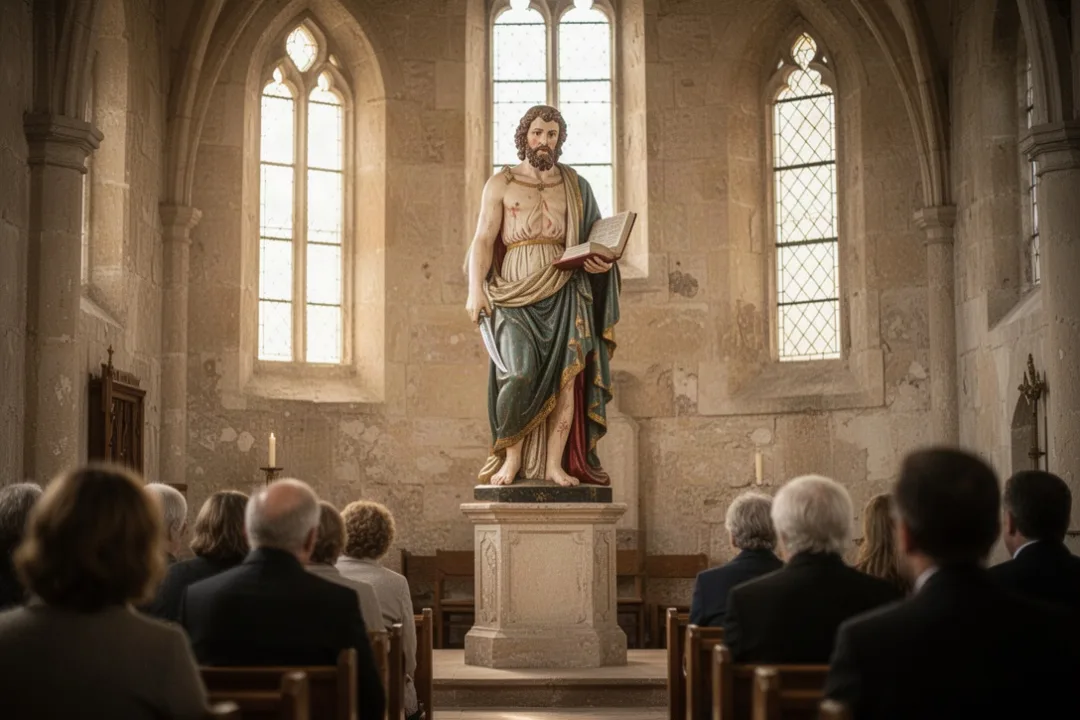
The flaying tradition explains why a knife and human skin became his unusual identifying symbols. It also explains why artists sometimes show Bartholomew holding a large knife or carrying a strip of skin. These images can be difficult to look at, but their purpose is to represent the cost of his apostolic witness rather than to glorify violence.
The famous sculpture of St Bartholomew in Milan Cathedral, often associated with Marco d’Agrate, depicts the saint carrying his skin over his body. It is a particularly dramatic example of how artists used the martyrdom tradition to communicate identity. The work is not a biblical illustration of a recorded scene; it is a later visual interpretation of his traditional death.
Because the surviving accounts are varied, responsible descriptions should say that Bartholomew’s traditional martyrdom involved flaying and beheading, rather than presenting every detail as historically documented. His commemoration rests on his apostolic status and witness even where the precise circumstances cannot be verified.
What St Bartholomew’s symbols mean
Religious art needed a way to distinguish apostles who might otherwise look alike. Since Bartholomew has no long Gospel narrative or universally recognized personal object, artists relied heavily on the instruments of his martyrdom and on the traditions surrounding his mission.
A knife: This refers to the tradition that he was flayed before being killed. It is his most recognizable attribute in Western art.
A piece of skin: Artists use this unsettling symbol to represent the traditional manner of his martyrdom.
A book: The book identifies him as an apostle and preacher of the Gospel.
A cross: A cross can indicate Christian preaching, discipleship, and martyrdom.
A staff or sword: These may appear in particular artistic traditions, although they are less consistently associated with him than the knife.
Bartholomew is sometimes shown with dark hair and a beard, but there is no reliable physical description of him in the New Testament. Artistic appearances vary by region and period. A painting’s visual details often tell you more about the artist’s culture than about the apostle’s historical appearance.
When you see a figure holding a knife beside another apostle, the object can help identify Bartholomew. In a group of apostles, the book and knife together are especially useful clues. In some images, the saint is also labeled, because symbols can overlap and no single artistic convention has been used everywhere.
In the Roman Catholic calendar, St Bartholomew’s feast day is August 24. Many Anglican and other Western Christian communities also observe him on August 24. The date commemorates the apostle with liturgy, prayer, readings, and local celebrations rather than with a single universal set of customs.
Eastern Christian traditions commonly celebrate the apostle on June 11, although church calendars and local practices can differ. The date should therefore be checked against the calendar used by your denomination or parish, especially if you are planning a service or devotional observance.
August 24 is also connected to the historical St. Bartholomew’s Day Massacre in France in 1572. That event was a violent attack during the French Wars of Religion and is entirely separate from the apostle’s life. Sharing a date does not make the massacre part of the saint’s feast or a religious celebration of the violence.
Parishes named for St Bartholomew may mark the feast with a patronal service, a procession, a community meal, or a special sermon. The exact customs depend on local history. Some communities focus on missionary witness, while others emphasize the apostle’s movement from questioning to faith.
What St Bartholomew is the patron saint of
St Bartholomew is traditionally associated with several groups and occupations. The connection with leatherworkers, tanners, and bookbinders makes sense through the symbolism of skin and the book. He is also linked with butchers, often because of the knife used in depictions of his martyrdom.
He is named as a patron of various places, churches, and communities, especially in areas that preserve traditions about his missionary work. Some sources also associate him with people suffering from certain skin conditions or nervous disorders. These patronages developed through local devotion and symbolic associations, so lists can differ from one reference work to another.
When people ask St Bartholomew for prayers, they may be responding to his identity as an apostle and martyr rather than to one narrow occupational patronage. His traditional story can speak to anyone facing the cost of honest conviction, public misunderstanding, or a demanding call to serve others.
How to recognize St Bartholomew in a church or museum
Start with the figure’s object rather than facial appearance. If an apostle holds a knife, a strip of skin, or both, he is likely intended to be St Bartholomew. A book may reinforce the identification, especially in medieval or Renaissance works where the apostles are represented as teachers and witnesses.
Look at the surrounding figures and the setting. Bartholomew may appear with other apostles, in a scene of the Last Supper, in a martyrdom image, or in a local church’s patronal artwork. A label or inscription is more dependable than appearance, since artists often imagined the apostles in different ways.
Do not assume that a man holding a sword is Bartholomew. The sword can refer to martyrdom or to another saint’s story, and some traditions use different attributes. Identification works best when you combine the object, the inscription, the placement in the artwork, and the church’s dedication.
Practical tips for learning about St Bartholomew
A short passage can provide a sound starting point, while later traditions require more careful handling. These habits help you separate what Scripture says from what Christian communities have remembered over time.
Read the apostle lists: Consult Matthew 10, Mark 3, Luke 6, and Acts 1 to see where Bartholomew appears among the Twelve.
Read Nathanael’s encounter: John 1 presents the traditional connection with Bartholomew through Philip and Nathanael.
Mark levels of certainty: Treat the identification of Bartholomew with Nathanael and the details of his travels as ancient tradition, not explicit Gospel statements.
Check your church calendar: Western and Eastern communities may observe different feast dates.
Study symbols in context: A knife usually points to the martyrdom tradition, while a book suggests apostolic preaching.
Separate history from legend: A vivid story may be spiritually meaningful without being independently documented.
Several common mistakes can make a description of St Bartholomew misleading. Avoid saying that the Bible records his missionary journeys in detail, because it does not. Avoid presenting the flaying account as a fact established by a contemporary eyewitness source, and avoid treating every painting as historical evidence of his appearance.
It is also easy to confuse St Bartholomew’s feast with events that happened on the same date. The apostle’s commemoration is a religious observance; the 1572 massacre is a separate event in European political and religious history. Keeping those subjects distinct prevents a serious misunderstanding.
What St Bartholomew can mean for Christian prayer today
Devotion to St Bartholomew does not require certainty about every detail of his biography. Christians may honor him because he belonged to the original apostolic community, carried the message of Christ, and remained faithful according to the tradition of the Church.
The story associated with Nathanael offers a particularly accessible point for prayer. Nathanael begins with a question and does not hide his reservation. His example suggests that honest questioning can lead toward deeper faith when it remains open to truth rather than becoming an excuse to avoid it.
His traditional martyrdom also places courage at the center of his remembrance. The point is not to seek suffering or admire violence. It is to remember a person believed to have continued his witness despite danger, and to ask for steadiness when conscience, service, or faith becomes difficult.
A simple prayer might ask St Bartholomew to pray for clear judgment, truthful speech, and courage under pressure. Someone working with leather, books, or tools might also connect with his traditional patronage. A parish named for him may use the feast day to renew its commitment to welcome seekers and serve its wider community.
Why St Bartholomew remains a distinctive apostle
Many apostles are remembered through several Gospel scenes, letters, or major moments in Acts. Bartholomew stands out because his New Testament profile is so brief, while his later tradition is remarkably wide-ranging. His identity sits at the meeting point of Scripture, apostolic memory, missionary tradition, and sacred art.
That combination calls for both respect and precision. The Bible confirms that Bartholomew belonged to the Twelve. Christian tradition identifies him with Nathanael, sends him on missions across distant regions, and remembers him as a martyr. Those claims do not all have the same historical basis, but together they explain why churches, artists, and worshipers have continued to remember him.
Whether you encounter his name on August 24, see his knife in a painting, or read Nathanael’s conversation with Jesus in John 1, the central theme remains consistent: a questioning disciple became a committed witness. St Bartholomew’s lasting significance lies less in the amount of information preserved about him than in the faithfulness that generations of Christians have associated with his name.
Frequently asked questions
Is St Bartholomew the same person as Nathanael?
Most Christian traditions identify St Bartholomew with Nathanael, the disciple introduced by Philip in John 1. The New Testament does not state this connection directly. It is inferred because Philip is associated with both men and Nathanael does not appear in the apostle lists, while Bartholomew does.
What is St Bartholomew best known for?
St Bartholomew is best known as one of the Twelve Apostles and as a traditional martyr. Christian art often shows him with a knife or a piece of skin because tradition says he was flayed before being killed. He is also remembered for missionary work, especially in traditions connected with Armenia and other eastern regions.
What day is St Bartholomew’s feast day?
Western churches, including the Roman Catholic Church, generally celebrate St Bartholomew on August 24. Many Eastern Christian traditions observe his feast on June 11. Because local calendars can vary, check the schedule of your denomination or parish before planning a service or community observance.
Why does St Bartholomew carry a knife in paintings?
The knife represents the traditional account of his martyrdom, which says that he was flayed before being put to death. It serves as an identifying symbol in religious art, much like the keys associated with St Peter. The image reflects later Christian tradition rather than a scene described in the New Testament.














Leave a Reply