Saint James the Less: identity, life, and significance
Saint James the Less: identity, life, and significance
If you have heard the name Saint James the Less and wondered why an apostle seems to have such an unusual title, the short answer is that he was one of Jesus’ Twelve Apostles, identified in the Gospels as James son of Alphaeus. The word “Less” helps distinguish him from the other apostle named James, James son of Zebedee.
He appears in the apostolic lists, but Scripture gives very little information about his personal life or ministry. That silence can make him easy to overlook. Yet his place among the Twelve shows that Jesus chose and trusted him, even though the Gospel accounts do not preserve many stories about him.
Saint James the Less was one of the twelve men Jesus selected as apostles. The Gospel lists in Matthew 10:2–4, Mark 3:13–19, and Luke 6:12–16 name him as James son of Alphaeus. The list in Acts 1:13 includes him among the apostles who gathered in Jerusalem after Jesus’ ascension.
The biblical record does not describe a separate calling scene for James, a sermon he preached, or a miracle associated specifically with him. Unlike Peter, John, and James son of Zebedee, he is not featured in the Gospel narratives about the raising of Jairus’s daughter, the Transfiguration, or Jesus’ prayer in Gethsemane.
That does not mean James was unimportant. The Twelve represented the foundation of Jesus’ apostolic community, and James was named among them repeatedly. His inclusion in every major list of the apostles indicates a stable and recognized place in the earliest Christian community.
The name Alphaeus identifies his father, but the New Testament does not tell us much else about Alphaeus. Several people in the Gospels have similar names, and the text does not provide enough information to establish every possible family connection. Careful reading avoids turning later suggestions into biblical facts.
Essential identification: Scripture calls him James son of Alphaeus. “The Less” is a distinguishing title, not a statement that he was less faithful, less important, or less loved than the other apostles.
Why is he called “the Less”?
The title comes from the way early Christians distinguished him from James son of Zebedee, another member of the Twelve. James son of Zebedee was the brother of John and the son of Zebedee; he is sometimes called James the Greater. Since both men were apostles named James, additional descriptions were needed.
“The Less” is commonly connected with the Greek word mikros, which can refer to someone who is smaller, younger, or less prominent. English translations and Christian traditions have rendered the title in different ways, including “the younger” and “the little.” The exact intended meaning cannot be established with certainty from the New Testament alone.
The title may have referred to age, physical stature, or simply a difference in prominence. It may also have developed as a practical way to distinguish him from the better-known James son of Zebedee. It should not be read as an insult or as a ranking of spiritual worth.
James son of Zebedee is more visible in the Gospel stories because he belonged to Jesus’ closest circle of three apostles, along with Peter and John. James son of Alphaeus receives fewer individual references. That difference in narrative attention likely contributed to the use of “the Less,” but it does not tell us that his apostolic service mattered less.
How Saint James the Less differs from the other Jameses
The New Testament mentions several men named James, and confusion is understandable. The most important distinction is between the two apostles named James. A third important figure is James, the brother of the Lord, who became a leading figure in the Jerusalem church.
James son of Zebedee: One of the Twelve, brother of John, and son of Zebedee. Jesus called him and John Boanerges, a name explained in Mark 3:17. Herod Agrippa I killed this James, as recorded in Acts 12:1–2.
James son of Alphaeus: The apostle known in Christian tradition as James the Less. He appears in the lists of the Twelve, but Scripture records few details about his life.
James the brother of the Lord: A prominent leader in Jerusalem who appears in Acts and Paul’s letters. The New Testament distinguishes him from the two apostles named James, although Christian traditions differ in how they describe his exact family relationship to Jesus.
The Gospel of Mark names a Mary as the mother of James the Less in Mark 15:40. Matthew 27:56 also refers to Mary as the mother of James and Joses, with the wording differing slightly among Gospel accounts. Many readers connect this James with James son of Alphaeus, but the passage does not repeat his father’s name in that scene.
The Gospel accounts also mention a James among Jesus’ relatives. That person should not automatically be identified with James son of Alphaeus. The shared name was common in the Jewish world of the first century, and the biblical texts use family descriptions and titles to distinguish people in different settings.
What Scripture actually says about James son of Alphaeus
Scripture gives us a small but consistent set of facts. James was chosen as an apostle, was the son of Alphaeus, and was present with the apostolic community after the resurrection. He belonged to the group commissioned to witness to Jesus and to participate in the mission of the early Church.
The apostolic lists place James among other familiar names, including Peter, Andrew, John, Matthew, Thomas, Bartholomew, Simon the Zealot, and Judas son of James or Thaddaeus, depending on the Gospel’s wording. These lists are not identical in every detail, but James son of Alphaeus is consistently included.
After Jesus’ ascension, Acts 1:13 places James among the apostles gathered in Jerusalem. The next verses describe the community’s prayer and discernment as it selected Matthias to join the apostolic group. James is not singled out in the account, but his presence shows that he remained part of the community during this important transition.
Beyond those references, the New Testament does not provide a biography. It does not record his occupation, birthplace, marriage, travels, death, or the churches he may have served. Those unanswered questions are a reason to distinguish biblical evidence from later tradition.
What later Christian tradition says about his ministry
Christian communities developed traditions about the apostles’ later missions, and James the Less is associated with several different accounts. Some traditions connect him with preaching in regions near Jerusalem, Egypt, Syria, or Persia. These reports are not uniform, and they are difficult to verify from the New Testament.
Accounts of his death also vary. Some traditions describe martyrdom by stoning, while others mention being beaten or killed with a club. Because these stories developed in different places and periods, they should be presented as traditional accounts, not as details established by Scripture.
Images of James sometimes show a club, a fuller’s club, a saw, or another instrument of martyrdom. Such symbols reflect particular traditions about his death and help distinguish him in religious art. They do not prove that one specific account is historically certain.
His traditional feast is often observed together with Saint Philip, another apostle. In the Roman Catholic calendar, their shared feast is May 3. Other Christian traditions use different calendars, feast dates, or commemorations. If you are preparing a parish service or classroom lesson, check the calendar of the denomination or church you are studying.
Read tradition carefully: Stories about James’ mission and martyrdom can express how Christians honored him, but the New Testament itself does not supply a detailed account of his later life.
What the title “the Less” can teach about unnoticed service
James is often remembered precisely because the biblical record says so little about him. His example challenges the assumption that an important life must produce a large collection of stories, speeches, or public achievements. He served as an apostle without becoming one of the most visible characters in the Gospel narrative.
His story also clarifies the difference between visibility and significance. Peter’s actions are recorded frequently, but James’ fewer appearances do not place him outside the central apostolic calling. The Twelve were not all given the same personality, role in the narrative, or amount of recorded attention.
For readers, this can offer a grounded way to think about Christian service. A person who teaches children, visits the sick, supports a congregation, cares for family members, or serves quietly may not receive public recognition. James’ place among the apostles shows that hidden work should not be confused with meaningless work.
At the same time, James should not be turned into a symbol detached from history. He was not merely “the unknown apostle.” He was a real member of the earliest apostolic community, identified by name and family connection, even though the surviving texts preserve only a few details about him.
How James the Less relates to the Letter of James
The New Testament contains a Letter of James, but its opening identifies the writer simply as “James,” not specifically as James son of Alphaeus. For that reason, it is not possible to state from the letter alone that James the Less wrote it.
Some Christian traditions attribute the letter to James the brother of the Lord, who held a major leadership role in Jerusalem. Other discussions have considered one or another of the apostles named James. The biblical text itself does not provide enough information to settle the question in a way accepted by every Christian tradition.
The letter emphasizes practical Christian conduct, including endurance in trials, responsible speech, care for those in need, impartial treatment of the poor, and faith expressed through action. Those teachings may be spiritually valuable regardless of which James wrote the document, but they should not be used as proof of a direct biography for James son of Alphaeus.
A similar caution applies to the claim that the James named in Galatians 1:19 or Galatians 2:9 was James the Less. Paul’s letters refer to James in the Jerusalem leadership, but the passages do not identify him as Alphaeus’s son. Context and later tradition are needed for any proposed identification.
Common mistakes when studying Saint James the Less
Several misunderstandings arise because the name James appears often in the New Testament. A careful approach keeps the people, texts, and traditions distinct.
Assuming all references to James mean the same person: Check whether the passage identifies him by his father, brother, or position in the church.
Confusing him with James son of Zebedee: The apostle who was John’s brother is a different James and is usually more prominent in the Gospel narratives.
Calling him the author of the Letter of James without qualification: The letter does not say “James son of Alphaeus.” Present the authorship as a matter of interpretation or tradition.
Treating a martyrdom symbol as a confirmed historical detail: A club, saw, or other object in artwork often represents a later tradition rather than a fact recorded in Scripture.
Reading “Less” as a judgment on his worth: The title distinguishes him from another James. It does not mean that he was spiritually inferior.
Filling every silence with speculation: It is acceptable to say that the Bible does not tell us something. Restraint is more accurate than an elaborate biography built from uncertain sources.
Practical ways to study James the Less
You can learn what is known about James without forcing the evidence to say more than it does. Begin with the passages that name him, then compare them with texts about the other Jameses and with later church traditions.
Read the apostolic lists: Compare Matthew 10:2–4, Mark 3:13–19, Luke 6:12–16, and Acts 1:13. Notice how each list identifies James and where he appears.
Mark the family descriptions: Record “son of Alphaeus,” “son of Zebedee,” “brother of John,” and other identifying phrases. These details prevent names from being merged.
Separate direct evidence from inference: A statement such as “James was one of the Twelve” is biblical evidence. A claim about his missionary destination may come from later tradition.
Compare a trusted Bible dictionary or commentary: Look for explanations that acknowledge uncertainty rather than presenting every traditional story as established fact.
Consider the spiritual theme carefully: Reflect on faithful service that receives little public attention, while remembering that the theme should grow from the biblical portrait rather than replace it.
For a group study, ask participants to list every fact they can support directly from a biblical reference. Then create a second list for traditions and interpretations. This simple exercise helps readers appreciate what is known while leaving room for respectful disagreement.
Churches commemorate James the Less as an apostle and witness to Jesus. He may appear in paintings, stained-glass windows, icons, statues, and devotional calendars among the company of the Twelve. His image is often identified by a traditional instrument associated with his martyrdom, although the exact symbol differs by artistic and denominational tradition.
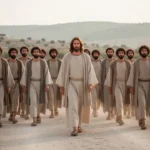
Because he is less prominent in the Gospel stories, artists sometimes portray him with the other apostles rather than in a scene that belongs to him alone. This reflects the nature of the surviving evidence: his identity is secure within the apostolic group, while the details of his individual ministry are limited.
His commemoration can also be connected with the broader meaning of apostolic witness. The Church remembers not only those whose words dominate the narrative, but also those who belonged faithfully to the community and carried its mission beyond the moments recorded in detail.
What makes Saint James the Less worth remembering?
James the Less matters first because Jesus chose him as one of the Twelve. That fact stands firmly in the New Testament even though his personal story remains brief. His name appears in the apostolic lists as part of the group entrusted with Jesus’ mission.
He also matters because his limited biography teaches readers how to handle silence. The Bible does not preserve every apostle’s experiences in equal detail, and faithful interpretation does not need to invent missing chapters. James invites attention to the evidence that is present: his name, his calling, his place among the Twelve, and his presence with the apostolic community after the resurrection.
Finally, his title reminds us that distinction is not dismissal. “The Less” separates him from another James; it does not reduce his dignity. In Christian memory, he remains an apostle whose quiet place in the record is still a real place among the witnesses of Jesus.
Frequently asked questions
Was Saint James the Less one of the Twelve Apostles?
Yes. The Gospels and Acts identify James son of Alphaeus among the Twelve Apostles. He appears in the apostolic lists in Matthew, Mark, Luke, and Acts. The New Testament does not give him a detailed narrative, but his repeated inclusion confirms his membership in the apostolic group.
Is James the Less the same person as James, the brother of Jesus?
The New Testament does not clearly identify them as the same person. James the brother of the Lord became a leader in Jerusalem, while James the Less is identified as the son of Alphaeus. Some later traditions connect or compare figures named James, but the biblical evidence supports keeping their identities distinct unless a tradition says otherwise.
What does “the Less” mean?
“The Less” is a distinguishing title for James son of Alphaeus because another apostle was also named James. The underlying term may suggest younger, smaller, or less prominent, but its exact meaning is uncertain. It is not a judgment that James was less faithful or less important to Jesus.
Did James the Less write the Letter of James?
The letter identifies its author only as James. It does not specify “James son of Alphaeus,” so assigning it to James the Less cannot be proven from the text alone. Many Christian traditions associate the letter with James the brother of the Lord, while discussions of authorship vary among scholars and denominations.

















Leave a Reply