Saint James the Greater: life, symbols, and legacy
Saint James the Greater: life, symbols, and legacy
When you hear the name Saint James, you may wonder which James people mean. The New Testament mentions more than one important James, but Saint James the Greater is the apostle who was the brother of John, one of the sons of Zebedee, and part of Jesus’ closest group of disciples.
James the Greater is remembered for his close association with Jesus, his courage and ambition, his role as the first apostle recorded as a martyr, and the long Christian tradition connecting him with the shrine of Santiago de Compostela in Spain. His feast day is July 25 in many Western Christian calendars.
The short answer: Saint James the Greater was one of Jesus’ Twelve Apostles, the brother of Saint John the Evangelist, and a witness to several major events in Jesus’ ministry. He was executed by order of Herod Agrippa I, as recorded in Acts 12:2.
The title “the Greater” does not necessarily mean that James was holier, older, or more important than the other apostles. It is a traditional way to distinguish him from James the Less, another apostle and the son of Alphaeus.
The English word “greater” reflects an old method of distinguishing two people with the same name. Some traditions understand the title as referring to seniority or stature, while others connect it with the possibility that James the Greater was older. The Bible itself does not clearly explain the label.
James the Greater should also be distinguished from James, the brother of the Lord, who became a major leader of the church in Jerusalem. These different figures are sometimes confused because “James” was a common name in the Jewish world of the first century.
James the Greater: son of Zebedee, brother of John, and one of the Twelve Apostles.
James the Less: another apostle, identified in the Gospels as the son of Alphaeus.
James of Jerusalem: a prominent early Christian leader associated with Jesus’ family and the Jerusalem church.
Who Saint James the Greater was during Jesus’ ministry
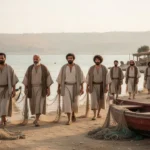
James was the son of Zebedee and the brother of John. The Gospel accounts present the two brothers as fishermen working with their father and other fishing partners on the Sea of Galilee. Their family appears to have had enough resources for them to employ others, since the Gospel of Mark mentions hired workers in connection with Zebedee’s boat.
Jesus called James and John while they were engaged in their fishing work. They responded by leaving their boat and their father to follow him. That decision became a defining feature of their story: they moved from an ordinary livelihood into the demanding, uncertain life of Jesus’ disciples.
The brothers were given the name Boanerges, which Mark 3:17 explains as “Sons of Thunder.” The name suggests forceful personalities or intense zeal. The Gospels show that James and John could be ambitious and impetuous, but they also became committed witnesses who accepted the cost of following Jesus.
James belonged to the group of three apostles closest to Jesus: Peter, James, and John. The Gospel narratives repeatedly place these three at significant moments that the rest of the Twelve did not witness in the same way.
Three important events James witnessed
James’ special place among the apostles is shown by his presence at three major episodes in the Gospel accounts. These scenes do not present him as perfect. Instead, they show a disciple being formed through awe, confusion, suffering, and renewed faith.
The raising of Jairus’s daughter: Jesus allowed Peter, James, and John to accompany him when Jairus’s daughter was restored to life, as described in Mark 5:37 and related passages.
The Transfiguration: James was present when Jesus was transfigured before Peter, James, and John. The event is recorded in Matthew 17, Mark 9, and Luke 9 and revealed Jesus’ glory in a powerful way.
The agony in Gethsemane: On the night before his crucifixion, Jesus brought Peter, James, and John farther into the garden to remain near him in prayer, according to Matthew 26, Mark 14, and related passages.
These experiences form a striking pattern. James saw a sign of life restored, a revelation of divine glory, and the deep distress of Jesus before his death. His discipleship was not built on one kind of experience alone; it included joy, mystery, fear, and sorrow.
What the Gospels reveal about James’ character
James was not portrayed as a silent or passive disciple. In one Gospel episode, he and John asked for positions of honor beside Jesus in his future glory. Their request caused tension among the other apostles, who became upset when they heard about it.
Jesus used the moment to teach that leadership among his followers is not measured by status or control. A disciple must be willing to serve and to share the suffering connected with faithful service. James’ request exposed his ambition, but Jesus’ response also gave him a deeper definition of greatness.
Another episode shows the brothers reacting strongly when a Samaritan village did not welcome Jesus and his disciples. James and John asked whether they should call down fire from heaven upon the village. Jesus rebuked them, and the group continued on its way.
These accounts make James recognizable. He had strong emotions, a desire for importance, and an instinct to defend his teacher. Yet his story is not simply a warning against intensity. It also shows how zeal can be purified and redirected toward faithful witness.
A useful lesson from James: Christian tradition does not remember him because he began as a flawless disciple. His life shows how courage and strong conviction need to be shaped by humility, service, and patient love.
James and the cost of discipleship
When Jesus questioned James and John about whether they could share the “cup” associated with him, they answered that they could. The conversation appears in Matthew 20:20-28 and Mark 10:35-45. Jesus connected that cup with suffering and service rather than privilege.
James’ later death gives the exchange a serious meaning. The Gospels do not say that he understood everything at the time, but his life eventually included the kind of suffering Jesus had described. His discipleship moved beyond admiration or closeness and became a willingness to remain faithful under threat.
For Christians, this does not mean that suffering is automatically good or that people should seek danger. It means that faithfulness may carry a real cost, especially when a person refuses to abandon deeply held convictions. James became an early example of a disciple whose commitment was tested by political power.
How Saint James the Greater died
The Book of Acts gives the clearest biblical account of James’ death. Acts 12:1-2 states that Herod the king began persecuting members of the church and had James, the brother of John, killed with the sword. The Herod named in this passage is generally identified as Herod Agrippa I.
This brief account has great historical and theological importance. James is the first of the Twelve Apostles whose martyrdom is explicitly recorded in the New Testament. His death took place during an early period of persecution in Jerusalem, before the later traditions surrounding many of the other apostles had developed.
The biblical account does not provide a long speech, a detailed trial, or a description of James’ final moments. Its simplicity is part of the force of the passage. James’ death is reported in a few words, yet it marks the cost of public Christian leadership and the vulnerability of the young church.
Herod’s action also shows how early Christian persecution could be influenced by political motives. The passage says that the king’s actions pleased certain groups, suggesting that the persecution was not only a private dispute. James’ execution became part of a wider effort to intimidate the Christian community.
What happened to the other apostle named James
James the Greater is sometimes mistakenly identified with James the Less or James of Jerusalem. The New Testament treats these figures separately, although later Christian traditions have differed in how they identify some of the people named James.
James the Greater was the son of Zebedee and the brother of John. That family connection is repeated in the Gospel lists and in the account of his death in Acts. James the Less is associated with Alphaeus, while James of Jerusalem appears as a leader of the church in Jerusalem.
Keeping these identities distinct helps prevent a common mistake: assuming that every reference to “James” in the New Testament concerns the same person. Names, titles, and family relationships are especially important when reading passages about the apostles and the earliest Christian communities.
Why Santiago de Compostela is connected with James
Saint James the Greater became closely associated with Santiago de Compostela, a city in northwestern Spain. Christian tradition holds that James preached in parts of the Iberian Peninsula before returning to Jerusalem. After his martyrdom, tradition says that his remains were eventually taken to the region of Galicia.
The shrine at Compostela became one of the most important pilgrimage destinations in medieval Europe. The routes leading there are known collectively as the Camino de Santiago, or Way of Saint James. Pilgrims traveled from many parts of Europe, following different roads that converged at the shrine.
The historical details behind the transfer and discovery of James’ remains are matters of tradition and debate. The New Testament does not describe a journey from Jerusalem to Spain after his death. For that reason, responsible explanations distinguish between what Scripture records and what later Christian tradition preserves.
Regardless of how one evaluates every historical claim, the devotion associated with Compostela has had an enormous effect on Christian culture. It shaped churches, hospitals, bridges, hostels, charitable institutions, art, literature, and patterns of travel across Europe.
What the Camino de Santiago means to pilgrims
The Camino is not one single road. It is a network of pilgrimage routes leading to the cathedral and shrine at Santiago de Compostela. Some pilgrims walk for religious reasons, while others undertake the journey for reflection, personal change, cultural interest, or a mixture of motives.
Traditional pilgrimage includes physical effort, prayer, hospitality, and attention to the destination. The road itself becomes part of the spiritual practice. Walking day after day can create room for silence, examination of conscience, gratitude, and a renewed awareness of other people.
People who want to understand the connection between James and pilgrimage can look for several recurring features:
The destination: Santiago de Compostela represents the shrine associated with the apostle.
The scallop shell: It is the best-known symbol of the Camino and of pilgrims traveling toward Santiago.
The yellow arrow: Modern routes commonly use arrows and other signs to guide walkers, though markings vary by route.
Hospitality: Pilgrim shelters, churches, and local communities have long been part of the culture surrounding the roads.
Prayer and reflection: The journey may include formal worship, private prayer, or quiet reflection in churches and landscapes along the way.
A pilgrimage does not have to be treated as a test of athletic ability. The meaning of the Camino rests less on speed or distance than on purposeful travel toward a sacred destination. A person may approach it as a religious observance, a cultural experience, or both.
The scallop shell and other symbols of Saint James
The scallop shell is the most recognizable symbol linked with Saint James the Greater. Pilgrims have used shells as signs of their journey, and the shell appears in church decoration, pilgrimage credentials, artwork, jewelry, and route markers associated with Santiago.
The shell has several traditional interpretations. Its ridges can suggest the many routes converging at one destination. It can also recall the sea, James’ original work as a fisherman, or the practical use of a shell by travelers for food and water.
Other common symbols include a pilgrim’s staff, a broad-brimmed hat, a travel pouch, and a sword. The sword refers to the manner of James’ martyrdom as described in Acts. Religious art may combine several of these objects to identify him.
Artists often portray James in more than one way. He may appear as an apostle holding a book or scroll, as a pilgrim with a shell and staff, or as a more richly dressed figure associated with Spanish devotion. These images reflect different aspects of his identity rather than separate saints.
Saint James as a patron of Spain and pilgrims
Saint James is widely honored as a patron of Spain, although the cultural and religious history of that patronage developed over many centuries. He is also associated with pilgrims, travelers, those who work with horses, and various places, churches, and groups connected with the Camino.
Spanish devotion to James has included major feast-day celebrations, processions, regional customs, and artistic traditions. The name Santiago itself comes from a Spanish form of “Saint James,” and many towns, churches, and institutions bear that name.
Some traditions portray James as a mounted warrior, especially in connection with the medieval figure of Santiago Matamoros. This imagery reflects the religious and military conflicts of medieval Spain. It is historically significant, but many modern Christians approach it carefully because the representation is tied to warfare and hostile portrayals of non-Christians.
The older image of James as a pilgrim often offers a different emphasis: travel, humility, endurance, hospitality, and the search for God. Both artistic traditions belong to the history of devotion, but they communicate very different ideas about what it means to remember the apostle.
When Saint James the Greater is celebrated
The principal feast of Saint James the Greater is July 25. The date is observed in many Western Christian traditions, including Roman Catholic communities and churches influenced by the historic Western calendar.
Celebrations may include Mass or other worship services, processions, pilgrim blessings, lectures, concerts, local festivals, and prayers for travelers. In Santiago de Compostela, the feast is part of a major annual religious and cultural observance.
Some churches also remember James alongside his brother John or with the other apostles at broader celebrations. The exact calendar and liturgical practices differ among denominations, so local church schedules are the best source for details.
What Saint James can mean for Christians today
James’ life offers several themes for Christian reflection. His story begins with ordinary work, includes moments of ambition and misunderstanding, and ends with costly faithfulness. That combination makes him more than a distant religious symbol.
His example can encourage people to examine the difference between being close to a teacher and actually living by that teacher’s values. James witnessed extraordinary events, yet he still had to learn that greatness meant service rather than rank.
His relationship with John also shows that discipleship often develops within family and community connections. The brothers followed Jesus together, shared an intense temperament, and stood among the closest disciples. Their story can prompt reflection on how relatives and friends influence one another’s faith.
His martyrdom raises questions about courage and conscience. James did not control the political circumstances surrounding his death, but the Christian tradition remembers him as someone who remained identified with the community Jesus had formed. His witness is therefore connected with steadfastness rather than triumphalism.
Finally, the pilgrimage tradition associated with him emphasizes movement. A person may not walk to Compostela, but the image of a road can still express a life of conversion, patience, and attention. The scallop shell, staff, and open road point toward a faith practiced over time rather than reduced to a single moment.
How to learn more about Saint James responsibly
If you want to study Saint James the Greater, begin with the New Testament passages that identify him and describe his role. Read the Gospel accounts of his calling, the lists of the Twelve, the Transfiguration, Gethsemane, and the request for positions of honor. Then read Acts 12:1-2 for the brief account of his death.
Afterward, separate biblical information from later tradition. The Bible establishes James’ family, apostolic role, presence at key events, and martyrdom. The connection with Spain, the location of his shrine, and many pilgrimage customs belong to the long history of Christian tradition and devotion.
Start with primary texts: Read Mark 1, Mark 3, Mark 5, Mark 9, Mark 10, Mark 14, and Acts 12.
Compare parallel accounts: Matthew and Luke provide additional perspectives on several events involving James.
Check the identity: Note whether a passage refers to James the son of Zebedee, James the son of Alphaeus, or another James.
Study the symbols: Learn why the shell, staff, sword, and pilgrim clothing appear in art.
Explore Compostela carefully: Distinguish established pilgrimage history from claims that depend on later tradition.
Visit local celebrations: A church or pilgrimage organization can explain how July 25 is observed in your community.
Approached this way, Saint James the Greater becomes easier to understand. He was a fisherman called into an extraordinary mission, a passionate disciple who had to learn humility, a witness to pivotal moments in Jesus’ life, and the first apostle whose martyrdom is explicitly recorded in the New Testament.
Frequently asked questions
Was Saint James the Greater related to Jesus?
The New Testament identifies James the Greater as the son of Zebedee and brother of John. It does not identify him as a blood relative of Jesus. He should not be confused with James called the brother of the Lord, who became a leader of the Jerusalem church.
Did Saint James really travel to Spain?
Christian tradition says James preached in Spain and that his remains were later brought to Galicia. The New Testament does not record such a journey, so the Spanish mission and transfer of relics belong to later tradition rather than directly documented biblical history.
Why is Saint James shown with a shell?
The scallop shell became a badge of pilgrims traveling to Santiago de Compostela. It is also connected with James’ former life as a fisherman and with the many pilgrimage routes that converge at the shrine. It remains the most recognizable symbol associated with him.
What is the difference between Saint James the Greater and Saint James the Less?
James the Greater was the son of Zebedee and brother of John. James the Less was another member of the Twelve, identified as the son of Alphaeus. The traditional labels distinguish two apostles with the same name and do not necessarily describe their holiness or importance.













Leave a Reply