James the Just: Jesus’ brother and Jerusalem leader
James the Just: Jesus’ brother and Jerusalem leader
James the Just was the leading figure of the Jerusalem church and is traditionally identified as Jesus’ brother.
He appears in the earliest Christian sources as a respected authority in Jerusalem, a close associate of the apostles, and a person whose judgment shaped the relationship between Jewish and non-Jewish followers of Jesus. His title, “the Just,” reflects an ancient reputation for exceptional righteousness rather than a formal office.
James the Just was a Jewish follower of Jesus who became a central leader of the early Christian movement after Jesus’ death. Paul refers to him as “the Lord’s brother” in Galatians 1:19, and Acts presents him as the senior voice in the Jerusalem community during an important dispute about Gentile believers.
The New Testament does not provide a complete biography. It gives scattered references to James, while later writers preserve additional traditions about his character, teaching, and death. Taken together, these sources portray him as a Jerusalem-based Jewish Christian leader whose authority was recognized by both Jesus’ followers and outside observers.
The name James comes from the same underlying name as Jacob. In Greek, the New Testament uses Iakobos, while English translations traditionally render it as James. He is also called James the Just, James the brother of the Lord, and James of Jerusalem.
The central identification: James the Just is generally understood to be the James who led the Jerusalem church, not James the son of Zebedee, who was one of the Twelve and was killed earlier under Herod Agrippa I.
Why James is called “the Just”
“The Just” translates a title associated with uprightness, fairness, and devotion to God. The title probably developed from James’ reputation among early Christians and was preserved by later writers who described him as unusually disciplined and prayerful.
The historian Josephus does not call him “the Just” in the surviving passage about his death. Josephus identifies him as James, the brother of Jesus who was called Christ, and reports that the high priest Ananus convened a council and had James condemned. The title is more prominent in Christian tradition, especially in material associated with Hegesippus.
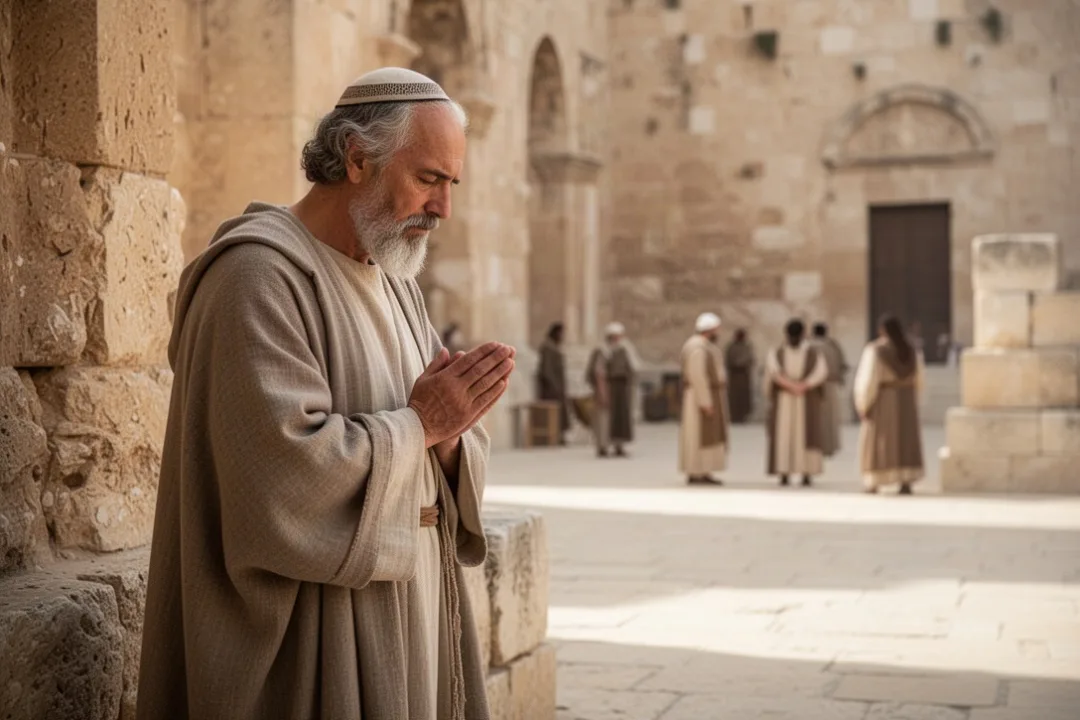
According to Hegesippus, a second-century Christian writer whose account was preserved by Eusebius, James was known for a life of prayer and strict devotion. The story describes him praying in the Temple so frequently that his knees became hardened. This detail is a religious portrait, not independently verified medical evidence, but it explains why later Christians remembered him as a model of holiness.
The title also communicates something about James’ public authority. He was not remembered mainly as a traveling missionary or a military organizer. He was remembered as a trusted judge of conduct, especially in a community trying to follow Jesus while remaining connected to Jewish Scripture and practice.
How to identify James the Just among the New Testament Jameses
Several men named James appear in early Christian writings. Sorting them out prevents one of the most common errors in discussions of James the Just.
James, son of Zebedee: One of Jesus’ first disciples and the brother of John. Acts 12:2 says Herod Agrippa I had him killed by the sword.
James, son of Alphaeus: One of the Twelve. The New Testament gives little information about him beyond his place among the apostles.
James, the Lord’s brother: The Jerusalem leader mentioned by Paul and Acts. This is the person most commonly identified as James the Just.
James, the writer named in the Letter of James: The letter names only “James,” so its authorship has been debated. Many Christians have traditionally connected it with James the Just, while scholars also consider questions of language, date, and literary setting.
James the Just cannot be the son of Zebedee if the accounts are read in their ordinary chronological sequence. James the son of Zebedee was executed during the reign of Herod Agrippa I, while James the Just was killed later, around 62 CE, under the authority of the high priest Ananus.
What the earliest sources say about James
Paul’s letters place James near the center of leadership
Paul’s letters are among the earliest surviving Christian writings, and they mention James in ways that show his importance. In Galatians 1:18-19, Paul says that after his conversion he met Cephas, or Peter, and also James, “the Lord’s brother.” The passage places James in Jerusalem and distinguishes him from the apostles generally, though the exact grammatical force has been discussed.
In Galatians 2:9, Paul names James, Cephas, and John as people regarded as “pillars” of the church. Paul’s wording shows that James held recognized authority in the Jerusalem movement. In the same letter, Paul describes people associated with James as influencing the behavior of some believers in Antioch. That episode suggests that James’ position affected communities outside Jerusalem as well.
Paul also reports in 1 Corinthians 15:7 that the risen Jesus appeared to James. Paul does not explain the circumstances, but the reference indicates that James’ experience of Jesus after the crucifixion was part of the movement’s early proclamation.
Acts 15 describes a meeting in Jerusalem over whether Gentile converts had to undergo circumcision and fully adopt Jewish practice. Peter speaks, Paul and Barnabas report on their mission, and James gives the judgment that shapes the community’s response.
James’ speech draws on Israel’s Scriptures and argues that God is also gathering people from the nations. He then proposes a limited set of requirements for Gentile believers. Acts 15:20 and 15:29 mention avoiding food connected with idols, sexual immorality, meat from strangled animals, and blood.
The passage does not present James as rejecting Jewish identity. Instead, it shows him trying to establish a workable arrangement between Jewish followers of Jesus and Gentile followers. His decision protects fellowship without requiring Gentiles to become Jews in every respect.
Acts 21 gives another glimpse of James. When Paul arrives in Jerusalem, he meets James and the elders. They discuss concerns that Jewish believers have heard about Paul’s teaching concerning the law. James and the elders ask Paul to take part in a public purification action at the Temple, apparently to demonstrate that he is not encouraging Jewish believers to abandon their ancestral customs.
Whether every detail of Acts reflects an eyewitness transcript is a separate historical question. The narrative nevertheless preserves a consistent picture: James is the senior Jerusalem representative, consulted on difficult matters and surrounded by a group of elders.
James’ relationship to Jesus
The phrase “the Lord’s brother” has produced centuries of debate. Some readers understand it to mean a biological younger brother of Jesus. Others interpret “brother” as a close male relative, such as a cousin. A third historic view holds that Joseph had children from an earlier marriage, making James Jesus’ stepbrother in that tradition.
These interpretations are connected to different Christian teachings about Mary. The New Testament itself does not settle the question in a single explicit statement. Mark 6:3 and Matthew 13:55 list James and other named people among Jesus’ family, while John 7:5 says Jesus’ brothers did not initially believe in him.
The most straightforward historical reading for many scholars is that James was a close family member of Jesus, probably his brother. Catholic and Eastern Orthodox traditions generally preserve different explanations that maintain Mary’s perpetual virginity. Protestant traditions vary, with many accepting the ordinary meaning of “brother” and others favoring a broader kinship interpretation.
Keep the categories separate: The historical question is what “brother” meant in the earliest sources; the theological question is how that meaning fits a particular doctrine about Mary. The two questions overlap, but they are not identical.
James’ initial skepticism, if John 7:5 is read historically, makes his later leadership especially significant. The early sources do not portray him as a lifelong public disciple who always stood beside Jesus. They portray him as someone who became a convinced leader after Jesus’ death and the experiences the movement understood as appearances of the risen Jesus.
James and the Jerusalem church
Jerusalem was the movement’s original center, and James’ leadership there was shaped by the city’s Jewish religious environment. The earliest believers in Jerusalem continued to pray at the Temple and to identify with Israel’s Scriptures. James therefore led a community that was both devoted to Jesus and deeply connected to Jewish life.
His leadership should not be imagined as identical to the later structure of a monarchical bishop overseeing a large institution. The first-century Jerusalem community included apostles, elders, missionaries, and local believers. James appears as the community’s most prominent resident authority, but he worked within a network rather than acting as an isolated ruler.
The Jerusalem church also faced practical pressures. It had to care for members, maintain relationships with other Jewish groups, communicate with Gentile communities, and respond to disputes over food, circumcision, purity, and table fellowship. James’ decisions addressed these issues in concrete ways rather than treating them as abstract theology.
His influence may also explain why later Christian communities remembered Jerusalem as a place of authoritative teaching. Even when Paul’s mission expanded across the eastern Mediterranean, Jerusalem remained a reference point for questions about Jesus’ teachings and the identity of the movement.
What the Letter of James may reveal
The Letter of James begins by naming its author simply as James, a servant of God and of the Lord Jesus Christ. It does not call him Jesus’ brother or describe his position in Jerusalem. For that reason, the question of authorship remains open.
Many Christians have traditionally attributed the letter to James the Just. Its concerns fit aspects of his remembered profile: practical obedience, care for the poor, control of speech, integrity, prayer, and the danger of favoritism toward wealthy people. The letter emphasizes that genuine faith must be expressed through conduct.
Some scholars question whether the historical James could have written the Greek of the letter or whether the text was written later in his name. The letter contains polished Greek and draws on forms of teaching common in Jewish and Greco-Roman moral instruction. Those features do not by themselves prove or disprove authorship, because a leader could have used a secretary, received education, or had traditions shaped by later followers.
The letter’s portrait of religion is strongly ethical. James 1:27 connects faithful religious practice with care for orphans and widows and with moral separation from corrupting influences. James 2 criticizes giving special treatment to rich visitors while humiliating poor people. James 3 warns about the destructive power of speech and contrasts earthly ambition with wisdom marked by peace.
These themes help explain the “Just” tradition. James is remembered not only for making decisions but also for insisting that belief become visible in mercy, fairness, self-control, and practical obedience.
How James the Just died
Josephus’ account
The strongest non-Christian source for James’ death is Josephus, a first-century Jewish historian. In Jewish Antiquities 20.9.1, Josephus says that the high priest Ananus assembled the Sanhedrin during an interval between Roman governors and brought before it James and others. Josephus identifies James as the brother of Jesus, who was called Christ.
Josephus reports that Ananus accused them of breaking the law and had them stoned. Some residents objected to Ananus’ action and complained to the incoming Roman governor, Albinus. King Agrippa also removed Ananus from the high-priesthood. This account places James’ death around 62 CE.
Josephus’ wording is valuable because it is relatively restrained. He does not present James as a heroic martyr or explain Christian beliefs about resurrection. He treats the execution as a political and legal event and notes that Ananus acted improperly during a transition in Roman administration.
Later Christian traditions
Hegesippus, whose account survives through Eusebius’ Ecclesiastical History, gives a more detailed and devotional story. In this version, the authorities ask James to speak publicly against Jesus. Instead, James confesses Jesus before a crowd, is thrown from the Temple height, survives the fall, and is then attacked and killed.
Hegesippus’ account says that James prayed for his attackers and was finally struck with a club. The story contains features common to martyr narratives: public testimony, courage under pressure, prayer for enemies, and a violent death. It was written later than Josephus, so historians generally treat it as a valuable tradition that must be evaluated cautiously rather than as an equal eyewitness record.
The two accounts agree on the basic point that James died violently in Jerusalem during the early 60s. They differ in setting and detail. Josephus emphasizes an irregular legal execution; Hegesippus emphasizes James’ witness, holiness, and martyrdom.
What happened to the Jerusalem movement after James
James’ death removed a leader who had strong ties to Jerusalem’s Jewish believers and who had helped mediate disagreements within the wider movement. The community did not disappear, but it faced a changing political and social environment.
Around the same general period, tensions in Judea intensified and eventually contributed to the Jewish revolt against Rome. Jerusalem was destroyed by Roman forces in 70 CE. The city’s destruction changed the location, leadership patterns, and public identity of many Jewish and Christian groups.
Later traditions name Symeon, identified as a relative of Jesus, as a successor to James in Jerusalem. The details of the succession are not as well documented as James’ own role. What can be said with greater confidence is that the Jerusalem church continued after James, even as the city and the region underwent severe upheaval.
Why James the Just still matters
James matters historically because he connects several parts of early Christianity that are often discussed separately. He was linked to Jesus’ family, recognized by Paul, influential in Jerusalem, involved in the Gentile question, and remembered by a Jewish historian outside the Christian movement.
He also complicates simple pictures of early Christian authority. The first generation was not led by one person in every place or by a single uniform structure. Peter, Paul, James, John, local elders, and other missionaries exercised influence in different settings. James’ authority was especially strong in Jerusalem and in questions involving Jewish believers.
His life also shows that early Christianity was not initially detached from Judaism. James prayed in Jerusalem, drew on Jewish Scripture, and led people who continued to care about Jewish law and customs. At the same time, his judgment in Acts 15 helped make room for Gentile believers who did not adopt the whole Jewish way of life.
For readers interested in Christian ethics, James’ legacy is equally direct. The traditions surrounding him emphasize that religious status means little without justice, mercy, honest speech, and concern for vulnerable people. That emphasis appears in the Letter of James, even though the letter’s precise authorship remains debated.
A practical reading path for studying James
You can build a reliable picture of James by reading the sources in a deliberate order. Start with the shortest references, then compare the narrative accounts and later traditions.
Read Galatians 1:18-19 and 2:9. These passages establish James’ connection to Jerusalem, Jesus’ family, and the recognized leaders of the movement.
Read 1 Corinthians 15:7. This brief reference places James among those associated with an appearance of the risen Jesus.
Read Acts 15. Pay attention to James’ use of Scripture, his proposed requirements for Gentile believers, and the role of the Jerusalem elders.
Read Acts 21:17-26. This shows James dealing with concerns about Jewish practice and Paul’s reputation among Jerusalem believers.
Compare Josephus, Jewish Antiquities 20.9.1, with Eusebius, Ecclesiastical History 2.23. The first gives the main external account of James’ execution; the second preserves Hegesippus’ more detailed Christian tradition.
Read the Letter of James with authorship in mind. Notice its ethical themes, but distinguish what the letter says from the separate claim that James the Just personally wrote it.
As you read, mark three kinds of evidence: direct references to James, later interpretations of James, and theological traditions connected with his family relationship to Jesus. This method keeps the historical core visible without dismissing the significance James acquired in Christian memory.
Common misunderstandings about James the Just
He was not James the son of Zebedee. That apostle was executed earlier, as reported in Acts 12:2.
He was not simply an obscure relative. Paul and Acts present him as a major authority in the Jerusalem church.
His title is not a claim that he was sinless. “The Just” describes a reputation for righteousness and devotion.
Josephus does not give the full later martyr story. His account supports James’ identity and violent death, while Hegesippus supplies additional details.
The family relationship is debated. “Brother” may be understood biologically, as close kin, or within traditions involving Joseph’s earlier family.
The Letter of James is not an uncontested autobiography. Its author identifies himself as James, but the connection to James the Just is traditional rather than universally accepted.
Questions historians can and cannot answer
The available evidence supports several conclusions with reasonable confidence: James was a prominent Jerusalem leader, Paul knew him, he was associated with Jesus’ family, and he died violently around 62 CE. These points rest on early Christian writings and Josephus, although each source has its own purpose and limitations.
Other questions remain less certain. Historians cannot establish with confidence exactly how James was related to Jesus, whether he personally wrote the Letter of James, or whether every detail in Hegesippus’ account preserves an earlier eyewitness tradition. The responsible approach is to distinguish firm evidence from plausible interpretation and devotional memory.
That distinction does not make James less significant. It clarifies why his reputation endured: he stood at the intersection of Jesus’ family, the Jerusalem church, Jewish religious life, and the expanding Gentile mission. His authority came not from one title alone but from the combination of personal connection, moral credibility, public judgment, and community trust.
James’ enduring profile in Christian history
James the Just is remembered as a leader who held together convictions that could easily have pulled the early movement apart. He remained rooted in Jerusalem and Jewish Scripture while helping the community recognize Gentile believers. He exercised authority without being described as the founder of the movement, and he became influential without replacing the apostles in every setting.
The most consistent picture is of a prayerful, respected, and practical leader. Ancient sources differ about the circumstances of his death, but they agree that James’ character mattered. His name became associated with justice because early Christians saw him as someone whose belief was expressed through disciplined living and concern for others.
For that reason, James the Just is more than a name in a list of early leaders. He is one of the clearest windows into the first Jerusalem community and into the difficult process by which a Jewish movement centered on Jesus became a broader international faith.
Frequently asked questions
Was James the Just one of the twelve apostles?
The New Testament lists James the son of Zebedee and James the son of Alphaeus among the Twelve. James the Just is usually identified as “the Lord’s brother,” who led the Jerusalem church. Some early Christian traditions may use apostolic language broadly for him, but the sources do not clearly place him among the Twelve.
Did James the Just write the Letter of James?
Christian tradition often attributes the letter to James the Just, and its ethical teaching fits his remembered reputation. However, the text gives no further identification beyond the name James. Its Greek style, date, and literary setting have led scholars to debate whether it came directly from James or from a later author writing in his authority.
How did James the Just die?
Josephus reports that James was condemned and stoned around 62 CE after the high priest Ananus convened a council during a change in Roman administration. A later account by Hegesippus describes a longer martyrdom involving the Temple and a club. The two sources differ in detail but agree that James died violently in Jerusalem.
Why is James called the brother of Jesus?
Paul uses the phrase “the Lord’s brother,” and other New Testament passages name James among Jesus’ family. Many scholars understand this as a biological brother. Catholic and Eastern Orthodox traditions interpret the relationship differently, as a stepbrother or close relative, in connection with their teachings about Mary’s perpetual virginity.

















Leave a Reply