What is Catholic? Beliefs, practices, and identity
What is Catholic? Beliefs, practices, and identity
Catholic means belonging to the Catholic Church, a worldwide Christian community centered on Jesus Christ, his teachings, and the sacraments. The word also describes the Church’s beliefs, worship, members, and way of life.
The term catholic comes from a Greek word meaning “universal” or “according to the whole.” Catholics use it to express the Church’s worldwide mission, its welcome to people from every culture, and its belief that the Christian faith is meant for all humanity. The Catholic Church is led by the pope and bishops in communion with him.
Catholic belief is centered on one God in three Persons: the Father, the Son, and the Holy Spirit. This teaching is called the Trinity. Catholics do not believe in three gods. They believe the one God exists eternally as Father, Son, and Holy Spirit, sharing one divine nature.
Jesus Christ is the Son of God and the central figure of Catholic faith. Catholics believe that Jesus is fully divine and fully human. He was born of Mary, taught about God’s kingdom, healed and served others, died by crucifixion, rose from the dead, and remains alive with the Father. His death and resurrection are understood as God’s work of salvation for humanity.
Catholics believe that people are created in the image of God and therefore possess inherent dignity. Human beings are called to love God and their neighbors, but sin damages this relationship. Through Jesus Christ, God offers forgiveness, reconciliation, and the grace needed to live a holy life.
Salvation, in Catholic teaching, is not simply a one-time statement of belief. It involves faith in Christ, God’s grace, participation in the Church, and a life shaped by love and obedience. Catholics believe that good works do not purchase salvation; instead, genuine faith should produce charity, mercy, justice, and service.
What the Catholic Church is and how it is organized
The Catholic Church understands itself as both a spiritual community and a visible institution. It includes people who share the same core faith, sacraments, and communion with one another. Local Catholic communities are usually organized into parishes, which are led by priests under the authority of a bishop.
A diocese is a geographic area overseen by a bishop. Dioceses are grouped into larger regions in many countries, while the pope serves as the bishop of Rome and the universal pastor of the Catholic Church. Bishops are considered successors of the apostles, and priests and deacons assist them in serving local communities.
The pope does not function as a president who personally manages every parish. His role includes teaching, preserving unity, appointing bishops, and guiding the Church’s worldwide mission. Catholics recognize him as the successor of Saint Peter, one of Jesus’ apostles, and as a visible sign of unity among Catholics.
Religious orders and congregations are another part of Catholic life. Members may be priests, brothers, sisters, or laypeople who follow a particular spiritual tradition. Benedictines, Franciscans, Dominicans, Jesuits, and Carmelites are examples of Catholic communities with distinctive histories and ministries.
A useful distinction: A Catholic parish is a local community, while the Catholic Church refers to the worldwide body of believers, its leadership, its teaching, its worship, and its shared sacramental life.
How Scripture, tradition, and Church teaching work together
Catholics receive the Bible as inspired Scripture and treat it as essential for faith and worship. The Bible is proclaimed during Mass, studied in homes and schools, used in personal prayer, and interpreted within the life of the Church. Catholic editions include books that are not found in every Protestant Bible.
Catholic teaching also gives an important role to Sacred Tradition. In this context, tradition does not mean every custom or habit passed down through a family. It means the living transmission of the faith received from the apostles and handed on through the Church’s worship, teaching, and communal life.
Catholics generally understand Scripture and Tradition as connected rather than competing authorities. The Magisterium, or teaching office of the pope and bishops, has the responsibility to interpret the word of God faithfully. This does not mean that every statement by a Catholic leader has the same authority. Catholic teaching has different levels of importance and certainty.
The Catechism of the Catholic Church presents a broad reference to Catholic belief and moral teaching. It is not a replacement for the Bible or for prayer and worship. It gathers teachings on the Creed, sacraments, moral life, and Christian prayer in an organized form.
Catholics may disagree about many practical, political, or cultural matters while sharing the Church’s essential beliefs. The Church distinguishes between central doctrines, authoritative moral teaching, theological opinions, local customs, and personal preferences. That distinction helps explain why Catholics around the world may worship in different languages and express their faith through different cultural traditions.
What Catholics mean by the seven sacraments
A sacrament is an outward sign of inward grace, instituted by Christ and entrusted to the Church. Catholics believe the sacraments are effective signs through which God gives grace. They are not merely symbolic ceremonies, although they do contain powerful signs and actions that communicate spiritual realities.
Baptism begins a person’s Christian life, brings forgiveness of sin, and incorporates the person into the Church.
Confirmation strengthens baptismal grace and is associated with a deeper gift of the Holy Spirit and fuller participation in the Church’s mission.
The Eucharist is the sacrament in which Catholics receive Christ under the appearances of bread and wine.
Reconciliation, or confession, offers God’s forgiveness for sins through the ministry of a priest.
Anointing of the Sick brings prayer, comfort, and spiritual strength to people facing serious illness, frailty, or other significant physical hardship.
Holy Orders is the sacrament through which men are ordained as bishops, priests, or deacons for service in the Church.
Matrimony is the covenant of marriage between a man and a woman, understood as a lifelong partnership ordered toward the good of the spouses and the raising of children.
The seven sacraments are commonly grouped into three categories. Baptism, Confirmation, and the Eucharist are sacraments of initiation. Reconciliation and Anointing of the Sick are sacraments of healing, while Holy Orders and Matrimony are sacraments of service and vocation.
Why the Eucharist is central to Catholic worship
The Eucharist is the center of Catholic worship. Catholics believe that during the Mass, bread and wine become the Body and Blood of Christ while retaining the appearances of bread and wine. This change is called transubstantiation.
Catholics do not understand Communion as ordinary food or as a reminder with no spiritual reality. They believe Christ is truly present in the Eucharist. Receiving Communion is therefore an act of faith and a sign of unity with Catholic teaching and the Church community.
The Mass includes readings from Scripture, a homily, prayers, praise, the presentation of bread and wine, the Eucharistic Prayer, and Holy Communion. Catholics usually attend Mass on Sundays because Sunday celebrates Jesus’ resurrection. The liturgical calendar also gives special attention to Christmas, Easter, Lent, Advent, and other holy days.
Before receiving Communion, Catholics are expected to be properly prepared. A person conscious of serious sin ordinarily receives the sacrament of Reconciliation first. Catholics who are not Catholic, or Catholics who are not properly disposed, may attend Mass and pray without receiving Communion.
“Do this in memory of me” is the biblical command Catholics connect with the Eucharist, understood as a living participation in Christ’s saving self-gift.
How Catholics pray and worship beyond Mass
Mass is the principal form of public Catholic worship, but Catholic prayer takes many forms. Catholics may pray privately, with their families, in small groups, or in a parish setting. Prayer may include spoken words, silence, Scripture reading, music, meditation, or acts of service.
The Rosary is a popular Catholic devotion that uses repeated prayers while meditating on events in the lives of Jesus and Mary. It is not meant to replace the Mass or the Bible. For many Catholics, it provides a structured way to reflect on the Gospel and ask for Mary’s prayers.
Other common practices include Eucharistic adoration, the Stations of the Cross, novenas, devotional reading, retreats, fasting, and praying with the Liturgy of the Hours. Customs differ by country and community. Some Catholics are especially drawn to silence and contemplation, while others express faith through music, pilgrimage, social service, or communal prayer.
Catholics may ask Mary and the saints to pray for them. This is different from worshiping them. Worship belongs to God alone. Catholics honor Mary because of her role as the mother of Jesus and ask the saints to intercede as members of the Christian family who are believed to be alive with God.
What Catholics believe about Mary and the saints
Mary has a uniquely honored place in Catholic belief. Catholics call her the Mother of God because Jesus, whom she bore, is truly God as well as truly human. This title protects the belief that Jesus is one person, not a human person later joined to a divine person.
Catholic teaching includes several doctrines about Mary, including her perpetual virginity, her Immaculate Conception, and her Assumption. The Immaculate Conception refers to Mary’s being preserved from original sin from the beginning of her own life; it does not refer to Jesus’ conception. The Assumption refers to Mary’s being taken into heavenly glory at the end of her earthly life.
A saint is a person recognized by the Church as being with God in heaven and worthy of honor as an example of Christian holiness. The formal canonization process examines a person’s life, writings, reputation for holiness, and reported miracles. Catholics are not required to know or imitate every saint, and saints come from many cultures, occupations, and historical periods.
How Catholic moral teaching guides daily life
Catholic moral teaching begins with the dignity of each human person and the command to love God and neighbor. It addresses personal choices, relationships, work, economic life, politics, care for creation, and treatment of vulnerable people. Conscience is important, but Catholics understand conscience as something to form through truth, prayer, Scripture, and sound moral instruction.
The Ten Commandments, the teachings of Jesus, and the moral wisdom of the Church all contribute to Catholic ethics. Catholics are called to practice virtues such as prudence, justice, courage, temperance, faith, hope, and love. Moral growth includes repentance after failure and a willingness to repair harm when possible.
Catholic social teaching emphasizes the dignity of work, the needs of the poor, the common good, solidarity with others, and the responsibility to care for creation. Catholics may apply these principles differently to particular public-policy questions. The principles themselves are intended to shape a society where people and communities can flourish.
Catholic teaching on serious sin considers the seriousness of the act, the person’s knowledge, and the person’s freedom. This means moral responsibility can be affected by fear, pressure, habit, ignorance, or other circumstances. The Church calls people to moral truth while also emphasizing mercy, forgiveness, and conversion.
What happens during a Catholic Mass
A Catholic Mass has two major movements: the Liturgy of the Word and the Liturgy of the Eucharist. The first includes biblical readings, a responsorial psalm, a Gospel reading, a homily, and prayers. The second includes the preparation of the gifts, the Eucharistic Prayer, and Communion.
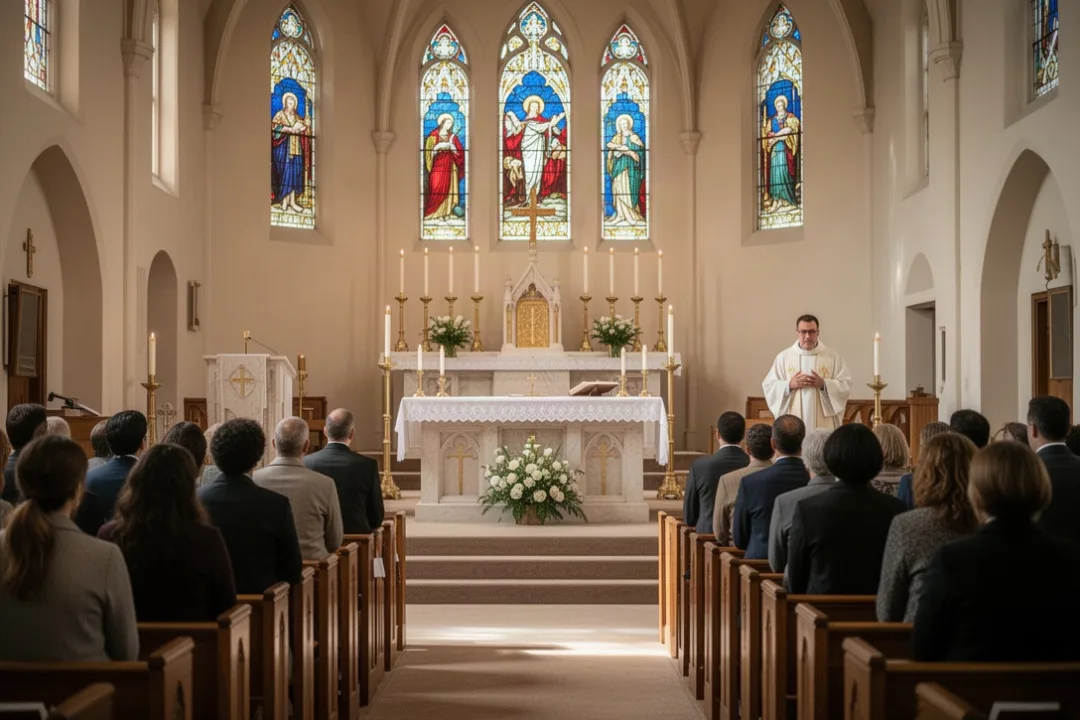
People commonly stand, sit, and kneel at different points. These postures are signs of attention, respect, prayer, and worship, though local customs can vary. The congregation responds to prayers, listens to Scripture, sings when music is included, and participates through gestures such as making the Sign of the Cross.
A visitor does not need to know every response or gesture. You can follow the congregation when comfortable, remain seated if necessary, and observe quietly. If you are not receiving Communion, you may stay in your place or approach the minister with your arms crossed, depending on local parish practice.
The Mass is not primarily a performance or a lecture. It is the Church’s public act of worship, with Christ understood as the central actor. The congregation gathers to hear God’s word, give thanks, receive grace, and be sent to live the Gospel in daily life.
Common misunderstandings about what is Catholic
One common misunderstanding is that Catholics worship Mary or the saints. Catholic language distinguishes worship owed to God from honor given to holy people. Images, statues, and feast days are intended to direct attention toward God’s work in the lives of the people represented, not to treat those objects or people as gods.
Another misunderstanding is that Catholics believe they can buy forgiveness or earn salvation through charitable acts. The Church rejects the idea that money purchases forgiveness. Catholics believe salvation is a gift of God’s grace, received through faith and lived out through love, repentance, and the sacramental life.
Some people assume every Catholic practices the faith in exactly the same way. Core teachings and liturgical forms are shared, but Catholic communities differ in music, architecture, food, devotional customs, languages, and cultural celebrations. Catholics may also vary in how regularly they attend Mass and how deeply they understand Church teaching.
It is also inaccurate to treat the pope as personally infallible in every statement. Catholic teaching on papal infallibility is limited. It concerns particular acts of teaching on faith or morals under specific conditions, not everyday opinions, political comments, private decisions, or predictions about the future.
Practical tips for learning about Catholicism
If you are exploring Catholicism, start with the central claims rather than trying to memorize every custom at once. Pay attention to how Catholics connect Jesus, the Church, the sacraments, Scripture, and service. A respectful conversation with a priest, deacon, religious educator, or practicing Catholic can answer questions that books alone may not resolve.
Attend a Mass as a visitor and observe the readings, prayers, gestures, and movement of the service.
Read one Gospel, such as Mark or Luke, while noting how Catholic worship reflects the life and teachings of Jesus.
Ask about the parish’s inquiry process if you are considering becoming Catholic; many communities offer sessions for adults exploring the faith.
Use reliable Catholic sources, such as a diocese, parish, Catholic Bible, or the Catechism, rather than relying on stereotypes.
Separate doctrine from local custom; a food tradition, musical style, or popular devotion may not be required belief.
Ask what a term means in context, especially words such as grace, sacrifice, tradition, veneration, and infallibility.
Several mistakes can make Catholicism seem more confusing than it is. One is focusing only on external objects, clothing, or rituals without asking what they signify. Another is treating an individual Catholic’s political opinion or personal habit as though it represents the entire Church.
Do not assume that every Catholic custom has the same authority as a central doctrine.
Do not receive Communion simply because you are visiting; participation has a specific religious meaning.
Do not confuse asking a saint to pray with replacing God as the object of worship.
Do not judge the whole tradition from one parish, one country, or one historical controversy.
Do not expect every Catholic to answer complex theological questions immediately.
If you attend Mass for the first time: You are welcome to observe. You do not need to recite every prayer, and you should not receive Communion unless you meet the Catholic Church’s requirements for doing so.
How someone becomes Catholic
The process depends on whether a person has never been baptized, was baptized in another Christian tradition, or was already baptized Catholic but has not completed the sacraments of initiation. A parish usually begins by listening to the person’s questions and explaining the faith, rather than requiring an immediate decision.
Adults who are not baptized commonly participate in the Order of Christian Initiation of Adults, often abbreviated OCIA. The process includes instruction, prayer, reflection, and gradual participation in the community. Those who freely choose to become Catholic may receive Baptism, Confirmation, and the Eucharist, often during the Easter season.
A baptized Christian seeking full communion with the Catholic Church follows a different path. The person’s previous baptism is normally respected if it used water and the Trinitarian formula. The person may then make a profession of Catholic faith and receive Confirmation and the Eucharist after appropriate preparation.
Becoming Catholic is not only an educational course or a change of membership. It involves conversion, worship, community, and a lifelong relationship with Christ. People may take time to ask difficult questions about history, doctrine, morality, family circumstances, or personal experience before deciding.
How Catholic identity connects faith and everyday life
Being Catholic is more than identifying with a denomination. It involves belonging to a worldwide community, accepting the central teachings of the faith, participating in sacramental worship, and seeking to follow Jesus in ordinary responsibilities. Catholics may express this identity through family life, vocation, work, volunteer service, study, prayer, and care for people in need.
The Catholic Church includes people at different stages of faith. Some attend Mass every week and take part in parish ministries. Others are returning after years away, learning the faith as adults, or trying to reconnect after a difficult experience. Catholic identity can include both a strong sense of belonging and honest questions that remain unresolved.
At its center, Catholicism calls people to receive God’s grace and to become instruments of love in the world. The Church’s teachings, sacraments, prayers, and traditions are intended to support that calling. Understanding what is Catholic therefore means looking at both what Catholics believe and how those beliefs shape a shared life of worship and service.
Frequently asked questions
Is Catholic the same as Christian?
Yes. Catholics are Christians because they believe in Jesus Christ as the Son of God, his death and resurrection, and the central teachings of historic Christianity. Catholicism is one major Christian tradition, alongside Eastern Orthodoxy, Protestant traditions, and other Christian communities. Catholics have distinctive beliefs about the pope, sacraments, Mary, Church authority, and the relationship between Scripture and Tradition.
Can a Catholic eat meat on Fridays?
Catholic practice concerning meat on Fridays varies by season, country, and local bishops’ rules. Abstaining from meat is especially associated with Fridays during Lent, when Catholics remember Christ’s Passion. Outside Lent, some Catholic communities observe Friday abstinence throughout the year, while others permit a different penitential practice. Local parish or diocesan guidance provides the most accurate answer.
Do Catholics have to pray to Mary?
Catholics are encouraged to honor Mary and may ask her to pray for them, but they do not worship her. Worship belongs to God alone. Catholics differ in how often they use Marian devotions such as the Rosary. A person can be Catholic without having the same personal devotion to Mary as another Catholic, provided the Church’s basic teaching about her is respected.
What is the difference between a Catholic church and a cathedral?
A Catholic church is generally a place where a parish community gathers for Mass and other worship. A cathedral is the principal church of a diocese and contains the bishop’s official seat, called the cathedra. Every cathedral is a Catholic church, but most Catholic churches are not cathedrals. A basilica is another designation that may be granted because of historical, spiritual, or architectural significance.











Leave a Reply