Mary is honored as the mother of Jesus and the foremost of the saints, while the saints are faithful followers of Christ who are believed to live with God and pray for the Church. Catholics do not worship Mary or the saints; worship belongs to God alone. They honor Mary in a unique way and ask the saints to pray with them and for them.
The phrase “Mary and the saints” usually refers to Catholic and Eastern Christian beliefs about the communion of saints: the spiritual unity of Christians on earth, the faithful departed being purified, and those already with God. Different Christian traditions understand Mary’s role and prayers differently, so the clearest answer depends on the church being discussed.
Mary is a saint because she is a human being who received God’s grace and responded to it with faith. She is also given a unique place because she became the mother of Jesus Christ, whom Christians confess to be both truly human and truly divine. Catholic teaching therefore calls her the Mother of God, meaning the mother of the person who is God the Son—not the source of Christ’s divine nature.
The Gospel accounts present Mary as a young Jewish woman who accepts a difficult calling. In Luke 1, she responds to the angel’s message with trust and willingness to serve God. Her role is not portrayed as passive: she asks how the promise will take place, visits Elizabeth, gives birth to Jesus, and remains connected to his mission throughout his life.
Mary appears at several decisive moments in the New Testament. She gives birth to Jesus in Bethlehem, presents him at the Temple, searches for him when he is a boy, and is present at the wedding at Cana in John 2. She is also listed among the disciples praying after Jesus’ ascension in Acts 1. These passages support the Christian view of Mary as a faithful disciple as well as a mother.
Catholics distinguish Mary’s honor from the worship offered to God. In theological language, worship belongs to the Trinity, while Mary receives a special form of honor because of her relationship to Christ. The saints receive honor because God’s grace has been visible in their lives. Mary points beyond herself to Jesus, rather than replacing him.
Central distinction: Catholics may honor Mary with titles, feast days, hymns, and prayers, but they do not consider her a goddess. Any grace or power associated with Mary is understood to come from God through Christ.
What Catholics mean by the communion of saints
The communion of saints means more than a list of especially admirable Christians. It describes the spiritual fellowship of the whole Church. Christians on earth, the dead who are being purified, and the saints in heaven are understood to belong to one body in Christ. Death does not destroy that bond because the life of the Church is rooted in Christ’s resurrection.
The Apostles’ Creed includes the phrase “communion of saints,” which Christians have interpreted in more than one related way. “Saints” can mean all baptized believers, as it often does in the New Testament, or it can refer more specifically to holy men and women recognized by the Church. In ordinary Catholic speech, “the saints” usually means Christians who are believed to be with God and are publicly honored.
The practice of asking saints for prayers follows the belief that love continues in heaven. If Christians ask friends, pastors, or family members on earth to pray, Catholics see no contradiction in asking a saint to pray as well. The saint is not treated as an independent source of salvation. Instead, the request is directed through a member of Christ’s family toward God.
Revelation 5:8 and Revelation 8:3-4 use imagery of prayers rising before God. Catholics understand these passages as compatible with heavenly participation in the prayers of the faithful, although Christians disagree about how literally such imagery should be applied. The practice also reflects the wider biblical theme that believers pray for one another.
Saints are not believed to know everything or to possess God’s unlimited power. Catholic explanations generally hold that God allows the saints to share in his care for the Church. Their awareness and intercession depend on God, just as every gift of grace does. The saint’s role is always secondary and dependent; God remains the giver of every good gift.
How sainthood is recognized in the Catholic Church
The Catholic Church does not create a saint by canonization. Canonization is a formal judgment that a deceased Christian is already with God and may be publicly honored throughout the Church. The process examines the person’s life, writings, reputation for holiness, and, in many cases, reported miracles attributed to the person’s intercession.
A candidate may first be called a Servant of God, then receive the title Venerable after a formal investigation finds evidence of heroic virtue. Beatification permits limited public veneration, usually in a particular region or religious community. Canonization extends that permission to the universal Catholic Church. Martyrs follow a distinct path because their death for the faith can affect the requirements.
This process does not mean every saint had a flawless personality or an easy life. Saints can have complicated histories, make serious mistakes, or belong to very different cultures and periods. Their holiness is understood as a life transformed by grace, repentance, courage, love, and perseverance.
Mary is honored uniquely as the mother of Jesus and the model disciple.
Martyrs witness to Christ through faithfulness even under persecution.
Confessors are recognized for holiness without dying as martyrs.
Founders, teachers, missionaries, and caregivers show how Christian holiness can take different forms.
Ordinary people can also live holy lives without public recognition or canonization.
How Mary and the saints relate to Jesus
Christian devotion to Mary and the saints is meant to remain centered on Jesus. Mary’s importance comes from her relationship to Christ, and the saints’ importance comes from their participation in Christ’s life. Catholic teaching rejects the idea that a saint is a rival to Jesus or that Mary’s compassion corrects a reluctant or unwilling God.
The New Testament presents Jesus as the unique mediator of salvation. First Timothy 2:5 identifies one mediator between God and humanity in relation to Christ’s saving work. Catholics agree that Christ alone reconciles humanity to the Father. They understand the prayers of Mary and the saints as a secondary participation in Christ’s one mediation, similar to the way Christians on earth intercede for each other.
A simple example can clarify the distinction. If you ask a friend to pray for a job interview, you are not claiming that your friend replaces God. You are inviting another believer to bring the need before God. Asking a saint to pray is understood in a similar way, with the additional belief that the saint already lives in God’s presence.
Mary’s role at Cana is often used to illustrate this relationship. In John 2, she notices a need at the wedding and brings it to Jesus. Christians interpret the passage differently, but Catholic devotion sees it as an image of Mary’s intercession: she directs attention to Christ and encourages faithful obedience to him. The passage does not present Mary as the source of the miracle.
The same principle applies to other saints. A Christian may ask Saint Francis of Assisi to pray for care of creation, Saint Monica to pray for a troubled family, or Saint Luke to pray for healing and medical workers. These associations arise from the person’s life and tradition. The prayer is not a magical formula, and the saint does not control the outcome.
A useful test: If a devotion makes Mary or a saint seem independent of God, more powerful than God, or necessary instead of Christ, it has moved away from the purpose of Christian veneration.
What Catholics mean when they pray to Mary or a saint
In older Christian language, “pray” can mean ask or speak to, not only worship God. When Catholics say “pray for us” to Mary or a saint, they are making a request for intercession. They are not claiming that the saint answers prayers by personal authority or that the saint should receive the worship given to God.
Common prayers make this distinction explicit. The Hail Mary asks Mary to pray for the person praying, both now and at the time of death. The phrase does not ask Mary to forgive sins, create grace, or replace Jesus. Catholics understand her intercession as a motherly request made within the community of Christ.
Prayers to other saints often use similar wording. A person may say, “Saint Peter, pray for me,” or “Saint Teresa, ask God to help me remain patient.” The request can be brief and personal, or it may appear in a litany, novena, or communal service. A novena is a pattern of prayer over a period of days, traditionally nine, although practices vary.
People do not need to use prayers to saints in order to be Catholic. The Mass, the sacraments, direct prayer to the Trinity, and Scripture remain central. Catholics may also pray directly to God while asking Mary and the saints to join their prayers. Intercession adds a sense of spiritual family; it does not replace personal prayer.
If you are unfamiliar with the practice, a simple approach is to keep the request clearly directed toward God:
Begin by addressing God and naming the need honestly.
Ask Mary or a particular saint to pray for that intention.
Ask for the grace, wisdom, healing, courage, or mercy that God wills to give.
End by entrusting the outcome to God rather than treating the prayer as a guarantee.
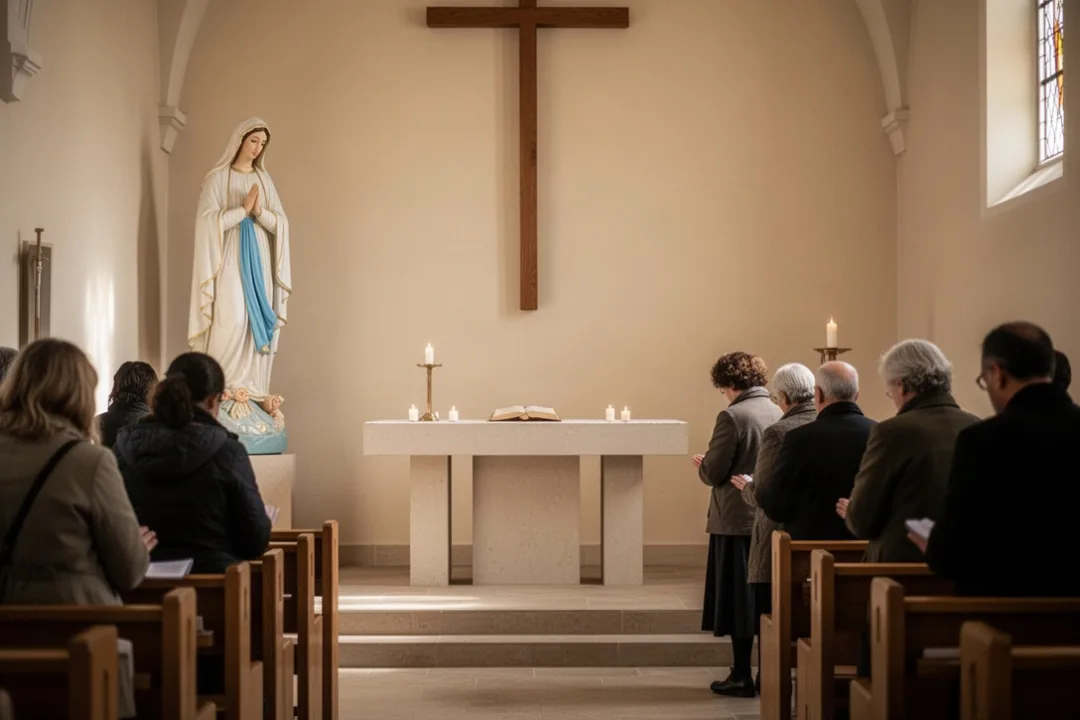
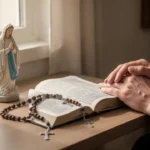
Some people use images, medals, candles, or statues while praying. These objects are reminders and aids to devotion, not idols in Catholic teaching. A statue of Mary does not contain Mary, and a medal does not have automatic spiritual power. The object helps a person remember the person represented and the Christian truths connected with that life.
How Christian traditions differ on Mary and the saints
Roman Catholics, Eastern Orthodox Christians, Oriental Orthodox Christians, Anglicans, and some other Christian communities honor Mary and the saints in different ways. Catholic and Orthodox traditions generally accept prayers asking saints to intercede and maintain calendars of feast days. They also use icons, hymns, processions, and other forms of public devotion, though the language and customs vary.
Many Protestant churches honor Mary as the mother of Jesus and a model of faith but do not ask her or other saints to pray for them. They may emphasize the direct access believers have to God through Christ and may be concerned that devotional practices could distract from Scripture or Christ’s unique role. Some Anglican and Lutheran communities retain certain saint days and forms of commemoration without sharing every Catholic practice.
Evangelical churches often use “saint” to describe every Christian rather than a special category of believers who can be invoked after death. They may still respect historical figures such as Mary, Peter, Augustine, or Martin Luther, but remembrance is distinct from requesting their intercession. These differences arise from varying interpretations of Scripture, church authority, tradition, and the meaning of mediation.
Respectful conversation works best when the terms are defined carefully. Asking a Catholic, “Do you worship Mary?” may assume a meaning the Catholic rejects. Asking, “What do you believe happens when you ask Mary to pray?” addresses the actual belief. Likewise, a Catholic should not assume that a Protestant who declines saintly intercession has no respect for Mary or the faithful Christians who came before.
Across these differences, most historic Christians agree on several central points: Mary was the mother of Jesus, Jesus is the source of salvation, God alone deserves worship, and Christians are called to imitate lives of faithfulness. The disagreements concern how the Church’s fellowship extends beyond death and how Mary’s honor should be expressed.
Honoring Mary and the saints is most useful when it leads to a more faithful Christian life. Reading a saint’s biography, observing a feast day, or praying a traditional prayer can help you consider how faith is lived in concrete circumstances. The goal is not admiration for its own sake but greater love of God and neighbor.
Mary’s example highlights attentive faith, courage, humility, and perseverance. Her life also includes uncertainty, danger, grief, and waiting. A person praying with Mary may reflect on how to trust God while facing circumstances that cannot be controlled.
The saints offer a wide range of examples rather than one ideal personality. Some served the poor, some taught theology, some raised families, some worked for justice, some endured imprisonment, and some practiced quiet service in ordinary communities. Their differences can help you see that holiness is not limited to one career, culture, temperament, or form of ministry.
Read one Gospel passage about Mary, such as Luke 1-2 or John 2, and reflect on her response.
Choose a saint whose life relates to a real concern, such as family, illness, work, grief, or service.
Ask what virtue the person practiced rather than focusing only on extraordinary events.
Use a feast day as a prompt for prayer, Scripture reading, generosity, or reconciliation.
Check whether a devotional practice brings you closer to Christ and more attentive to other people.
Mary and the saints are not meant to make Christian faith more complicated or to create a spiritual hierarchy of competing powers. They are understood as members of one family gathered around God. For Catholics, Mary has a singular place within that family, while every saint remains a creature dependent on divine grace.
The most balanced understanding keeps three truths together: God alone is worshiped, Jesus is the unique source of salvation, and the faithful can pray for one another across the boundary of death. Seen this way, devotion to Mary and the saints is intended to deepen trust in God, strengthen communion within the Church, and encourage practical holiness.
Frequently asked questions
Is Mary considered a saint in Catholicism?
Yes. Catholics consider Mary the foremost of the saints because she is the mother of Jesus and is understood to have cooperated uniquely with God’s grace. She is honored above all other saints, but she remains human and is not treated as divine. Catholic devotion to her is therefore distinct from the worship offered to God.
Do Catholics believe saints can answer prayers?
Catholics believe saints can intercede by praying for people, but they do not believe saints answer prayers through independent power. God alone grants grace, performs miracles, and determines the outcome of a petition. Asking a saint for help means asking that person to bring a concern before God, much as Christians ask living friends to pray.
Why do some Christians not pray to Mary or the saints?
Many Protestants emphasize direct prayer to God through Jesus Christ and interpret biblical teaching about mediation differently. They may honor Mary as Jesus’ mother and respect historical saints without invoking them. Their concern is often that asking saints for intercession could obscure Christ’s unique role, while Catholic and Orthodox Christians understand such requests as participation in Christ’s one mediation.
What is the difference between a saint and a patron saint?
A saint is a Christian recognized for exceptional holiness or martyrdom, while a patron saint is associated with a particular place, occupation, illness, cause, or group. Catholics may ask a patron saint to intercede for that concern. Patronage does not mean the saint has exclusive control over it; it reflects a devotional connection based on the saint’s life or tradition.











Leave a Reply