Christianity is the broader religion, and Catholicism is one major tradition within Christianity. Every Catholic is Christian, but not every Christian is Catholic. The main differences usually arise when Catholic beliefs and practices are compared with those of Protestant Christians, because “Christian” includes Catholics, Protestants, Eastern Orthodox Christians, and several other traditions.
Catholics and other Christians share the central belief that Jesus Christ is the Son of God and Savior. They generally affirm his death and resurrection, the importance of the Bible, the need for faith, and the call to love God and neighbor. Their differences involve questions such as church authority, the sacraments, Mary and the saints, salvation, worship, and how Christian teaching should be interpreted.
The word Christian describes someone who follows Jesus Christ. It can also refer to the entire worldwide religion based on his life, teachings, death, and resurrection. The word Catholic comes from a Greek term meaning “universal,” and it identifies the Catholic Church as a particular Christian communion with its own history, theology, worship, and leadership.
Christianity began in the first century among the followers of Jesus. Over many centuries, Christian communities developed different traditions and structures. The largest broad groupings today are the Catholic Church, the Eastern Orthodox churches, and the many churches commonly called Protestant.
That means the phrase “Christian vs Catholic” can be misleading. A more accurate comparison is usually Catholic vs Protestant or Catholic vs non-Catholic Christian. A Baptist, Lutheran, Presbyterian, Pentecostal, Methodist, or non-denominational believer is also Christian, but may disagree with Catholic teaching on several important matters.
Simple answer: “Christian” is the larger category; “Catholic” identifies one Christian tradition. The word Christian does not normally mean “non-Catholic.”
Christian traditions do not all define membership in exactly the same way. Some place strong emphasis on personal conversion, while others emphasize baptism, participation in the church, or continuity with historic Christian communities. Still, the shared focus on Jesus is why these traditions are grouped under Christianity.
What Catholics and other Christians believe together
Despite their differences, Catholics and most other historic Christian groups share a substantial foundation. They look to the Old Testament and New Testament, although they do not always use identical biblical canons or interpret every passage in the same way. They also worship the God of the Bible as Father, Son, and Holy Spirit.
Most Catholic, Orthodox, and Protestant Christians affirm the Trinity: one God who exists as three distinct persons—Father, Son, and Holy Spirit. They also confess that Jesus is truly divine and truly human. Christian belief centers on Jesus’ ministry, crucifixion, resurrection, and promised return.
Many Christians summarize their shared beliefs through historic statements such as the Apostles’ Creed or the Nicene Creed. The Nicene Creed expresses belief in one God, Jesus Christ, the Holy Spirit, the church, baptism, resurrection, and eternal life. Churches may explain these beliefs differently, but the creed provides a common foundation across many traditions.
Shared Christian beliefs commonly include the following:
Jesus Christ is Lord, the Son of God, and central to salvation.
Jesus was crucified, died, and was raised from the dead.
God calls people to repentance, faith, holiness, and love of neighbor.
The Bible is a sacred authority for Christian faith and practice.
Human beings need God’s grace and cannot make themselves righteous through moral effort alone.
There will be a resurrection of the dead and a final judgment.
These common convictions do not remove every disagreement. For example, Christians may all affirm the importance of grace while disagreeing about how grace, faith, works, baptism, and church membership relate to salvation. Shared language can therefore conceal meaningful theological differences.
How Catholic and Protestant authority differs
The most significant dividing line between Catholicism and many Protestant traditions concerns religious authority. Catholics view divine revelation as transmitted through both Scripture and Sacred Tradition, interpreted within the teaching authority of the church. The pope and bishops have a particular role in preserving and explaining official Catholic doctrine.
Catholic teaching does not treat tradition as a collection of human customs that can replace the Bible. Instead, Catholics understand Sacred Tradition as the living transmission of the faith received from the apostles. The church’s teaching office, often called the Magisterium, is responsible for interpreting Scripture and tradition together.
Many Protestant churches emphasize sola Scriptura, a Latin phrase commonly translated as “Scripture alone.” In this view, the Bible is the highest or final authority for establishing Christian doctrine. Protestant groups differ among themselves about how the Bible should be interpreted and who has authority to settle disputes, but they generally do not recognize the pope or the Catholic Magisterium as binding authorities over all Christians.
The practical results can be seen in several areas:
Catholicism: Scripture, Sacred Tradition, and the church’s teaching authority work together.
Many Protestant traditions: Scripture has the highest authority, with interpretation guided by pastors, confessions, councils, or the individual believer’s study.
Eastern Orthodoxy: Scripture is understood within Holy Tradition and the authority of the historic Orthodox church, without accepting the pope’s universal jurisdiction.
Protestantism is not a single church. It includes thousands of denominations and independent congregations with different views on baptism, communion, church government, spiritual gifts, and salvation. As a result, there is no single Protestant answer to every question. A Catholic may differ from a Lutheran in one way and from a Pentecostal in another.
The role of the pope is especially distinctive. Catholics regard the pope as the bishop of Rome and the successor of Saint Peter, with a unique responsibility to serve the unity of the church. Catholic doctrine limits papal infallibility to specific conditions involving formal teaching on faith or morals; it does not mean the pope is incapable of sin or never makes an error in ordinary speech.
Protestant and Eastern Orthodox Christians generally respect the historical importance of the bishop of Rome but do not accept the Catholic understanding of the pope’s universal authority. This disagreement is one reason the churches remain separate.
How Catholic worship compares with other Christian worship
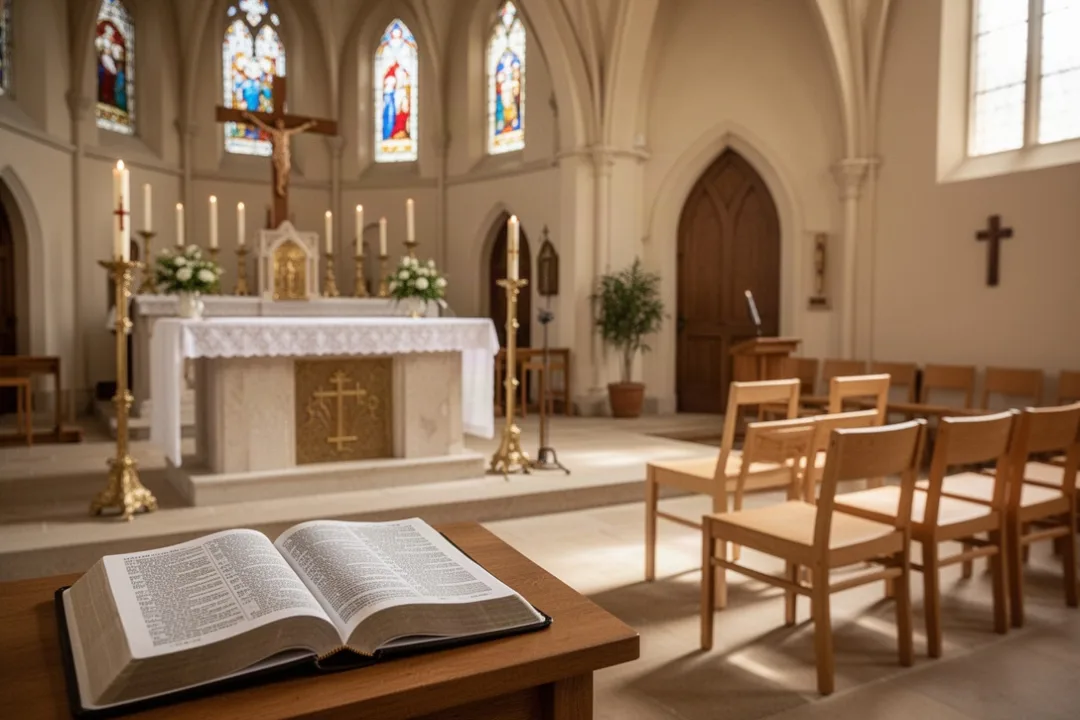
Catholic worship is centered on the Mass, which includes readings from Scripture, prayers, preaching, and the Eucharist. Catholics believe that the bread and wine become the body and blood of Christ in a sacramental manner, while retaining the appearances of bread and wine. The Eucharist is therefore not merely a symbolic reminder in Catholic theology.
Many Protestant churches also celebrate communion, often called the Lord’s Supper or Holy Communion. Their views vary widely. Some believe Christ is truly present in a special way; others understand the meal primarily as a memorial or public expression of faith. The frequency of communion also differs from one church to another.
Catholicism recognizes seven sacraments:
Baptism
Confirmation
The Eucharist
Reconciliation, also called confession or penance
Anointing of the Sick
Holy Orders
Matrimony
Catholics believe the sacraments are effective signs through which God gives grace. Baptism normally begins a person’s life in the church, and Catholic families commonly baptize infants. Confirmation strengthens baptismal grace, while reconciliation involves confessing sins to a priest and receiving absolution.
Protestant churches usually recognize two ordinances or sacraments instituted directly by Jesus: baptism and communion. Some Protestant traditions baptize infants, while others baptize only people who personally profess faith. The mode may be sprinkling, pouring, or immersion, depending on the denomination and congregation.
Worship styles can differ visibly. A Catholic Mass follows a structured liturgy and calendar, with set prayers, Scripture readings, gestures, vestments, and a formal Eucharistic service. Protestant worship may also be highly liturgical, especially in Anglican, Lutheran, and some Methodist churches, or it may center more strongly on preaching, congregational singing, and spontaneous prayer.
Those outward differences do not always show the full theological picture. A quiet Protestant service may have a carefully planned liturgy, and a Catholic parish may offer contemporary music. The more useful questions concern what the church believes worship accomplishes and how it understands baptism, communion, prayer, and the church itself.
Practical distinction: Catholics normally receive Communion only when they are properly prepared and in full communion with the Catholic Church. Visitors should follow the instructions given by the parish rather than assuming all Christians may receive.
What Catholics believe about Mary and the saints
Mary has a prominent place in Catholic devotion because she was the mother of Jesus. Catholics honor Mary as the Mother of God, a title that emphasizes the identity of her son as truly divine. They also teach the Immaculate Conception, meaning Mary was preserved from original sin from the beginning of her own life, and the Assumption, meaning she was taken into heavenly glory at the end of her earthly life.
These teachings are often confused with the claim that Catholics consider Mary equal to God. Catholic theology does not teach that Mary is divine or that she replaces Jesus. Catholics distinguish between worship owed to God and honor given to Mary and the saints.
Catholics also ask saints to pray for them. They believe the saints are alive with God and can intercede, much as a Christian might ask another believer to pray. Catholic prayers addressed to Mary or a saint are understood as requests for intercession, not as worship of another god.
Many Protestants honor Mary as an important biblical figure and the mother of Jesus but reject or do not accept Catholic teachings about her sinlessness, lifelong virginity, Assumption, or special intercessory role. They may prefer to pray directly to God through Jesus, emphasizing that Christ is the unique mediator between God and humanity.
Protestants also vary in their view of saints. Some use “saint” for every believer in Christ, following New Testament language, while others honor particular historic Christians as examples of faith. They typically do not invoke saints in prayer as Catholics do.
The distinction becomes clearer through the different meanings of veneration and worship. Catholics may use images, statues, icons, candles, and devotional prayers as aids to remembrance and prayer. They insist that these objects are not gods. Many Protestant communities avoid such practices because they fear images or saintly devotion could blur the line between honoring a person and worshiping God.
How Catholic and Protestant views of salvation differ
All major Christian traditions teach that salvation depends on God’s grace, not on human beings earning heaven through good behavior. The disagreement is less about whether grace matters and more about how grace is received, how faith and works relate, and how the church’s sacraments participate in the life of salvation.
Catholic teaching describes salvation as a life of grace that begins with God’s initiative and is nourished through faith, the sacraments, prayer, obedience, and works of love. Catholics do not understand good works as a way to purchase salvation. Instead, they see faithful action as the fruit of grace and a real response to God.
Many Protestants emphasize justification by faith, teaching that sinners are declared righteous before God through faith in Christ rather than through works performed to merit acceptance. In classic Protestant teaching, good works follow genuine faith as evidence of a transformed life, but they are not the basis on which a person earns justification.
The phrase “faith alone” can cause confusion if it is treated as permission to live without moral change. Protestant churches generally teach that saving faith produces repentance and good works. Catholic teaching likewise insists that faith must be living faith expressed through love, not merely intellectual agreement.
Catholic theology also includes the ideas of mortal and venial sin. Mortal sin is understood as a grave violation committed with sufficient knowledge and deliberate consent; venial sin damages a person’s relationship with God without destroying it. Catholics seek forgiveness through repentance and the sacraments, especially confession for mortal sin.
Protestant approaches to sin and assurance vary. Some teach that a truly justified person cannot lose salvation, while others hold that serious or persistent rejection of faith can place salvation in danger. Some emphasize a believer’s assurance based on God’s promises, while others focus on continuing faith and perseverance.
Purgatory is another difference. Catholics believe that some people who die in God’s friendship still need purification before entering the fullness of heaven. Purgatory is not a second chance at salvation in Catholic teaching and is not the same as hell. Most Protestant traditions reject purgatory because they do not find it compatible with their understanding of Christ’s completed work and biblical authority.
How to compare Christian denominations fairly
If someone asks whether Catholicism is Christian, the direct answer is yes. If they want to know how Catholicism differs from their own church, the comparison needs more detail. Start by identifying the specific tradition being discussed rather than treating all non-Catholic Christians as one group.
Use these questions to make the comparison more precise:
What does the church recognize as its highest authority?
How does it define the church and its leadership?
How many sacraments or ordinances does it practice?
What does it believe happens in baptism and communion?
How does it explain salvation, justification, sanctification, and assurance?
What place do Mary, the saints, confession, and religious images have?
Does it use a formal liturgy, informal worship, or a combination?
Personal practice also differs within every broad tradition. A Catholic who attends Mass regularly may have a different experience from a Catholic who rarely attends. Likewise, a conservative Baptist congregation, a mainline Lutheran church, and a non-denominational megachurch may all have different worship styles and teachings.
Respectful comparison separates official doctrine from individual behavior. Not every Catholic knows or follows every Catholic teaching, and not every Protestant agrees with the official beliefs of a denomination. Asking what a church officially teaches is different from asking what its members personally practice.
It also helps to avoid describing one group as “real Christians” and another as outsiders simply because they worship differently. Christians have debated doctrine throughout their history, and some disagreements are serious. Yet the central identity of Christianity remains connected to faith in Jesus Christ, not to one modern worship style, denomination, or cultural background.
The clearest answer is therefore both simple and specific: Catholics are Christians, and Catholicism is one historic expression of Christianity. When people use “Christian” to mean Protestant, they are using the word in a narrower informal sense, not giving the word its broadest religious meaning.
Frequently asked questions
Are Catholics considered Christians?
Yes. Catholics are Christians because they follow Jesus Christ and affirm core Christian beliefs about his divine identity, death, and resurrection. Catholicism is one of Christianity’s historic branches, alongside Eastern Orthodoxy and Protestant traditions. The wording can become confusing when people use “Christian” informally to mean “Protestant,” but that narrower usage does not exclude Catholics from Christianity.
Do Catholics believe in the Bible?
Yes. Catholics regard the Bible as inspired Scripture and read it publicly during Mass and other forms of worship. They interpret it within Sacred Tradition and the teaching authority of the Catholic Church. Catholic and Protestant Bibles do not contain exactly the same collection of Old Testament books, which is one reason their biblical references and doctrinal arguments can differ.
Why do Catholics pray to Mary?
Catholics do not believe Mary is a goddess or a replacement for God. They ask Mary to pray for them, just as Christians may ask another believer to pray. Catholics honor her because she was Jesus’ mother and because of her role in the Gospel story. Many Protestants respect Mary but prefer to direct all prayer to God through Christ.
Can a Protestant receive Communion at a Catholic Mass?
In ordinary circumstances, Catholic Communion is reserved for Catholics who share the church’s faith and are properly prepared. This reflects the Catholic belief that receiving the Eucharist expresses full unity in doctrine and church membership, not merely a general belief in Jesus. Visitors may attend Mass respectfully without receiving Communion and should follow the parish’s stated guidance.












Leave a Reply