Bible Old and New Testament: What’s the Difference?
Bible Old and New Testament: What’s the Difference?
When you open the Bible and see two major divisions, you may wonder where to begin: the Old Testament or the New Testament? The simplest answer is that the Old Testament tells the story of God’s relationship with humanity and Israel before Jesus, while the New Testament centers on Jesus Christ and the early Christian church.
These sections are different, but they are not unrelated books placed side by side. The Old Testament provides the setting, promises, laws, history, poetry, and expectations that help readers understand the New Testament. The New Testament presents Jesus as the fulfillment of the Bible’s central story and describes how his life, death, resurrection, and teachings shape Christian faith.
Quick answer: The Old Testament looks forward through creation, Israel, covenant, worship, wisdom, and prophecy. The New Testament announces and explains Jesus Christ, then follows the growth of the Christian church and points toward God’s future restoration.
The word testament can mean a collection of writings, but its biblical meaning is closely connected to the idea of a covenant—a committed relationship established by God. The Old Testament describes the covenants and promises associated especially with Israel, while the New Testament describes the new covenant connected with Jesus.
The Old Testament is also called the Hebrew Bible or the Hebrew Scriptures, although the arrangement and naming of its books differ among Jewish and Christian traditions. Christians use “Old Testament” to describe the Scriptures they understand as the earlier part of the Bible. Jewish readers generally do not describe their Scriptures as “old” in the same theological sense.
The New Testament is the second major part of the Christian Bible. It contains writings from the first generations of Jesus’ followers, including the four Gospels, the book of Acts, letters to churches and individuals, and the book of Revelation.
“Old” does not mean useless, defective, or discarded. The Old Testament remains central to Christian Scripture because it introduces themes such as creation, sin, holiness, sacrifice, justice, mercy, kingship, wisdom, and hope. The New Testament repeatedly refers to these earlier writings and assumes that readers know their basic story.
Likewise, “new” does not mean completely disconnected from everything before it. The New Testament presents the life and work of Jesus within the world of the Old Testament. Jesus is born as a Jewish man, teaches from Israel’s Scriptures, observes Jewish practices, and speaks about the promises given to Israel.
What books are in the Old and New Testaments?
The number and order of biblical books vary among Christian traditions, so the answer depends on which Bible you are using. Most Protestant Bibles contain 66 books: 39 in the Old Testament and 27 in the New Testament. Catholic Bibles contain additional Old Testament books, often called Deuterocanonical books by Catholics and the Apocrypha by many Protestants. Eastern Orthodox traditions include a somewhat different collection.
The New Testament contains the same 27 books in the major Christian traditions, although their order can vary slightly in some editions. These writings are grouped by type rather than arranged as one continuous modern narrative.
The Gospels: Matthew, Mark, Luke, and John present Jesus’ ministry, teaching, death, and resurrection from four perspectives.
Acts: This book follows the spread of the Christian message and the growth of the early church after Jesus’ resurrection.
Paul’s letters: Romans through Philemon address Christian belief, church life, moral questions, leadership, conflict, and encouragement.
General letters: Hebrews through Jude offer teaching and pastoral guidance to wider audiences or particular communities.
Revelation: This book uses visions and symbolic imagery to address suffering, judgment, faithfulness, and God’s ultimate victory.
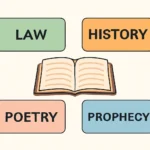
The Old Testament is more varied because it covers a much longer span of literary history and includes several distinct kinds of writing. Its books tell Israel’s story, preserve worship songs, explore wisdom, record prophetic messages, and describe national crisis and restoration.
The Law or Torah: Genesis, Exodus, Leviticus, Numbers, and Deuteronomy describe creation, the ancestors of Israel, the exodus from Egypt, covenant law, worship, and Israel’s journey toward the promised land.
Historical books: These books follow Israel’s settlement, judges, kings, division, exile, return, and later history, depending on the tradition’s arrangement.
Poetry and wisdom: Job, Psalms, Proverbs, Ecclesiastes, Song of Solomon, and related books explore suffering, worship, love, wisdom, mortality, and life with God.
Major prophets: Isaiah, Jeremiah, Ezekiel, and others address injustice, idolatry, judgment, repentance, restoration, and future hope.
Minor prophets: The twelve shorter prophetic books speak about covenant faithfulness, social wrongdoing, judgment, mercy, and restoration.
“Major” and “minor” prophets do not refer to importance. They mainly describe the length of the books. A short prophetic book can raise major theological and ethical questions, while a long book may contain many different kinds of material.
The strongest connection between the two Testaments is their shared concern with God’s purpose to bless, judge, rescue, and restore. The Bible moves through repeated patterns: people turn away, consequences follow, God calls them back, and hope appears through mercy and renewal.
Genesis begins with creation and humanity’s rebellion. It then narrows its focus to Abraham and his family, through whom God promises blessing for the nations. The story continues through Isaac, Jacob, the tribes of Israel, Moses, the judges, the kings, the prophets, exile, and return. The New Testament presents Jesus as the one through whom God’s promises reach their decisive stage.
One major connecting theme is covenant. God makes covenant commitments with Noah, Abraham, Israel through Moses, and David’s royal line. These covenants are not identical, and they should not be flattened into one simple agreement. Together, however, they develop the Bible’s picture of a faithful God forming a people and working toward redemption.
Another connection is the theme of God’s kingdom. The Old Testament describes God as the true King, even when Israel is ruled by human kings. The prophets look forward to a future in which God’s justice, peace, and rule are fully established. In the New Testament, Jesus announces the arrival of God’s kingdom and teaches what life under that rule looks like.
The New Testament also uses Old Testament images and institutions to explain Jesus’ significance. Jesus is described through ideas connected with the Messiah, the Passover, the temple, the priesthood, sacrifice, wisdom, and the suffering servant. Readers do not need to assume that every Old Testament detail is a direct prediction, but they should recognize that the New Testament interprets Jesus within the larger biblical story.
The New Testament cannot be understood well without the Old Testament, and the Old Testament receives a new interpretive focus for Christians through the New Testament.
Writers in the New Testament frequently refer to earlier Scripture. Sometimes they quote or paraphrase a passage; sometimes they use a story, image, or theme. These references show that the first Christians read Jesus’ life in continuity with Israel’s Scriptures rather than treating Christianity as an entirely separate religion.
How the two Testaments differ in focus and form
The Old Testament and New Testament differ in historical setting, literary form, and immediate purpose. These differences matter when you read them. A poem should not be read exactly like a legal instruction, and a letter to a first-century church should not be treated as though it were a modern newspaper report.
The Old Testament focuses on Israel’s story and covenant life
The Old Testament begins with the whole human family but gives particular attention to Israel’s relationship with God. It describes how Israel was formed as a people, delivered from slavery, given laws, brought into a land, governed by kings, divided by political conflict, sent into exile, and partly restored.
Its laws address worship, food, festivals, civil matters, agriculture, family relationships, property, treatment of the poor, and communal responsibility. Some laws are tied to Israel’s national and temple system, while others express broader moral principles. Christians differ in how they understand the continuing role of individual Old Testament laws, so careful interpretation requires attention to context.
The Old Testament also gives substantial space to human experience. The Psalms include praise, grief, confession, protest, thanksgiving, and trust. Job wrestles with undeserved suffering. Ecclesiastes examines the limits of human achievement and the certainty of death. Proverbs offers observations about wisdom, speech, work, relationships, money, and self-control.
The New Testament focuses on Jesus and the early church
The New Testament centers on Jesus’ identity and mission. Matthew emphasizes Jesus’ relationship to Israel’s story and presents him as a teacher and Messiah. Mark moves quickly through Jesus’ public ministry and highlights his authority and suffering. Luke places Jesus within a broad story of salvation and gives particular attention to outsiders and the poor. John uses distinctive language and imagery to explore Jesus’ identity and purpose.
Acts continues the story after Jesus’ resurrection. It describes the Holy Spirit’s work, the preaching of the apostles, the inclusion of non-Jewish believers, and the movement of the gospel from Jerusalem into the wider Roman world. Acts also shows disagreements, persecution, generosity, leadership challenges, and the practical difficulties of forming diverse congregations.
The letters explain Christian belief and apply it to real communities. Romans discusses sin, grace, faith, Israel, and transformed living. First Corinthians addresses division, sexuality, worship, spiritual gifts, the resurrection, and love. Galatians argues about freedom and the relationship between faith and the law. James emphasizes practical obedience, speech, impartiality, and care for people in need.
Revelation belongs to a literary form known as apocalyptic writing, which uses vivid symbols and visions to communicate hope and warning. It should not be read as though every image were a literal description. Its original readers faced pressure and uncertainty, and the book calls them to remain faithful while affirming God’s final judgment and renewal.
What the New Covenant changes for Christian readers
Christians understand the New Testament as announcing a new covenant through Jesus. This does not mean God changed from harsh to loving. The Old Testament already describes God as merciful, patient, and committed to forgiveness, while the New Testament still speaks about judgment and the seriousness of sin.
The change concerns how God’s covenant purposes are accomplished and experienced. The New Testament emphasizes forgiveness through Jesus, the work of the Holy Spirit, and the formation of a people drawn from many nations. Christian identity is no longer defined by belonging to the ethnic nation of Israel or by participation in Israel’s temple system.
The book of Hebrews presents Jesus as the decisive high priest and connects his sacrifice with the older sacrificial system. Its argument is theological rather than a simple statement that every Old Testament passage has only one meaning. The writer uses Israel’s worship practices to explain why Jesus’ work is sufficient and why believers can approach God with confidence.
Jesus also reshapes how his followers understand the law. In the Sermon on the Mount, recorded in Matthew 5–7, he addresses murder, adultery, retaliation, love for enemies, prayer, generosity, and anxiety. He does not treat righteousness as outward rule-keeping alone; he points to the heart, motives, reconciliation, mercy, and wholehearted devotion.
The New Testament’s teaching about salvation includes several related ideas:
Forgiveness: God releases people from guilt and restores them to relationship with him.
Reconciliation: Hostility between God and humanity is addressed through Christ.
Justification: People are accepted by God through faith rather than earning a right standing through personal achievement.
Transformation: The Holy Spirit enables believers to grow in holiness, love, and obedience.
New community: Followers of Jesus become part of a people that includes Jews and Gentiles, women and men, and people from many nations.
Future resurrection: Christian hope looks beyond death toward resurrection and the renewal of creation.
Different Christian traditions explain these themes with different emphases. Some stress substitutionary sacrifice, others reconciliation, victory over evil, participation in God’s life, or moral transformation. These views can overlap, and no single short formula captures every New Testament image of salvation.
Reading tip: Do not treat the Old Testament as a list of obsolete rules or the New Testament as a collection of isolated inspirational sayings. Read both as parts of a developing story, paying attention to the original audience, literary form, and place in the Bible’s wider narrative.
How to read the Bible’s Old and New Testaments together
If you are reading the Bible for the first time, starting at Genesis and moving straight through Revelation is possible, but it can be difficult. Long legal sections, detailed genealogies, and unfamiliar historical settings may slow you down before you reach the New Testament. A balanced plan often gives you the main storyline while gradually adding background.
One practical approach is to begin with Luke and Acts, because they form a connected account of Jesus and the early church. You can then read Genesis, Exodus, selected Psalms, Isaiah, and one or more New Testament letters. This gives you narrative, worship, prophecy, teaching, and application without requiring you to understand every book at once.
As you read, ask questions that fit the passage rather than forcing every section into the same mold. A law, psalm, proverb, prophecy, Gospel scene, and letter each communicate differently.
Identify the kind of writing. Ask whether you are reading narrative, law, poetry, wisdom, prophecy, a Gospel, a letter, or apocalyptic vision.
Notice the original setting. Consider who is speaking, who is listening, what problem is being addressed, and what historical circumstances matter.
Read the surrounding paragraphs. A single verse can be misleading when separated from its argument or story.
Trace repeated themes. Look for ideas such as covenant, faithfulness, justice, sacrifice, kingdom, wisdom, exile, restoration, and hope.
Compare related passages carefully. Use cross-references to see how later biblical writers interpret earlier texts, but distinguish direct quotation from broader allusion.
Apply the passage responsibly. Ask what it meant to its first audience before deciding how its principles speak to your life.
Reading order also depends on your purpose. Someone studying Christian doctrine may focus on Romans, Galatians, Hebrews, and John. Someone exploring prayer may begin with Psalms and then examine Jesus’ teaching on prayer in Matthew, Mark, Luke, and John. Someone trying to understand the Bible’s overall plot should give priority to Genesis, Exodus, the historical books, selected prophets, the Gospels, Acts, and Revelation.
Use a reliable study Bible or commentary when historical details, unfamiliar customs, or difficult passages cause confusion. Comparing several translations can help with meaning, but remember that translations make different choices about word order, style, and ancient terms. Reading a passage in more than one translation is useful; treating one English wording as the only possible expression is less helpful.
It also helps to distinguish description from instruction. The Bible may describe deception, violence, political failure, family conflict, or religious hypocrisy without approving those actions. Narrative passages often invite reflection on character and consequences rather than giving a direct command to imitate everything a person does.
Finally, read with patience. The Bible’s two Testaments contain different voices, genres, and historical settings, but they repeatedly return to the questions that shape biblical faith: Who is God? What has gone wrong with humanity? What does faithful living look like? How does God respond to sin and suffering? What kind of future does God promise?
For Christians, the answer to these questions comes into sharp focus in Jesus, while the Old Testament supplies the story and vocabulary that make that focus understandable. Together, the two Testaments present a unified account of creation, covenant, human failure, divine mercy, redemption, and the hope of restored creation.
Frequently asked questions
Is the Old Testament the same as the Hebrew Bible?
They overlap substantially, but the terms reflect different traditions and arrangements. The Hebrew Bible is organized according to Jewish tradition, while the Christian Old Testament follows a Christian collection and order. Catholic and Orthodox Bibles also include books that are not part of most Protestant Old Testaments. Comparing editions requires attention to both the book list and the arrangement.
Should I read the Old Testament before the New Testament?
Not necessarily. Beginning with Luke and Acts can provide a clear introduction to Jesus and the early church, while reading Genesis, Exodus, Psalms, and Isaiah gives essential background. You can alternate between sections rather than reading every book in order. A study Bible and a manageable reading plan can make difficult historical or legal passages easier to understand.
Do Christians still follow the Old Testament laws?
Christian traditions answer this differently, especially concerning ceremonial, civil, and moral laws. Most Christians believe Jesus’ new covenant changes how believers relate to Israel’s sacrificial and ritual system. Christians generally continue to take seriously biblical teachings about love, justice, faithfulness, and holiness, while interpreting individual laws through Jesus and the New Testament.
Why are there four Gospels instead of one account?
Matthew, Mark, Luke, and John each present Jesus with a distinct emphasis, structure, vocabulary, and selection of events. Their differences allow readers to see complementary perspectives rather than a single flattened narrative. Matthew strongly connects Jesus to Israel’s Scriptures, Mark emphasizes urgent action and suffering, Luke highlights salvation’s broad reach, and John uses distinctive theological imagery.














Leave a Reply