If you are comparing a Catholic Bible with a Protestant Bible and notice that the page counts do not match, you are probably asking the right question: how many books are in the Catholic Bible? The standard Catholic Bible contains 73 books altogether—46 books in the Old Testament and 27 books in the New Testament.
The difference is mainly in the Old Testament. Catholic Bibles include seven additional books, commonly called the deuterocanonical books: Tobit, Judith, 1 Maccabees, 2 Maccabees, Wisdom, Sirach, and Baruch. Catholic editions also contain additional passages in Esther and Daniel. The New Testament has the same 27 books in Catholic and Protestant Bibles.
Quick answer: A Catholic Bible has 73 books—46 Old Testament books and 27 New Testament books. A typical Protestant Bible has 66 books.
The Catholic Bible is divided into two major sections: the Old Testament and the New Testament. These names describe the Bible’s two broad collections of sacred writings and the covenant relationship they present.
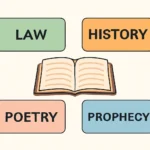
The Old Testament has 46 books. It includes the Law, historical books, wisdom literature, and prophetic books. The New Testament has 27 books, including the four Gospels, Acts, the letters, and Revelation.
Old Testament: 46 books
New Testament: 27 books
Total: 73 books
The 73-book count refers to the canon used by the Catholic Church in its liturgy and teaching. Individual Catholic Bible editions can differ in translation style, notes, introductions, page design, and the way certain passages are arranged, but the standard list of biblical books remains the same.
Which books are in the Catholic Old Testament?
The Catholic Old Testament contains 46 books. They are often grouped by literary type, although the order and grouping can vary among Bible editions. The following list uses common English names and presents the books in the order found in many Catholic Bibles.
The Pentateuch contains the first five books
The first five books are known as the Pentateuch, a word referring to a five-part collection. They are also called the Torah or the Law. These books tell of creation, the ancestors of Israel, the exodus from Egypt, the covenant at Sinai, and Israel’s early laws and worship.
Genesis
Exodus
Leviticus
Numbers
Deuteronomy
Genesis presents the stories of creation, the flood, Abraham, Isaac, Jacob, and Joseph. Exodus describes the Israelites’ liberation from Egypt and their covenant with God. Leviticus focuses heavily on worship and ritual law, Numbers follows Israel’s wilderness experience, and Deuteronomy restates and develops the law before the people enter the promised land.
The historical books tell Israel’s story
The Catholic Bible has 16 historical books in its Old Testament grouping. They cover the settlement in the land, the monarchy, the exile, the return, and later Jewish struggles. This section also includes the seven deuterocanonical books that distinguish the Catholic Old Testament from the standard Protestant Old Testament.
Joshua
Judges
Ruth
1 Samuel
2 Samuel
1 Kings
2 Kings
1 Chronicles
2 Chronicles
Ezra
Nehemiah
Tobit
Judith
Esther
1 Maccabees
2 Maccabees
These books are not history in exactly the same form as a modern textbook. They combine historical memory, religious interpretation, speeches, prayers, genealogies, and theological reflection. For example, Joshua and Judges describe different periods of Israel’s early life in the land, while Samuel and Kings focus on the monarchy and its eventual collapse.
Tobit follows a faithful Israelite family living away from Jerusalem and emphasizes prayer, charity, marriage, and God’s care. Judith tells of a courageous woman who defends her people. First and Second Maccabees describe Jewish resistance to foreign rule and religious persecution, with particular attention to faithfulness under pressure.
The wisdom books explore prayer and faithful living
Seven books are commonly grouped as wisdom or poetic books in the Catholic Old Testament. They address suffering, justice, love, practical conduct, mortality, worship, and the search for wisdom. Their writing includes poetry, proverbs, speeches, songs, and reflective teaching.
Job
Psalms
Proverbs
Ecclesiastes
Song of Solomon
Wisdom
Sirach
Job wrestles with the problem of undeserved suffering. Psalms contains prayers and songs of praise, lament, thanksgiving, trust, and repentance. Proverbs offers short teachings about wise and foolish behavior, while Ecclesiastes reflects on the limits of human achievement and understanding.
The Song of Solomon, also called the Song of Songs, uses love poetry. Catholic interpretation has read it both as a celebration of human love and, in a spiritual sense, as a picture of the relationship between God and his people. Wisdom and Sirach provide teachings about virtue, justice, discipline, worship, and the meaning of a wise life.
The prophetic books call people back to faithfulness
The Catholic Old Testament includes 18 prophetic books. The prophets spoke to particular communities and historical situations, calling people to worship God, practice justice, reject idolatry, and trust in God’s promises. Their writings also include warnings about judgment and hope for restoration.
Isaiah
Jeremiah
Lamentations
Baruch
Ezekiel
Daniel
Hosea
Joel
Amos
Obadiah
Jonah
Micah
Nahum
Habakkuk
Zephaniah
Haggai
Zechariah
Malachi
The first four books in this grouping are often called the major prophets because of their length, not because they are more important. The remaining 12 are often called the minor prophets because their books are shorter. Baruch is included in the Catholic Old Testament, and Catholic editions include additions to Daniel that are not counted as separate books.
Which seven books are included in Catholic but usually absent from Protestant Bibles?
The seven books most often associated with the difference between Catholic and Protestant Bibles are Tobit, Judith, 1 Maccabees, 2 Maccabees, Wisdom, Sirach, and Baruch. They are called deuterocanonical in Catholic usage, meaning that their canonical status was recognized in a later or secondary stage of the Church’s formal clarification of the canon.
Tobit: A story about faithfulness, family life, prayer, generosity, and divine guidance.
Judith: A narrative about a courageous woman who acts to protect her people.
1 Maccabees: A historical account of Jewish resistance and political change.
2 Maccabees: A theological history emphasizing martyrdom, resurrection hope, prayer for the dead, and fidelity to the law.
Wisdom: Reflections on wisdom, righteousness, immortality, and God’s justice.
Sirach: Practical instruction about character, relationships, speech, work, worship, and wise conduct.
Baruch: Prayers and teachings connected with repentance, wisdom, exile, and hope.
These books are not simply extra chapters added at random. They are complete works with their own literary forms and themes. Catholic Bibles also include additional sections of Esther and Daniel, but those passages are incorporated into those books rather than counted as separate books.
Counting tip: The additions to Esther and Daniel increase the amount of biblical text, but they do not increase the Catholic Bible’s book count beyond 73.
Why does the Catholic Bible have 73 books instead of 66?
The difference comes from the way Jewish and Christian communities received and recognized certain ancient scriptures. The seven deuterocanonical books were preserved in the Greek version of the Old Testament known as the Septuagint, a collection widely used by Greek-speaking Jews and early Christians.
Early Christian writers quoted from or referred to many books in the Septuagint. The history of the biblical canon was not a single event in which every Christian community immediately used an identical list. Different communities and writers sometimes gave different levels of authority to particular books.
During the Protestant Reformation, many Protestant traditions adopted a shorter Old Testament collection aligned more closely with the books in the later Jewish Hebrew Bible. The seven books were often placed in a separate section called the Apocrypha or were left out of editions altogether. This produced the familiar 66-book Protestant Bible: 39 Old Testament books and 27 New Testament books.
The Catholic Church formally reaffirmed its 73-book canon at the Council of Trent in the 16th century. That decision recognized the Old Testament books used in Catholic worship and teaching, including the seven deuterocanonical books, along with the universally received 27 books of the New Testament.
The difference should not be described as a difference in the number of books in the Christian Bible as a whole. It is more precise to say that different Christian traditions use different biblical canons. Catholics, Protestants, Eastern Orthodox Christians, and other churches may differ in their Old Testament lists and in the names or arrangement of certain books.
Are the New Testament books the same in Catholic and Protestant Bibles?
Yes. Catholic and Protestant Bibles both contain the same 27 New Testament books. These books are grouped as the Gospels, Acts, the letters, and Revelation.
The four Gospels and Acts
Matthew
Mark
Luke
John
Acts of the Apostles
The four Gospels present the life, ministry, death, and resurrection of Jesus from distinct perspectives. Matthew, Mark, and Luke share many episodes and are called the Synoptic Gospels. John has a distinct structure and style. Acts continues the story after the resurrection, describing the growth of the early Christian communities and the spread of the gospel.
The letters and Revelation
The remaining 22 books include letters attributed to Paul, other apostolic letters, and the book of Revelation. They address Christian belief, worship, morality, church life, suffering, hope, and perseverance.
Romans
1 Corinthians
2 Corinthians
Galatians
Ephesians
Philippians
Colossians
1 Thessalonians
2 Thessalonians
1 Timothy
2 Timothy
Titus
Philemon
Hebrews
James
1 Peter
2 Peter
1 John
2 John
3 John
Jude
Revelation
The 13 letters from Romans through Philemon are traditionally associated with Paul. Hebrews follows them in many Catholic Bible editions, although its authorship has long been discussed. James, Peter, John, and Jude are commonly called the Catholic Epistles because they are addressed more broadly than a single local congregation or person.
Common mistakes when counting the Catholic Bible
Counting biblical books can become confusing because editions use different headings, names, and layouts. These practical checks can help you avoid the most common errors.
Do not count chapters as books. A book such as Psalms contains many chapters, but it is still one book.
Count 1 and 2 Samuel separately. The same applies to 1 and 2 Kings, 1 and 2 Chronicles, and 1 and 2 Maccabees.
Include the seven deuterocanonical books. Tobit, Judith, 1 Maccabees, 2 Maccabees, Wisdom, Sirach, and Baruch belong to the Catholic Old Testament.
Do not count additions to Esther and Daniel as separate books. They are part of those two books in Catholic editions.
Remember that the New Testament still has 27 books. The difference between Catholic and Protestant counts is in the Old Testament.
Check the edition’s contents page. Some Bibles use names such as Ecclesiasticus for Sirach or Song of Songs for Song of Solomon.
A second source of confusion is the word Apocrypha. Protestant editions may use it for books that Catholic editions call deuterocanonical. The labels reflect different traditions and theological conventions, so the same ancient work may be described differently depending on the Bible edition.
How Catholic Bible names and arrangements can differ
Most Catholic Bibles follow a recognizable 73-book list, but the presentation is not identical in every edition. One Bible may place Baruch immediately after Jeremiah, while another may use slightly different section headings. These variations do not necessarily indicate a different canon.
Some names also vary by translation or tradition. Sirach may be called Ecclesiasticus, and Song of Solomon may be called the Song of Songs. The books commonly known as 1 and 2 Samuel may be labeled 1 and 2 Kings in some older traditions, while the books called 1 and 2 Kings may receive a different numbering.
Numbering differences are especially relevant when you compare a Catholic Bible with an Orthodox Bible or with older translations. A reference to a psalm may also differ by one number in some traditions because the Hebrew and Greek traditions divide and number the Psalms differently. When checking a citation, use the translation or tradition named by the source.
How to choose a Catholic Bible for reading and study
If you want to read the Catholic Bible, begin by checking that the edition contains all 73 books and has an approval or authorization appropriate to Catholic use. A Catholic edition usually includes introductions, notes, cross-references, and explanations of the biblical text.
Your choice can then depend on how you plan to read. A compact edition may be convenient for travel, while a study Bible may provide historical context and notes about difficult passages. A lectionary-based edition may be useful if you want to follow readings used at Mass.
For daily reading: Choose a readable translation with a manageable page size and clear layout.
For academic study: Look for substantial notes, maps, timelines, cross-references, and information about manuscript and historical context.
For prayer: Consider a translation whose language is comfortable to read aloud and whose edition supports slow reflection.
For following Mass: Check which translation is used by your parish or country’s lectionary.
For comparison: Read the same passage in more than one approved Catholic translation, remembering that wording and verse formatting can differ.
Page count is not a reliable way to identify the number of books. Large print, extensive notes, maps, appendices, and introductions can make one Bible much longer than another. The contents page is the most dependable place to verify whether an edition contains the complete Catholic canon.
What the 73-book count means for Catholic reading
The number 73 is more than a publishing detail. It tells you which writings the Catholic Church receives as part of its biblical canon for worship, doctrine, and personal reading. The seven deuterocanonical books contribute themes that are important in Catholic tradition, including almsgiving, wisdom, martyrdom, resurrection hope, prayer for the dead, and fidelity during persecution.
Reading the Catholic Bible as a whole also shows how its sections relate to one another. The Old Testament provides the scriptures of Israel and the story of God’s covenant, while the New Testament presents Jesus and the early Christian community. Catholics read both Testaments together, with the Old Testament understood as essential to the background and meaning of the New.
If a citation seems to refer to a book you cannot find, first check the Bible’s table of contents and alternate names. A Catholic Bible should list Tobit, Judith, Wisdom, Sirach, Baruch, and First and Second Maccabees, along with the 27 New Testament books. When those are included, the total is 46 plus 27, or 73 books.
Frequently asked questions
Does every Catholic Bible have exactly 73 books?
Standard Catholic Bibles use the same 73-book canon: 46 Old Testament books and 27 New Testament books. Editions can vary in translation, notes, order of headings, and naming conventions, but those editorial differences do not normally change the book count. Older or specialized editions may have unusual formatting, so the contents page can confirm what is included.
What is the difference between deuterocanonical books and the Apocrypha?
Deuterocanonical is the Catholic term for seven Old Testament books and related passages accepted as part of the canon. Apocrypha is often used in Protestant settings for some of the same writings, especially when they appear in a separate section or are omitted. The terms reflect different traditions concerning biblical authority and classification.
Does the Catholic Bible contain more books than the Jewish Bible?
The answer depends on which Jewish biblical collection and numbering system you mean. The Catholic Old Testament includes writings preserved in Greek that are not part of the Jewish Tanakh. The two traditions also arrange and group books differently, so simple book-by-book comparisons can be misleading even when the texts overlap substantially.
Why do some Bible references have different book names or numbers?
Biblical traditions and translations sometimes use different names or numbering systems. Sirach may be called Ecclesiasticus, and Song of Solomon may be called Song of Songs. Some traditions also number Samuel and Kings differently, and Psalm numbering can vary. Checking the edition cited by your source usually resolves the discrepancy.










Leave a Reply