The Old Testament has 39 books in most Protestant Bibles. Catholic Bibles contain 46 Old Testament books, while Eastern Orthodox Bibles include additional books and do not all use exactly the same count. In the Jewish Bible, the same core material is arranged as 24 books called the Tanakh.
These different numbers do not mean that one tradition has randomly added or removed large portions of Scripture. The main reasons for the difference are how books are grouped, which ancient writings are included, and how various religious traditions established their biblical collections.
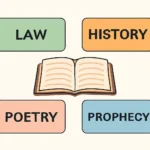
The familiar Protestant Old Testament contains 39 books. These books are usually organized into four broad groups: the Law, history, poetry and wisdom, and the Prophets. This arrangement helps readers understand the different kinds of writing, although the books were not necessarily written in the order in which they appear.
The first five books are known as the Pentateuch, a word meaning “five books.” They are also called the Torah or the Law. These books describe creation, the early history of humanity, God’s covenant with Abraham’s family, the exodus from Egypt, Israel’s journey through the wilderness, and the laws given to the nation.
Law: Genesis, Exodus, Leviticus, Numbers, and Deuteronomy.
Poetry and wisdom: Job, Psalms, Proverbs, Ecclesiastes, and Song of Solomon.
Major Prophets: Isaiah, Jeremiah, Lamentations, Ezekiel, and Daniel.
Minor Prophets: Hosea, Joel, Amos, Obadiah, Jonah, Micah, Nahum, Habakkuk, Zephaniah, Haggai, Zechariah, and Malachi.
The terms Major Prophets and Minor Prophets refer mainly to the length of the books, not to the importance of the prophets. Isaiah and Jeremiah are longer works, while Obadiah and other Minor Prophets are much shorter. Each book contributes a distinct message about Israel, Judah, judgment, justice, worship, repentance, and hope.
The 39-book Protestant arrangement ends with Malachi. Malachi addresses religious faithfulness and looks ahead to God’s future work. Because the New Testament begins with the ministry of John the Baptist and Jesus, readers sometimes experience a strong literary connection between the end of Malachi and the opening of Matthew.
Direct answer: If someone asks how many books are in the Old Testament and does not specify a tradition, 39 is usually the expected answer in the United States, especially in Protestant settings.
Why Catholic Bibles have 46 Old Testament books
Catholic Bibles contain 46 books in the Old Testament. The seven books included in Catholic Bibles but not in most Protestant Bibles are Tobit, Judith, Wisdom, Sirach, Baruch, 1 Maccabees, and 2 Maccabees. Catholic editions also include additional passages in Esther and Daniel.
Catholics commonly refer to these additional books as the Deuterocanonical books. The name means “second canon,” although Catholic teaching treats these writings as part of the biblical canon. Many Protestants use the term Apocrypha for the same or related books and do not place them on the same level as the 39 books they recognize as Scripture.
The additional writings cover several kinds of material. Tobit is a family story involving faithfulness, suffering, prayer, and divine help. Judith portrays a courageous woman who acts to protect her people. Wisdom reflects on righteousness, mortality, and divine wisdom, while Sirach offers practical instruction about character, speech, friendship, family life, and reverence for God.
First and Second Maccabees describe events surrounding Jewish resistance to foreign rule and the rededication of the Jerusalem temple. These books provide historical and religious background for the period between the Old and New Testaments. They are particularly valuable for understanding the political and spiritual setting that preceded the time of Jesus.
Baruch contains prayers, reflections, and encouragement connected with the experience of exile. Catholic editions also include expanded sections of Esther and Daniel. These additions contain prayers and narratives that are absent from the shorter forms used in most Protestant Bibles.
Tobit
Judith
Wisdom
Sirach, also called Ecclesiasticus
Baruch
1 Maccabees
2 Maccabees
As a result, a Catholic reader may see 46 Old Testament books, while a Protestant reader may see 39. The difference is not caused by Catholic Bibles having a completely different Old Testament structure. Most of the books are shared, and the seven additional books account for the main numerical difference.
How the 24 books of the Hebrew Bible correspond to 39 books
The Jewish Bible, commonly called the Tanakh, is counted as 24 books. Its three sections are the Torah, the Nevi’im, and the Ketuvim. These names are often translated as the Law, the Prophets, and the Writings.
The number 24 can seem surprising because the Jewish Bible contains essentially the same core writings that appear as 39 books in a Protestant Old Testament. The difference comes largely from combining books that Protestant Bibles count separately.
For example, the twelve Minor Prophets are traditionally counted as one book in the Hebrew Bible. Likewise, 1 and 2 Samuel form one book, 1 and 2 Kings form one book, and 1 and 2 Chronicles form one book. Ezra and Nehemiah are also traditionally counted together.
Several other groupings explain the difference:
Samuel is one book rather than 1 Samuel and 2 Samuel.
Kings is one book rather than 1 Kings and 2 Kings.
Chronicles is one book rather than 1 Chronicles and 2 Chronicles.
Ezra-Nehemiah is counted as one book.
The Twelve, meaning the Minor Prophets, are counted together.
The Hebrew Bible also places the books in a different order. The Protestant Old Testament ends with Malachi, but the Hebrew Bible ends with Chronicles. This difference affects how the collection is read as a whole. The arrangement of books can shape the sense of where the biblical story begins, develops, and reaches its literary ending.
The name Tanakh comes from the first letters of its three divisions: Torah, Nevi’im, and Ketuvim. The Torah includes Genesis through Deuteronomy. The Prophets include both historical narratives such as Joshua and Kings and prophetic books such as Isaiah and Jeremiah. The Writings include Psalms, Proverbs, Job, the five festival scrolls, Daniel, Ezra-Nehemiah, and Chronicles.
How the Jewish Bible’s sections are arranged
The Torah focuses on creation, the ancestors of Israel, the exodus, the covenant, and the formation of Israel as a people. It provides the foundation for Jewish identity and religious life.
The Nevi’im, or Prophets, includes the Former Prophets and the Latter Prophets. The Former Prophets tell Israel’s story in Joshua, Judges, Samuel, and Kings. The Latter Prophets include Isaiah, Jeremiah, Ezekiel, and the Twelve Minor Prophets.
The Ketuvim, or Writings, contains a broad collection of poetry, wisdom literature, historical reflection, and shorter scrolls. Psalms and Proverbs are familiar examples, while Ruth, Esther, Ecclesiastes, and Song of Songs are associated with particular Jewish festivals and traditions.
Why 24 and 39 can both be correct: The count changes because books such as Samuel, Kings, Chronicles, Ezra-Nehemiah, and the Twelve Minor Prophets are grouped differently. It is mainly a matter of collection and division, not a simple difference in content.
Which Old Testament books are shared across major Christian traditions
Most Christian traditions share the broad collection of writings from Genesis through Malachi, even when they count or arrange the books differently. These shared books contain the central narratives of creation, the patriarchs, the exodus, Israel’s monarchy, the exile, and the return from Babylon.
They also include Israel’s worship and wisdom traditions. Psalms provides prayers and songs covering praise, grief, confession, trust, thanksgiving, and kingship. Proverbs presents practical teachings about wisdom, work, speech, money, discipline, and relationships. Job wrestles with suffering and the limits of human understanding.
The historical books describe the rise and decline of Israel’s united monarchy under Saul, David, and Solomon, followed by the division into the northern kingdom of Israel and the southern kingdom of Judah. The books of Kings and Chronicles present overlapping history with different emphases. Kings strongly highlights covenant faithfulness and prophetic evaluation, while Chronicles gives special attention to worship, the temple, priests, and David’s line.
The prophetic books address real political and spiritual crises. The prophets criticize oppression, idolatry, dishonest leadership, empty religious practice, and the mistreatment of the poor. They also speak of restoration, renewed covenant faithfulness, justice, and future hope.
These writings are not all the same type of literature. Understanding their genres can make the Old Testament easier to read:
Narrative: Stories that trace people, families, kingdoms, conflicts, and divine action.
Law: Instructions concerning worship, community life, justice, sacrifice, purity, and covenant obligations.
Poetry: Songs and prayers that use parallel lines, vivid images, repetition, and emotional intensity.
Wisdom: Reflections on wise living, suffering, work, morality, mortality, and the fear of God.
Prophecy: Messages confronting present unfaithfulness while announcing judgment, mercy, or restoration.
The word Old Testament is a Christian term connected with the idea of an earlier covenant. Many Jewish readers prefer Hebrew Bible or Tanakh, because those terms reflect Jewish naming and organization. The choice of term can therefore signal a particular religious context, even when people are discussing much of the same collection of writings.
How Orthodox Old Testament collections differ
Eastern Orthodox Bibles generally include the books accepted by Catholic Bibles and may also contain additional writings. However, there is not one universally identical Orthodox table of contents used by every Orthodox church. The exact collection can vary according to local tradition and the edition of the Bible.
Orthodox editions may include books such as 1 Esdras, 3 Maccabees, and the Prayer of Manasseh. Some editions also include Psalm 151 or place 4 Maccabees in an appendix. Because these writings are not handled identically in every Orthodox tradition, quoting one fixed number for all Orthodox Bibles can be misleading.
The Ethiopian Orthodox biblical tradition has an even broader canon than the traditions usually discussed in American Protestant and Catholic settings. It includes writings that are not present in most Protestant or Catholic Bibles. For that reason, the answer to “How many books are in the Old Testament?” depends on which church’s Bible is being counted.
Orthodox use of the Greek Old Testament, often associated with the Septuagint, is part of the historical reason for these differences. The Septuagint is an ancient Greek translation and collection of Jewish Scriptures that circulated widely in the ancient world. Its contents and organization do not always match later Hebrew and Protestant arrangements book for book.
That historical background also explains why early Christian writers could refer to a somewhat broader group of sacred writings. Different communities inherited different textual traditions, and formal decisions about biblical collections developed over time rather than appearing in a single universally identical list.
How to count the Old Testament in your own Bible
If you need the exact number for a study group, class, or reading plan, check the table of contents in the specific Bible you are using. The publisher’s tradition will usually make the collection clear. A Protestant Bible will normally list 39 Old Testament books, while a Catholic Bible will normally list 46.
You can also identify the tradition by looking for the additional books between the Old Testament books and the New Testament, or integrated among the other books. In some Protestant editions, the Apocrypha is printed in a separate section. In many Catholic editions, the Deuterocanonical books appear as part of the Old Testament itself.
When comparing two Bibles, use these steps:
Check the table of contents rather than counting chapter headings, since chapters are not books.
Look for combined titles such as 1–2 Samuel, 1–2 Kings, or Ezra-Nehemiah.
Check for Tobit, Judith, Wisdom, Sirach, Baruch, and Maccabees.
Identify the Bible tradition named by the publisher, church, or study materials.
Compare the actual contents before assuming that different numbering means different teaching.
Reading plans can also create confusion. A plan based on the Protestant 39-book collection may skip books included in Catholic or Orthodox Bibles. Conversely, a Catholic reading plan may list Tobit or 1 Maccabees, making its total seem larger than a Protestant plan.
The best short answer depends on the context: 39 in Protestant Bibles, 46 in Catholic Bibles, 24 in the Hebrew Bible, and a varying number in Orthodox traditions. Asking which Bible tradition a person means removes nearly all ambiguity.
Frequently asked questions
Is the Old Testament the same as the Hebrew Bible?
The two collections largely overlap, but they are organized and counted differently. The Hebrew Bible is arranged as the Tanakh’s Torah, Prophets, and Writings, and it is traditionally counted as 24 books. Christian Old Testaments use a different order and commonly divide several combined Hebrew books, producing 39 in most Protestant Bibles.
Which seven books are in Catholic Bibles but not most Protestant Bibles?
They are Tobit, Judith, Wisdom, Sirach, Baruch, 1 Maccabees, and 2 Maccabees. Catholic Bibles also include expanded sections of Esther and Daniel. Catholics call these writings Deuterocanonical, while many Protestants refer to them as Apocrypha and do not classify them as part of the Old Testament canon.
Does the New Testament change the number of Old Testament books?
No. The New Testament is a separate collection of 27 books and does not alter how a tradition counts the Old Testament. Some New Testament passages refer to people or writings from the Old Testament period, but those references do not establish one universal table of contents for every Jewish or Christian community.
Why do Orthodox Bibles not have one standard number?
Orthodox churches inherit ancient Greek biblical traditions and may include writings that are absent from Protestant and Catholic editions. The exact contents can vary among Orthodox communities and publishers. Books such as 1 Esdras, 3 Maccabees, the Prayer of Manasseh, and Psalm 151 may appear in some editions.











Leave a Reply