The Old Testament: books, themes, and how to read it
The Old Testament: books, themes, and how to read it
You may have opened the Bible at Genesis, reached Leviticus, and wondered how laws, family stories, poetry, and prophetic warnings belong together. The Old Testament is not one continuous style of writing. It is a library of ancient books that tells the story of God’s relationship with Israel, explores human faithfulness and failure, and points readers toward justice, worship, wisdom, and hope.
In Christian Bibles, the Old Testament contains 39 books, arranged in several broad groups. Jewish Scripture, often called the Tanakh, contains the same core collection of writings but organizes and counts them differently. Learning the structure, historical setting, and major themes makes the Old Testament easier to read without treating every passage as if it were written in the same way.
The name Old Testament comes from Christian terminology about the earlier covenant relationship described in Scripture. The word “testament” can also mean covenant, an agreement involving obligations and promises. In Christian theology, the Old Testament is read alongside the New Testament; in Jewish tradition, the Hebrew Bible stands as its own sacred collection and is not understood merely as a preface to Christian writings.
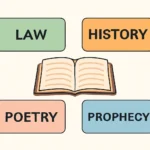
The books were written and compiled across many centuries by different authors and communities. They include narrative history, legal material, songs, wisdom sayings, prophetic speeches, genealogies, and symbolic visions. Their variety explains why a creation poem, a royal history, and a short prophetic book require different reading approaches.
At the center is the story of Israel’s covenant with God. Genesis begins with creation, human rebellion, and the calling of Abraham’s family. Exodus describes liberation from Egypt and the formation of a people at Sinai. Later books trace Israel’s settlement, monarchy, division, exile, and partial restoration while repeatedly asking how a community should live faithfully.
A useful starting point: Read the Old Testament as a collection of connected books, not as a single modern novel. Identify the kind of passage you are reading before deciding what it means.
How the Old Testament books are organized
Most Christian Bibles group the Old Testament into five sections: the Pentateuch, historical books, wisdom and poetic books, major prophets, and minor prophets. “Major” and “minor” refer mainly to length, not importance. A short book such as Micah can express themes as significant as those in Isaiah.
The Pentateuch establishes the story and covenant
The first five books are Genesis, Exodus, Leviticus, Numbers, and Deuteronomy. Jews call this collection the Torah, a word associated with instruction or teaching. These books introduce creation, the ancestors of Israel, the exodus from Egypt, covenant law, worship practices, wilderness travel, and preparation to enter the promised land.
Genesis covers creation, the spread of human wrongdoing, the flood, Babel, and the lives of Abraham, Isaac, Jacob, and Joseph.
Exodus describes Israel’s deliverance from Egypt, the covenant at Sinai, and the construction of the tabernacle.
Leviticus focuses on holiness, sacrifices, priests, festivals, purity, and responsibilities within the covenant community.
Numbers follows Israel through the wilderness, including rebellion, judgment, leadership disputes, and renewed preparation for the land.
Deuteronomy presents Moses’ speeches reviewing the law and urging Israel to remain loyal before entering Canaan.
These books are not simply a rulebook. They combine story and instruction, showing why Israel’s laws mattered within a particular relationship, society, and worship system. Reading each command in its surrounding passage helps prevent isolated rules from being misunderstood.
The historical books follow Israel’s national story
In the common Protestant arrangement, the historical books run from Joshua through Esther. They describe the conquest and settlement of the land, the period of the judges, the rise of the monarchy, the divided kingdoms of Israel and Judah, the destruction of Jerusalem, exile, and later return. The books often interpret events morally and theologically rather than offering a neutral modern chronicle.
Joshua presents Israel’s entrance into the land. Judges depicts a recurring pattern of disobedience, oppression, cries for help, and temporary deliverance. Ruth offers a smaller story of loyalty and family restoration during that unsettled period. First and Second Samuel focus on Samuel, Saul, and David, while First and Second Kings trace the monarchy through Solomon, the divided kingdom, and the fall of Jerusalem.
First and Second Chronicles retell much of Israel’s history with particular attention to David’s dynasty, the temple, priests, and worship. Ezra and Nehemiah describe efforts to rebuild the community and its religious life after exile. Esther tells the story of Jewish survival in the Persian Empire, even though God is not directly named in the Hebrew text.
Poetry and wisdom explore ordinary human experience
Job, Psalms, Proverbs, Ecclesiastes, and Song of Songs are commonly called the wisdom and poetic books. They do not all answer questions in the same way. Psalms gives words for praise, grief, confession, fear, protest, and trust. Proverbs offers practical observations about character and conduct, while Job challenges simple explanations for suffering.
Ecclesiastes reflects on life’s apparent instability, the limits of human achievement, and the difficulty of finding lasting meaning in earthly pursuits. Song of Songs uses lyrical love poetry and has been interpreted in several ways, including as an expression of human love and, in some traditions, as a symbolic picture of divine-human love.
Hebrew poetry often relies on parallel lines rather than rhyme. A second line may repeat, contrast, expand, or sharpen the first. Images such as mountains, shepherds, storms, trees, and paths communicate ideas through comparison, so readers should not automatically treat every poetic image as a literal statement.
The prophets confront injustice and announce hope
The prophetic books include Isaiah, Jeremiah, Lamentations, Ezekiel, Daniel, and the twelve shorter books from Hosea through Malachi. The prophets were not mainly fortune-tellers. They addressed real communities in specific political and spiritual crises, confronting idolatry, exploitation, corrupt leadership, empty worship, and broken covenant obligations.
Isaiah combines warnings of judgment with visions of restoration and peace. Jeremiah speaks to Judah before and during Jerusalem’s fall. Ezekiel addresses exiles and uses vivid symbolic actions and visions. Daniel contains court narratives and apocalyptic visions that encourage faithfulness under foreign rule.
The shorter prophets address different settings and concerns. Amos condemns economic oppression, Hosea uses marriage imagery to portray covenant unfaithfulness, Micah links worship with justice and humility, and Haggai urges returned exiles to rebuild the temple. Their messages become clearer when you ask who was being addressed, what crisis was occurring, and what response the prophet demanded.
The central themes that connect the Old Testament
Creation and the value of human life
Genesis presents God as the creator of the world and describes human beings as having a distinctive dignity. The creation accounts establish themes that return throughout the Bible: the goodness of the created order, human responsibility, the damage caused by sin, and the hope of renewed blessing.
The Old Testament does not treat the material world as worthless. Land, bodies, food, work, animals, seasons, and family life receive sustained attention. At the same time, creation is not presented as self-sufficient; dependence on God and responsible care for neighbors remain central concerns.
Covenant, promise, and faithfulness
Covenant is one of the Old Testament’s organizing ideas. God makes promises to Noah, Abraham, Israel, and David, although each covenant has its own setting and meaning. The covenant at Sinai gives Israel a communal identity and a pattern for worship, justice, leadership, and daily conduct.
Human faithfulness is shown as uneven. Abraham trusts and doubts, Moses leads and falters, David displays devotion but also commits serious wrongdoing, and the nation repeatedly turns toward other gods. The contrast between divine faithfulness and human instability explains why the books return so often to repentance, mercy, judgment, and restoration.
Holiness and the shape of communal life
Holiness means being set apart for God, but the Old Testament connects holiness with conduct rather than with religious ceremony alone. Laws about worship stand beside commands concerning honest business, treatment of workers, care for immigrants, protection of the poor, sexual ethics, courts, debts, and property.
Some laws distinguish Israel from surrounding peoples through food, clothing, festivals, sacrifices, or ritual boundaries. Other commands express broad moral concerns that recur throughout Scripture. Careful readers should resist flattening all laws into one category, especially when asking how particular commands relate to Jewish practice and Christian interpretation.
Justice, mercy, and concern for vulnerable people
The prophets repeatedly challenge the idea that religious activity can excuse cruelty. Isaiah, Amos, Micah, Jeremiah, and others connect genuine devotion with fair courts, honest treatment, generosity, and protection for the vulnerable. Widows, orphans, immigrants, the poor, and debtors appear frequently because their treatment reveals the character of the wider community.
Justice in the Old Testament includes punishment for wrongdoing, but it also involves restoring right relationships. The biblical writers criticize rulers who use authority for personal gain and wealthy people who exploit those with less power. These passages invite moral reflection without allowing modern readers to ignore the original social and political setting.
Worship, sacrifice, and the presence of God
The tabernacle and temple represent places where Israel worships and encounters God’s presence. Sacrifices express several ideas, including thanksgiving, fellowship, purification, dedication, and atonement. Leviticus can seem distant to modern readers, but its detailed rituals show how seriously the text treats holiness, responsibility, and access to sacred space.
The temple is important, but the Old Testament does not reduce God’s presence to a building. God meets people in the wilderness, speaks through prophets, accompanies exiles, and remains sovereign over foreign empires. The destruction of the temple therefore creates a theological crisis, and books such as Ezekiel and Isaiah explore how hope can survive catastrophe.
Wisdom, suffering, and the limits of easy answers
The wisdom books ask questions that remain familiar: Why do good people suffer? Does hard work guarantee success? How should you speak, choose friends, handle money, or face death? Proverbs often presents general patterns in life, while Job and Ecclesiastes show why those patterns cannot be turned into mechanical promises.
Job is especially important for readers who have heard that suffering always proves personal wrongdoing. Its dialogues expose the inadequacy of that claim. The book does not give a simple explanation for every tragedy; instead, it brings human limitations, protest, humility, and trust into view.
How the Old Testament relates to the New Testament
Christian readers often ask how the Old Testament connects with Jesus and the New Testament. The New Testament quotes or alludes to Old Testament passages extensively, presenting Jesus’ life and mission in relation to Israel’s Scriptures. Christians differ in how they understand prophecy, promise, law, and fulfillment, so one interpretation should not be presented as the only Christian approach.
Some passages concern their original historical setting and later receive additional meaning within Christian reading. For example, promises to David, songs of lament, temple imagery, and prophetic hopes may be read both in their ancient context and in relation to Christ. A responsible reading begins with what a passage meant in its own book before considering later theological connections.
Christians also disagree about how Old Testament laws apply today. Many distinguish between moral principles, ritual practices, and civil regulations given to ancient Israel, while recognizing that those categories do not always map neatly onto the text. Jewish interpretation does not depend on the New Testament and should be understood on its own terms rather than treated as an incomplete version of Christianity.
Read context before prediction: When a passage sounds like a prophecy, first ask what it addressed in its original setting. Then examine how later biblical writers may reuse or reinterpret its language.
Practical ways to read the Old Testament well
A clear reading plan is more useful than opening randomly and expecting every page to feel equally accessible. Start with books that establish the larger story, then move among narrative, poetry, wisdom, and prophecy so that one style does not become your only impression of the Old Testament.
Begin with Genesis and Exodus. These books establish creation, the ancestors, liberation, covenant, and the identity of Israel.
Add a historical bridge. Read Joshua, Judges, Ruth, First Samuel, and Second Samuel to follow the move from settlement to monarchy.
Read selected Psalms alongside the stories. They give emotional language for fear, gratitude, guilt, grief, and confidence.
Choose one prophet in context. Isaiah, Amos, Jeremiah, or Micah can show how prophecy addresses a real community rather than an abstract future.
Return to difficult books with a guide. Leviticus, Ezekiel, and Job often become more understandable with historical notes and attention to literary form.
As you read, keep a notebook with three columns: what happens, what the passage emphasizes, and what questions remain. This simple method separates observation from interpretation. It also prevents a striking phrase from controlling your understanding before you have considered the surrounding chapter.
Common mistakes to avoid when reading the Old Testament
The Old Testament can be misread when modern assumptions replace the world of the text. You do not need to know every detail of ancient history to read responsibly, but you should slow down when a passage feels especially confusing, harsh, or surprising.
Do not treat every passage as a direct command. Some passages report actions without approving them, while others preserve prayers, poems, or speeches by characters with limited understanding.
Do not remove laws from their setting. A command may relate to priests, sacrifices, land ownership, warfare, family structure, or a specific covenant arrangement.
Do not assume Proverbs gives guarantees. Wisdom sayings often describe normal patterns, not promises that every righteous person will prosper.
Do not read poetry as ordinary prose. Metaphors about mountains, wings, enemies, or divine anger communicate meaning through imagery.
Do not make every verse about the present day. First identify the ancient audience, political situation, and literary purpose.
Do not ignore morally difficult passages. Acknowledge violence, slavery, judgment, and suffering honestly, using historical and literary context rather than forcing quick answers.
Do not assume “old” means irrelevant. Themes such as power, grief, injustice, loyalty, fear, and hope remain recognizable, even when the setting is ancient.
When a passage describes violence, distinguish between what the narrator reports, what a speaker claims, and what the book itself presents as good or evil. Biblical narratives sometimes leave moral questions open, and that ambiguity can be intentional. Compare related passages instead of building a doctrine from one difficult scene.
How to understand difficult Old Testament passages
Historical context can clarify why a passage uses language that feels unfamiliar. Israel lived among ancient societies where kings, temples, warfare, family lineage, agriculture, and honor shaped public life. Words such as “clean,” “unclean,” “holy,” and “covenant” carry technical meanings that may be missed when read only through modern everyday usage.
Genre matters just as much. A lament may use dramatic exaggeration to express anguish. An apocalyptic vision may communicate through beasts, numbers, heavenly beings, and cosmic images. A legal passage may address a particular institution rather than offering a complete legal code for every society.
Several questions can guide careful interpretation:
Is the writing narrative, law, poetry, wisdom, prophecy, or apocalyptic vision?
What words, images, or ideas are repeated?
How does the passage fit the book’s larger argument?
Do other biblical books develop, challenge, or qualify the same theme?
Translation also matters. Hebrew words can carry a range of meanings, and English translations make different choices about tone, grammar, and poetic rhythm. Comparing two reputable translations or consulting a study Bible can reveal possibilities, but no single note should replace reading the passage itself.
What the Old Testament can offer readers today
The Old Testament gives language for experiences that people often struggle to express. Psalms makes room for anger and sorrow without requiring immediate emotional resolution. Lamentations shows grief after national disaster. Job allows questions about suffering, while Ruth portrays loyalty and generosity amid insecurity.
Its stories also examine the use of power. Pharaoh, judges, kings, priests, prophets, wealthy landowners, and ordinary families all make choices that affect others. Repeated warnings against pride and exploitation suggest that leadership should be measured by justice, humility, and responsibility, not merely by success.
The books offer spiritual practices as well as ideas: remembering, confessing, resting, giving thanks, welcoming strangers, caring for the poor, telling stories, singing, and returning after failure. Their vision of faith is communal. Personal devotion matters, but it is repeatedly tested by how people treat neighbors and whether institutions protect those with little power.
For Christians, the Old Testament provides the vocabulary and storyline used by the New Testament: creation, covenant, sin, sacrifice, kingdom, wisdom, prophet, shepherd, exile, redemption, and hope. For Jewish readers, it remains the foundational collection of Israel’s sacred writings, interpreted through generations of study and tradition. For anyone reading it as literature or history, it preserves a complex record of communities wrestling with God, suffering, identity, law, power, and the future.
Choosing a reading approach that fits your purpose
If your main goal is to understand the overall story, read selected narrative books in sequence and use a timeline or map. If you want prayer and emotional vocabulary, begin with Psalms and pair it with a short explanation of Hebrew poetry. If you are studying ethics, compare the laws with the prophetic criticism of injustice rather than reading either group in isolation.
A reader interested in wisdom can begin with Proverbs, Job, and Ecclesiastes, noticing where their perspectives complement and challenge one another. Someone studying prophecy should choose one book, learn its historical setting, and read several chapters together. Short passages taken from many prophets can hide the sustained argument each book is making.
However you proceed, allow the Old Testament to remain varied. Its books do not erase every tension or provide one style of answer. Their enduring force often comes from the way they hold together judgment and mercy, grief and hope, law and compassion, human failure and divine faithfulness.
Frequently asked questions
Why is it called the Old Testament?
In Christian usage, “Old Testament” refers to the earlier covenant writings in relation to the New Testament. The phrase comes from a Latin term meaning covenant or testament. Jewish communities commonly refer to their Scriptures as the Tanakh or Hebrew Bible rather than calling them the Old Testament, because that title belongs to a Christian framework.
Are the Old Testament and the Hebrew Bible the same?
They share the same core Jewish Scriptures, but their organization, order, naming, and counting differ. Christian Bibles usually arrange the books by literary type and count 39 books. The Jewish Tanakh groups them as Torah, Prophets, and Writings, resulting in a different count even though the underlying collection substantially overlaps.
What is the best Old Testament book to read first?
Genesis is a natural starting point because it introduces creation, human brokenness, the flood, and the ancestors of Israel. Exodus follows with liberation and covenant. If you prefer poetry, Psalms offers accessible prayers and songs, while Marking a historical reading with Ruth or First Samuel can provide a shorter narrative entry point.
Why does the Old Testament contain so many laws?
The laws address worship, community responsibilities, justice, purity, festivals, property, family life, and leadership within ancient Israel. They are part of a covenant framework rather than a random list of modern rules. Readers should distinguish the original setting from later Jewish and Christian interpretations and consider the literary purpose of each legal section.










Leave a Reply