The Old Testament is the first major section of the Christian Bible. It tells the story of God’s relationship with humanity, with particular attention to Israel’s calling, its covenant life, its failures, and its expectation of future restoration.
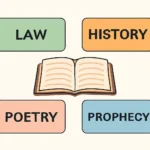
In Protestant Bibles, the 39 books are usually grouped into four broad categories: the Law, historical books, wisdom and poetry, and the prophets. These categories help you understand a book’s purpose, although they do not always describe its entire content.
The Law, or Pentateuch: Genesis, Exodus, Leviticus, Numbers, and Deuteronomy.
Historical books: Joshua through Esther.
Wisdom and poetry: Job through Song of Solomon.
Major prophets: Isaiah, Jeremiah, Lamentations, Ezekiel, and Daniel.
Minor prophets: Hosea through Malachi.
The word major refers mainly to length, not importance. The “Minor Prophets” are shorter prophetic books, while Isaiah and Jeremiah are called major because they are considerably longer. Every book contributes to the Old Testament’s larger message, even when its style and subject matter differ sharply from those around it.
The five books of Moses explain Israel’s beginnings and covenant
The first five Old Testament books are called the Pentateuch, a name meaning “five scrolls” or “five books.” Jewish tradition calls this collection the Torah, or instruction. Together, these books establish the foundations of creation, sin, worship, law, priesthood, and Israel’s national identity.
Genesis describes creation, the patriarchs, and God’s promises
Genesis begins with creation and traces the entrance of sin into the human story. It includes accounts of the flood, the tower of Babel, and the calling of Abraham. The second half follows Abraham’s family through Isaac, Jacob, and Joseph.
Several major promises begin in Genesis, including the promise of descendants, land, and blessing associated with Abraham. The book ends with Jacob’s family living in Egypt, setting the stage for the events of Exodus.
Exodus tells how God rescued Israel and formed a people
Exodus recounts Israel’s suffering in Egypt, Moses’ leadership, the plagues, and the departure commonly called the exodus. It also describes the covenant at Mount Sinai, including the Ten Commandments and many other laws for community life.
The second half focuses on the tabernacle, a portable sanctuary representing God’s presence among the people. Exodus therefore moves from deliverance to covenant responsibility: Israel is rescued from slavery and then called to live as a distinct people.
Leviticus explains worship, holiness, and community responsibilities
Leviticus gives instructions about sacrifices, priests, clean and unclean conditions, festivals, moral behavior, and the Day of Atonement. Its rituals can seem distant to modern readers, but they express a central idea: worship and daily conduct are connected.
The book repeatedly calls Israel to be holy because God is holy. Its laws address both the sanctuary and ordinary relationships, including treatment of the poor, workers, foreigners, and neighbors.
Numbers follows Israel through the wilderness
Numbers combines censuses, laws, travel accounts, rebellions, and stories of leadership. The title comes from the population counts near the beginning and end of the book, but the narrative centers on Israel’s repeated resistance to trusting God.
The wilderness years show the consequences of disobedience while also showing continued guidance and provision. Moses, Aaron, Miriam, Joshua, and Caleb all play important roles as the people move toward the promised land.
Deuteronomy renews the covenant before entry into the land
Deuteronomy presents Moses’ final speeches to Israel before the people cross the Jordan River. Much of the book restates earlier laws while applying them to life in the land rather than to life at Mount Sinai or in the wilderness.
Its central concern is the choice between faithful obedience and rebellion. Deuteronomy ends with Moses’ death and Joshua’s appointment, linking the Pentateuch to the historical books that follow.
Reading tip: Read the Pentateuch as one connected movement: creation, promise, rescue, covenant, wilderness testing, and preparation to enter the land.
The historical books trace Israel’s life in the land and monarchy
The historical books continue the story after Moses. They describe Israel’s entry into Canaan, the era of the judges, the rise and fall of the monarchy, the division of the kingdom, exile, and a limited return. They are not modern histories in the narrow sense; they interpret events through questions of faithfulness, justice, leadership, and covenant.
Joshua describes the conquest and division of Canaan
Joshua tells how Israel crossed the Jordan, took possession of parts of Canaan, and divided the land among the tribes. Joshua leads the people after Moses, and the book presents his leadership as an example of courage and obedience.
The conquest passages require careful reading because they involve ancient warfare, theological claims, and difficult ethical questions. The book’s narrative emphasizes that possession of the land is connected to God’s promise and Israel’s responsibility, not simply military strength.
Judges shows the instability of Israel without faithful leadership
Judges presents a recurring pattern: Israel turns away, suffers oppression, cries out, receives deliverance through a judge, and then falls away again. The judges include Deborah, Gideon, Jephthah, and Samson.
The book becomes progressively darker, illustrating the social and spiritual disorder that develops when every group follows its own desires. Its repeated pattern prepares readers for the later demand for a king.
Ruth tells a family story of loyalty and belonging
Ruth is a short narrative set during the time of the judges. Ruth, a Moabite widow, remains loyal to her Israelite mother-in-law, Naomi, and eventually marries Boaz.
The story highlights loyal love, family redemption, and the inclusion of an outsider within Israel’s story. Ruth becomes an ancestor of King David, giving the book importance beyond its intimate domestic plot.
First and Second Samuel follow Samuel, Saul, and David
First Samuel begins with Samuel’s birth and ministry, then follows the transition from the period of judges to the monarchy. Saul becomes Israel’s first king, while David emerges as a rival and future ruler.
Second Samuel focuses on David’s reign, including his military successes, covenant promise, serious moral failures, and family conflicts. Together, the books present David as both a gifted king and a deeply flawed human being.
First and Second Kings describe the divided kingdom and exile
First Kings opens with Solomon’s reign, the building of the temple, and the division of the kingdom into Israel in the north and Judah in the south. It includes the ministries of Elijah and other prophets.
Second Kings continues the accounts of the two kingdoms until the fall of Samaria and Jerusalem. Assyria conquers the northern kingdom, and Babylon later destroys Jerusalem and takes many people into exile. The books repeatedly evaluate kings according to their worship and justice.
First and Second Chronicles retell Israel’s history from a later perspective
First Chronicles begins with extensive genealogies and then retells the story of David. Its attention falls especially on worship, the Levites, the ark, and preparations for the temple.
Second Chronicles covers Solomon and the kings of Judah, ending with the destruction of Jerusalem and a decree allowing exiles to return. The books overlap with Samuel and Kings but emphasize the temple, priestly service, and the possibility of renewed faithfulness.
Ezra and Nehemiah describe restoration after exile
Ezra records the return of Jewish exiles, the rebuilding of the temple, and efforts to restore the community’s religious life. Ezra is presented as a teacher devoted to studying and practicing the law.
Nehemiah centers on the rebuilding of Jerusalem’s walls under Nehemiah’s leadership. It also describes social reforms, public reading of the law, and renewed commitments by the returned community.
Esther shows courage and providence in a foreign empire
Esther takes place in the Persian court. Esther becomes queen and, with the help of Mordecai, acts to prevent the destruction of the Jewish people planned by Haman.
The book is distinctive because the Hebrew version does not explicitly name God. Its events nevertheless invite readers to consider hidden providence, courage under pressure, political danger, and the preservation of a vulnerable community.
The wisdom and poetry books explore suffering, worship, and wise living
The wisdom and poetry books do not follow one continuous historical timeline. They address questions that arise in every generation: Why do innocent people suffer? How should you respond to joy and grief? What does a wise life look like? How can worship express fear, anger, trust, or praise?
Job wrestles with innocent suffering
Job tells of a righteous man who loses his children, wealth, and health. His friends insist that suffering must be proof of personal wrongdoing, but the book challenges that simple explanation.
Much of Job consists of poetry and debate. The book does not give a tidy formula explaining every tragedy. Instead, it questions human assumptions about justice, emphasizes the limits of human understanding, and portrays Job’s persistent engagement with God.
Psalms provides prayers and songs for many circumstances
Psalms is a collection of 150 poetic prayers and songs. Its subjects include praise, lament, thanksgiving, repentance, royal leadership, wisdom, pilgrimage, and confidence in God.
The Psalms give language to emotional experiences that are often difficult to express. Some celebrate God’s protection, while others ask urgent questions in the midst of danger. Their variety makes them useful for personal prayer, public worship, and reflection.
Proverbs teaches practical wisdom for everyday life
Proverbs gathers short sayings and longer teaching passages about speech, work, money, friendship, family, discipline, justice, and leadership. It frequently contrasts the wise person with the foolish person.
Proverbs generally describes how life works when people act with integrity, but its sayings should not be treated as mechanical guarantees. Other Old Testament books, especially Job and Ecclesiastes, show that faithful people can still experience hardship and uncertainty.
Ecclesiastes questions the value of achievement and pleasure
Ecclesiastes reflects on work, wealth, wisdom, pleasure, injustice, aging, and death. The speaker repeatedly observes that human accomplishments can seem temporary and difficult to control.
Rather than offering shallow optimism, the book confronts life’s unpredictability. It encourages humility about what people can understand and directs attention toward receiving ordinary gifts while living responsibly before God.
Song of Solomon celebrates love and desire
Song of Solomon, also called Song of Songs, is a collection of lyrical poems portraying romantic love between a woman and a man. Its imagery celebrates attraction, beauty, longing, commitment, and mutual delight.
Readers have interpreted the book both as poetry about human love and as a symbolic picture of divine-human or covenant love. Its direct literary subject is the tenderness and desire found in a committed relationship.
The major prophets address judgment, repentance, and future hope
The prophetic books speak into particular political and spiritual crises. Their messages often combine warning and promise: they confront idolatry, exploitation, violence, and false worship, while also announcing restoration, forgiveness, a renewed covenant, or a future ruler.
Isaiah combines judgment with a vision of restoration
Isaiah addresses Judah and other nations during periods of political threat. It condemns pride, injustice, empty religious practice, and dependence on foreign alliances instead of trust in God.
The book also contains strong visions of comfort and renewal, including the restoration of Jerusalem, the gathering of nations, and the arrival of a righteous servant and king. Christians frequently connect several passages in Isaiah with Jesus, while Jewish interpretation reads them within Israel’s prophetic and covenantal setting.
Jeremiah warns Judah before Jerusalem’s destruction
Jeremiah prophesies during the final years of Judah before Babylon destroys Jerusalem. He warns that political and religious reforms cannot replace genuine obedience and justice.
The book includes conflict between Jeremiah and other prophets, personal laments, symbolic actions, and promises of a new covenant. Its emotional honesty reveals the cost of delivering an unpopular message during national crisis.
Lamentations mourns Jerusalem’s destruction
Lamentations is a collection of poems grieving the fall of Jerusalem. The poems describe hunger, bereavement, exile, humiliation, and the devastation of the city and temple.
The book gives structured expression to grief rather than avoiding it. Alongside confession and sorrow, it contains moments of hope in God’s mercy, showing that faith can include honest mourning.
Ezekiel uses visions and symbols to address exiles
Ezekiel prophesies among Jewish exiles in Babylon. His dramatic visions include God’s glory, symbolic actions, judgment on Jerusalem, and the famous vision of dry bones.
The book explains why judgment has come while also promising a restored people, a cleansed heart, renewed life, and a future temple. Ezekiel’s imagery is vivid and sometimes difficult, so reading its historical setting helps clarify its symbols.
Daniel combines faithful resistance with apocalyptic visions
Daniel includes stories of Jewish faithfulness in foreign courts and visions concerning kingdoms, oppression, judgment, and God’s ultimate rule. Daniel and his companions remain committed to their worship while living under imperial power.
The first half is primarily narrative, while the second contains symbolic visions. These visions have inspired varied interpretations, so it is wise to distinguish the book’s central assurance—God rules over unjust empires—from speculative timelines.
The minor prophets deliver twelve shorter messages
The twelve Minor Prophets are traditionally collected as one scroll in the Hebrew Bible. Their books differ greatly in style, but they frequently address idolatry, injustice, covenant unfaithfulness, foreign oppression, and restoration.
Hosea: Uses a troubled marriage as a picture of Israel’s unfaithfulness and God’s persistent love.
Joel: Interprets a devastating locust plague and speaks of the day of the Lord and future spiritual renewal.
Amos: Condemns exploitation of the poor and insists that worship cannot substitute for justice.
Obadiah: Announces judgment against Edom for hostility toward Judah.
Jonah: Tells of a reluctant prophet sent to Nineveh and explores mercy toward an enemy city.
Micah: Denounces corruption while promising restoration and a ruler associated with Bethlehem.
Nahum: Announces the fall of Nineveh, the capital of Assyria.
Habakkuk: Questions why violence goes unpunished and learns to trust amid uncertainty.
Zephaniah: Warns of judgment while promising purification and restoration for a humble remnant.
Haggai: Encourages the returned exiles to rebuild the temple.
Zechariah: Uses visions and symbolic messages to encourage restoration and future hope.
Malachi: Challenges careless worship and prepares readers for renewed faithfulness.
These books are short, but they should not be treated as minor in significance. A single chapter in Amos or Micah can make a forceful claim about economic justice, worship, leadership, or hope. Reading them alongside the historical setting makes their urgency easier to recognize.
Why different Bibles contain different Old Testament books
Most Protestant Bibles list 39 Old Testament books. Catholic Bibles generally contain additional books known as the deuterocanonical books, including Tobit, Judith, Wisdom, Sirach, Baruch, and First and Second Maccabees, along with additional passages in Esther and Daniel.
Eastern Orthodox churches use a broader Old Testament collection, although the exact list can vary among Orthodox traditions. Their Bibles may include books such as First and Second Esdras, the Prayer of Manasseh, Psalm 151, and Third Maccabees, depending on the church and edition.
The Jewish Bible, or Tanakh, contains the same core material as the Protestant Old Testament but arranges it differently and counts it as 24 books. Several books that appear separately in Protestant Bibles are combined in the Tanakh, such as Samuel, Kings, Chronicles, Ezra-Nehemiah, and the twelve Minor Prophets.
Important distinction: The number and order of books can differ without changing the content of the shared Hebrew Bible collection. Always check which tradition and edition a reading plan is using.
Practical tips and common mistakes when reading the Old Testament
The Old Testament includes many literary forms, historical settings, and cultural practices. A careful reading method prevents common misunderstandings and helps you see how individual passages fit within each book’s purpose.
Do not read every passage as the same genre. Poetry uses imagery, law gives regulations, narrative tells a story, and prophecy often uses symbols and poetic warnings.
Read the surrounding chapters. A single verse can be misleading when separated from its speaker, audience, historical setting, or literary argument.
Do not assume every command applies directly to modern life. Sacrifices, food laws, land regulations, and kingship laws belong to Israel’s covenant setting and require theological interpretation.
Do not treat biblical characters as flawless heroes. Abraham, Moses, David, Solomon, and other major figures are shown with both faith and serious failures.
Distinguish description from approval. A narrative may report violence, deception, or injustice without presenting those actions as morally right.
Track repeated themes. Look for covenant, holiness, justice, exile, remnant, worship, wisdom, and hope as they develop across books.
Use cross-references carefully. Similar words or images do not always mean that two passages have identical meanings.
Read difficult sections with humility. Historical violence, prophetic judgment, and apparently conflicting accounts deserve patient study rather than quick conclusions.
Helpful reading plans for the Old Testament books
Reading the books in canonical order gives you the broad narrative from creation through the post-exilic period. That approach works well if you want to understand how the Pentateuch leads into Joshua, Judges, Samuel, Kings, exile, and return.
A thematic plan can make the material easier to absorb. You might read one book from each group at a time, pairing a historical book with a prophet who spoke during that period, or alternating narrative with poetry.
Start with Genesis and Exodus to establish creation, promise, rescue, and covenant.
Continue through Joshua, Judges, Ruth, Samuel, and Kings to follow Israel’s movement from settlement to monarchy and exile.
Add Psalms and Proverbs for prayer, worship, and practical wisdom alongside the historical narrative.
Read the prophets with their settings in mind. Isaiah, Jeremiah, and Ezekiel become clearer when connected to Assyrian, Babylonian, and exilic pressures.
Finish with Ezra, Nehemiah, Esther, and the post-exilic prophets to see how the community rebuilt its identity after displacement.
Short books such as Ruth, Jonah, Haggai, and Malachi can be read in one sitting. Longer books such as Isaiah, Jeremiah, Psalms, and Ezekiel are easier to understand when divided into manageable sections while keeping track of recurring themes.
How the Old Testament points beyond its own historical setting
The Old Testament does not present only a sequence of isolated stories. Its books build a developing picture of creation, covenant, human failure, judgment, mercy, and restoration. Israel’s kings fail to establish lasting justice, sacrifices do not eliminate every problem, and the people repeatedly need renewal.
Christian readers often interpret this pattern as preparing for the New Testament, especially through themes such as a coming king, a suffering servant, a new covenant, resurrection hope, and blessing for the nations. Jewish readers understand the same Scriptures within the continuing life of the Torah, prophets, wisdom, community, and expectation of redemption.
Both the historical distance and the theological importance of these books call for careful reading. Paying attention to genre, context, literary structure, and the Bible tradition you are using will help you understand not only what each Old Testament book says, but also why it remains significant.
Frequently asked questions
How many books are in the Old Testament?
Most Protestant Bibles contain 39 Old Testament books. Catholic Bibles include additional deuterocanonical books, and Eastern Orthodox Bibles generally contain an even broader collection, with some variation among churches. The Jewish Bible contains the same core material as the Protestant Old Testament but counts and arranges it as 24 books because several books are combined.
What is the easiest order for reading the Old Testament?
Reading from Genesis through Malachi follows the standard Protestant arrangement and gives you the broadest sense of the Bible’s storyline. You can also combine historical books with Psalms, Proverbs, and the prophets. For example, read Kings alongside the prophets who addressed Israel and Judah during the monarchy.
What is the difference between the Old Testament and the Hebrew Bible?
The Old Testament is the Christian name for the first major section of the Bible. The Hebrew Bible, or Tanakh, is the Jewish collection of these Scriptures, arranged into the Torah, Prophets, and Writings. The Protestant Old Testament has 39 books, while the Tanakh counts 24 because several books are grouped together.
Why are some Old Testament books difficult to understand?
They come from ancient societies and use several literary forms, including law, poetry, narrative, prophecy, genealogy, and apocalyptic vision. Cultural practices and political events may also be unfamiliar. Reading the surrounding chapters, identifying the genre, and using a reliable study Bible or historical background guide can clarify difficult passages.











Leave a Reply