Sections of the Bible: Books, Divisions, and Genres
Sections of the Bible: Books, Divisions, and Genres
The Bible is commonly divided into two major sections: the Old Testament and the New Testament. Within those sections, its books are grouped by purpose and literary style: law, history, wisdom, poetry, prophecy, Gospel, and letters.
In most Protestant Bibles, the 66 books are arranged into five broad Old Testament groups and four New Testament groups. Catholic and Orthodox Bibles follow the same overall story but include additional books or passages, so the exact number and order can vary by Christian tradition.
The Bible’s largest division is between the Old Testament and the New Testament. The word “testament” refers to a covenant, or a committed relationship established by God. The Old Testament describes God’s covenant dealings with Israel, while the New Testament centers on Jesus Christ and the covenant associated with him.
These two sections are connected rather than unrelated. The Old Testament provides the Bible’s creation story, account of Israel, laws, worship practices, wisdom, and prophetic hope. The New Testament presents Jesus as the fulfillment of many Old Testament themes and follows the growth of the early Christian church.
Old Testament: creation, Israel’s history, law, worship, wisdom, poetry, and prophetic messages.
New Testament: Jesus’ life and teaching, the church’s beginnings, Christian instruction, and future hope.
The division does not mean that the Old Testament is obsolete or that the New Testament can be understood without it. Names, places, promises, symbols, and quotations from the earlier Scriptures appear throughout the New Testament. Reading both sections together gives a fuller picture of the Bible’s central themes, including creation, sin, redemption, covenant, justice, mercy, and restoration.
A useful starting point: Think of the Bible as a library rather than a single type of book. Its sections contain different genres, authors, settings, and purposes, yet they form one broad story of God’s relationship with humanity.
The Old Testament sections and what they contain
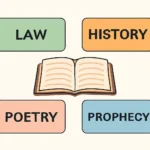
The Old Testament is arranged differently in Jewish, Protestant, Catholic, and Orthodox traditions, although much of the material overlaps. Protestant Bibles usually group its books into Law, History, Poetry and Wisdom, Major Prophets, and Minor Prophets. “Major” and “minor” refer mainly to the length of the prophetic books, not to their importance.
The Pentateuch or books of the Law
The first five books are called the Pentateuch, a Greek term meaning “five books.” They are also known as the Torah, especially in Jewish tradition, and are traditionally associated with Moses. These books establish many of the Bible’s foundational people, promises, laws, and stories.
Genesis: creation, the fall of humanity, the flood, the nations, and the families of Abraham, Isaac, Jacob, and Joseph.
Exodus: Israel’s escape from Egypt, the covenant at Sinai, the Ten Commandments, and the construction of the tabernacle.
Leviticus: sacrifices, priests, purity, holy living, festivals, and instructions for Israel’s worship.
Numbers: Israel’s wilderness journey, census records, rebellions, and preparation to enter the promised land.
Deuteronomy: Moses’ speeches reviewing the law and renewing the covenant before Israel enters Canaan.
The Law is not simply a collection of rules. It explains how Israel became a covenant people and how worship, community life, justice, and moral responsibility were meant to function. It also introduces recurring ideas such as holiness, sacrifice, obedience, forgiveness, and God’s presence.
The historical books
The historical books continue the story after Moses and describe Israel’s settlement, leaders, kings, division, exile, and partial restoration. They include both national history and theological reflection. The writers are concerned not only with what happened but also with how leaders and communities responded to God.
In Protestant Bibles, this section generally includes Joshua, Judges, Ruth, 1 and 2 Samuel, 1 and 2 Kings, 1 and 2 Chronicles, Ezra, Nehemiah, and Esther. Some traditions place additional books in this part of their Old Testament collection.
Joshua describes Israel’s entry into Canaan, while Judges presents a repeated pattern of rebellion, oppression, repentance, and deliverance. Ruth follows a Moabite woman whose loyalty and faithfulness connect her to Israel’s royal family. Samuel and Kings trace the rise of the monarchy, including the reigns of Saul, David, and Solomon, followed by the division of the kingdom and eventual exile.
Chronicles retells much of Israel’s royal history with particular attention to David, the temple, worship, and the southern kingdom. Ezra and Nehemiah describe efforts to rebuild the temple, Jerusalem’s walls, and the community after exile. Esther tells how Jewish people in Persia were preserved from destruction, even though the book does not use the word “God” in the same direct way as many other biblical books.
The poetry and wisdom books explore human experience through songs, prayers, observations, debates, and reflections. They address subjects that remain familiar: grief, friendship, injustice, work, love, aging, doubt, worship, and the search for meaning.
Job: suffering, human limits, and questions about God’s wisdom and justice.
Psalms: prayers and songs expressing praise, fear, anger, gratitude, confession, trust, and hope.
Proverbs: practical wisdom about speech, work, relationships, discipline, money, and character.
Ecclesiastes: reflections on life’s temporary nature, apparent contradictions, and the limits of human achievement.
Song of Solomon: poetic celebration of romantic love and desire.
These books should not all be read in the same way. Proverbs offers general wisdom rather than an unconditional promise that every good choice produces immediate success. Job uses extended speeches and dramatic dialogue to examine suffering, while Psalms include many different emotional voices. Poetry often communicates through images, parallel lines, metaphor, and exaggeration, so interpretation requires attention to literary form.
The Major and Minor Prophets
The prophetic books contain messages delivered by prophets to particular communities and historical situations. Prophets confronted idolatry, exploitation, corrupt leadership, empty worship, and unfaithfulness to the covenant. They also offered hope for restoration, justice, a renewed people, and God’s future rule.
The Major Prophets are Isaiah, Jeremiah, Lamentations, Ezekiel, and Daniel in the usual Protestant arrangement. Their books are longer or more extensive, though Daniel also contains narrative sections and symbolic visions. Isaiah includes warnings of judgment alongside powerful promises of comfort and restoration. Jeremiah addresses Judah’s unfaithfulness and the coming exile, while Ezekiel speaks to exiles and uses vivid symbolic actions and visions.
The Minor Prophets, also called the Twelve, are shorter books that range from a single chapter to several chapters. They include Hosea, Joel, Amos, Obadiah, Jonah, Micah, Nahum, Habakkuk, Zephaniah, Haggai, Zechariah, and Malachi.
These shorter books cover different settings and concerns. Amos condemns economic injustice and religious hypocrisy. Hosea uses the prophet’s troubled marriage as a sign of Israel’s unfaithfulness. Jonah focuses on resistance to God’s mercy toward an enemy city. Haggai and Zechariah encourage the rebuilding of the temple, while Malachi addresses careless worship and spiritual indifference.
The New Testament sections and their purposes
The New Testament contains 27 books in Protestant, Catholic, and most Orthodox Christian collections, although traditions can differ in the wider biblical canon. Its books were written in the first-century Mediterranean world and focus on Jesus Christ, the early church, Christian identity, and future hope.
The four Gospels
The first four New Testament books are Matthew, Mark, Luke, and John. They are called Gospels, a word associated with good news. Each presents the ministry, teaching, death, and resurrection of Jesus, but each Gospel has its own structure, emphasis, and audience.
Matthew: emphasizes Jesus as the promised Messiah and teacher, with frequent connections to Israel’s Scriptures.
Mark: presents a fast-moving account that highlights Jesus’ actions, authority, suffering, and call to discipleship.
Luke: stresses God’s mercy, concern for outsiders, the poor, women, sinners, and the work of the Holy Spirit.
John: uses distinctive imagery and extended conversations to emphasize Jesus’ identity and relationship with the Father.
The Gospels are not four unrelated biographies. They overlap in major events while selecting and arranging material in different ways. Comparing them can show both shared testimony and distinctive themes. Readers should also remember that the Gospels use ancient literary conventions; they are theological accounts of Jesus’ life, not modern biographies organized according to contemporary standards.
Each Gospel includes Jesus’ public ministry, teachings, conflicts, death, and resurrection, but the arrangement and detail differ. Matthew contains substantial teaching sections, including the Sermon on the Mount. Mark gives considerable attention to Jesus’ suffering and the cost of discipleship. Luke connects Jesus’ ministry to God’s saving purpose for all peoples, while John uses signs and symbolic language to invite belief.
Acts and the growth of the early church
The book of Acts continues the story begun in Luke’s Gospel. It describes the Holy Spirit’s work among Jesus’ followers, the church’s growth in Jerusalem, and the spread of the Christian message into wider parts of the Roman world. Peter receives significant attention in the early chapters, while Paul becomes the central figure in the later narrative.
Acts includes sermons, conflicts, conversions, arrests, travel, and decisions about how Jewish and non-Jewish believers should live together. The book shows a community wrestling with practical questions such as shared resources, leadership, persecution, cultural differences, and the meaning of inclusion.
Acts is both history and theology. It does not present every event in the early church or give a complete organizational manual for modern congregations. Instead, it shows how the gospel moved across social and geographic boundaries through the witness of ordinary believers, apostles, and church communities.
The letters, or epistles, make up most of the New Testament. They address real communities and individuals facing specific questions about belief, worship, ethics, leadership, suffering, division, and hope. Reading a letter well means paying attention to its original audience and the problem or circumstance behind each section.
Paul’s letters include Romans, 1 and 2 Corinthians, Galatians, Ephesians, Philippians, Colossians, 1 and 2 Thessalonians, 1 and 2 Timothy, Titus, and Philemon. Some Christian traditions also discuss Hebrews alongside Paul’s letters, but its author is not identified in the text. The remaining letters are commonly called the General Epistles: James, 1 and 2 Peter, 1, 2, and 3 John, and Jude.
Romans explains the universal problem of sin and the significance of faith, grace, and new life. Corinthians addresses division, sexuality, worship, spiritual gifts, resurrection, and community relationships. Galatians argues that belonging to God’s people is not established by adopting the complete boundary markers of the Mosaic law.
Letters such as Philippians and 1 Thessalonians encourage communities facing pressure and uncertainty. Pastoral letters offer guidance about teaching, leadership, and conduct. James emphasizes practical obedience, care for the vulnerable, and disciplined speech. Peter’s letters speak to suffering and faithful conduct, while John’s letters emphasize truth, love, obedience, and confidence in Christian belief.
Revelation and apocalyptic literature
Revelation is the final book of the New Testament and uses visions, symbols, numbers, angels, beasts, heavenly worship, and dramatic contrasts. It is addressed to churches in Asia Minor and offers encouragement to believers facing pressure to compromise their loyalty to God.
Revelation belongs to a literary category often called apocalyptic literature. This style uses vivid symbolic scenes to reveal spiritual realities and God’s ultimate judgment. Its imagery should not automatically be treated as a coded newspaper or a simple timeline of modern events.
The book’s major movement is from conflict and judgment toward the defeat of evil, the vindication of the faithful, and renewed creation. Because interpretations differ widely, readers should consider the book’s original setting, repeated symbols, connections to the Old Testament prophets, and message of perseverance before applying it to current events.
How the Bible’s genres shape the way you read
Knowing the sections of the Bible is helpful, but recognizing its literary genres is just as important. A historical narrative, a psalm, a proverb, a prophetic vision, and a letter communicate truth in different ways. The genre affects what details deserve emphasis and how a passage should be interpreted.
Narrative: follows people and events, often showing both faithful and unfaithful behavior without approving everything it describes.
Law: gives covenant instructions for Israel’s worship, community life, justice, and identity.
Poetry: uses rhythm, imagery, repetition, and emotional expression rather than plain prose alone.
Wisdom: reflects on how to live well, often through observations and memorable sayings.
Prophecy: confronts present sin while announcing judgment, hope, or future restoration.
Gospel: presents the significance of Jesus through selected accounts of his words and actions.
Epistle: applies Christian teaching to particular churches, leaders, and personal situations.
Apocalyptic: uses symbolic visions to reveal divine judgment, spiritual conflict, and ultimate hope.
A common mistake is to treat every sentence as though it were a proverb, command, historical report, or direct promise. For example, a character’s speech in Job may express a limited or mistaken viewpoint, and a dramatic prophetic image may communicate theological meaning without functioning as a literal description.
Context works at several levels. Read the surrounding paragraph, identify the speaker and audience, notice the larger book’s purpose, and ask how the passage connects to the Bible section where it appears. A verse about Israel’s kings, a prayer from the Psalms, and an instruction to a first-century church should not be interpreted as though they arose from identical circumstances.
Reading tip: Start with the passage’s genre and context before asking how it applies to you. Application becomes more responsible when it grows from what the text was communicating to its first readers.
Different Bible traditions and their book arrangements
The number and order of biblical books depend partly on Christian and Jewish tradition. Protestant Bibles generally contain 66 books: 39 in the Old Testament and 27 in the New Testament. Catholic Bibles include additional Old Testament books, commonly called the Deuterocanonical books, while Orthodox traditions may include a somewhat different collection.
These differences are not usually about the New Testament. They mainly concern books and passages connected with the period between the Old Testament and the New Testament or with the wider Greek Jewish Scriptures. Examples found in Catholic Bibles include Tobit, Judith, Wisdom, Sirach, Baruch, and 1 and 2 Maccabees, along with additional passages in Esther and Daniel.
Jewish Bibles contain the same broad body of Hebrew Scriptures as Protestant Old Testaments but arrange and count the books differently. The traditional Jewish arrangement is often described through three divisions: Torah, Prophets, and Writings. The order changes the shape of the collection without creating a different set of core narratives and teachings in the overlapping books.
Book titles can also vary. The books known as 1 and 2 Samuel and 1 and 2 Kings in many English Bibles have different naming and grouping traditions in the Greek Old Testament and some other Christian arrangements. These differences are useful to understand when comparing study Bibles, commentaries, or quotations from different communities.
For everyday reading, you do not need to memorize every canon difference before opening the Bible. It is enough to identify which tradition a particular edition follows and to use its table of contents. A study Bible can explain unfamiliar names, historical settings, cross-references, and alternative arrangements.
A practical order for reading the Bible’s sections
The Bible does not have to be read from the first page to the last page in one uninterrupted sequence. Genesis through Revelation is a meaningful order, but a first-time reader may understand the larger story more easily by beginning with a Gospel and then moving among related sections.
Begin with Luke or Mark to encounter Jesus’ ministry, teaching, death, and resurrection in a continuous narrative.
Read Acts to see how the early Christian movement developed after Jesus’ resurrection and ascension.
Read Genesis and Exodus for creation, the patriarchs, Israel’s liberation, covenant, and worship.
Use selected Psalms and Proverbs for prayer, emotional honesty, and practical wisdom.
Return to the letters to understand how early Christian communities applied the message about Jesus.
Read the prophets with historical context, especially alongside the Kings and Chronicles narratives when possible.
Another useful approach is to read one book at a time rather than jumping between isolated verses. Before beginning, note the book’s apparent audience, repeated words, major characters, and changes in setting. After each chapter, write down one claim the passage makes, one question it raises, and one connection to the surrounding book.
Cross-references can reveal important links, but they can also encourage disconnected reading if every verse is treated as a standalone quotation. Read the entire paragraph first, then the chapter, and then consult references. This method helps preserve the author’s argument and reduces the risk of using a familiar line to mean something unrelated to its original setting.
If the Bible feels difficult, choose a reliable modern translation and read a manageable portion consistently. A Bible dictionary, historical background guide, or reputable study note can clarify unfamiliar places and customs. You can also compare translations, keeping in mind that wording differs because translators make choices about ancient languages, grammar, and style.
The sections of the Bible are best understood as connected parts of a large library. The Law establishes foundational covenant themes, history shows those themes unfolding among real communities, wisdom gives language for ordinary life, prophecy challenges injustice and points toward hope, and the New Testament centers that story on Jesus and the church. Reading each section according to its purpose makes the whole collection clearer and more coherent.
Frequently asked questions
How many sections are in the Bible?
The Bible has two major sections, the Old Testament and the New Testament. In a common Protestant outline, the Old Testament is further grouped as Law, History, Poetry and Wisdom, Major Prophets, and Minor Prophets. The New Testament is grouped as the Gospels, Acts, the letters, and Revelation. The exact number of books varies among Christian traditions.
What is the best section of the Bible to read first?
Many readers begin with one of the Gospels, such as Mark or Luke, because these books present Jesus’ life and teaching in a connected narrative. Acts can follow the Gospels, and Genesis provides essential background for creation, covenant, Israel, and the Bible’s major themes. Your purpose matters, so Psalms may be a better starting point for prayer and reflection.
What is the difference between the Old Testament and the New Testament?
The Old Testament contains Israel’s Scriptures, including its law, history, poetry, wisdom, and prophetic writings. The New Testament focuses on Jesus Christ, the early Christian church, Christian teaching, and future hope. Christians understand the New Testament as connected to and fulfilling many themes in the Old Testament, rather than replacing its importance as biblical Scripture.
Why do some Bibles have different numbers of books?
Jewish, Protestant, Catholic, and Orthodox traditions developed different collections and arrangements of biblical books. Protestant Bibles usually contain 66 books, while Catholic and Orthodox Bibles include additional Old Testament books or passages. The New Testament collection is generally shared, but the Old Testament canon and the order of books can differ between traditions.











Leave a Reply