Canonical books of the Bible: A clear list and guide
Canonical books of the Bible: A clear list and guide
If you have ever wondered why one Bible contains more books than another, the short answer is that Christian traditions recognize different biblical canons. A canon is the collection of writings a religious community accepts as authoritative Scripture. The differences are concentrated in the Old Testament; the New Testament contains the same 27 books across the major Christian traditions.
The most commonly encountered Protestant Bible has 66 books: 39 in the Old Testament and 27 in the New Testament. Catholic Bibles generally have 73 books, while Eastern Orthodox Bibles may include several additional books, with the exact collection varying among churches. The Jewish Bible, called the Tanakh, contains the same basic writings as the Protestant Old Testament but arranges and counts them differently.
The word canonical comes from a term meaning a rule, standard, or measuring line. When Christians call a book canonical, they mean that the book belongs to the recognized body of Scripture used for faith, worship, teaching, and doctrine. Canon does not simply mean “an old religious book” or “a book that contains useful wisdom.”
Many ancient Jewish and Christian writings survive outside the Bible. Some are historically valuable, some are devotional, and some influenced later religious thought. A book may be respected without being part of a community’s biblical canon. That distinction explains why the Bible is not simply a collection of every ancient text connected with Israel or the early church.
The word Scripture is also used in more than one way. In Christian usage, “Scripture” usually refers to the canonical books. In a historical discussion, however, scholars may describe a writing as scriptural, influential, or treated as authoritative by a particular group without claiming that all churches place it in the same canon.
The basic answer: The Protestant Bible has 66 books, the Catholic Bible usually has 73, and Orthodox collections can be larger. These differences concern the Old Testament or its related writings, not the 27-book New Testament.
Canon formation was not decided by one single meeting that instantly produced an agreed list for every community. Jewish and Christian communities gradually recognized authoritative writings over time. Their decisions were shaped by factors such as connection to prophets or apostles, consistency with received teaching, widespread use in worship, and acceptance across important communities.
The 66 books in the Protestant Bible
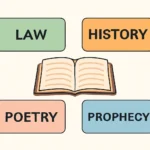
Most Protestant Bibles contain 39 Old Testament books and 27 New Testament books. The Old Testament is often grouped as Law, History, Poetry and Wisdom, and Prophets. The New Testament is commonly arranged as Gospels, Acts, Letters, and Revelation.
The 39 Old Testament books
The first five books are known as the Pentateuch, or the Law. They describe creation, the ancestors of Israel, the exodus from Egypt, the covenant at Sinai, Israel’s wilderness years, and the laws associated with Moses.
Genesis
Exodus
Leviticus
Numbers
Deuteronomy
The historical books continue Israel’s story from the conquest of Canaan through the monarchy, exile, and partial restoration. They include accounts of leaders, kings, wars, national failure, and God’s continuing relationship with Israel.
Joshua
Judges
Ruth
1 Samuel
2 Samuel
1 Kings
2 Kings
1 Chronicles
2 Chronicles
Ezra
Nehemiah
Esther
The poetry and wisdom books address suffering, worship, love, justice, practical conduct, and the search for meaning. Their forms range from songs and prayers to proverbs, philosophical reflection, and dramatic poetry.
Job
Psalms
Proverbs
Ecclesiastes
Song of Solomon, also called Song of Songs
The prophetic books are divided into the Major Prophets and the Minor Prophets. “Major” and “minor” refer mainly to length, not importance. These books call Israel and Judah to faithfulness, confront injustice and idolatry, and speak about judgment, restoration, and future hope.
The New Testament opens with the four Gospels. Matthew, Mark, Luke, and John present the life, teaching, death, and resurrection of Jesus from distinct perspectives. They are not four unrelated biographies; together they form the central narrative about Jesus Christ in Christian Scripture.
Matthew
Mark
Luke
John
Acts continues the story after Jesus’ resurrection. It describes the work of the apostles, the growth of the early Christian movement, the role of the Holy Spirit, and the expansion of the church from Jerusalem toward the wider Roman world. Acts is closely connected to Luke in style and narrative.
The New Testament Letters address churches, leaders, and individual believers. Paul is traditionally associated with 13 letters, from Romans through Philemon. Hebrews does not identify its author within the text, and its authorship has been debated since antiquity. The remaining letters are commonly called the General, or Catholic, Epistles because most address wider Christian audiences rather than one congregation.
Romans
1 Corinthians
2 Corinthians
Galatians
Ephesians
Philippians
Colossians
1 Thessalonians
2 Thessalonians
1 Timothy
2 Timothy
Titus
Philemon
Hebrews
James
1 Peter
2 Peter
1 John
2 John
3 John
Jude
The final book is Revelation, also called the Apocalypse. Through visions, symbols, letters to seven churches, and scenes of judgment and renewal, it presents a theological vision of God’s ultimate victory. Its highly symbolic style means that readers should interpret its imagery carefully rather than treating every image as a straightforward prediction.
How Catholic and Orthodox Bibles differ
The Catholic Old Testament includes the seven books commonly called the Deuterocanonical books: Tobit, Judith, Wisdom, Sirach, Baruch, 1 Maccabees, and 2 Maccabees. Catholic editions also include additional sections in Esther and Daniel. Counting these writings and sections, Catholic Bibles generally contain 46 Old Testament books and 27 New Testament books.
Tobit
Judith
Wisdom, also called the Wisdom of Solomon
Sirach, also called Ecclesiasticus
Baruch
1 Maccabees
2 Maccabees
“Deuterocanonical” means “belonging to a second canon” or “later recognized canon.” Catholics use this term for these books to distinguish them from the protocanonical books, not to suggest that they are unimportant. Protestant writers often call the same works the Apocrypha, a term that can carry different meanings depending on the tradition and historical context.
The Catholic additions to Esther and Daniel are substantial sections rather than merely a few isolated sentences. They include material such as prayers, stories, and expansions of existing narratives. As a result, a Catholic Bible may have different chapter or verse arrangements from a Protestant Bible in these books.
Eastern Orthodox churches generally accept the same 27 New Testament books but may recognize a broader Old Testament collection than Catholics or Protestants. Depending on the church, editions may include 1 Esdras, 3 Maccabees, Psalm 151, the Prayer of Manasseh, and sometimes other writings. The exact list is not identical across all Orthodox jurisdictions.
Some Orthodox Bibles include 2 Esdras, also known in some traditions as 4 Ezra, and a book called 4 Maccabees may appear as an appendix or in a secondary position. These variations make it inaccurate to give one universal “Orthodox Bible” book count. The safest approach is to identify the specific church or edition being discussed.
Why the counts differ: Books can be counted differently when one tradition treats a work as a single book and another divides it into two. The number on the cover matters less than the edition’s table of contents and the tradition that produced it.
Why the same biblical books have different arrangements
The Protestant Old Testament follows the traditional order found in many Christian Bibles, beginning with Genesis and ending with Malachi. The Jewish Tanakh contains the same basic books but places them into three divisions: Torah, Nevi’im, and Ketuvim, meaning Law, Prophets, and Writings.
The Tanakh is often said to contain 24 books, while Protestant Bibles count 39 Old Testament books. The difference comes mainly from grouping. The twelve Minor Prophets are counted as one book, Samuel is one book, Kings is one book, Chronicles is one book, and Ezra–Nehemiah is one book in the Jewish arrangement.
For example, the Protestant books of 1 Samuel and 2 Samuel are treated as one work in the Tanakh. The same applies to 1 and 2 Kings, 1 and 2 Chronicles, and often Ezra and Nehemiah. The content is not simply missing; the organization and counting system are different.
The order also affects how readers perceive the biblical story. The Christian Old Testament ends with the Minor Prophets, especially Malachi in most Protestant editions. The Tanakh ends with Chronicles. These endings create different literary connections and reflect the distinctive arrangement of each tradition.
The term Old Testament is Christian language for the first major section of the Christian Bible. Jews generally use Tanakh or Hebrew Bible instead, although “Hebrew Bible” can also be used in academic settings. The word “Old” should not automatically be treated as meaning obsolete; Christians use it as part of a relationship between the biblical covenants and the New Testament.
Another source of confusion is the Septuagint, an ancient Greek translation and collection of Jewish Scriptures. Early Christians frequently used Greek Scripture, and the Septuagint tradition includes books or passages that do not appear in the later Jewish canon or in Protestant Bibles. Catholic and Orthodox traditions retain more of these writings than most Protestant traditions.
How the biblical canon developed
The Bible’s books were written over many centuries by different authors and communities. The Old Testament writings emerged from Israel’s history and worship, while the New Testament writings arose from the first generations of the Christian movement. Recognition of these writings developed through use, transmission, teaching, and communal discernment.
For the Old Testament, the process involved the preservation of Israel’s sacred traditions, the use of texts in worship, and the recognition of writings associated with the Law, the Prophets, and the Writings. The exact history is complex, and modern scholars do not reduce it to one date or one event. Different Jewish communities also preserved and organized texts in somewhat different ways.
The New Testament canon took shape as churches circulated apostolic letters and read Gospel accounts in worship. By the early centuries of Christianity, many communities already treated a core group of writings as authoritative. Questions remained about a smaller number of books, including Hebrews, James, 2 Peter, 2 and 3 John, Jude, and Revelation.
Several tests influenced recognition of New Testament books:
Apostolic connection: a book was linked directly to an apostle or to the apostolic generation.
Consistency with received faith: its teaching fit the churches’ inherited understanding of God, Jesus, salvation, and Christian life.
Widespread use: churches in different regions read the book publicly and treated it as authoritative.
Historical credibility: the writing was regarded as connected to the earliest Christian witnesses rather than a much later invention.
These criteria were not always applied in a mechanical or uniform way. A book could be widely accepted in one region and questioned in another. Some writings were valuable and respected but ultimately were not included in the New Testament canon, while others took time to gain broad recognition.
Lists matching the present 27-book New Testament appear in late fourth-century Christian sources, but those lists document a process rather than proving that a single meeting created the canon from nothing. Church councils and influential leaders helped confirm boundaries that many communities had already been using.
The Reformation brought renewed disagreement about the Old Testament books included in Catholic Bibles. Protestant churches generally received the shorter Hebrew-based collection for the Old Testament and placed other ancient Jewish writings in a separate section called the Apocrypha, or did not print them at all. Catholic authorities formally reaffirmed their broader collection in the sixteenth century.
Canon and authorship are related but not identical questions. A canonical book can have disputed authorship, as with Hebrews, while a writing associated with a respected figure may still be outside the canon. The central question is not only who wrote a text, but whether a faith community recognizes it as Scripture.
How to use a Bible’s canon when reading or studying
Start by checking the table of contents rather than assuming every Bible has the same list. Look for the edition’s tradition, publisher, and translation notes. A Catholic, Protestant, Greek Orthodox, or study Bible may label additional books differently and place them in different sections.
If you are comparing a passage across editions, check the book name, chapter, and verse carefully. A passage may have a different location because of variations in chapter divisions, or a book may appear under another name. Examples include Sirach and Ecclesiasticus, Song of Solomon and Song of Songs, and 1 Esdras and related Ezra traditions.
A sensible reading plan depends on your purpose. Someone learning the central Christian narrative may begin with a Gospel, then read Acts and selected letters. Someone studying Israel’s story may start with Genesis and Exodus before moving through Joshua, Judges, Samuel, Kings, and the Prophets.
Identify your Bible’s tradition and note which books it includes.
Read each book in its literary setting, paying attention to genre and historical context.
Use cross-references carefully, since similar names and numbering can vary among editions.
Compare translations or study notes when a passage is difficult or has significant textual differences.
Respect the tradition behind the edition instead of treating one arrangement as the only possible Christian format.
Genre matters as much as canon. Poetry should not be read exactly like narrative, wisdom sayings are not all unconditional promises, and apocalyptic visions use symbols in distinctive ways. Understanding what kind of book you are reading helps you interpret its message more responsibly.
For Christians, the two Testaments are read as related parts of a larger story, but they should not be flattened into one undifferentiated text. The Law, historical narratives, wisdom books, prophetic writings, Gospels, letters, and Revelation each make their own contribution. Their different voices are part of the Bible’s structure.
When a church or study group disagrees about the canon, begin by identifying the actual difference. Often the dispute concerns whether a small group of Old Testament books is called deuterocanonical, Apocrypha, or Scripture. Clarifying the terminology can prevent an argument that is really about labels rather than the texts themselves.
The most useful practical rule is simple: read the edition you have on its own terms, learn which tradition it represents, and consult a reliable study resource when comparing it with another Bible. The canonical books are not defined only by their position in a printed volume; they belong to living traditions that have preserved, read, and interpreted them across generations.
Frequently asked questions
How many books are in the Bible?
The number depends on the Christian tradition. Protestant Bibles usually contain 66 books, Catholic Bibles generally contain 73, and Eastern Orthodox editions may contain additional books beyond the Catholic collection. All major Christian traditions recognize the same 27 New Testament books. Differences mainly involve the Old Testament and how certain works are grouped or counted.
Which books are not included in most Protestant Bibles?
Most Protestant Bibles do not include Tobit, Judith, Wisdom, Sirach, Baruch, 1 Maccabees, or 2 Maccabees as canonical books. They also omit the expanded sections of Esther and Daniel found in Catholic editions. These writings may appear in a separate Apocrypha section in some Protestant Bibles.
Are the Apocrypha and Deuterocanonical books the same?
They largely refer to the same group of ancient Jewish writings, but the terms reflect different traditions. Catholics usually call them Deuterocanonical books and include them in the Old Testament. Protestants commonly use Apocrypha and generally place them outside the canon, although some editions print them for historical or devotional reading.
Does the Jewish Bible have fewer books than the Christian Old Testament?
The Jewish Tanakh is commonly counted as 24 books, while the Protestant Old Testament has 39. The difference mainly comes from grouping: the Minor Prophets count as one book, and books such as Samuel, Kings, Chronicles, and Ezra–Nehemiah are combined. The underlying collection is largely the same as the Protestant Old Testament.











Leave a Reply