An easy to read Catholic Bible uses familiar vocabulary, clear sentence structure, and helpful page design without removing the depth of Scripture. Readability is not the same as making the Bible childish or shallow. A good translation explains ancient ideas in natural English while preserving the meaning, imagery, and seriousness of the original texts.
A Catholic Bible also needs the complete Catholic canon: 73 books, including the seven deuterocanonical books. These are Tobit, Judith, 1 and 2 Maccabees, Wisdom, Sirach, and Baruch, along with additions to Esther and Daniel. Some popular Protestant editions contain 66 books instead, so checking the table of contents matters before you buy.
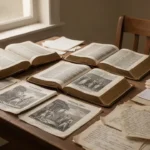
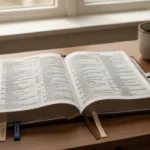
Readability depends on more than translation. Large type, comfortable spacing, section headings, maps, footnotes, and introductions can make a major difference. A translation that feels accessible in a study Bible may be tiring in a small, densely printed pocket edition.
Quick check: Look for a Catholic edition that includes all 73 books and has Catholic approval or publication information from a recognized Catholic publisher. Then compare a few sample pages before choosing.
Popular easy to read Catholic Bible translations
Several Catholic translations can work well for readers who want straightforward English. They differ in vocabulary, sentence rhythm, closeness to the original wording, and the amount of explanation supplied in the notes.
Good News Translation Catholic Edition
The Good News Translation Catholic Edition, sometimes called the Good News Bible Catholic Edition, is known for simple, direct English. Its short sentences and everyday vocabulary can help new readers follow stories, conversations, and major themes without stopping to decode older expressions.
This edition is often a strong choice for first-time Bible readers, English-language learners, and devotional reading. Its style is more meaning-focused than word-for-word, so readers who want detailed study may prefer a translation with fuller scholarly notes or a more formal wording.
New American Bible Revised Edition
The New American Bible Revised Edition, commonly called the NABRE, is a Catholic translation widely used in the United States. It offers readable modern English while retaining a more formal tone than some highly simplified versions. The extensive introductions and notes can help explain historical background, literary structure, and difficult passages.
The NABRE works well if you want one Bible for reading and study. Some passages may feel more demanding than those in the Good News Translation, but the notes can provide valuable context. A larger-print or reader-friendly NABRE edition may be easier to use than a compact standard edition.
New Revised Standard Version, Catholic Edition
The New Revised Standard Version, Catholic Edition, or NRSV-CE, is respected for its careful scholarship and broad usefulness in Catholic study settings. Its English is modern, but it is not always the simplest option for a young reader or someone encountering the Bible for the first time.
Choose the NRSV-CE when you want clear but relatively formal language, strong study resources, and a translation often used in academic or ecumenical contexts. If you find some sentences difficult, a guided edition with introductions and notes can make the text much more approachable.
New Jerusalem Bible
The New Jerusalem Bible has a literary style and distinctive vocabulary. Many readers appreciate its poetic sound, especially in the Psalms and prophetic books. It can be engaging for sustained reading, although certain word choices and sentence patterns may feel less conversational than those in simpler translations.
This translation suits readers who want readable prose with a literary character. It may not be the first choice for someone seeking the plainest possible English, but its introductions and notes can support readers who want to understand the Bible as both sacred Scripture and significant literature.
Revised Standard Version, Catholic Edition
The Revised Standard Version, Catholic Edition, or RSV-CE, uses dignified traditional English. It is valued by many Catholics for its careful wording and formal style, but it may not feel easy to read if you are unfamiliar with older biblical vocabulary or long sentence patterns.
The RSV-CE can be a good choice when liturgical or traditional language matters to you. For casual daily reading, however, a more contemporary translation may reduce distractions and help you understand the passage more quickly.
How to choose an easy to read Catholic Bible step by step
You do not need to choose a Bible simply because it is popular or attractive. A practical comparison will help you find an edition that matches your purpose, reading level, and preferred format.
Confirm the Catholic contents. Check that the table of contents includes the deuterocanonical books and that the edition identifies itself as Catholic.
Decide why you want the Bible. Daily prayer, beginner reading, family use, serious study, parish preparation, and group discussion may call for different editions.
Read the same passage in several translations. Compare a narrative passage, a Psalm, a Gospel teaching, and one of Paul’s letters. Notice which wording you understand naturally.
Inspect the notes and introductions. Look for explanations that clarify people, places, customs, literary forms, and challenging passages without overwhelming the page.
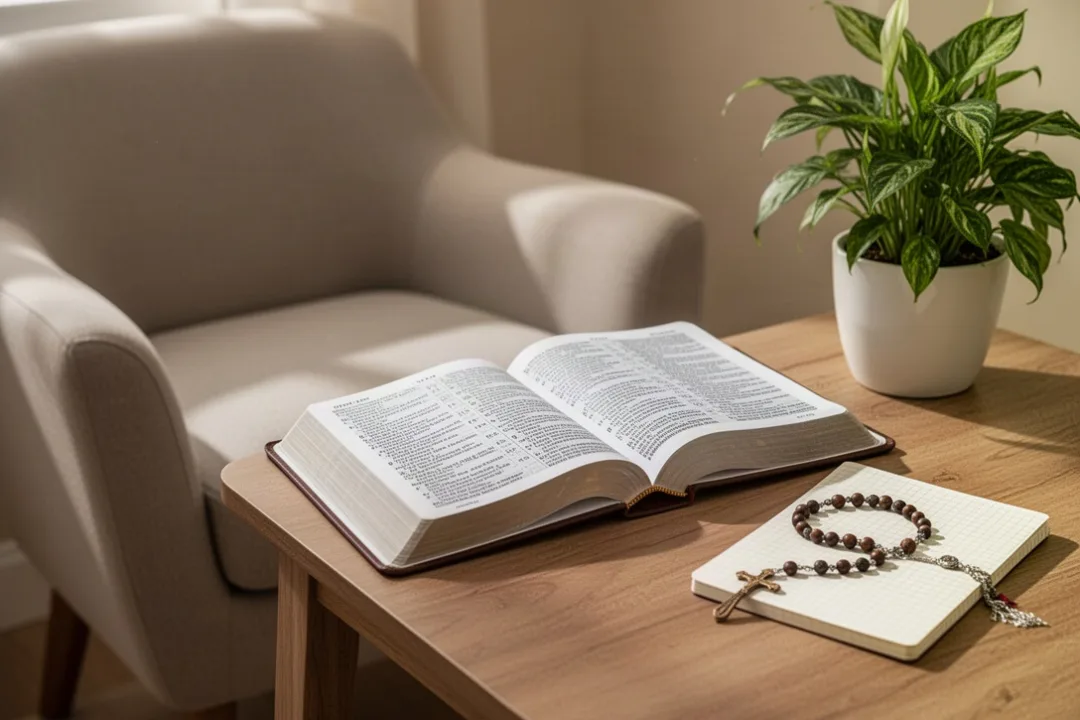
Check the physical design. Examine font size, line spacing, paper quality, binding, page weight, and whether the book lies open comfortably.
Choose a format you will actually use. A large-print Bible may be best at home, while a lightweight edition or approved app may work better for travel.
Ask whether the edition has Catholic approval information. Look for publication details such as an imprimatur or other statements supplied by the publisher, while remembering that approval does not guarantee that every reader will find the style easy.
When comparing translations, do not judge from one familiar verse alone. A passage may sound natural because you already know it, while another translation may be clearer when you read an unfamiliar chapter. Read several paragraphs in context instead of comparing isolated lines.
Which Catholic Bible is best for beginners?
For many beginners, a Good News Catholic Edition offers the least intimidating starting point because its vocabulary and sentence structure are especially direct. A Catholic Bible with clear headings, brief introductions, and a manageable page layout can be even more helpful than a translation chosen only for its reputation.
The NABRE is another strong beginning choice if you want to grow into more detailed study. Its notes can answer questions as they arise, and its modern English avoids much of the difficulty found in older translations. You may need to read more slowly in some sections, but the extra explanation can make the reading experience richer.
A beginner’s Bible should not hide difficult subjects. Scripture includes violence, grief, complicated family relationships, political conflict, and passages that require historical context. Good notes acknowledge those challenges and help you read responsibly instead of presenting every passage as immediately simple.
For the simplest everyday wording: consider the Good News Translation Catholic Edition.
For readable text with extensive notes: consider the NABRE.
For formal modern English and serious study: consider the NRSV-CE.
For literary language and traditional Catholic use: consider the New Jerusalem Bible or RSV-CE.
These are general tendencies, not fixed rules. One reader may find the NABRE natural while another prefers the NRSV-CE. Your best choice is the edition that lets you follow the passage, understand its setting, and continue reading without constant frustration.
How Catholic Bible approval differs from readability
Catholic approval and reading ease answer different questions. Approval concerns whether an edition is suitable for Catholic use according to the Church’s standards. Readability concerns how comfortably you understand the English, how the pages are arranged, and whether the explanatory material fits your needs.
Terms such as imprimatur and nihil obstat may appear in Catholic publications. Their presence provides useful information about ecclesial review, but they do not mean the translation will be the simplest one available. They also do not eliminate the need to consider the edition’s notes, format, and intended audience.
Be cautious with products described only as “Catholic-inspired” or “Catholic-friendly.” Some may be prayer books, paraphrases, or study resources rather than complete Catholic Bibles. Check the publisher’s description and contents page before purchasing, especially when shopping online.
Do not confuse an easy-reading paraphrase with a full Bible translation. A paraphrase can be useful for reflection, but it should not replace a complete Catholic edition when you need the biblical text itself or want to compare passages carefully.
Why the page design matters as much as the translation
Many readers blame themselves when a Bible feels difficult, but the physical edition may be the real problem. Tiny type, narrow margins, thin paper, and crowded notes can make even clear English tiring to read. A larger volume with generous spacing may improve comprehension because your attention stays on the passage.
Look for headings that divide long books into meaningful sections. Headings should guide you without replacing your own reading of the passage. Footnotes are useful when they explain a place name, manuscript difference, cultural practice, or cross-reference, but too many notes can interrupt a beginner’s flow.
Consider whether you prefer a single-column or two-column layout. Single-column pages often feel more like ordinary reading and may help you follow narrative passages. Two-column pages are usually more compact and familiar, but they can make the text feel denser.
Choose large print if you experience eye strain or plan to read for longer periods.
Choose a single-column layout if continuous reading helps you follow the story.
Choose wide margins if you like to write questions or observations.
Choose a durable binding if the Bible will travel in a bag or be used by a family.
Choose a lightweight edition if portability will determine whether you carry it regularly.
Choose ribbon markers or sewn binding if you often return to several books during prayer or study.
If possible, visit a Catholic bookstore or library and hold several editions. Read one page standing and one page seated, because glare and hand fatigue may become more obvious after a few minutes. An online preview can help, but it rarely shows the full experience of the binding and paper.
How study notes help you understand difficult passages
Easy English does not answer every question. The Bible was written across different periods, cultures, and literary forms, so a short note about historical setting or genre may be more useful than a simpler synonym. A note can explain that a poem uses imagery, that a genealogy serves a purpose, or that a passage reflects an ancient custom.
Look for introductions to each book that identify its major themes, structure, and setting. For beginners, brief explanations are often easier to use than pages of academic discussion. More advanced readers may prefer extensive notes that discuss translation choices, historical questions, and connections among books.
Cross-references can also improve comprehension. They show where a Gospel echoes an earlier biblical passage or where a New Testament writer uses an image from the Hebrew Scriptures. Use cross-references as invitations to explore, not as instructions to chase every reference during your first reading.
Study notes are not a substitute for the Bible’s own wording. Read the passage first, then consult the notes when something is unclear. This habit helps you distinguish the biblical text from editorial explanation and gives you space to notice what the passage says before interpreting it.
Choosing between a print Catholic Bible and a digital edition
A digital Bible can be an excellent option when you want adjustable font size, search tools, audio reading, bookmarks, and several translations in one place. It may be especially useful for readers with vision difficulties or for people who travel frequently. Use a Catholic app or website that clearly identifies the edition and provides the full Catholic canon.
Print has advantages that a screen may not provide. A physical Bible makes it easier to remember where a passage appears on the page, write personal notes, and read without notifications. Screen convenience and print concentration serve different habits, so some readers benefit from using both.
Before relying on a digital version, check whether it includes the deuterocanonical books, footnotes, introductions, and the same edition named in the app’s description. Some platforms offer multiple Catholic translations, while others provide only selected books or excerpts. If audio is important, listen to a sample to make sure the narrator’s pace and pronunciation work for you.
How to read an easy Catholic Bible without getting overwhelmed
Start with a book that gives you a clear sense of the Bible’s central story. Many readers begin with one of the Gospels, then read Acts, selected Psalms, and another Gospel before attempting the Bible from beginning to end. This approach introduces Jesus’ life and teaching while giving you manageable sections.
You can also use a short, repeatable pattern. Read a paragraph slowly, identify one sentence or image that stands out, and write one question in the margin or a notebook. Then look at the notes only after you have formed your first impression.
Choose a small section. A chapter may be suitable, but a shorter passage is better when the material is unfamiliar.
Read for the main movement. Ask who is speaking, what is happening, and what changes by the end.
Notice repeated words and ideas. Repetition often signals the author’s emphasis.
Check the introduction or notes. Use them to clarify background rather than to replace your own reading.
Respond in prayer or reflection. Consider what the passage reveals about God, people, suffering, mercy, justice, or hope.
Record the reference. Writing down the book and chapter makes it easier to return to the passage later.
Do not measure success by how many chapters you finish. Regular attention is more useful than hurried quantity, especially when you are learning the Bible’s vocabulary, people, and recurring themes. A readable edition should make that steady practice easier, not turn it into a test.
One mistake is choosing the smallest or cheapest edition without checking the type size. A low price may be appealing, but eyestrain can quickly make the Bible unused. Another is selecting a cover or study feature before reading sample pages in the translation itself.
Some buyers also assume that every modern English Bible includes the same books. That is not true. Canon, translation, and format are separate decisions, and you should verify each one. A beautifully designed Bible is still the wrong purchase if it lacks the Catholic books you expect.
Another common mistake is treating “easy to read” as “best for every purpose.” A simple translation may be ideal for a first pass, while a more formal edition may be better for detailed comparison or parish study. You can use a beginner-friendly Catholic Bible as your main edition and consult another translation when a passage raises questions.
When to choose a different Catholic Bible later
Your first Bible does not have to be your only Bible. After several months, you may discover that you want more notes, a different literary style, larger print, or language that is closer to the original structure. That is a normal part of learning how you read Scripture.
Keep your first edition if it contains notes you value or personal markings that record your growth. Add another Catholic translation when you have a clear reason, such as comparing a difficult passage, preparing for a study group, or reading the Psalms in a more poetic style.
The most useful long-term choice is often a combination: one accessible Bible for regular reading and one well-annotated edition for deeper study. Both should serve the same purpose—helping you encounter the biblical text with attention, understanding, and respect.
Questions to ask before you buy
Use these questions when comparing editions in a store, library, or online preview:
Does it contain all 73 books of the Catholic Bible?
Can you understand a full page without repeatedly rereading each sentence?
Are the introductions and notes helpful for your current level of knowledge?
Is the print large and clear enough for your usual reading conditions?
Will the size and binding encourage you to carry and use it?
Does the publisher identify the edition and its Catholic status clearly?
Would you prefer a simpler translation, a more formal translation, or a balance between the two?
Does the format support the way you pray, study, or read with others?
If you can answer these questions confidently, you are close to a good choice. The ideal easy to read Catholic Bible is not necessarily the newest, largest, or most expensive edition. It is the complete Catholic Bible whose language and design help you understand the passage and keep reading.
Frequently asked questions
Is the Good News Bible Catholic edition a complete Catholic Bible?
A Good News Catholic Edition is intended to include the Catholic canon, including the deuterocanonical books. Editions can vary by publisher and market, so check the contents page or product description before buying. Do not assume that every Bible with “Good News” in its name is the Catholic edition; confirm the edition label and publication details.
Is the NABRE easy to understand?
The NABRE uses contemporary English and is generally accessible, although it is more formal than some beginner-focused translations. Its extensive introductions and notes can make difficult books easier to approach. Readers who want the simplest possible wording may prefer the Good News Catholic Edition, while readers seeking a balance between readability and study support may appreciate the NABRE.
Can Catholics use a Bible that is not labeled Catholic?
Catholics can read individual biblical passages from many translations, but a personal Catholic Bible should include the complete Catholic canon and have suitable Catholic publication information. A non-Catholic edition may omit the deuterocanonical books or present notes from a different theological tradition. Checking the contents and edition details avoids confusion.
Should I read the Bible in order from Genesis to Revelation?
You can read it from beginning to end, but that approach can become difficult when you reach lengthy legal, genealogical, or prophetic sections. Many readers begin with a Gospel, continue with Acts, and then add Psalms or another book. A reading plan that alternates narrative, poetry, and teaching may be easier to sustain.











Leave a Reply