The Bible explained: its story, structure, and meaning
The Bible explained: its story, structure, and meaning
The Bible is a collection of sacred writings that Christians understand as revealing God’s character, humanity’s condition, and the path of redemption through Jesus Christ. It is not one book written in one sitting, but a library of books composed across many centuries, in several literary styles and historical settings.
Its central storyline moves from creation and human rebellion to covenant, rescue, judgment, restoration, and the hope of a renewed creation. To understand the Bible well, you need to see how its individual books fit together, recognize what kind of writing you are reading, and pay attention to historical and cultural context.
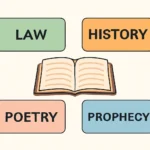
The word Bible comes from a term meaning “books,” which reflects its basic nature. The Bible contains many separate writings rather than a single continuous volume. These writings include history, law, poetry, wisdom, prophecy, biographies of Jesus, letters, and apocalyptic visions.
Christian Bibles are divided into two major parts: the Old Testament and the New Testament. “Testament” can also mean covenant, referring to a binding relationship established by God. The Old Testament presents Israel’s story and the covenant traditions that shape the biblical expectation of a coming redeemer. The New Testament centers on Jesus, the early church, and the meaning of his death and resurrection.
The two sections are connected, but they are not identical. The Old Testament was written before Jesus’ earthly life and contains the Scriptures used by Jesus and his first followers. The New Testament interprets Jesus’ life within that earlier story and describes the community that formed around him.
Different Christian traditions arrange and count the biblical books somewhat differently. Protestant Bibles generally contain 66 books, while Catholic and Orthodox Bibles include additional books or passages often called the Deuterocanonical books by Catholics and the Apocrypha in many Protestant contexts. This difference comes from varied traditions about which ancient writings belong in the canon, not from different versions of the same individual books.
The Bible’s books were written in Hebrew, Aramaic, and Greek. The Old Testament was mainly written in Hebrew, with some Aramaic sections. The New Testament was written in Greek. Modern readers therefore encounter the Bible through translations, each of which makes choices about wording, style, and readability.
Translations are often grouped into broad approaches:
More literal translations try to preserve the wording and sentence structure of the original languages as closely as English allows.
Meaning-based translations emphasize communicating the sense of the original text in natural contemporary English.
Paraphrases restate the biblical message in a freer, more interpretive style.
No translation eliminates the need for interpretation. A word may have several possible meanings, and an ancient expression may not have a direct modern equivalent. Reading more than one reputable translation can help you distinguish the text itself from a particular translator’s choice.
Helpful distinction: The Bible’s table of contents is not arranged in the order the events happened or the books were written. It is organized mainly by literary type, so a chronological reading requires a separate plan.
How the Bible’s main story develops
The Bible’s many stories, laws, poems, and letters contribute to a larger account of God and humanity. Christians commonly read that account as a movement through several connected stages. These stages are not a replacement for the individual books, but they provide a framework for seeing how the parts relate.
Creation, humanity, and broken relationship
Genesis opens with God creating the world and giving human beings a distinctive role within it. Humans are portrayed as bearing God’s image, which gives them dignity and responsibility. The early chapters then describe disobedience, violence, alienation, and the spread of sin.
In Christian theology, sin means more than isolated mistakes. It includes rebellion against God, disordered desires, injustice, and the failure to love God and neighbor as intended. The opening chapters of Genesis explain why the biblical story is concerned with both personal wrongdoing and the damage that reaches families, societies, and creation itself.
Abraham, Israel, and covenant
God’s response to human brokenness unfolds through a promise to Abraham and his descendants. Genesis presents Abraham as the ancestor of a people through whom blessing will extend to other nations. That promise develops into the story of Israel, the people who are brought out of slavery in Egypt and formed into a covenant community.
The books of Exodus through Deuteronomy describe the Law of Moses, including commands about worship, justice, community life, festivals, sacrifice, and care for vulnerable people. These laws served several purposes within ancient Israel. They shaped a distinct people, provided ways to address wrongdoing, and expressed what faithful life with God was expected to look like.
Readers sometimes treat biblical law as one undifferentiated list, but the text contains different kinds of commands. Some concern Israel’s worship, some address civil life in its ancient setting, and some express broad moral principles. Christians differ over how particular Old Testament commands apply under the new covenant, so interpretation requires attention to the Bible’s own developing storyline.
Kings, prophets, exile, and expectation
Israel’s later history includes the period of judges, the establishment of the monarchy, the reigns of David and Solomon, political division, foreign invasions, and exile. The historical books do not portray Israel’s leaders as flawless heroes. David is central to the biblical story, yet the text also records his serious failures and their consequences.
The prophets spoke into these political and spiritual crises. Their messages often confronted idolatry, exploitation, dishonest worship, and abuse of the poor. They also offered hope: God would judge evil, restore his people, establish justice, and bring about a deeper covenant relationship.
Prophecy is not limited to predicting distant events. A prophet was also a covenant messenger who interpreted present circumstances in light of God’s character and purposes. Some prophetic passages address immediate events, while others create expectations that later biblical writers connect with Jesus and the future restoration of all things.
Jesus and the new covenant
The four Gospels—Matthew, Mark, Luke, and John—present the life, teaching, death, and resurrection of Jesus. They are not four unrelated biographies. Each selects and arranges material to emphasize particular aspects of Jesus’ identity and mission.
Jesus announces the kingdom of God, meaning God’s active rule and the restoration associated with it. He teaches about repentance, forgiveness, prayer, wealth, power, enemies, marriage, leadership, and love of neighbor. His parables use familiar scenes such as farming, meals, debt, family conflict, and travel to challenge assumptions about God and faithful living.
The New Testament presents Jesus’ crucifixion as central to God’s saving work. Christians interpret the cross in several closely related ways: as a sacrifice for sin, the defeat of evil, the fullest expression of divine love, and the means of reconciliation between God and humanity. The resurrection is presented as God’s vindication of Jesus and the beginning of new creation.
The church and the hope of restoration
Acts describes the spread of the Christian message from Jerusalem outward through the Roman world. The early church included Jews and Gentiles, people from different languages and social positions, and communities that had to work through serious disagreements.
The letters explain how these communities should understand Jesus, live together, practice worship, handle conflict, and remain faithful under pressure. The New Testament ends with Revelation, a highly symbolic book that portrays judgment, the defeat of evil, and a renewed creation in which God’s presence is fully experienced.
Across the whole Bible, the central movement is therefore not simply “people try to be good.” It is the story of God’s initiative to restore what sin has damaged. Christians see that restoration reaching its decisive point in Jesus and awaiting its complete fulfillment in the renewal of creation.
What the Bible’s major genres mean for interpretation
One of the most common reading mistakes is treating every biblical passage as though it were written in the same way. A poem, a legal instruction, a proverb, a Gospel narrative, and an apocalyptic vision communicate truth through different conventions. Good interpretation begins by asking what kind of writing you are reading.
Narrative and historical writing
Biblical narratives tell what happened—or what the authors present as having happened—but they do not always tell you directly what to imitate. The text may describe a character’s deception, violence, fear, or poor judgment without approving it.
When reading narrative, consider the larger sequence:
Who is speaking, acting, or being addressed?
What problem or conflict drives the scene?
What details does the narrator repeat or emphasize?
How does the passage connect to what comes before and after?
Does the text explicitly praise the behavior, criticize it, or leave the judgment to the surrounding story?
The Gospels require an additional question: how does this scene reveal Jesus’ identity and the significance of his mission? Comparing parallel accounts can show each Gospel writer’s particular emphasis without assuming that every difference is a contradiction.
Psalms, Proverbs, Job, Ecclesiastes, and Song of Songs use imagery, rhythm, repetition, metaphor, and compressed language. A poem about God as a rock is making a claim about security and dependability, not describing God as a geological object.
Proverbs usually express wise patterns rather than unconditional guarantees. A proverb about diligence may describe what generally leads to success, but it does not promise that every diligent person will prosper immediately. Job and Ecclesiastes are especially useful reminders that biblical wisdom includes honest debate about suffering, injustice, death, and the limits of human understanding.
The Psalms also contain a wide emotional range. They include praise, grief, fear, anger, confession, gratitude, and longing. Their presence in Scripture gives readers language for bringing complicated emotions before God rather than pretending that faith removes every difficult feeling.
Prophecy and apocalyptic writing
Prophetic passages often combine warnings about the present with visions of future hope. They use symbolic images, poetic parallelism, and references to historical events that may be unfamiliar to modern readers. Their purpose is not always to supply a detailed timeline.
Apocalyptic writing, especially Revelation, communicates through vivid symbols such as beasts, lamps, crowns, seals, and cosmic upheaval. These symbols should not automatically be converted into modern political figures or newspaper headlines. Interpretations differ widely, and responsible reading considers the book’s Old Testament imagery, first-century setting, repeated themes, and stated purpose.
Letters and teaching
The New Testament letters were written to real communities and individuals facing particular questions. Romans addresses the meaning of righteousness, faith, sin, and God’s inclusion of Gentiles. First Corinthians responds to divisions and ethical problems in a church. James emphasizes practical obedience and the relationship between faith and conduct.
A letter’s instruction should first be understood in its original situation before being applied today. Ask what problem the author is addressing, whether the command is tied to a local circumstance, and what broader principle can be carried into a different culture.
Reading rule: Start with the plain sense of the passage in its literary and historical setting, then connect it to the Bible’s wider teaching. Do not build a major belief on one isolated sentence while ignoring its context.
How to understand difficult passages and apparent contradictions
The Bible contains challenging material: violence, slavery, harsh laws, troubling prayers, conflicting details, and accounts that seem difficult to reconcile. Avoiding these questions rarely produces a stronger understanding. A careful approach separates several issues that are often blended together.
First, identify what kind of difficulty you are facing. Is the concern about a translation, a manuscript difference, a historical question, a moral command, a number that varies between passages, or a theological tension? Each type requires a different method.
Second, examine the passage’s historical setting. Ancient societies differed from modern societies in law, warfare, family structure, honor, punishment, and economic life. Context does not automatically resolve a moral concern, but it can reveal what a command meant to its first audience and prevent modern assumptions from being placed into the text.
Third, compare related passages. The Bible often addresses a topic in more than one place, and later writings may develop or reinterpret earlier material. Jesus’ teaching, for example, frequently engages with Israel’s Scriptures while pressing listeners toward a deeper understanding of motive, mercy, and faithfulness.
Fourth, distinguish what the text reports from what it prescribes. A passage may record polygamy, war, deception, or political failure without presenting that action as an ideal. Narrative selection is not the same as moral approval.
Translation can also create the appearance of disagreement. Ancient measurements, names, place names, and numbers may be represented differently across manuscripts or translations. Study Bibles and reputable biblical commentaries can identify these issues, but no single note should be treated as unquestionable.
Read the complete paragraph or chapter rather than quoting one sentence alone.
Check parallel accounts in other biblical books when they exist.
Look up key terms in a study resource instead of relying only on an English word’s modern meaning.
Consider the whole canon, especially themes of justice, mercy, holiness, human dignity, and redemption.
Consult multiple perspectives, including scholars from traditions that do not reach the same conclusion.
Christians disagree about many interpretive questions while sharing core convictions about God, Jesus, Scripture, sin, grace, and resurrection. A thoughtful reading can acknowledge uncertainty without treating every question as equally decisive.
How to read the Bible with understanding and consistency
You do not need to begin by reading from Genesis through Revelation without interruption. The Bible is a large collection, and some books are more accessible entry points than others. A clear plan helps you notice both the immediate message of a passage and its place in the larger story.
A practical reading process
Choose a manageable book. Mark, Luke, John, Genesis, Ruth, Philippians, or James can provide a coherent starting point. Begin with a complete book rather than collecting disconnected quotations.
Read the passage more than once. The first reading gives you the flow; later readings reveal repeated words, contrasts, commands, and turning points.
Ask observation questions. Identify the people, setting, action, problem, response, and result before deciding what the passage means for you.
Study the context. Read the surrounding chapter, learn who wrote the book if known, and consider the audience and historical situation.
State the central point in your own words. If you cannot explain the passage simply, read it again before applying it.
Apply the message carefully. Ask what it reveals about God, people, wisdom, sin, grace, community, or hope, and what faithful response fits your circumstances.
Reading a short section consistently is usually more useful than rushing through many chapters. Keep a notebook with three columns: what the text says, what it means in context, and how it may shape your response. This prevents personal reactions from replacing interpretation.
Resources that make study clearer
A translation with readable notes can explain geography, customs, names, and cross-references. A Bible dictionary helps with people, places, objects, and theological terms. A commentary offers detailed discussion, although commentaries reflect the convictions and methods of their authors.
Maps are especially helpful for the historical books, the Gospels, and Acts. Knowing the distance between locations, the route of a journey, or the political boundaries of the ancient world can clarify why a scene mattered to its original readers.
Use online sources with care. Check the author’s qualifications, the publication’s editorial standards, and whether claims are supported by evidence. A confident interpretation is not necessarily a reliable one.
Questions to carry through your reading
Several questions remain useful across almost every biblical book:
What does this passage say about God’s character and actions?
What does it reveal about human desires, fears, responsibilities, and failures?
What did the original audience need to hear?
How does the passage relate to the book’s main purpose?
How does it connect with the Bible’s larger themes of creation, covenant, sin, redemption, justice, and hope?
What response does the passage invite, and what response would distort it?
For Christians, Bible reading is both an intellectual and spiritual practice. The aim is not merely to collect information, win arguments, or find instant reassurance. It is to hear the text accurately, recognize its claim on belief and conduct, and understand how its many voices contribute to the story of God’s work in the world.
The Bible’s lasting significance comes from the way its diverse books hold together a coherent vision: a good creation damaged by sin, a people shaped through covenant, a promise of blessing and restoration, Jesus at the center of redemption, and a future in which justice and peace are fully established. Reading it well means respecting each book’s voice while seeing how the whole collection points toward that larger hope.
Frequently asked questions
Why is the Bible divided into the Old Testament and New Testament?
The two parts describe two major stages of the biblical story and its covenant structure. The Old Testament records Israel’s Scriptures, history, worship, wisdom, and prophetic hopes. The New Testament focuses on Jesus, the meaning Christians assign to his death and resurrection, and the growth and teaching of the early church. They are distinct collections but are intended to be read as connected.
Which book of the Bible should someone read first?
Many readers begin with one of the Gospels, such as Mark, Luke, or John, because these books introduce Jesus directly. Genesis provides the Bible’s opening creation and covenant stories, while Psalms offers accessible prayers and poetry. A shorter New Testament letter such as Philippians or James can also be a manageable starting point. Choose a complete book rather than isolated verses.
Why do Bible translations use different wording?
The original biblical texts were written in Hebrew, Aramaic, and Greek, so translators must express ancient words and grammar in modern English. Some translations stay close to the original structure, while others prioritize natural expression. Differences can also reflect uncertainty about a word’s meaning or variations among ancient manuscripts. Comparing two or three respected translations can clarify the range of meaning.
Do all Christians interpret the Bible in the same way?
No. Christians share central beliefs but differ over baptism, church leadership, spiritual gifts, the relationship between faith and works, prophecy, ethics, and the application of Old Testament law. Differences arise from traditions, translation choices, theological methods, and views of history. Careful interpretation should acknowledge these disagreements while distinguishing foundational beliefs from secondary issues.















Leave a Reply