Nag Hammadi Library: texts, discovery, and meaning
Nag Hammadi Library: texts, discovery, and meaning
The Nag Hammadi Library is a collection of thirteen ancient codices discovered in Upper Egypt in 1945. Written mainly in Coptic and copied onto papyrus, the codices preserve more than fifty tractates, including the Gospel of Thomas, the Apocryphon of John, and the Gospel of Philip.
These writings offer evidence of the diverse religious world of late antiquity. They include Christian works associated with groups often labeled Gnostic, but also mystical, philosophical, and Hermetic texts. The collection does not present one unified belief system, nor does it provide a single alternative version of Christianity.
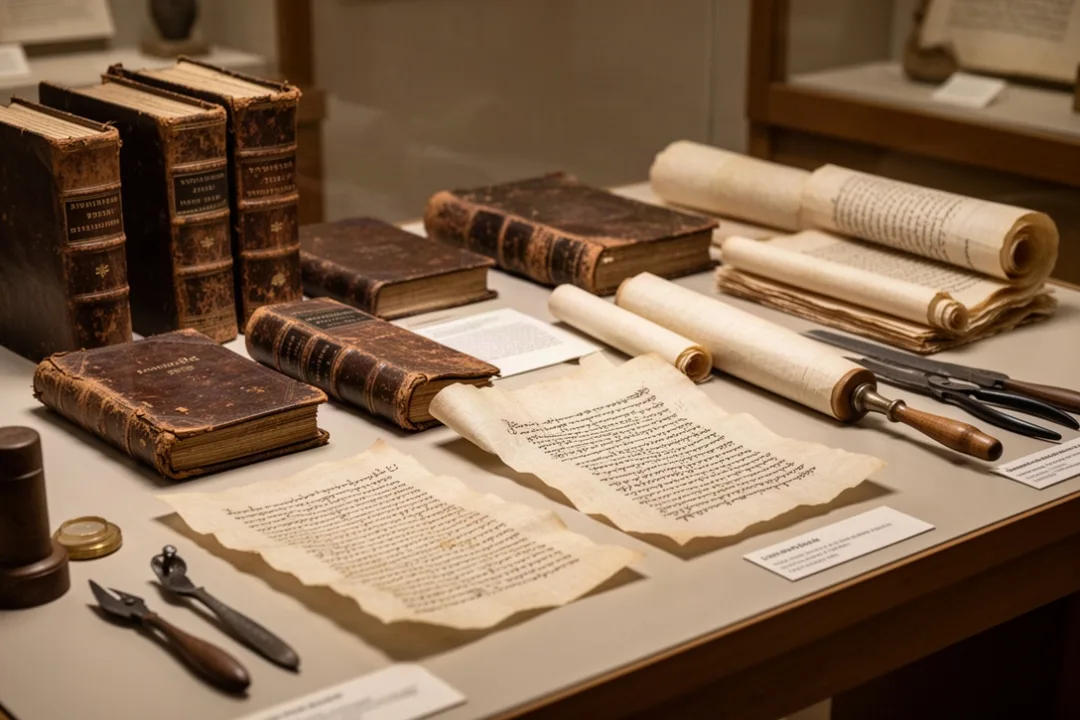
The library consists of thirteen leather-bound codices, or ancient manuscript books, containing texts copied in the fourth century. Most works are Coptic translations of earlier Greek compositions, although the original Greek manuscripts have usually been lost or survive only in fragments.
Scholars count approximately fifty-two tractates in the collection, though the exact total depends on how repeated or incomplete works are counted. Several texts appear more than once, sometimes in different versions. This repetition helps researchers compare wording, editing, and the ways ancient scribes transmitted religious ideas.
The manuscripts cover several types of writing rather than one clearly defined genre. Some are presented as secret revelations, some as collections of sayings, and others as sermons, prayers, philosophical arguments, or accounts of the soul’s origin and destiny.
Sayings collections: The Gospel of Thomas presents sayings attributed to Jesus, many without the narrative structure found in the canonical Gospels.
Revelatory dialogues: The Apocryphon of John describes revelations about God, creation, humanity, and salvation.
Mystical and symbolic works: The Thunder, Perfect Mind uses a powerful first-person voice to explore paradoxical divine identity.
Christian theological treatises: The Tripartite Tractate and the Gospel of Truth reflect on creation, Christ, ignorance, knowledge, and restoration.
Hermetic and philosophical writings: The collection includes works connected with Hermetic spirituality and a short passage from Plato’s Republic.
The term library can be misleading if it suggests that one person assembled a carefully organized collection. The codices were likely produced or gathered within a Christian intellectual environment, but their exact ownership, purpose, and place of storage remain uncertain.
Key distinction: The Nag Hammadi codices are fourth-century copies of mostly earlier works. The date of a manuscript is not automatically the date when the text was first composed.
How the codices were discovered and preserved
The manuscripts were found in December 1945 near the village of Hamādī, close to the modern Egyptian town of Nag Hammadi. Accounts describe local farmers discovering a large earthenware jar near the base of cliffs known as Jabal al-Tarif. The codices were removed from the jar and entered a complicated chain of private ownership, sale, and scholarly investigation.
The discovery site lies near the ancient settlement of Chenoboskion, in a region associated with early Christian monasticism. That geographic connection has encouraged theories about why the books were buried, but no surviving evidence proves who placed them there or what motivated the burial.
Some of the manuscripts were damaged, separated, or handled before scholars could study them. One codex was reportedly burned in part for household fuel before its value was recognized. Other leaves moved through the antiquities market, and Egyptian authorities eventually worked to bring the collection together.
The codices were written on papyrus sheets folded and sewn into book form, then protected by leather covers. Their survival was helped by Egypt’s dry climate, although the pages still show water damage, missing sections, stains, and broken edges.
Modern scholars have reconstructed the contents through conservation, photography, comparison of duplicate passages, and analysis of the Coptic language. The manuscripts are associated with the Coptic Museum in Cairo, while individual pieces and related materials have had different conservation and publication histories.
Understanding the discovery requires caution because early reports sometimes mixed documented evidence with later storytelling. The broad facts are secure: thirteen codices were discovered in Upper Egypt, they contain dozens of ancient religious texts, and most were unknown in complete form before the find. Details about the original owner and burial circumstances remain unresolved.
Which writings are most important in the collection
The Gospel of Thomas and sayings of Jesus
The Gospel of Thomas is the best-known work in the library. It contains a series of sayings attributed to Jesus rather than a continuous account of his birth, ministry, death, and resurrection. Some sayings resemble material in Matthew, Mark, Luke, or John, while others have no close canonical parallel.
The text repeatedly emphasizes the importance of seeking, recognizing, and understanding. Its language often suggests that transformation comes through insight into one’s true condition and the nature of the kingdom. Readers should not assume that every saying has one obvious meaning; the work uses compressed, enigmatic language that can support several interpretations.
The Gospel of Thomas has attracted debate about its date and relationship to the canonical Gospels. Some scholars have proposed that it preserves early traditions, while others emphasize its later theological shaping. The manuscript itself was copied in Coptic during the fourth century, but that fact does not settle when the individual sayings or the complete work took shape.
The Apocryphon of John and creation theology
The Apocryphon of John, also called the Secret Book according to John, is one of the most significant texts for studying the theological ideas often described as Gnostic. It presents a revelation given to John after he asks questions about the world, the human condition, and the nature of salvation.
The work describes a supreme, transcendent source beyond ordinary human categories. It then presents a complex account of divine beings, wisdom, creation, and the formation of a flawed material order. A lower creator figure, often called the demiurge, plays a major role in the story. The text’s mythology explains human alienation while also preserving the hope that a divine element within humanity can awaken.
Its several versions in the Nag Hammadi collection make the Apocryphon of John especially useful for comparing ancient textual traditions. Differences among the copies show that scribes and communities could preserve related material while arranging or wording it differently.
The Gospel of Philip, the Gospel of Truth, and related works
The Gospel of Philip is not a narrative about Jesus’ life. It is a collection of reflections, interpretations, and symbolic discussions associated with Valentinian Christianity, a movement linked to the teacher Valentinus and his followers. The text explores baptism, anointing, union, resurrection, and the relationship between visible rituals and spiritual realities.
The Gospel of Truth is a meditative theological work rather than a biography. It portrays ignorance as a condition that separates people from their divine origin and presents knowledge, recognition, and the revelation of Christ as forces that restore what has been lost. Its style is poetic and reflective, with recurring images of forgetfulness, awakening, and return.
Other writings expand the collection’s range. The Gospel of the Egyptians presents elaborate spiritual genealogies; the Second Treatise of the Great Seth offers a distinctive account of Christ and salvation; and the Treatise on the Resurrection discusses how resurrection should be understood by believers.
Texts beyond the label “Gnostic”
Not every work in the codices fits the same religious category. The Prayer of the Apostle Paul is brief and devotional. The Exegesis on the Soul interprets the soul’s alienation and return through imagery connected with biblical and classical traditions. The Asclepius, preserved in Coptic in the collection, belongs to Hermetic literature associated with Hermes Trismegistus.
Codex VI also includes a passage from Plato’s Republic, along with other philosophical and Hermetic works. Their presence shows that the people who preserved the codices lived in an environment where Christian theology, Greek philosophy, and religious speculation could overlap.
Christian themes: Christ, revelation, resurrection, baptism, prayer, salvation, and the interpretation of scripture.
Platonic themes: The relationship between the visible world and higher reality, the soul’s origin, and the pursuit of wisdom.
Hermetic themes: Spiritual knowledge, cosmic order, transformation, and humanity’s relationship to the divine.
Mythological themes: Divine emanations, cosmic rulers, wisdom figures, and the origins of evil or ignorance.
How the library relates to early Christianity
The Nag Hammadi texts were produced within a period when Christianity was not yet fully uniform. Communities differed over scripture, ritual, authority, the nature of Christ, the meaning of resurrection, and the relationship between the material world and God.
Some of the writings use Christian names and stories while interpreting them in ways that differ sharply from later orthodox theology. Others share language and themes with works that became part of the New Testament. This mixture makes the collection valuable: it reveals conversations, disagreements, and overlapping traditions rather than a simple division between “Christian” and “non-Christian.”
The word Gnostic comes from the Greek term gnosis, meaning knowledge. Modern scholars use it as a convenient label for some ancient movements that emphasized saving knowledge, often involving a divine origin or inner spiritual reality. Ancient writers did not necessarily use the term for themselves in the same broad way.
Many scholars therefore avoid treating “Gnosticism” as a single organized religion with one founder, creed, or membership list. The texts associated with the label vary considerably. Some describe a hostile or defective creator, while others present creation more positively. Some emphasize secret knowledge, while others focus on ritual, ethical transformation, prayer, or philosophical contemplation.
Read the texts on their own terms: Calling a work “Gnostic” can be useful for orientation, but it should not replace close attention to that work’s particular theology, symbolism, and historical setting.
Early Christian authors such as Irenaeus, Hippolytus, and Epiphanius criticized certain rival teachings. Their writings preserve valuable information about disputes, but they were written from opposing positions. The Nag Hammadi manuscripts allow researchers to examine some of the contested traditions directly instead of relying only on their opponents’ descriptions.
The discovery also changed how scholars understand the formation of Christian scripture. The canonical Gospels were not simply selected from a large pile of identical books at one moment. Their authority developed through long processes of use, interpretation, community practice, and debate. The Nag Hammadi texts show that other Christian writings circulated alongside them.
That evidence does not mean the Nag Hammadi works were secretly removed from the Bible or that they represent the original form of Christianity. Most were composed or shaped in settings with distinctive theological commitments. Their value lies in showing the variety of early Christian thought, not in proving one modern theory about the church.
Why the Nag Hammadi Library matters today
The collection matters because it preserves voices that would otherwise be known mainly through hostile summaries or scattered quotations. It expands the historical record of religious communities that interpreted Jesus, scripture, creation, and salvation in different ways.
It also gives scholars direct evidence about ancient book culture. The codices reveal how texts were copied, translated, arranged, and reused. Repeated works provide an opportunity to compare versions, while the physical format shows that early Christians adopted the codex, or bound book, as an important vehicle for reading and preserving sacred material.
The manuscripts are equally important for the study of the Coptic language. Coptic uses the Greek alphabet with additional signs for Egyptian sounds. The translations preserve vocabulary and sentence structures that help researchers reconstruct how religious ideas moved from Greek-speaking communities into Egyptian Christian settings.
For readers, the library can broaden the question of what ancient religious literature does. These works do not merely provide alternative stories about Jesus. They ask questions about memory, identity, suffering, embodiment, ritual, and the possibility of recognizing a deeper reality.
A careful reading also requires historical discipline. The manuscripts are not modern spiritual books, and their symbolism cannot be separated from ancient debates about philosophy, Judaism, Christianity, and the Roman world. A passage that sounds familiar to a modern reader may have carried a very different meaning in its original setting.
If you want to begin reading the collection, a sensible order is:
Start with the Gospel of Thomas to become familiar with sayings-based writing and its connection to some New Testament traditions.
Read the Gospel of Truth for a more reflective and theological style.
Turn to the Apocryphon of John when you are ready for a longer mythological account of creation and salvation.
Compare the Gospel of Philip with the others to see how ritual, symbolism, and theological interpretation can work together.
Use scholarly notes and introductions to distinguish the ancient text from modern interpretations of Gnosticism.
Translations differ in how they handle difficult Coptic terms, damaged passages, and technical theological language. Reading more than one reputable translation can clarify where the manuscript is uncertain and where translators have made interpretive choices.
The library is best approached as a collection of distinct ancient witnesses. Some texts are close in theme, some preserve competing ideas, and some belong to different intellectual traditions altogether. Taken together, they provide a more detailed picture of late antique religious life than any single label can convey.
Common misconceptions about the Nag Hammadi texts
One common misconception is that the codices contain a complete “lost Bible.” They do not. The collection includes religious works that were not included in the later Christian canon, but it also contains philosophical and Hermetic material, repeated texts, and writings with very different aims.
Another misconception is that every text was hidden because church authorities wanted to suppress it. The reason for the burial is unknown. Scholars have proposed several possibilities, including the storage of books no longer being used, the concealment of texts during a period of conflict, or the placement of manuscripts in a monastic context. None of these explanations has been proven.
The discovery also does not show that the canonical Gospels were copied from the Nag Hammadi works. Most Nag Hammadi manuscripts are later than the earliest surviving witnesses to the New Testament, and their texts come from varied traditions. Similar sayings or themes may reflect shared sources, common religious language, literary adaptation, or direct familiarity.
Finally, the Gospel of Thomas should not automatically be treated as either the earliest or the latest Gospel. Its sayings may preserve some old traditions, but the work as a whole also reflects a particular theological arrangement. Dating ancient texts involves language, theology, manuscript evidence, literary relationships, and historical context rather than one decisive clue.
The most reliable interpretation keeps several facts in view at once: the manuscripts are ancient but not original copies; the collection is diverse rather than uniform; and the texts illuminate early Christianity without replacing the canonical writings as a group. That balanced approach allows the Nag Hammadi Library to speak as both a historical archive and a record of serious religious reflection.
Frequently asked questions
Where was the Nag Hammadi Library discovered?
The codices were discovered in 1945 near Nag Hammadi in Upper Egypt, close to the ancient settlement of Chenoboskion. They were reportedly found in a large earthenware jar near cliffs called Jabal al-Tarif. The manuscripts were later dispersed through private handling and the antiquities market before Egyptian authorities and scholars worked to preserve and study the collection.
How many books are in the Nag Hammadi Library?
The collection contains thirteen codices, or ancient bound books. Together they preserve approximately fifty-two tractates, although the count can vary because some works are incomplete or appear in more than one copy. The manuscripts were copied mainly in Coptic during the fourth century, while many of the underlying works were composed earlier in Greek.
Is the Gospel of Thomas part of the Nag Hammadi Library?
Yes. The Gospel of Thomas is preserved in Codex II and is the collection’s most famous text. It consists mainly of sayings attributed to Jesus rather than a continuous biography. Some sayings resemble passages in the canonical Gospels, while others are unique. Scholars continue to debate the date and sources of the complete work.
Are the Nag Hammadi texts all Gnostic?
No. Several writings are associated with ideas commonly described as Gnostic, but the collection is more varied. It includes Christian theological works, mystical reflections, Hermetic literature, philosophical material, and a passage from Plato’s Republic. “Gnostic” is a modern scholarly label that can help classify some texts, but it does not describe every work in the codices.













Leave a Reply