Matthew Bible study: Themes, structure, and practical guide
Matthew Bible study: Themes, structure, and practical guide
A useful Matthew Bible study combines careful reading, historical context, cross-references, and personal application. Read the Gospel in manageable sections, ask what Jesus teaches about God’s kingdom and discipleship, and pay attention to how Matthew connects Jesus’ life with Israel’s Scriptures.
Matthew is more than a collection of familiar stories. Its arrangement, repeated phrases, parables, miracles, speeches, and Old Testament references guide you toward a unified picture of Jesus as Messiah, King, teacher, and risen Lord. A good study respects both the individual passages and the way the entire Gospel develops its message.
Matthew presents Jesus as the promised Messiah who brings God’s reign into human history. The opening genealogy places him within Israel’s story, while the birth narrative connects him with royal hopes, Scripture, and God’s presence. From the beginning, the Gospel asks you to see Jesus not as an isolated religious figure but as the fulfillment of a long biblical account.
The title “Son of David” appears at important points and links Jesus with Israel’s royal line. Matthew also emphasizes Jesus as the new Moses-like teacher who explains God’s will with authority. This does not mean Jesus simply repeats Moses; rather, he brings the law toward its intended depth, especially in the Sermon on the Mount.
Jesus’ authority appears in several forms. He teaches crowds, forgives sins, interprets Scripture, heals the sick, commands nature, confronts evil, and sends disciples to continue his work. Matthew’s Gospel therefore presents faith as a response to Jesus’ identity and authority, not merely admiration for his moral instruction.
Central idea: Matthew invites you to recognize Jesus as the promised King and to respond through trusting obedience, transformed character, and faithful participation in God’s kingdom.
How Matthew is organized for Bible study
Matthew contains 28 chapters and can be studied as a continuous story or divided into several major movements. The Gospel alternates between narrative sections and substantial teaching sections. This pattern helps you see that Jesus’ actions and words interpret each other: his miracles display kingdom authority, while his teaching explains what kingdom life requires.
A practical outline looks like this:
Matthew 1–2: Jesus’ ancestry, birth, threats against him, and early movements.
Matthew 3–4: John the Baptist, Jesus’ baptism, temptation, and the beginning of public ministry.
Matthew 5–7: the Sermon on the Mount and the character of kingdom citizens.
Matthew 8–9: miracles, healing, authority over creation, and the calling of disciples.
Matthew 10: instructions for the twelve apostles and the cost of mission.
Matthew 11–12: responses to Jesus, opposition from religious leaders, and the meaning of true allegiance.
Matthew 13: parables explaining the hidden and growing nature of the kingdom.
Matthew 14–18: identity, faith, community, forgiveness, and life among disciples.
Matthew 19–25: discipleship, wealth, leadership, judgment, and readiness for the coming King.
Matthew 26–28: the Last Supper, arrest, crucifixion, resurrection, and the worldwide mission.
Another helpful pattern centers on five major teaching collections: Matthew 5–7, 10, 13, 18, and 23–25. The exact boundaries can be discussed, but the pattern is clear. Matthew wants readers to remember Jesus’ instruction and practice it, not simply read isolated sayings.
Matthew’s teaching about the kingdom of heaven
The phrase “kingdom of heaven” is one of Matthew’s defining expressions. It refers to God’s active rule rather than merely a place people enter after death. Matthew often uses this expression where other Gospels use “kingdom of God,” so the wording should not lead you to imagine two different kingdoms.
The kingdom is both present and future. Jesus announces that it has drawn near, and his healings and exorcisms show its power already at work. At the same time, Jesus teaches his followers to pray for the kingdom to come fully and describes a future judgment when God’s rule will be openly revealed.
Matthew 13 is especially important for understanding this tension. The parables of the sower, weeds, mustard seed, yeast, hidden treasure, and valuable pearl show that the kingdom may begin quietly, face resistance, and grow in ways people do not expect. Its apparent smallness does not mean God is absent.
When studying a kingdom passage, ask questions such as:
What does this passage show about the character of God’s rule?
Who recognizes the kingdom, and who resists it?
What kind of response does Jesus call for: repentance, faith, patience, sacrifice, mercy, or watchfulness?
Does the passage emphasize the kingdom’s present work, its future fulfillment, or both?
How does the teaching challenge common ideas about status, success, power, and security?
The kingdom also changes how disciples view greatness. In Matthew 18, Jesus places humility, care for the vulnerable, restoration, and forgiveness at the center of community life. In Matthew 20, he contrasts servant leadership with the power-seeking patterns of ordinary rulers. Kingdom greatness is measured by service rather than social rank.
Why Matthew repeatedly connects Jesus with the Old Testament
Matthew frequently says that events happened to fulfill what God had spoken through the prophets or Scriptures. These references are not decorative footnotes. They establish continuity between Israel’s story and Jesus’ mission, showing that the Gospel understands Jesus within the promises, failures, hopes, and expectations of the Hebrew Scriptures.
Matthew draws on several parts of the Old Testament, including the law, historical narratives, Psalms, and prophets. Readers familiar with those texts can see echoes that may not be obvious at first glance. For example, Matthew’s presentation of Jesus’ early life recalls themes of deliverance, threatened children, exile, and return.
Matthew 5:17–20 is a central passage for studying Jesus and the law. Jesus does not present his mission as a cancellation of Scripture. He brings its purpose to completion and teaches a righteousness that reaches beyond external compliance into motives, relationships, truthfulness, mercy, and wholehearted devotion.
Study these connections with care. A fulfillment statement may refer to a direct prediction, a repeated biblical pattern, a broader theme, or a passage whose meaning Matthew sees reaching its fullest expression in Jesus. Reading the Old Testament reference in its original setting will often sharpen rather than weaken Matthew’s point.
Study tip: When Matthew cites or echoes an earlier Scripture, read the surrounding paragraph or chapter in the original book. Ask what theme Matthew is carrying forward, not only which single sentence resembles the event.
How to study the Sermon on the Mount
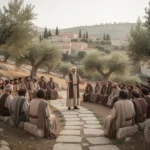
Matthew 5–7 is the Gospel’s longest continuous teaching section and one of the best places to begin a Matthew Bible study. It describes the values, practices, and inner character of people who live under God’s reign. The Sermon should be read as a connected message, not as a loose series of inspirational sayings.
The Beatitudes introduce people who may not appear powerful or successful by ordinary standards: the poor in spirit, mourners, the meek, those who hunger for righteousness, the merciful, the pure in heart, peacemakers, and those who suffer for doing right. Jesus describes God’s favor and future hope, then shows how his followers are to live as salt and light in the world.
Jesus’ teaching about anger, reconciliation, adultery, divorce, oaths, retaliation, and enemies moves beneath outward behavior. He addresses the heart behind the action. The commands are demanding because they form a people whose righteousness reflects God’s generous and impartial goodness.
Matthew 6 turns to religious practices such as giving, prayer, and fasting. Jesus warns against performing devotion to gain public recognition. The Lord’s Prayer provides a pattern that begins with God’s name and kingdom, then moves to daily provision, forgiveness, and protection from evil.
Matthew 6:19–34 addresses possessions, anxiety, and divided loyalty. Jesus does not deny practical needs; he teaches his followers to place those needs within trust in God. Matthew 7 then presses toward discernment, perseverance in prayer, obedience, and the difference between hearing Jesus’ words and actually practicing them.
For each paragraph in the Sermon, consider three levels of meaning:
Original setting: What question, conflict, or religious assumption does Jesus address?
Character formation: What desire, habit, or attitude is he shaping in his listeners?
Concrete practice: What would obedience look like in your relationships, work, money, speech, or private life?
What Matthew’s miracles mean beyond the supernatural event
Matthew’s miracles are signs of Jesus’ authority and compassion. They also reveal what the kingdom does: it restores health, frees people from destructive powers, cleanses those excluded by impurity, calms fear, and gathers outsiders into a restored community. Do not reduce these accounts to arguments about power alone; notice the people Jesus sees and the restoration he brings.
Matthew 8–9 groups many miracles together after the Sermon on the Mount. This arrangement creates a deliberate contrast: Jesus first teaches with authority, then acts with authority. Healing stories also raise questions about faith, fear, suffering, purity, and the meaning of following him.
When examining a miracle, identify the human need, the person’s response, Jesus’ words and actions, the reaction of onlookers, and the effect on the wider community. Some stories highlight trust, while others expose fear or opposition. The same event can reveal both Jesus’ compassion and the inadequacy of those who misunderstand him.
Matthew 9:35–38 connects Jesus’ ministry with compassion for crowds who are described as distressed and scattered. The response is not passive sympathy. Jesus tells his disciples to pray for workers and later sends them. Compassion in Matthew leads to mission and practical service.
How Matthew portrays discipleship and obedience
To be a disciple in Matthew means more than agreeing with certain beliefs. It means following Jesus, learning from him, obeying his commands, and joining his mission. The first disciples leave familiar security to follow him, but Matthew also shows their confusion, fear, ambition, and failure. Discipleship is demanding without being presented as a path reserved for flawless people.
Matthew 10 prepares the twelve for ministry. They receive authority, but they also receive warnings about rejection, conflict, and dependence on God. The chapter makes clear that mission is not measured only by visible success. Faithfulness may include suffering and uncertainty.
Peter’s confession in Matthew 16 identifies Jesus as the Messiah, but the disciples still misunderstand what kind of Messiah he is. Jesus immediately teaches about suffering, self-denial, and taking up the cross. This sequence corrects the assumption that recognition of Jesus’ title automatically produces mature discipleship.
Matthew 18 focuses on life together. Humility, protection of the vulnerable, correction of wrongdoing, repeated forgiveness, and reconciliation are not optional extras. They are essential expressions of belonging to Jesus. The parable of the unforgiving servant connects receiving mercy with extending mercy to others.
The final commission in Matthew 28:18–20 gives the church its continuing task. Jesus sends his followers to make disciples among all nations, baptize them, and teach them to obey everything he commanded. The mission is therefore broader than gaining decisions or transmitting information; it involves forming communities that live under Jesus’ instruction.
Common mistakes to avoid in a Matthew Bible study
Matthew rewards close reading, but several habits can make study shallow or confusing. Use these cautions to keep your interpretation connected to the text.
Reading verses in isolation: A familiar line may mean something different when read within the paragraph, speech, or narrative conflict surrounding it.
Treating every teaching as a private message: Many commands address a community, public witness, leadership, or relationships with enemies, not only individual self-improvement.
Ignoring Jewish context: Matthew’s debates about law, purity, Sabbath, prayer, and religious authority arise within first-century Jewish life and should not be turned into stereotypes about Jewish people.
Flattening the kingdom into heaven after death: Matthew includes future hope, but the kingdom also shapes present ethics, worship, justice, mercy, and mission.
Assuming the disciples understand everything immediately: Their misunderstandings are part of Matthew’s storytelling and can expose the reader’s own assumptions.
Using prophecy references as proof-texts: Read the original context and consider whether Matthew is showing prediction, fulfillment of a pattern, or completion of a larger biblical theme.
Applying difficult commands without wisdom: Teachings about forgiveness, submission, or reconciliation should never be used to excuse abuse, coercion, or ongoing danger.
Studying only favorite passages: Read difficult sections about judgment, wealth, hypocrisy, suffering, and costly obedience alongside the comforting passages.
A practical method for studying any passage in Matthew
Choose a section small enough to read several times, usually a paragraph, story, or short teaching unit. Read it once for the basic movement, then again while marking repeated words, contrasts, questions, commands, and reactions. Before consulting commentaries, write down what the passage appears to emphasize.
Use this sequence to structure your study:
Observe the passage: Identify the people, setting, action, conflict, repeated terms, and turning point.
Locate it in Matthew: Ask how the section relates to the surrounding speech, miracle collection, controversy, or journey.
Compare parallel accounts: If Mark or Luke records the event, compare the accounts without assuming one cancels out the others. Differences may highlight each Gospel’s purpose.
Trace biblical connections: Check Old Testament quotations, allusions, titles, symbols, and themes. Read the source passage in context.
State the main claim: Write one sentence explaining what Matthew wants readers to understand about Jesus, God’s kingdom, or discipleship.
Test the application: Ask what the passage calls you to believe, change, practice, resist, or hope for. Make the application specific.
Pray and revisit: Return to the text after a few days. Notice whether a different detail becomes clearer when you have considered its implications.
A notebook can include four simple columns: what the text says, what it reveals about Jesus, what it requires of disciples, and questions that need further research. This prevents application from becoming detached from interpretation and prevents research from becoming detached from obedience.
A short plan can give you a broad view before you focus on individual passages. Read several chapters at a time, but do not rush through the teaching sections. The goal is to notice the Gospel’s movement from promise and announcement to conflict, crucifixion, resurrection, and mission.
Week 1: Read Matthew 1–7. Focus on Jesus’ identity, the kingdom announcement, temptation, and the Sermon on the Mount.
Week 2: Read Matthew 8–14. Track miracles, the calling and sending of disciples, opposition, and the parables of the kingdom.
Week 3: Read Matthew 15–23. Study faith, purity, confession, discipleship, community life, leadership, and Jesus’ warnings against hypocrisy.
Week 4: Read Matthew 24–28. Consider watchfulness, judgment, the Last Supper, the cross, resurrection, and the worldwide commission.
For each week, choose one central passage for slower study. You might select Matthew 5:1–20, 6:19–34, 13:1–23, 18:15–35, 20:20–28, 23:1–12, or 28:16–20. Read the passage aloud, identify its main movement, and connect it to the wider section before deciding how it applies.
Questions Matthew raises about faith and religious practice
Matthew repeatedly contrasts outward religious performance with genuine faithfulness. This does not make visible practices unimportant. Prayer, fasting, almsgiving, worship, teaching, and community discipline all matter, but their value is distorted when they become tools for reputation or control.
The Gospel also refuses to separate belief from action. Jesus commends faith, but he challenges faith that produces no obedience. The image of two builders at the end of the Sermon on the Mount makes this point clearly: stability comes from hearing Jesus’ words and putting them into practice.
Matthew’s warnings to religious leaders should be handled with care. They address specific forms of hypocrisy and abuse of authority within the Gospel’s setting. They should not be used to cultivate contempt for an entire religious or ethnic group. The same warnings can challenge Christian leaders and communities when public spirituality hides pride, exploitation, or neglect of mercy.
How the cross and resurrection complete Matthew’s message
The final chapters show that Jesus’ kingship does not follow ordinary patterns of power. He is mocked, condemned, crucified, and placed in a tomb. Yet Matthew frames these events through Scripture, the language of kingship, and the faithful purpose of God. The apparent defeat becomes the path through which Jesus fulfills his mission.
The resurrection changes the disciples’ failure into renewed commission. The women at the tomb become early witnesses, while the disciples are directed toward Galilee. At the mountain, some worship and some hesitate, a realistic detail that does not erase their weakness but shows Jesus entrusting mission to imperfect followers.
Matthew ends with Jesus’ authority over heaven and earth, the command to make disciples of all nations, and the promise of his continuing presence. The ending reaches back to the Gospel’s opening emphasis on God with us. A Matthew Bible study should therefore finish by asking not only what the resurrection proves, but how Jesus’ presence shapes worship, courage, teaching, and mission now.
Frequently asked questions
Who wrote the Gospel of Matthew?
The Gospel itself does not name its author. Early Christian tradition associates it with Matthew, one of Jesus’ twelve apostles, while many modern scholars discuss its composition in terms of an anonymous Jewish-Christian author or community. You can study its message, structure, and theology without treating the authorship question as settled beyond what the text and historical evidence support.
What is the main theme of Matthew?
Matthew centers on Jesus as the promised Messiah and King who brings God’s kingdom, fulfills Israel’s Scriptures, teaches authoritative righteousness, dies, rises, and sends his disciples to all nations. The Gospel joins belief and obedience: those who recognize Jesus are called to live as his disciples and practice his commands within a faithful community.
How long should a Matthew Bible study take?
A complete first reading can take two to four weeks, depending on how much time you have each day. A slower study of major sections may take several months. Read a short passage repeatedly, then allow time for context, cross-references, discussion, prayer, and practical application rather than measuring progress only by chapters completed.
Is Matthew a good Gospel for new Bible readers?
Yes, especially if you want to understand Jesus’ teaching, the kingdom of God, and connections with the Old Testament. Some passages assume familiarity with Jewish Scripture and first-century religious debates, so a study Bible or reliable commentary can help. Reading Mark or Luke alongside selected passages may also clarify the Gospel’s distinctive emphasis.















Leave a Reply