Genesis explains how God creates, judges, promises, and preserves life through the stories of beginnings and the family chosen to carry his blessing.
The book of Genesis is the first book of the Bible and the opening book of the Pentateuch, the five-book collection that also includes Exodus, Leviticus, Numbers, and Deuteronomy. Its name comes from a Greek word meaning origin or beginning, which fits its wide scope: Genesis addresses the beginnings of the world, humanity, sin, marriage, nations, languages, covenant, and Israel’s family story.
Genesis is not simply a collection of isolated Bible stories. Its accounts are connected by a movement from creation to corruption and then from judgment toward promise and redemption. The book begins with the world made good and ends with a family living in Egypt, waiting for what God will do next.
Central idea: Genesis shows God bringing order and blessing into a broken world, working through imperfect people and a covenant family to advance his purposes.
Genesis has 50 chapters and falls naturally into two large parts. Chapters 1–11 describe the history of the world before Abraham, while chapters 12–50 focus on the ancestors of Israel: Abraham, Isaac, Jacob, and Joseph. The first part moves across humanity as a whole; the second narrows to one family.
A useful way to remember the structure is primeval history followed by patriarchal history. “Primeval” refers to the earliest period of human history. “Patriarchal” describes the stories of the male ancestors whose families become central to the biblical story.
Genesis 1–2: God creates the heavens, earth, living creatures, and human beings.
Genesis 3–11: sin enters human experience, violence increases, judgment comes, and nations spread.
Genesis 12–25: God calls Abraham and establishes a covenant with him.
Genesis 25–36: Isaac’s family continues through Jacob, whose name becomes Israel.
Genesis 37–50: Joseph’s suffering and rise in Egypt preserve Jacob’s family during famine.
The repeated family records in Genesis also help mark its progression. Several sections begin with a genealogy or a phrase such as “the account of,” depending on the Bible translation. These transitions show that Genesis is tracing family lines, not merely arranging unrelated episodes.
Questions that make Genesis easier to understand
Read each passage at three levels. First, ask what happens in the immediate story. Second, ask what the event reveals about God, people, and relationships. Third, ask how the passage advances the book’s larger themes of promise, blessing, land, descendants, and God’s presence.
What problem appears? Look for disobedience, barrenness, family conflict, famine, fear, or danger.
What does God say or do? Pay attention to commands, promises, judgment, protection, and unexpected mercy.
How do people respond? Characters may trust, deceive, bargain, wait, repent, resist, or forgive.
What changes afterward? A promise may become clearer, a family may divide, or a future pattern may be established.
How does the story prepare for what follows? Genesis frequently leaves an issue unresolved so later chapters can develop it.
Genesis contains narrative, genealogical material, poetry, blessings, and speeches. A blessing in Genesis is more than a kind wish. It can describe a person’s future, assign a family’s place, or identify how God’s promise will continue. The blessings of Abraham, Isaac, Jacob, and Jacob’s sons therefore deserve careful attention.
Genesis 1–11: creation, human rebellion, and the nations
Genesis 1 presents God as the sovereign creator who brings a well-ordered world from darkness and disorder. God creates by speaking, separates and names parts of creation, and evaluates what he has made as good. The repeated pattern gives the account a deliberate rhythm and emphasizes that creation depends on God’s authority, not on conflict among competing gods.
Human beings receive a unique role. They are made in God’s image and likeness, which gives every person dignity and responsibility. Genesis 1 connects that identity with ruling over other living creatures, while Genesis 2 emphasizes cultivating and guarding the garden. Together, the chapters portray people as both honored members of creation and accountable stewards within it.
Genesis 2 focuses more closely on the human pair, the garden, work, marriage, and the command concerning the tree of the knowledge of good and evil. The chapter describes human life as relational: the man is not meant to be alone, and the woman is presented as a fitting partner. The garden is a place of abundance, vocation, fellowship, and moral boundaries.
What the fall changes in Genesis 3
Genesis 3 describes the serpent’s deception, the woman and man’s disobedience, and the consequences that follow. The central issue is not merely eating forbidden fruit. The humans distrust God’s word and seek moral independence, wanting to determine good and evil on their own terms.
The effects of sin spread through every major relationship. Shame disrupts the relationship between people and God; blame damages the relationship between the man and woman; pain enters family life; the ground becomes difficult to work; and the humans leave the garden. Genesis presents sin as alienation from God that produces disorder in the whole created world.
Yet judgment is not the only feature of the chapter. God seeks the humans, confronts them, clothes them, and prevents them from living forever in their fallen condition. Christians often connect the serpent’s defeat in Genesis 3:15 with later biblical hope, though interpretations of that verse differ. The broader point is clear: the conflict introduced in Eden will shape the rest of Scripture.
Cain, the flood, and Babel
Cain and Abel show how quickly sin moves from hiding and blame to violence. Cain’s murder of his brother is followed by God’s questioning, judgment, and protection. The story does not minimize Cain’s guilt, but it also shows that God restrains vengeance and refuses to let human violence have the final word.
Genesis 6–9 describes a world filled with corruption and violence and God’s judgment through the flood. Noah finds favor with God, builds the ark, and survives with his family and representatives of the animal world. After the flood, God establishes a covenant with Noah and the living creatures, using the rainbow as its sign. This covenant is universal in scope, not limited to one ethnic group.
Noah’s later failure reminds readers that the flood does not remove the human tendency toward sin. A new beginning still needs more than a changed environment. Genesis continues by tracing Noah’s descendants and explaining the spread of peoples across the earth.
The tower of Babel in Genesis 11 portrays people united in pride and self-protection. They seek to make a name for themselves and resist spreading across the earth. God confuses their language and scatters them. The chapter explains the diversity of nations while also preparing for the call of Abram, through whom God will address the problem of scattered humanity.
Genesis 12–25: Abraham’s call, covenant, and tested faith
Genesis 12 marks the book’s major turn. God calls Abram to leave his country and family connections, promising to make him into a great nation, bless him, make his name significant, and bring blessing to all families of the earth through him. This is the beginning of the central covenant promise that drives the rest of Genesis.
The promise contains several connected elements: offspring, land, blessing, and a worldwide purpose. Abram’s story repeatedly raises the question of how these promises can be fulfilled. He and Sarai are old and childless; famine threatens the land; family conflict creates separation; and danger puts the promise at risk.
Abram’s faith is real but uneven. He leaves home, builds altars, and responds to God’s direction, yet he also uses deception in Egypt and later worries about having no heir. Genesis does not turn him into a flawless hero. His trust develops amid fear, delay, and mistakes.
God’s covenant with Abraham
In Genesis 15, God reassures Abram that his heir will come from his own household and compares his future descendants with the stars. The covenant ceremony in that chapter communicates that God himself guarantees the promise. Abram’s faith is counted as righteousness, a theme later discussed in the New Testament.
Genesis 17 gives Abram and Sarai new names—Abraham and Sarah—and identifies circumcision as the covenant sign for Abraham’s household. The chapter makes clear that the promised son will come through Sarah, not through an alternative plan. Isaac’s birth in Genesis 21 therefore represents more than the arrival of a child; it demonstrates that God keeps his promise despite human impossibility.
The account of Hagar and Ishmael should be read carefully. Abraham and Sarah attempt to solve the problem of childlessness through Hagar, an Egyptian servant. The resulting conflict causes suffering, but God sees Hagar, hears Ishmael, and promises to care for them. Genesis holds together the special covenant role of Isaac and God’s compassion toward people outside that line.
Abraham’s hardest test
Genesis 22 records God’s command that Abraham offer Isaac and the provision of a ram in Isaac’s place. The passage is difficult and should not be treated casually. It belongs to the ancient setting of sacrifice and functions within the narrative as a test of Abraham’s trust, while the outcome decisively prevents Isaac’s death.
The chapter emphasizes that God provides what is needed and that the covenant promise will continue through Isaac. It also contrasts the God of Genesis with the destructive practices associated with other ancient religious settings. Abraham’s obedience is not presented as permission for people to claim that God has ordered them to harm someone.
After Sarah’s death, Abraham secures a burial place in Canaan, and Genesis 23 gives unusual attention to that purchase. The burial field becomes an early, tangible possession in the promised land. Abraham dies after seeing only part of what God promised, a reminder that biblical faith often involves trusting a future one will not personally witness in full.
Genesis 25–36: Isaac, Jacob, and the making of Israel
Isaac receives less narrative space than Abraham and Jacob, but his role is essential. He is the promised son, husband of Rebekah, and father of Esau and Jacob. The birth of the twins introduces a pattern that appears throughout Genesis: God’s purposes do not always follow the expected order of birth, status, or human preference.
Jacob’s name is associated with grasping or deception, and his early life reflects that description. He acquires Esau’s birthright and receives Isaac’s blessing through a scheme involving Rebekah. Esau’s anger forces Jacob to leave home, beginning a long period in which the deceiver himself experiences manipulation and uncertainty.
Jacob’s encounters with God
At Bethel, Jacob dreams of a connection between heaven and earth and hears God reaffirm the promises given to Abraham and Isaac. The encounter assures Jacob that God’s presence and promise are not limited to one location. Jacob leaves with a more direct awareness that his family story belongs to a larger divine purpose.
Jacob then works for Laban and marries Leah and Rachel, along with relationships involving their servants Bilhah and Zilpah. The household becomes large and deeply complicated. Rivalry, favoritism, fertility, and labor disputes shape the family, but God continues to build the family that will become Israel’s tribes.
Jacob’s return to Canaan leads to a fearful meeting with Esau. Before that meeting, Jacob wrestles through the night with a mysterious divine figure in Genesis 32. He receives the name Israel and leaves wounded. The encounter portrays transformation as both blessing and struggle: Jacob is preserved, but he is not unchanged.
The reconciliation with Esau does not erase every difference between them, yet it prevents the expected revenge. Later family violence, including the attack on Shechem and the selling of Joseph, shows that Jacob’s household remains morally fractured. God’s promise advances through a family that needs discipline, healing, and mercy.
Study caution: Genesis describes many actions without approving them. Deception, exploitation, favoritism, and violence appear in the narrative so readers can see their consequences; description is not the same as endorsement.
Genesis 37–50: Joseph, suffering, and providence
Joseph’s story begins with family favoritism and resentment. Jacob openly prefers Joseph, and Joseph’s dreams suggest that his family will one day bow before him. His brothers respond by selling him into slavery and deceiving their father into believing he is dead. The story develops the consequences of envy while also moving Joseph into the setting where he will later save many lives.
In Egypt, Joseph rises in Potiphar’s household but is falsely accused after resisting sexual wrongdoing. He is imprisoned, interprets dreams, and eventually comes before Pharaoh. His wisdom in explaining Pharaoh’s dreams leads to a plan for storing grain before severe famine. Joseph becomes a powerful administrator, but his position does not erase the suffering that brought him there.
Joseph’s success reflects both practical wisdom and divine providence. Genesis repeatedly shows him receiving insight and favor, while Joseph himself attributes the larger outcome to God’s purpose. Providence in Genesis does not mean that every harmful act is good. It means God can work through human decisions without approving the evil involved.
Joseph and his brothers
When famine brings Joseph’s brothers to Egypt, they do not recognize him at first. Their encounters test whether they have changed. Judah, who once helped sell Joseph, eventually offers himself in place of Benjamin. This act of self-sacrifice contrasts sharply with the brothers’ earlier willingness to sacrifice Joseph for their own advantage.
Joseph finally reveals his identity and weeps with his brothers. He does not deny their wrongdoing, but he interprets the story through God’s larger purpose: their actions caused harm, yet God used the situation to preserve life. This does not remove responsibility. Instead, it shows that forgiveness can acknowledge evil without allowing evil to define the future.
Jacob’s entire family moves to Egypt, where they receive land and food during the famine. Genesis ends with Jacob’s death, his burial in Canaan, and Joseph’s final instructions concerning his bones. Joseph dies in Egypt but remains confident that God will visit his descendants and bring them toward the promised land.
The ending is intentionally unfinished. The family has multiplied, but it is not yet a nation in its own land. The promise exists, but its fulfillment remains ahead. Genesis therefore points directly toward Exodus and the next stage of the biblical story.
Major themes and practical questions for Genesis study
Creation and human dignity stand at the beginning of Genesis. People are not accidents or mere consumers of the world; they bear God’s image and receive responsibility for the earth. That dignity applies across social status, nationality, ability, and family background.
Sin spreads through relationships. Adam and Eve hide, Cain attacks Abel, the world fills with violence, Babel grows from pride, and Jacob’s family fractures through favoritism and deception. Genesis helps you examine not only private actions but also how fear, envy, power, and mistrust affect households and communities.
God’s promises endure through delay. Abraham waits for a son, Jacob works many years, and Joseph spends years in slavery and prison. The characters often see only part of the outcome. Their stories challenge the assumption that delay means abandonment.
Blessing is meant to extend beyond the person who receives it. God blesses Abraham so that other families and nations may be blessed through him. This outward purpose keeps the covenant from becoming a story about private privilege alone.
God works through flawed people. Abraham lies, Sarah mistreats Hagar, Jacob deceives, Judah fails, and Joseph’s brothers commit a terrible crime. Genesis neither excuses these failures nor treats them as barriers God cannot overcome. The book presents grace as active within real human weakness.
Use the following questions for personal study, group discussion, or a teaching outline:
What does this passage reveal about God’s character?
What desire, fear, or false belief influences the human characters?
Which promise or covenant idea is being developed?
What consequences follow from the characters’ choices?
Where do you see mercy alongside judgment?
How does this chapter connect with an earlier event?
What remains unresolved at the end of the passage?
How might later biblical books refer back to this story?
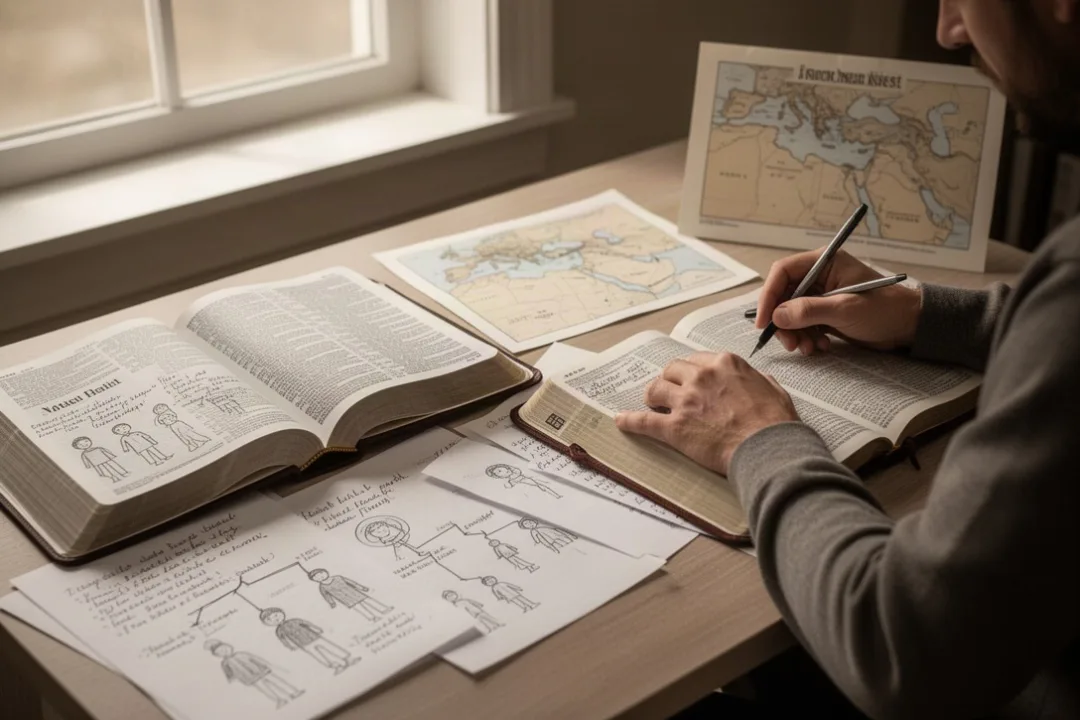
For a manageable reading plan, study one or two chapters at a time and keep a running page of names, locations, promises, and family relationships. Mark repeated words such as bless, seed or offspring, land, remember, and fear not. Repetition often signals what the narrator wants you to notice.
Genesis rewards both close reading and patience. Some passages invite theological reflection, while others require attention to ancient customs, geography, or family structure. Read difficult scenes honestly, avoid turning every character into a simple role model, and follow the book’s central movement: God creates a good world, humanity breaks trust, and God begins his work of blessing and restoration through a promised family.
Frequently asked questions
Who wrote the book of Genesis?
Jewish and Christian tradition has long associated Genesis with Moses as part of the Pentateuch. Genesis itself does not name its human author. Many modern scholars understand the book as reaching its final form through the preservation and shaping of earlier traditions, family records, and narratives. You can study its message without treating every question about composition as settled in exactly the same way.
What is the main message of Genesis?
Genesis presents God as the creator who remains faithful after human rebellion. The book traces how sin damages the world while God establishes covenant promises through Abraham’s family. Its major concern is not only how the world began, but how God’s purposes for blessing, descendants, land, and relationship continue despite human failure, suffering, delay, and family conflict.
Are Genesis 1 and 2 contradictory creation accounts?
The chapters use different emphases and styles. Genesis 1 gives a broad, ordered account of creation, while Genesis 2 focuses closely on humanity, the garden, work, marriage, and moral responsibility. Readers differ on how the chapters relate chronologically, but both present one God as creator and humans as uniquely responsible within creation.
Why does Genesis include so much family conflict?
Family conflict allows Genesis to show how sin operates through favoritism, jealousy, fear, deception, and competition for status. These stories also reveal God’s faithfulness in unpromising circumstances. The difficult behavior of the ancestors is usually described rather than praised, and the consequences help readers understand both the need for reconciliation and the surprising ways God advances his purposes.