Why Matthew, Mark, and Luke are called the Synoptic Gospels
The word synoptic comes from Greek roots meaning “seeing together”. Matthew, Mark, and Luke receive this name because their accounts can be placed side by side and compared across a broad sequence of events. They often tell the same stories, use similar wording, and arrange material in similar ways.
The three books are also called Gospels because each announces and interprets the good news about Jesus Christ. They are not three separate biographies written with exactly the same purpose. Each Gospel selects material, shapes the narrative, and emphasizes particular themes for its readers.
Many passages appear in all three accounts. These include Jesus’ baptism, his calling of disciples, numerous healings, the feeding of a crowd, Peter’s declaration about Jesus, the transfiguration, the final journey to Jerusalem, the crucifixion, and the discovery of the empty tomb. Other passages appear in only two Gospels, while some stories are unique to one author.
The similarities are too extensive to be explained simply by the fact that all three writers knew the general story of Jesus. They share distinctive details and, at times, phrases or sequences that suggest literary or traditional connections. Their differences are also meaningful: one Gospel may expand a saying, relocate an event, omit a detail, or emphasize a different aspect of Jesus’ identity.
Key distinction: “Synoptic” describes the close relationship among Matthew, Mark, and Luke. It does not mean that the three books are identical or that they offer a single, uniform account.
The Gospel of John is not normally included among the Synoptic Gospels. John contains some familiar events, such as Jesus’ baptismal setting, the feeding of a multitude, and the crucifixion, but its structure, vocabulary, chronology, and presentation of Jesus differ substantially from Matthew, Mark, and Luke.
What Matthew, Mark, and Luke have in common
The strongest connection among the Synoptic Gospels is their shared narrative framework. In broad terms, each begins with Jesus’ public appearance in or around Galilee, describes his teaching and works, follows him toward Jerusalem, and ends with his death and resurrection. The wording and amount of detail vary, but the overall movement is recognizable.
All three Gospels portray John the Baptist as the prophetic figure who prepares the way for Jesus. They then describe Jesus’ baptism and his period of testing in the wilderness, followed by the beginning of his public ministry. Jesus teaches crowds, calls disciples, confronts opponents, heals people, and announces God’s reign.
Shared episodes often reveal the central interests of early Christian preaching. For example, all three Synoptic accounts include the feeding of the five thousand. The event presents Jesus as a provider for a hungry crowd, but each Gospel places it within its own narrative and theological setting. The story is not merely a repeated miracle report; it contributes to each writer’s portrait of Jesus and his disciples.
The Synoptics also share many sayings and teaching units. These include teachings about loving enemies, practicing generosity without seeking public praise, responding to anxiety, forgiving others, and taking seriously the demands of discipleship. Jesus’ parables, especially stories about seeds, servants, lost things, and stewardship, appear in overlapping but not identical forms.
Another shared feature is the prominence of the kingdom of God, or in Matthew’s common wording, the kingdom of heaven. This expression refers to God’s active rule and saving purpose, not simply to a place people enter after death. Jesus’ announcement of the kingdom shapes his preaching, miracles, parables, conflicts, and calls to repentance.
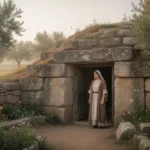
The three accounts also give special attention to the final portion of Jesus’ life. Jesus enters Jerusalem, teaches in the temple area, shares a final meal with his disciples, is arrested, questioned, crucified, and buried. On the first day of the week, women discover that the tomb is empty and receive a message concerning his resurrection.
Several shared themes help readers compare the books:
Jesus’ authority: He teaches, forgives, heals, commands nature, and interprets Scripture with unusual authority.
Discipleship: Those who follow Jesus are called to faith, service, endurance, and a willingness to put God’s purposes above status.
Conflict: Jesus’ actions and teachings create tension with religious and political authorities, especially as his ministry approaches Jerusalem.
Reversal: The humble are lifted up, the powerful are challenged, and apparent defeat at the cross becomes central to the Christian message.
Resurrection: The death of Jesus is not the final event; the empty tomb and resurrection proclamation complete the Gospel story.
These common elements make comparison possible, but comparison should not erase each Gospel’s individual voice. Matthew, Mark, and Luke are best read as related witnesses that share material while making distinct interpretive choices.
How the Synoptic Gospels differ from one another
Matthew, Mark, and Luke do not tell the story of Jesus in precisely the same way. Their differences appear in their openings, arrangement of events, favorite expressions, treatment of the disciples, and presentation of Jesus’ relationship to Israel, outsiders, suffering, and the future.
Matthew presents Jesus as the promised king and teacher
Matthew begins with a genealogy connecting Jesus to Abraham and David, followed by an account of Jesus’ birth and early childhood. This opening places Jesus within Israel’s history and highlights promises associated with Israel’s Scriptures. Matthew repeatedly draws attention to ways Jesus’ life and ministry correspond to those Scriptures.
Matthew contains large, carefully arranged blocks of teaching. The Sermon on the Mount is the best-known example. It gathers teachings about anger, reconciliation, prayer, possessions, judgment, love of enemies, and faithful practice. The arrangement gives the Gospel a strong portrait of Jesus as an authoritative teacher who explains what life under God’s reign requires.
Matthew also uses the phrase “kingdom of heaven” frequently. This wording does not indicate a different kingdom from the one called the kingdom of God in the other Synoptics. It reflects Matthew’s characteristic language and may express reverence for God’s name.
At several points, Matthew portrays the disciples and the church community with particular attention. The Gospel includes teaching about humility, correction, forgiveness, and responsibility within the community of believers. It also closes with Jesus commissioning his followers to make disciples among all nations.
Mark emphasizes urgency, conflict, and the suffering Messiah
Mark is the shortest Synoptic Gospel and begins abruptly with John the Baptist and Jesus’ public appearance. It does not include a birth narrative. The early chapters move quickly from one scene to another, often emphasizing immediate action and repeated encounters with crowds, opponents, illness, demons, and the disciples.
Mark’s Jesus is powerful, but his identity is not easily understood by those around him. Demons recognize something about him, while crowds and disciples struggle to grasp his mission. The Gospel repeatedly presents a pattern in which Jesus performs an act of power, withdraws or teaches privately, and then faces misunderstanding about what it means to follow him.
A major turning point occurs when Peter identifies Jesus as the Christ. Jesus then begins to teach that the Son of Man must suffer, be rejected, die, and rise again. In Mark, the disciples repeatedly resist or misunderstand this teaching. The Gospel therefore joins Jesus’ messianic identity to the path of suffering and challenges readers to understand discipleship in the same light.
Mark’s ending requires careful attention because ancient manuscripts and modern Bibles differ concerning the material after Mark 16:8. Many scholars regard Mark 16:8, where the women leave the tomb in fear and amazement, as the earliest recoverable ending, while later manuscript traditions include additional resurrection appearances. This textual question does not affect the fact that Mark proclaims Jesus’ resurrection, but it does affect how readers discuss the Gospel’s final verses.
Luke highlights God’s mercy, the Holy Spirit, and outsiders
Luke opens with a formal preface explaining that the author has investigated earlier reports and is presenting an orderly account for a reader named Theophilus. It then gives detailed birth narratives for John the Baptist and Jesus. Luke’s opening chapters emphasize the work of the Holy Spirit, the fulfillment of God’s promises, and the significance of Jesus’ birth for Israel and the wider human family.
Luke includes several well-known passages that are absent from Matthew and Mark. These include the parables of the Good Samaritan and the Prodigal Son, as well as a fuller account of Jesus’ interaction with Zacchaeus. Luke often places people who are socially overlooked near the center of the story, including the poor, women, Samaritans, sinners, and those regarded as outsiders.
Prayer is another prominent theme. Luke frequently shows Jesus praying at important moments, and the Gospel gives special attention to Jesus’ teaching about persistence and trust in prayer. Joy, praise, the activity of the Spirit, and God’s concern for the vulnerable also receive sustained emphasis.
Luke’s Gospel is the first part of a two-volume work completed by the book of Acts. The transition from Jesus’ resurrection and ascension to the Spirit-empowered mission of the apostles gives Luke a broad view of God’s saving work, extending from Israel’s story to the proclamation of Jesus among the nations.
How scholars explain the relationship among the Synoptic Gospels
The question of how Matthew, Mark, and Luke are related is called the Synoptic Problem. It is not a question about whether the Gospels are valuable or whether their central claims can be believed. It is a literary and historical question: how did these three authors receive, arrange, and write their shared material?
Readers have always recognized both similarities and differences. Early Christian writers offered explanations involving apostolic testimony, memory, preaching, and the use of earlier written material. Modern scholarship has proposed several models, but no single explanation has been accepted by every scholar.
The two-source model and Markan priority
The most widely discussed model in modern Synoptic studies is often called the two-source hypothesis. It proposes that Mark was written first and that Matthew and Luke used Mark as one of their sources. It also proposes a second source, commonly called “Q,” for material shared by Matthew and Luke but not found in Mark.
Under this model, Matthew and Luke would have used Mark’s narrative framework while adding other traditions. The hypothetical Q source is not an existing manuscript. The letter is simply a convenient label for a proposed collection or source of sayings. Because no independent copy of Q has survived, scholars continue to debate whether it existed as a written document or whether the shared material came through overlapping oral and written traditions.
Several observations support Markan priority. Mark is generally more compact and sometimes uses rougher or less polished Greek than Matthew and Luke. Matthew and Luke often expand Mark’s scenes, clarify expressions, or smooth the wording. They also occasionally omit material that may have seemed difficult or less useful for their purposes.
Other models for explaining shared material
Some scholars argue for other relationships. The Farrer model, for example, accepts Markan priority but proposes that Luke used Matthew directly, removing the need for a separate Q source. Other approaches suggest that Luke may have been written before Matthew, or that Matthew and Luke independently used Mark and shared oral traditions.
A different family of proposals, sometimes called the Griesbach or Two-Gospel model, argues that Matthew came first, Luke used Matthew, and Mark drew from both. This model explains certain features of Mark as a shortened or conflated account, though many scholars prefer models that place Mark first.
Ancient testimony about authorship and modern analysis of language, structure, and editorial patterns do not always point in exactly the same direction. The Synoptic Problem therefore remains an area of continuing study rather than a question settled by one simple formula.
It helps to separate three levels of confidence:
Clear relationship: Matthew, Mark, and Luke share enough material and order to show that their traditions are closely connected.
Strong scholarly proposal: Many scholars consider Markan priority a persuasive explanation for the evidence.
Open question: The precise relationship between Matthew and Luke, including the existence and nature of Q, remains debated.
Reading tip: A proposed source relationship explains how the Gospels may have been composed; it does not replace attention to what each Gospel actually says or how each author shapes the story.
How to compare the Synoptic Gospels responsibly
Comparing parallel passages can show both shared tradition and distinctive emphasis. A useful comparison begins with the same episode in two or three Gospels rather than attempting to compare every verse at once. The feeding of the five thousand, the calming of the storm, Peter’s confession, or the resurrection narratives provide accessible starting points.
Read the passage in its immediate setting. A saying may have a different force depending on what comes before and after it. One Gospel may place a teaching during a journey, another within a major discourse, and another near a conflict with religious leaders. The surrounding narrative often reveals why the author included the material there.
Pay attention to what changes and what stays the same. Useful questions include:
Which people are present, and does the Gospel add or omit someone?
What details receive the most space?
How are Jesus’ disciples described in this scene?
Does the passage emphasize faith, fear, misunderstanding, compassion, judgment, or fulfillment?
Where does the event occur in the narrative, and what does that placement accomplish?
Does the author use a distinctive title for Jesus, such as Son of Man, Son of God, Messiah, or Lord?
Word choice also matters, although readers should avoid treating every small variation as a contradiction. Ancient authors could retell the same event with flexible wording, and translations may conceal or create differences. A responsible comparison considers the whole passage, the Gospel’s recurring themes, and the cultural setting of the first-century Mediterranean world.
The differences in the resurrection accounts deserve particular care. Matthew, Mark, and Luke agree on the central proclamation that Jesus was raised and that women were among the first witnesses to the empty tomb. They differ in details such as the number and identity of heavenly messengers, the reactions of the women, and the location or timing of appearances. These variations invite readers to hear each Gospel’s testimony on its own terms rather than forcing every detail into a single blended narrative.
The same principle applies to Jesus’ teachings. Matthew’s version of a saying may appear in a carefully arranged teaching discourse, while Luke’s version may occur during a journey or in a setting that highlights poverty, prayer, or social reversal. The variation does not automatically mean that one writer misunderstood Jesus. It may reflect different occasions of teaching, flexible oral transmission, or deliberate editorial arrangement.
Why the Synoptic Gospels matter for understanding Jesus
The Synoptic Gospels give readers three closely related portraits of Jesus. Taken together, they present him as a Jewish teacher and prophet, the Messiah, the Son of Man, the Son of God, and the one whose death and resurrection stand at the center of Christian faith. Each Gospel contributes details that sharpen the others without becoming interchangeable.
Matthew helps readers see Jesus in relation to Israel’s Scriptures and the formation of a community shaped by his teaching. Mark presses the question of whether people will recognize Jesus when power is joined to suffering. Luke broadens the view toward mercy, prayer, the Spirit, social outsiders, and the mission that continues through Acts.
Their shared witness also protects readers from reducing Jesus to one theme. He is not only a teacher, not only a miracle worker, and not only a political or religious figure. The Synoptic accounts hold together his compassion for individuals, his announcement of God’s kingdom, his conflict with opponents, his call to radical discipleship, and his willingness to suffer.
Reading the Synoptics together can also clarify the difference between historical sequence and theological arrangement. Ancient biographies did not always organize material according to modern expectations of chronological reporting. An author could place related sayings together or arrange events to make a theological point while still presenting a genuine account of Jesus’ ministry.
For a focused study, choose one theme and trace it through all three books. You might follow Jesus’ treatment of children, his response to illness, the role of meals, the meaning of the kingdom, the disciples’ failures, or the place of prayer. This method reveals repeated patterns while preserving each Gospel’s individual contribution.
A practical reading plan can look like this:
Read one complete Gospel without stopping to harmonize it with the others.
Mark repeated themes, titles for Jesus, and descriptions of the disciples.
Choose three or four parallel episodes and read them side by side.
Record additions, omissions, changes in order, and distinctive wording.
Ask what each author wants the reader to understand about Jesus and faithful response.
Return to the larger narrative so that individual differences are interpreted within the Gospel’s full shape.
The Synoptic Gospels are therefore both a shared testimony and three crafted narratives. Their agreements make comparison possible, while their differences invite careful reading. Together, Matthew, Mark, and Luke offer a fuller understanding of Jesus’ ministry, teaching, suffering, death, and resurrection than any one account could provide by itself.
Frequently asked questions
Is the Gospel of John one of the Synoptic Gospels?
No. The Synoptic Gospels are Matthew, Mark, and Luke. John is grouped separately because it follows a different structure, uses different language, includes different material, and presents Jesus’ ministry in a distinct way. John still shares some major events with the Synoptics, but those overlaps do not make it a Synoptic Gospel.
Which Synoptic Gospel was written first?
Many scholars believe Mark was written first, a position known as Markan priority. Matthew and Luke may then have used Mark along with other traditions or sources. The exact relationship remains debated, however, and alternative models propose different orders or kinds of dependence.
What does “Q” mean in studies of the Synoptic Gospels?
“Q” is a scholarly label for a proposed source containing material shared by Matthew and Luke but absent from Mark. No surviving manuscript of Q has been found. Some scholars think it was a written collection, while others explain the shared material through oral tradition or other sources.
Do differences among the Synoptic Gospels mean they contradict one another?
Differences show that Matthew, Mark, and Luke selected and arranged material for distinct purposes. Some details are difficult to reconcile precisely, but variation does not automatically amount to contradiction. Each Gospel should first be read as a complete narrative, with its own emphasis, context, and way of presenting Jesus.

















Leave a Reply