Jesus heals blind men: Every Gospel account explained
Jesus heals blind men: Every Gospel account explained
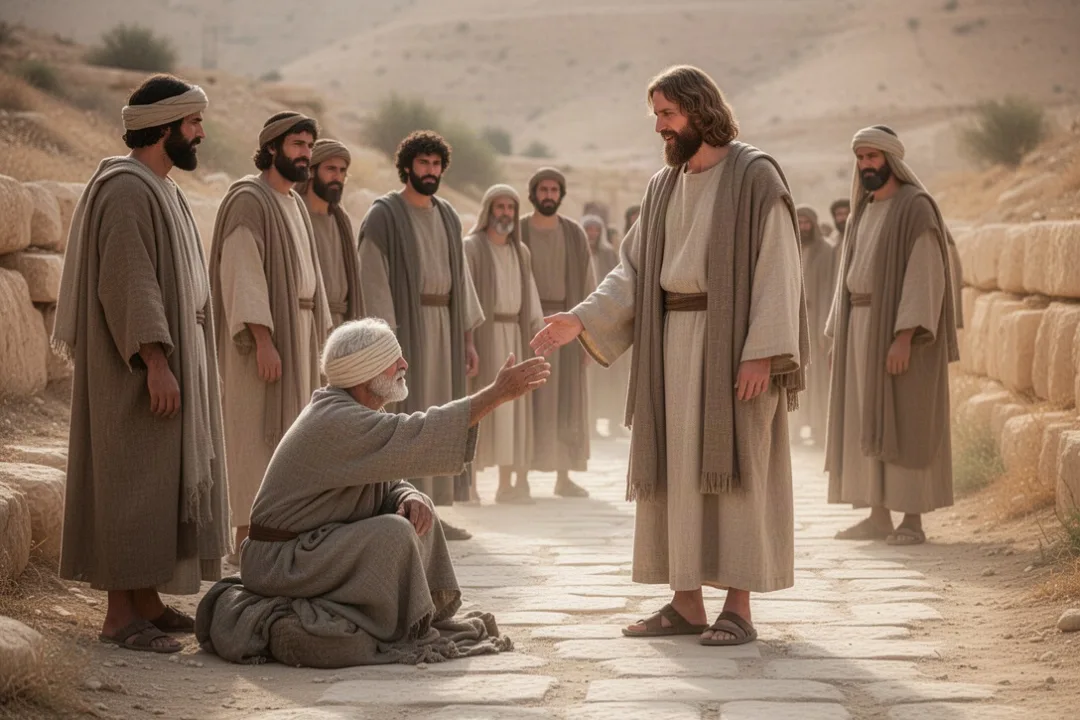
When you read that Jesus heals blind men, you may wonder which story the Bible means. The Gospels record several different healings, not one repeated account: Matthew describes two men near Jericho and two men who approached Jesus in Galilee, while Mark and Luke focus on a man named Bartimaeus or an unnamed blind beggar. John also tells of a man who had been blind from birth.
These accounts differ in setting and detail, but they share a central message. Jesus responds to people who call for mercy, restores sight with compassion and authority, and uses physical healing to reveal something about faith, recognition, and discipleship. The stories should be read as individual encounters rather than merged into a single event.
Quick answer: The main accounts are Matthew 9:27-31, Matthew 20:29-34, Mark 8:22-26, Mark 10:46-52, Luke 18:35-43, and John 9:1-41. Matthew’s account near Jericho mentions two blind men; Mark names one of them Bartimaeus, and Luke describes one unnamed man.
The Gospel writers present multiple healings involving blindness. Their accounts are not all descriptions of the same event, and each writer emphasizes different details. Some stories happen in villages or on roads, while others occur as Jesus travels toward Jerusalem.
Two blind men in Galilee: Matthew 9:27-31 describes two men following Jesus and asking for mercy. After they affirm their trust in his ability to help, Jesus restores their sight.
A blind man at Bethsaida: Mark 8:22-26 records a gradual healing in which Jesus leads the man outside the village, applies saliva to his eyes, and touches him more than once.
Blind men near Jericho: Matthew 20:29-34 says two blind men call out to Jesus as he leaves Jericho. One of them is not named in Matthew.
Bartimaeus near Jericho: Mark 10:46-52 names Bartimaeus, the son of Timaeus, and describes his persistent appeal as Jesus leaves Jericho.
An unnamed blind man near Jericho: Luke 18:35-43 describes a blind man sitting beside the road as Jesus approaches Jericho. The man receives his sight and follows Jesus.
A man blind from birth: John 9:1-41 tells of Jesus healing a man who had never seen. The story also examines the hostility of religious leaders and the man’s growing understanding of who Jesus is.
Matthew’s two stories deserve special attention. In Matthew 9, the men come to Jesus inside a Galilean setting and later spread news of the healing despite his instruction to keep it quiet. In Matthew 20, the men are beside the road near Jericho during Jesus’ final journey to Jerusalem, and the crowd tries to silence them before Jesus stops to help.
Mark and Luke may be describing the same Jericho encounter from different perspectives. Mark gives the man’s name, Bartimaeus, while Luke leaves him unnamed. Matthew mentions two men, whereas Mark and Luke highlight one. These differences do not require the accounts to be treated as contradictory; an eyewitness tradition or group encounter can be reported with attention to one especially memorable person.
John 9 is different in both length and purpose. It is not a brief healing story followed by a departure. Instead, the healing becomes the center of a longer conflict about sin, suffering, religious authority, spiritual blindness, and the identity of Jesus. The man’s restored physical sight leads to a public testimony, questioning, rejection, and an increasingly clear confession of faith.
What happened when Jesus healed blind men near Jericho?
The Jericho accounts take place as Jesus travels toward Jerusalem. In Mark and Luke, a blind man hears that Jesus is passing by and begins calling out for mercy. Matthew records two men calling out together. Their words identify Jesus as the Son of David, a title connected with the expected royal deliverer.
The crowd’s reaction forms an important part of the story. The people around Jesus tell the men to be quiet, but they continue calling out. Their persistence is not presented as rude or pointless. It shows that they recognize an opportunity for help and refuse to let public pressure keep them silent.
Jesus stops and asks that the man or men be brought to him. In Mark and Luke, the crowd’s attitude changes once Jesus responds: the people encourage the blind man to take heart and come forward. The scene moves from exclusion to welcome. A person sitting at the edge of the road is now directly addressed by Jesus.
Jesus asks what the man wants him to do. The request is straightforward: he wants to see. The question does not suggest that Jesus lacks knowledge of the need. Instead, it gives the man an opportunity to express his desire openly and to approach Jesus as a person with a voice, not merely as someone receiving charity.
Matthew says Jesus is moved with compassion and touches their eyes. Mark and Luke emphasize the man’s faith and the immediate restoration of sight. The precise wording varies among the accounts, but the result is the same: the blind man can see, and the encounter changes the direction of his life.
Luke says the man responds by glorifying God and follows Jesus. Mark also portrays Bartimaeus as following Jesus on the road. That detail matters because the healing is not treated as an isolated benefit. Restored sight leads to a new relationship with Jesus, public praise, and active discipleship.
The Jericho stories portray faith as a persistent response to Jesus’ presence, not as a technique that forces a desired result.
The phrase “your faith has made you well,” found in the Mark and Luke accounts, should not be reduced to the idea that confidence itself produces a miracle. The story presents faith as trust directed toward Jesus. The man hears that Jesus is near, calls to him, persists when discouraged, and follows him after receiving sight.
These events also challenge the assumption that a person’s social position determines whether he can approach God. The blind beggar has little public influence, but Jesus gives him attention. The crowd may see him as an interruption; Jesus sees a person whose request deserves to be heard.
How do the other Gospel healings differ?
Two blind men ask Jesus for mercy in Matthew 9
Matthew 9:27-31 describes two blind men following Jesus and calling him the Son of David. They ask for mercy rather than presenting a claim based on merit. Jesus then asks whether they believe he can do what they are requesting. After they answer, he touches their eyes, and their sight is restored.
This story places emphasis on trust in Jesus’ authority. The men do not simply admire him as a teacher or seek a general blessing. They believe he has the power to restore what they have lost. Matthew also includes a private setting: Jesus enters a house, and the men come to him there.
Jesus tells them not to spread the news, but they make his reputation known throughout the region. Their response creates a tension found in several Gospel stories. Jesus may seek to avoid publicity that distorts his mission, while those who experience his mercy feel compelled to tell others.
The gradual healing at Bethsaida
Mark 8:22-26 is the only Gospel account in which Jesus heals a blind man in stages. People bring the man to Jesus and ask him to touch him. Jesus takes him outside the village, uses saliva, places his hands on him, and asks whether he can see.
At first, the man’s vision is incomplete. He describes people in a confused way, and Jesus touches his eyes again. After that, his sight is fully restored. Jesus then sends him home and tells him not to return to the village.
The gradual nature of this healing is significant because it shows that the Gospel narratives do not present every miracle as occurring in exactly the same way. Jesus heals instantly in some accounts and progressively in this one. The story does not imply that the man’s faith was defective or that the first touch failed. It simply records a healing that unfolds in stages.
Mark places this event near other scenes involving the disciples’ limited understanding. Because of that wider context, many readers see the restored sight as fitting Mark’s repeated contrast between physical sight and spiritual perception. The disciples may see Jesus’ works and still struggle to understand his mission, just as the man’s sight becomes clear in stages.
The man born blind in John 9
John 9 begins with Jesus and his disciples encountering a man blind from birth. The disciples ask whether the blindness resulted from the man’s sin or his parents’ sin. Jesus rejects the assumption that the man’s condition can be explained by assigning personal blame for it.
Jesus makes mud with saliva, puts it on the man’s eyes, and tells him to wash in the pool of Siloam. The man obeys and returns able to see. John does not end the story at the miracle. Neighbors question what happened, the Pharisees investigate, and the man repeatedly describes the facts of his experience.
As the questioning continues, the healed man becomes more direct about Jesus. He begins by identifying him as the man who healed him. Later, he argues that Jesus must come from God because God does not ordinarily work through someone acting in deliberate rebellion. After being expelled, he encounters Jesus again and comes to recognize him more fully.
John uses the conflict to expose another kind of blindness. The man who lacked physical sight gradually sees more clearly who Jesus is, while some leaders who possess physical sight refuse to acknowledge what has happened. The story therefore connects healing with revelation and moral perception, not merely with improved eyesight.
Keep the stories distinct: Bartimaeus is associated with the Jericho healing in Mark 10, while the man born blind belongs to John 9. Combining these accounts can obscure the particular details and meanings each Gospel writer preserves.
What do these healings teach about Jesus?
The healings portray Jesus as someone who responds to human suffering with both authority and compassion. He does not treat blindness as an abstract theological problem. He listens to people, asks questions, touches them in several accounts, and restores their ability to participate more fully in ordinary life.
They also reveal Jesus as the promised Son of David. In the Jericho stories, the blind men use this title when they call for mercy. Their physical need becomes an occasion for recognizing Jesus’ royal and messianic identity, especially as he approaches Jerusalem.
The stories present Jesus’ power as personal rather than mechanical. He uses different actions in different situations: a touch, a word, saliva, mud, or a second touch. These details prevent readers from treating healing as a formula. The source of the miracle is not a particular substance, gesture, or sequence but Jesus himself.
At the same time, the accounts do not portray every person who asks as receiving the same visible outcome in the same way. The Gospels record particular signs connected with Jesus’ ministry; they do not provide a promise that every modern illness will be healed immediately if someone believes strongly enough.
That distinction matters pastorally. The phrase “your faith has made you well” can be misused to blame sick or disabled people when healing does not occur. The Gospel accounts do not authorize such blame. John 9 directly rejects the idea that suffering can automatically be traced to the individual’s sin or the parents’ sin.
The miracles also point beyond physical restoration. Blindness is frequently used in Scripture as an image for misunderstanding or resistance to God, but the physical people in these accounts should not be reduced to symbols. They are real people who suffer, speak, make choices, and receive compassionate attention.
A careful reading holds both dimensions together:
Physical healing matters: Jesus responds to real bodily suffering and restores sight as a genuine act of mercy.
Spiritual insight matters: the stories ask whether people recognize Jesus and respond to him faithfully.
Human dignity matters: the blind men are not treated as objects or interruptions.
Discipleship matters: those who are healed often praise God, tell others, or follow Jesus.
The stories also show that Jesus’ mission is not shaped by the crowd’s priorities. The crowd may want order, speed, or silence. Jesus stops for people whose needs are easy to overlook. His compassion includes attention: he hears the call, makes room for the person, and responds directly.
How should Christians read and apply these stories?
For Christian readers, the blind men’s cries provide a model of honest prayer. They do not disguise their need or pretend to be self-sufficient. They ask Jesus for mercy, identify what they want, and continue calling when other people discourage them.
That does not mean prayer is a way to pressure God into granting a specific outcome. Their example is better understood as candid dependence. They bring their need to Jesus because they trust his character and authority, while the Gospel narratives leave room for God’s timing and purposes.
The accounts also encourage churches to examine how they treat vulnerable people. The crowd initially acts as a barrier, but Jesus makes the person welcome. A congregation can unintentionally silence people through rushed services, inaccessible spaces, dismissive attitudes, or assumptions about what someone needs.
Practical care can include:
Providing clear, accessible paths and seating for people with visual disabilities.
Offering large-print, Braille, audio, or screen-reader-friendly resources where possible.
Speaking directly to a blind person instead of addressing a companion as though the person were absent.
Asking before offering physical assistance and respecting the person’s answer.
Avoiding language that treats disability as proof of weak faith or divine punishment.
Listening to people with disabilities about the support they actually want.
Readers should also resist turning the stories into a simple formula: ask loudly, believe perfectly, and receive exactly what you request. The Gospels emphasize faith, but they do not present faith as a force controlled by human technique. Biblical faith is relational trust in God, not a guarantee that removes all uncertainty.
The account in John 9 is especially helpful for people who have experienced religious blame. Jesus does not accept the disciples’ assumption that blindness must be explained by someone’s sin. The story then shows a healed man facing interrogation and exclusion, reminding readers that religious communities can respond poorly even when God’s work is plainly visible.
For someone praying for healing today, these accounts can support several honest responses at once. You may ask God for restoration, seek competent medical care, receive help from others, lament what remains difficult, and continue to trust God without pretending that pain is easy. Faith does not require denying a diagnosis or silencing grief.
The stories finally invite a personal question: what does it mean to see Jesus clearly? The blind men recognize that they need mercy. Bartimaeus follows after receiving sight. The man in John 9 moves from uncertainty toward worship. Their examples suggest that spiritual sight involves humility, courage, truthful witness, and willingness to follow.
Why are there different details in the Gospel accounts?
Readers sometimes become concerned when Matthew mentions two men, while Mark and Luke focus on one. The same concern arises when one account places the event as Jesus approaches Jericho and another as he leaves it. Such differences deserve careful reading rather than quick dismissal.
Each Gospel writer selects and arranges material for a particular purpose. A writer may mention everyone present, while another may focus on the person who became especially memorable or whose response best serves the narrative. A location can also be described in relation to entering or leaving a town, especially when an event occurs near its outskirts.
The accounts agree on the main shape of the Jericho encounter: a blind person or persons hear that Jesus is passing, call for mercy, face resistance from the crowd, receive Jesus’ attention, and are restored. Mark supplies the name Bartimaeus; Luke emphasizes praise and following; Matthew includes two men and highlights compassion.
These differences can enrich reading when each account is allowed to speak in its own voice. Combining every detail into one flattened version may seem to solve the tension, but it often removes the emphasis the writer intended. A sound approach is to compare the passages while preserving their individual details.
The central claim remains clear across the accounts: Jesus has authority to heal, compassion for those who suffer, and power to bring people from exclusion into restored participation. The Gospels invite readers not merely to catalogue miracles but to consider how people respond when Jesus passes by and calls them into a new way of seeing.
Frequently asked questions
How many blind people did Jesus heal according to the Bible?
The Gospels describe several separate healings involving blind people. Matthew records two men in Galilee and two near Jericho. Mark records the man at Bethsaida and Bartimaeus, while Luke records one unnamed man near Jericho. John tells of a man blind from birth. The exact total cannot be determined from the Gospel accounts alone because some reports may describe the same encounter from different perspectives.
Is Bartimaeus the same person as the blind man in Luke?
Bartimaeus is named in Mark 10:46-52, while Luke 18:35-43 describes an unnamed blind man near Jericho. Many readers understand these as parallel accounts of the same healing, because the location, timing, request, and response are similar. Luke may simply omit the name, and the difference in wording does not require treating the accounts as unrelated.
Why did Jesus heal the blind man at Bethsaida in two stages?
Mark 8 records a gradual healing: the man first sees unclearly, and after Jesus touches him again, his vision becomes clear. The passage does not say that the man lacked faith or that Jesus’ first action failed. The unusual sequence may also fit Mark’s wider theme of people gaining understanding gradually, but the text does not give one explicit explanation.
Does the Bible say blindness is caused by sin?
No. In John 9, Jesus rejects the disciples’ assumption that a man’s blindness must be caused by his sin or his parents’ sin. The passage does not deny that wrongdoing can cause harm in some situations, but it does reject automatic blame. Blindness and other disabilities should not be treated as proof of personal spiritual failure or divine punishment.













Leave a Reply