The transfiguration of Jesus: Meaning and Bible account
The transfiguration of Jesus: Meaning and Bible account
The transfiguration of Jesus was a moment when Jesus’ appearance changed before three disciples, revealing his divine glory. Moses and Elijah appeared with him, and a heavenly voice identified Jesus as God’s beloved Son and commanded the disciples to listen to him.
The event is recorded in Matthew 17:1–8, Mark 9:2–8, and Luke 9:28–36. It took place on a high mountain shortly before Jesus began the final journey toward his suffering, death, and resurrection.
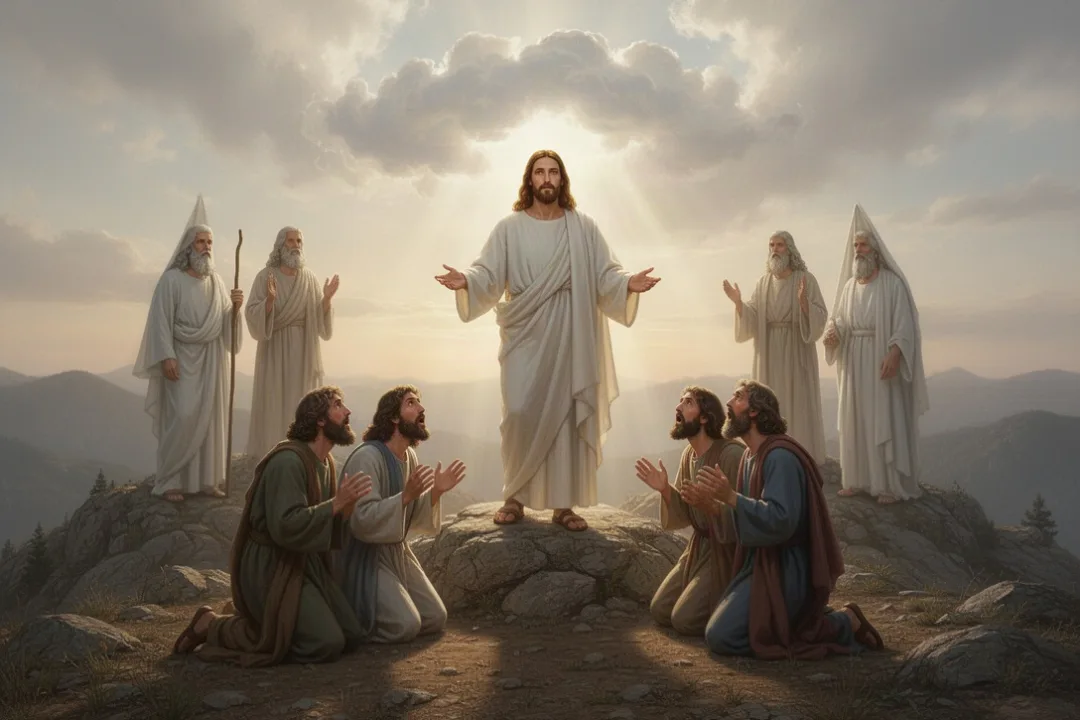
Jesus took Peter, James, and John with him up a mountain to pray. While he was praying, his appearance changed: his face shone or became altered, and his clothing became brilliantly bright. The Gospel accounts present this change as a visible revelation of the glory that belonged to Jesus.
Moses and Elijah then appeared and spoke with him. Luke explains that they discussed Jesus’ approaching departure, meaning the saving work he would accomplish in Jerusalem. A bright cloud overshadowed the disciples, and a voice from the cloud declared Jesus’ unique relationship with God.
The disciples fell facedown in fear, but Jesus came near and touched them. When they looked up, they saw no one except Jesus. As they came down the mountain, Jesus instructed them not to speak about the vision until after the Son of Man had been raised from the dead.
Central meaning: The transfiguration reveals Jesus’ divine glory and confirms his authority before the disciples face the shock of his suffering and crucifixion.
The biblical context before the mountain
The transfiguration does not appear as an isolated miracle. In each Gospel, it follows a major turning point in Jesus’ ministry: the disciples begin to recognize him as the Messiah, and Jesus starts speaking openly about his coming suffering.
In Matthew 16, Peter identifies Jesus as the Messiah and Son of God. Jesus then explains that he must suffer, be killed, and be raised. This prediction is difficult for the disciples, who expect the Messiah to bring victory and visible rule rather than rejection and death.
Mark presents the same tension in Mark 8. Peter’s confession is followed by Jesus’ teaching about the cost of discipleship. The transfiguration therefore serves as a divine confirmation: the path to the cross does not cancel Jesus’ identity or glory.
Luke connects the event especially closely with prayer. Jesus goes up the mountain to pray, and his appearance changes during prayer. Luke also emphasizes that Moses and Elijah speak about what Jesus will accomplish in Jerusalem, linking the mountain vision with the central events of the Gospel.
The transfiguration step by step
Jesus chooses three disciples. Peter, James, and John accompany him. These same disciples will later be present at the raising of Jairus’s daughter and at Jesus’ anguish in Gethsemane.
Jesus goes up a high mountain. The Gospel writers do not all name the mountain. The height creates a setting associated with prayer, revelation, and meeting with God.
Jesus is transfigured. His face and clothing become radiant. The change is not described as a costume or external disguise, but as a revelation of extraordinary glory.
Moses and Elijah appear. They represent major parts of Israel’s Scripture and history, and they speak with Jesus about his mission.
Peter responds to the vision. He offers to make shelters for Jesus, Moses, and Elijah, although the Gospel accounts explain that he does not fully understand what he is saying.
The cloud overshadows the group. A cloud often signifies God’s presence in biblical scenes of revelation.
The Father’s voice speaks. The voice confirms Jesus as the beloved Son and directs the disciples to listen to him.
The vision ends with Jesus alone. Moses and Elijah disappear, leaving Jesus as the central and decisive figure.
Jesus tells the disciples to wait before speaking. They are to keep the vision private until after the resurrection, when its meaning will become clearer.
Why Jesus was transfigured before Peter, James, and John
The transfiguration strengthened the disciples before Jesus’ suffering. They would soon see him rejected, beaten, and crucified. The mountain vision gave them a deeper understanding that his humiliation did not disprove his divine identity.
Peter, James, and John were not shown every detail of Jesus’ future, but they received a sign they could remember. The experience helped connect Jesus’ glory with his obedience and suffering, rather than treating them as contradictory parts of his mission.
The event also prepared the disciples to receive Jesus’ teaching with greater seriousness. The heavenly command is not simply an invitation to admire the vision. It tells them to listen to Jesus, including his difficult teaching about the cross, self-denial, forgiveness, and the coming kingdom.
For Christian readers, the setting carries a practical lesson. Spiritual understanding is not measured only by dramatic experiences. The disciples see something extraordinary, yet they still need to follow Jesus down the mountain and live faithfully amid confusion, need, and suffering.
What the word transfiguration means
The English word transfiguration means a change in appearance that reveals a deeper reality. The New Testament accounts describe Jesus as being changed before the disciples, but the event is more than a change in lighting or facial expression.
Christian theology generally understands the transfiguration as a manifestation of Jesus’ divine glory. Jesus does not become divine at that moment. Instead, the disciples are allowed to perceive something of the glory that is ordinarily hidden by his ordinary human appearance.
This is why the event matters so much in relation to the incarnation. Jesus is fully present as a human being—tired, praying, traveling, and soon to suffer—while also being revealed as the Son who shares divine glory. The transfiguration holds these truths together rather than forcing a choice between them.
Why Moses and Elijah appeared with Jesus
Moses and Elijah are two of the most important figures in the Hebrew Scriptures. Moses received the law and encountered God on a mountain. Elijah served as a prophet during a time of widespread unfaithfulness and also experienced a significant encounter with God on a mountain.
Their presence places Jesus within the story of Israel while also showing that his authority exceeds theirs. Moses and Elijah do not compete with Jesus or stand beside him as equal centers of revelation. After the cloud and the voice, they disappear, and the disciples see Jesus alone.
Many Christians understand Moses as representing the law and Elijah as representing the prophets. This interpretation fits the wider biblical pattern in which Jesus fulfills the hopes and promises of Israel’s Scriptures. The exact symbolism is not stated in one simple sentence, so it should be treated as a theological reading rather than a claim that the Gospel writers explicitly define every detail.
Luke adds an important detail: Moses and Elijah speak with Jesus about his “departure,” understood as the work he will accomplish in Jerusalem. This connects the ancient witnesses directly to the cross, resurrection, and the completion of Jesus’ mission.
The meaning of the mountain and the cloud
The mountain is a setting of prayer and revelation throughout the Bible. Moses receives the law on a mountain, Elijah encounters God in a mountain setting, and Jesus often withdraws to elevated or solitary places to pray.
The Gospel writers do not identify the mountain by name. Later Christian tradition associated the transfiguration with Mount Tabor, while some readers have proposed other locations, including a mountain in the region of Caesarea Philippi. The text itself leaves the location unspecified, so the spiritual meaning does not depend on identifying it.
The cloud recalls the visible signs of God’s presence in Israel’s worship and wilderness story. It is not presented merely as weather. The cloud marks the arrival of divine glory and creates the setting for the Father’s declaration about Jesus.
At the same time, the cloud conceals as well as reveals. The disciples receive genuine knowledge, but they do not receive complete mastery over God’s purposes. The scene invites reverence and trust rather than the idea that a single vision answers every question.
What the voice from heaven means
The voice identifies Jesus as God’s beloved Son. This echoes the voice at Jesus’ baptism, where Jesus is publicly affirmed at the beginning of his ministry. At the transfiguration, the statement comes after Jesus has begun teaching about suffering, making the confirmation especially significant.
The command to listen to Jesus directs the disciples toward obedience. They are not told only to look at the shining figure or to preserve the experience. They must hear and follow Jesus’ words, including his explanation of the cross and his call to faithful discipleship.
The voice also establishes Jesus’ authority over the representatives of the law and the prophets. Moses and Elijah are honored, but the command centers on Jesus. His teaching is not one voice among several; it is the decisive revelation the disciples are called to receive.
“Listen to him” is the central instruction of the mountain scene, directing attention from the spectacle to the person and teaching of Jesus.
Peter suggests building three shelters, one for Jesus, one for Moses, and one for Elijah. The Gospel accounts present his response as confused or incomplete. He recognizes that the moment is important, but he does not yet understand that Jesus cannot be placed on the same level as the other two figures.
Peter may also be trying to preserve the experience. Like many people who encounter something meaningful, he wants to remain at the place of revelation. Yet Jesus’ mission does not end on the mountain. The disciples must return to ordinary life, where they will face suffering, questions, and the needs of other people.
His response offers a useful warning about spiritual experiences. A powerful moment can be genuine and still be misunderstood. The proper response is not to cling to the moment or make it the center of faith, but to let it deepen obedience to Jesus.
How the transfiguration points toward the resurrection
Jesus tells the disciples to keep the vision quiet until the Son of Man has risen. This instruction shows that the transfiguration cannot be fully understood apart from the resurrection. The disciples need the resurrection to interpret both the glory they saw and the suffering Jesus predicted.
The event anticipates the resurrection by revealing Jesus in radiant glory, but it is not itself the resurrection. Jesus remains on the mountain, speaks with the disciples, and then continues toward Jerusalem. The vision points forward; it does not replace the death and resurrection at the heart of the Gospel.
The relationship between the two events is essential. The transfiguration says that the crucified Jesus is truly glorious, while the resurrection confirms that his suffering leads to victory. Together, they challenge the assumption that weakness, rejection, or death can have the final word over God’s saving purpose.
How the three Gospel accounts differ
Matthew, Mark, and Luke describe the same central event while emphasizing different details. Comparing them can help you see the full picture without treating their differences as contradictions.
Matthew 17:1–8 describes Jesus’ face shining like the sun and his clothes becoming white. It emphasizes the disciples’ fear and Jesus’ reassuring touch.
Mark 9:2–8 gives a vivid description of Jesus’ clothes becoming exceptionally white. Mark also highlights Peter’s uncertainty because the disciples are frightened.
Luke 9:28–36 says the event occurs while Jesus is praying. It names the subject of Jesus’ conversation with Moses and Elijah as his departure in Jerusalem.
All three accounts agree on the central features: Jesus takes the three disciples up a mountain, his appearance changes, Moses and Elijah appear, a cloud overshadows them, the heavenly voice speaks, and Jesus remains after the other figures vanish.
The differences give each account its own emphasis. Matthew highlights fulfillment and Jesus’ authority, Mark emphasizes the disciples’ limited understanding, and Luke connects the vision with prayer and the coming events in Jerusalem.
What the transfiguration teaches about Jesus’ identity
The transfiguration presents Jesus as more than a prophet or teacher. He stands in continuity with Moses and Elijah, yet he is also the one whom the heavenly voice commands the disciples to hear. His identity is shown through divine glory, the Father’s testimony, and his relationship to Israel’s Scriptures.
The scene also confirms the title Son of God. That title does not merely describe a close relationship with God. In the context of the Gospel narratives, it points to Jesus’ unique authority, mission, and unity with the Father.
At the same time, the event does not erase Jesus’ humanity. He prays, speaks with the disciples, touches them, and walks back into a world of need. The transfiguration presents divine glory revealed through the life and mission of the incarnate Jesus.
What the transfiguration teaches about discipleship
The disciples are invited to witness Jesus’ glory, but they are not allowed to remain spectators. They must descend the mountain with him. The next part of the Gospel story returns them to arguments, suffering, unbelief, and the practical work of serving others.
This pattern can shape Christian discipleship. Prayer and worship may give clarity, strength, or a deeper awareness of God, but they lead toward faithful action. A meaningful spiritual experience is measured partly by how it changes a person’s listening, choices, compassion, and endurance afterward.
Listen before speaking. The Father’s command places attentive obedience above speculation about the vision.
Hold glory and suffering together. Faith does not require pretending that hardship is unreal or that God is absent in it.
Return to ordinary responsibilities. The disciples leave the mountain and continue serving in difficult circumstances.
Trust Jesus when understanding is incomplete. The disciples do not grasp everything immediately, yet they remain part of Jesus’ continuing work.
Keep the focus on Jesus. Religious symbols, teachers, and experiences can point toward him but should not displace him.
How Christians observe the transfiguration
Many Christian traditions commemorate the transfiguration on a dedicated feast day. The date and customs vary by denomination and church calendar, but the readings commonly come from one of the three Gospel accounts.
Worship services may use bright colors, themes of light, or prayers about seeing God’s glory. These practices are intended to direct attention toward Jesus rather than recreate the event. No Christian practice can reproduce the mountain vision, and the Gospel does not instruct believers to seek a similar spectacle.
A thoughtful observance might include reading all three accounts, praying through the command to listen to Jesus, or reflecting on how faith remains steady when suffering follows a season of clarity. The purpose is remembrance and deeper discipleship, not a search for extraordinary experiences.
Questions the transfiguration raises for readers today
The story raises questions about how people respond when God’s purposes do not match their expectations. The disciples expect a powerful Messiah, but Jesus tells them about suffering. The transfiguration gives them a vision of glory without removing the road to the cross.
It also asks what it means to listen to Jesus in practice. Listening may involve receiving difficult teachings, changing an established opinion, forgiving someone, accepting a costly responsibility, or remaining faithful when the outcome is not immediately visible.
Another question concerns the relationship between spiritual clarity and daily faith. The disciples receive an unforgettable revelation, but they still struggle to understand. Their example allows room for questions and weakness while also calling believers to continue following Jesus.
For personal study: Read Matthew 17:1–8, Mark 9:2–8, and Luke 9:28–36 together. Ask what each account emphasizes, what the voice commands, and how the vision prepares the disciples for the cross.
How to read the transfiguration without missing its main point
Start with the narrative itself rather than assigning meaning to every visual detail. Notice who is present, what changes, what the voice says, and who remains when the vision ends. These features provide the clearest guide to the passage’s central message.
Next, read the surrounding chapters. Jesus’ predictions of suffering explain why the revelation is needed, while the later resurrection explains why the disciples are eventually able to understand it. Biblical scenes often gain meaning from their placement within the larger story.
Finally, keep Jesus at the center. Moses, Elijah, the mountain, the cloud, the brightness, and the disciples all serve the revelation of who Jesus is. The passage leads the reader toward trust in him, attention to his teaching, and confidence that glory remains present even on the road through suffering.
Frequently asked questions
Where did the transfiguration of Jesus take place?
The Gospel accounts say that Jesus took Peter, James, and John up a high mountain, but they do not name it. Mount Tabor became the traditional location in later Christian practice. Some scholars have suggested other mountains based on the surrounding geography, but the biblical text does not settle the question.
Who saw the transfiguration of Jesus?
Peter, James, and John witnessed the event. They were part of Jesus’ closest group of disciples and also accompanied him during other especially significant moments. The wider group of disciples was not present on the mountain, so the experience was given to these three witnesses rather than to everyone following Jesus.
Did Moses and Elijah literally appear at the transfiguration?
The Gospel narratives present Moses and Elijah as appearing and speaking with Jesus. Christians generally receive this as a real vision or heavenly encounter within the story. The passage does not explain the mechanics of their appearance, so readers should focus on their role as witnesses connected with Israel’s Scriptures and Jesus’ mission.
Why did Jesus tell the disciples not to discuss the transfiguration?
Jesus told them to wait until after the resurrection. Before the resurrection, people could easily misunderstand the vision as proof of a political or earthly victory and overlook Jesus’ teaching about suffering. Afterward, the disciples could explain the event as a revelation of Jesus’ identity connected with his death and resurrection.













Leave a Reply