The 5 luminous mysteries in order and what they mean
The 5 luminous mysteries in order and what they mean
If you are trying to remember the 5 luminous mysteries in order, the sequence begins with Jesus’ Baptism in the Jordan and ends with the institution of the Eucharist. These mysteries focus on important moments in Christ’s public ministry and are traditionally prayed on Thursdays.
The complete order is:
The Baptism of Jesus in the Jordan
The Wedding at Cana
The Proclamation of the Kingdom of God
The Transfiguration
The Institution of the Eucharist
The word luminous means “full of light.” These mysteries are called luminous because they reveal who Jesus is and how he brings God’s light to the world through his teaching, signs, mercy, glory, and gift of himself.
Why the luminous mysteries were added to the Rosary
The traditional Rosary already included the joyful, sorrowful, and glorious mysteries. Together, these sets covered major events from Jesus’ conception through his Resurrection and the glory of Mary and the saints. The luminous mysteries provide a fuller meditation on the years between Jesus’ childhood and his Passion.
They were proposed by Pope John Paul II in his 2002 apostolic letter Rosarium Virginis Mariae. The purpose was not to replace the older mysteries, but to give the Rosary an additional set centered on Christ’s public ministry. Their placement between the joyful and sorrowful mysteries follows the story of the Gospel.
The five mysteries move through a meaningful progression:
Jesus is revealed as the beloved Son at his Baptism.
His divine power becomes visible through the sign at Cana.
He announces God’s kingdom and calls people to conversion and faith.
His divine glory shines through at the Transfiguration.
He gives himself to the Church in the Eucharist.
Helpful memory aid: Think of the sequence as Jordan, Cana, Kingdom, mountain, table. Jesus begins his public ministry, performs his first sign, teaches, reveals his glory, and gives the Eucharist.
Like every Rosary mystery, a luminous mystery is not simply a fact to memorize. It is a scene to enter prayerfully. You can imagine the setting, consider the people involved, listen for the spiritual message, and ask how the mystery speaks to your own life.
The first luminous mystery: Jesus’ Baptism in the Jordan
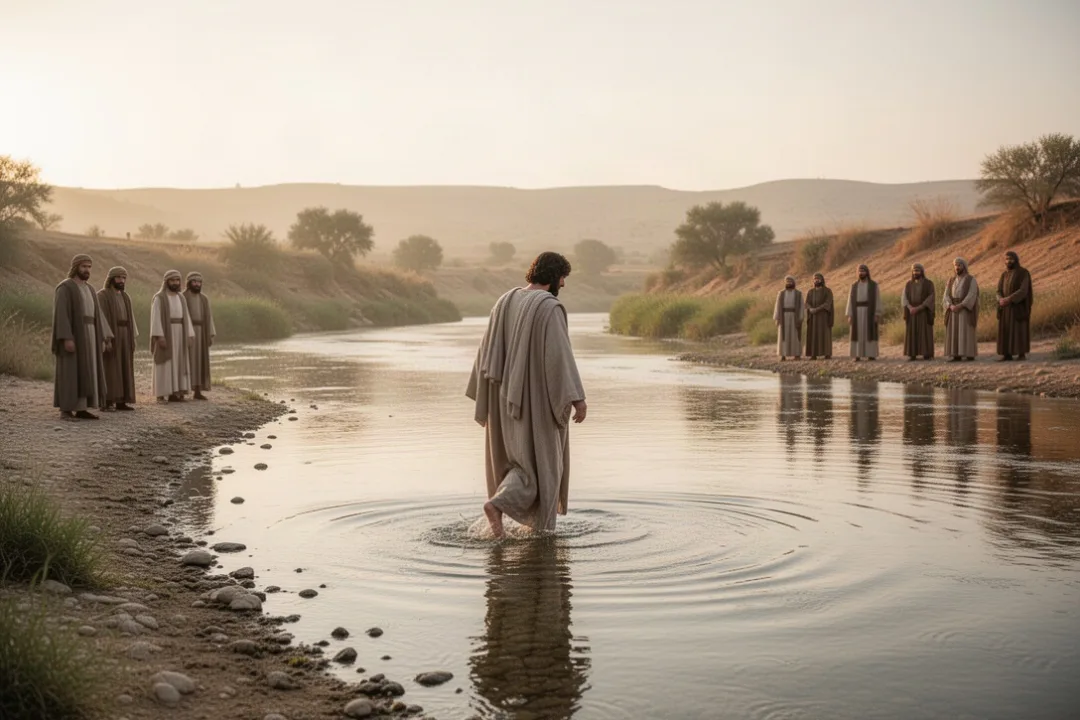
The first luminous mystery is the Baptism of Jesus in the Jordan. The Gospel accounts appear in Matthew 3:13-17, Mark 1:9-11, and Luke 3:21-22. Although Jesus is sinless, he approaches John the Baptist and accepts baptism, identifying himself with the people he came to save.
At the Jordan, the heavens open, the Holy Spirit descends in the form of a dove, and the Father identifies Jesus as his beloved Son. The scene reveals the Holy Trinity: the Son stands in the water, the Spirit appears, and the Father speaks from heaven.
Jesus’ Baptism also marks the beginning of his public ministry. He does not begin with a display of earthly power. Instead, he begins in humility and obedience, standing among ordinary people who are turning back toward God.
What to meditate on during the first decade
Consider the contrast between Jesus’ sinlessness and his willingness to enter the waters of baptism. He does not need repentance, yet he accepts a place among sinners. This points toward his later decision to carry human suffering and sin on behalf of the world.
You can also reflect on your own baptism and identity before God. The mystery invites you to remember that Christian life begins not with achievement, status, or perfect performance, but with being received as God’s beloved. The Father’s love comes before the work of ministry.
Renewal of your baptismal promises and commitment to Christian living.
Grace to recognize your identity as a beloved child of God.
Humility when beginning a new responsibility or season of life.
Compassion for people who feel ashamed, excluded, or far from God.
When you pray this mystery, picture the Jordan as a place of transition. Jesus leaves the hidden years of Nazareth and begins the mission entrusted to him. You might ask where God is calling you to move from preparation into faithful action.
The second luminous mystery: the Wedding at Cana
The second luminous mystery is the Wedding at Cana, described in John 2:1-12. During the celebration, the wine runs out, creating an embarrassing and potentially serious problem for the family hosting the wedding. Mary brings the need to Jesus, and he changes water into wine.
This is presented as Jesus’ first sign in John’s Gospel. The miracle does more than solve a practical problem. It reveals something about Jesus’ glory and leads his disciples toward faith. Mary’s role also stands out: she notices the need, brings it to Jesus, and directs the servants to follow his instructions.
Cana is a mystery of trust, intercession, and transformation. Jesus takes something ordinary and changes it into something abundant. The event also takes place at a wedding feast, a setting that points toward joy, covenant, and the relationship between God and his people.
What Cana teaches about prayer and daily needs
The situation at Cana is not a dramatic public crisis. It is a hidden need at a family celebration. That detail makes the mystery especially accessible. You can bring small concerns to God: strained relationships, financial pressure, loneliness, fatigue, uncertainty, or the needs of people you love.
Mary does not try to control the outcome. She presents the problem to Jesus and trusts him. Her example can shape the way you pray for others. Intercession is an act of love, but it does not require you to manage every result.
The servants at Cana also offer an example of quiet obedience. They fill the jars and draw out what Jesus has transformed, even though they do not fully understand what is happening. Their cooperation shows how ordinary actions can become part of God’s work.
During this decade, you might reflect on:
Where your life feels depleted or lacking in hope.
People who need healing, reconciliation, provision, or encouragement.
Mary’s attentive concern for others.
Your willingness to obey God before you see the outcome.
The ways grace can transform ordinary circumstances.
The Cana mystery can be especially meaningful when you are praying for a marriage or family. It does not promise that every difficulty will disappear immediately. Instead, it directs your attention to Christ as the source of renewal and asks you to trust him with both visible problems and hidden needs.
The third luminous mystery: Jesus proclaims the kingdom of God
The third luminous mystery is the proclamation of the kingdom of God, along with Jesus’ call to repentance and conversion. This mystery gathers together Jesus’ preaching throughout the Gospels rather than focusing on one single event. Key passages include Mark 1:14-15, Matthew 5–7, Luke 4:16-21, and Matthew 25:31-46.
Jesus announces that God’s kingdom is near. He calls people to believe the good news, change direction, and live according to God’s will. His teaching includes mercy, forgiveness, love of enemies, care for the poor, purity of heart, prayer, trust in God, and a readiness to serve.
The kingdom is not merely a place people enter after death. It is God’s active rule breaking into human life through Jesus. It begins now wherever people receive God’s grace and allow that grace to shape their choices, relationships, priorities, and treatment of others.
How to pray with Jesus’ call to conversion
This mystery invites an honest examination of life. Conversion is more than feeling regret. It means turning toward God with the whole person. That may involve changing a habit, seeking forgiveness, repairing harm, rejecting resentment, or accepting a responsibility you have avoided.
Jesus’ teaching also challenges a narrow idea of religious practice. In the Sermon on the Mount, he directs attention beyond outward appearances to the heart. In Matthew 25, he connects love for him with practical care for people who are hungry, thirsty, sick, imprisoned, or in need.
What attitude or habit is keeping me from greater faithfulness?
Where do I need to forgive or ask for forgiveness?
How am I treating people who cannot repay me?
What would it look like to place God’s will ahead of comfort or reputation?
Where can I practice mercy in a concrete way this week?
The proclamation of the kingdom is both challenging and hopeful. Jesus does not call people to change through fear alone. He announces that God is near and offers a new way to live. The appropriate response is not passive admiration, but faith expressed through action.
Prayer tip: If this mystery feels broad, choose one teaching of Jesus for the decade, such as forgiveness, love of enemies, care for the poor, or trust in God. A focused meditation is often more fruitful than trying to consider every teaching at once.
The fourth luminous mystery: the Transfiguration
The fourth luminous mystery is the Transfiguration, recorded in Matthew 17:1-8, Mark 9:2-8, and Luke 9:28-36. Jesus takes Peter, James, and John up a high mountain. There, his appearance changes, his clothing becomes radiant, and Moses and Elijah appear with him.
The disciples receive a glimpse of Jesus’ divine glory. A cloud overshadows them, and the Father’s voice directs them to listen to his beloved Son. The event confirms Jesus’ identity and connects him with the Law, represented by Moses, and the prophets, represented by Elijah.
The Transfiguration takes place as Jesus moves toward Jerusalem and the suffering of the Passion. Its brightness does not remove the coming Cross. Instead, it gives the disciples a deeper vision of who Jesus is so they can remain faithful when his glory seems hidden.
Finding faith when the path becomes difficult
This mystery speaks to moments when you have received encouragement but still face uncertainty. A meaningful prayer experience, a season of peace, or a clearer sense of God’s presence may strengthen you, but it does not eliminate every future trial.
The disciples eventually come down from the mountain. Christian prayer is not an escape from responsibility. It prepares you to return to ordinary life with greater trust, clearer priorities, and a willingness to follow Christ through both joy and suffering.
Consider these themes during the decade:
Jesus’ identity as the Son of God.
The connection between prayerful vision and faithful action.
The need to listen to Christ’s teaching.
Times when God seemed present, and how those memories sustain you.
Hope during grief, temptation, illness, or uncertainty.
You may also reflect on the difference between seeking spiritual experiences and seeking Christ himself. The disciples are not told to remain on the mountain permanently. They are invited to listen, trust, and continue following Jesus when the scene returns to normal.
The fifth luminous mystery: the institution of the Eucharist
The fifth luminous mystery is the institution of the Eucharist at the Last Supper. The principal Gospel accounts are Matthew 26:26-30, Mark 14:22-26, and Luke 22:14-20. Paul also recalls the tradition in 1 Corinthians 11:23-26.
At the meal, Jesus takes bread and wine and gives them to his disciples as his Body and Blood. He connects the gift with the new covenant and commands his followers to continue this remembrance. The Eucharist makes present the self-giving love that reaches its visible climax in the Passion.
This mystery brings the luminous sequence to a profound point. Jesus has been revealed at the Jordan, has shown his power at Cana, has taught about the kingdom, and has displayed his glory on the mountain. Now he gives himself as spiritual food and covenant love.
Praying with the Eucharist and Christ’s self-gift
The Eucharist is a mystery of presence, sacrifice, communion, and mission. Jesus is not simply offering an idea to remember. He gives himself to unite his followers with him and with one another. Prayer with this mystery can lead you to greater reverence for Mass and deeper gratitude for Christ’s self-giving.
It also challenges you to receive the Eucharist as a call to become more generous. The person who receives Christ is sent to love in practical ways: by serving family members, showing patience, visiting someone who is isolated, supporting people in need, and working for reconciliation.
During this decade, meditate on:
Jesus’ complete self-giving at the Last Supper.
The connection between the Eucharist and the Cross.
Unity with Christ and with the members of his Church.
Gratitude for God’s presence in ordinary life.
How receiving Christ should change the way you serve others.
The Eucharistic mystery can be prayed before or after Mass, during Eucharistic adoration, or at home. If you are unable to receive Communion, you can still ask Christ to deepen your desire for union with him and to form your heart according to his love.
How to pray the luminous mysteries in their traditional order
The luminous mysteries are prayed using the same basic structure as the other Rosary sets. After the opening prayers, you announce one mystery for each decade and spend time reflecting on it while praying the Our Father, ten Hail Marys, and Glory Be.
A simple method can help keep the prayer from becoming mechanical:
Announce the mystery clearly, such as “The First Luminous Mystery: the Baptism of Jesus in the Jordan.”
Read or recall a short Gospel passage connected with the mystery.
Ask the Holy Spirit to help you see Christ more clearly.
Bring a personal intention or the needs of another person to prayer.
Pray the decade slowly, returning your attention to the Gospel scene when your mind wanders.
Pause briefly after the Glory Be and notice one grace or insight.
You do not need to create a detailed mental picture for prayer to be sincere. Some people meditate through imagination; others focus on a phrase, a theological truth, or a practical question. The essential point is to let the prayer direct your mind and heart toward Jesus Christ through Mary.
Traditionally, the luminous mysteries are prayed on Thursday. Many people also pray them on another day when a particular mystery fits their needs, such as the Baptism of Jesus during a baptismal anniversary or the Eucharist before attending Mass. The traditional weekday schedule is a guide, not a restriction.
When time is limited, you can pray one decade rather than abandoning prayer altogether. You can also pray a full five-decade Rosary across several periods during the day. What matters is attentive, faithful prayer rather than rushing to complete a set number of words.
The five luminous mysteries offer a clear path through Jesus’ public ministry: he is revealed, trusted, heard, encountered in glory, and received in self-giving love. Learning the order makes it easier to pray the Rosary, but allowing each mystery to shape your daily choices is where its meaning becomes personal.
Frequently asked questions
Which day of the week is traditionally assigned to the luminous mysteries?
The luminous mysteries are traditionally prayed on Thursdays. This schedule reflects their place between the joyful mysteries, commonly prayed on Mondays and Saturdays, and the sorrowful and glorious mysteries. You may also pray them on any day that suits your devotional practice, especially when one of the mysteries connects closely with a feast, Mass, retreat, or personal intention.
Are the luminous mysteries required for praying the Rosary?
No. The luminous mysteries are a recognized set for Rosary meditation, but Catholics may choose any approved set or combine mysteries according to their needs. Some people follow the traditional weekday pattern, while others select mysteries based on the liturgical season, a particular intention, or the amount of time available for prayer.
Can I pray the luminous mysteries without a Rosary?
Yes. A physical Rosary helps you keep track of the prayers, but it is not necessary. You can count the decades on your fingers, use a prayer app, or pray one decade at a time from memory. The beads are a practical aid; the central purpose is meditating on the life and mission of Jesus.
What is the difference between a luminous mystery and a joyful mystery?
Luminous mysteries focus mainly on Jesus’ public ministry, beginning with his Baptism and ending with the Eucharist. Joyful mysteries focus on events surrounding his conception, birth, and childhood, including the Annunciation, Visitation, Nativity, Presentation, and Finding in the Temple.














Leave a Reply